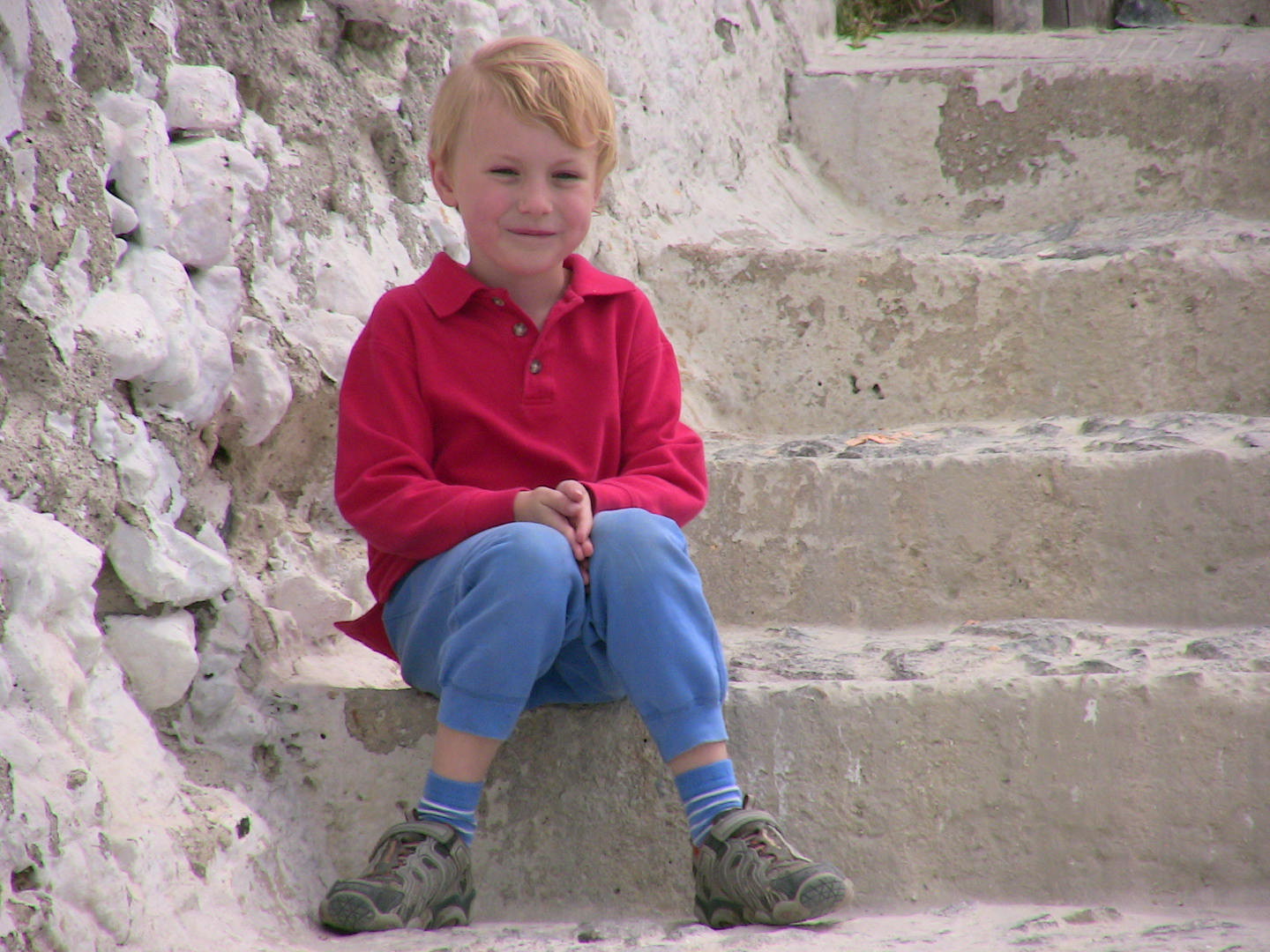
 Sitting our hotel room in Nafplio; it’s 2:20 p.m., and we’re tired and wet after a great day of rainy sightseeing. “I love you,” says Will, sitting next to me drawing. Outside the window, the bay is a pale jade green; across the bay, the mountains are this amazing purple gray, blurred by a mist.
We started the day with another strike scare. The International Herald Tribune reported that national museum and archeological site officials were debating yesterday whether to strike today; there was no way to know, so we decided to proceed as planned. Fortunately, the sites were open. (Again Rick somehow manages to avoid disaster by his clairvoyant travel planning.) We drove (Rick will fill in the details of that escapade) up to the ancient Mycaenean palace, circa 1600 to 1300 BC, thought to be the home of Agamemnon, best known for leading the Greeks in the Trojan War (his brother’s wife was Helen, stolen away by Trojan Paris). The Mycaeneans dominated much of this part of Greece and the Mediterranean; it’s the classic Bronze Age civilization.
The setting was gorgeous: rolling hills of olive groves lead up to the archeological site, perched on a rock between two deep ravines. The palace had a sweeping view of a strategic pass to the north (think foreign invaders) and down the Argolid plain to the sea, where Agamemnon likely launched his ships (and where our hotel is.) It was very quiet, with no other tourists when Will, Rick and I entered the so-called Treasury of Atreus (Atreus being the cursed family of Agamemnon). It is a huge “beehive” tomb, built into the hillside, entered under a door-lintel weighing 50 tons. Inside, the acoustics were eerie; when you spoke from one side of the tomb, your voice sounded like it was coming from the opposite side. Bees buzzed at the entrance.
Up on the ruins, which are apparently brutally hot and crowded in the summer, it was green, with wildflowers, especially poppies, blooming everywhere. It smelled like thyme and fresh rain in dust. We saw the famous grave circles where ancient kings were buried with gold death masks and jewelry and pottery. We saw the bases of what were once colonnades, and tried to imagine what the palace must have looked like. We descended into an ancient cistern, but it was dark dark dark, and Mommy freaked out and had to ascend.
Finally, we drove over to the ancient ruins of the temple of Asclepius (considered the father of modern medicine) and the adjacent theater of Epidaurus, with its reputed amazing acoustics. We weren’t that impressed with the acoustics, but there was a gorgeous view from the amphitheaters’ seats. Musical performances are still held here in the summer; I’m sure that gives the acoustics a better test than listening to Eastern European tourists wearing plastic bags over their hair warble. It was pouring by then, so we headed home. Another amazing day.
 The Thompson Attigs