Sunday, Oct. 3, 2022 – It was another perfect day in Seoul, starting with a visit to a hillside museum and traditional garden overlooking the skyscrapers of downtown and ending with the arrival of Asma and a stroll through a downpour to see the lights and flashing video screens of a festival celebrating Korean pop culture. Modern Seoul is bright and shiny and constantly moving, like the hypnotic, dreamlike video art that is everywhere – on the sides of buildings, at subway entrances, inside museums. But today we were reminded of how that modern culture taps into centuries of history, how the modern high rises are backed by mountains where hikers still walk on the ancient walls, and modern painters look to ancient ceramics for inspiration.

With rain forecast for Monday, Rick and I decided to to get out of the city while the weather was still nice and seek a little quiet in a neighborhood called Buam-dong, just a short cab ride up into the mountains north of the city. These mountains stood as fortresses of a sort for emperors past, protecting the Joseon era capital from northern invaders, and they are etched with protective stone walls built starting at the end of the 14th century. They look incredibly steep, snaking up the sides of the hills, like the Great Wall of China or the walls above Kotor. There is a popular hiking route that follows these walls, and we saw lots of Koreans – many of them older than us – wearing brightly colored hiking gear and carrying ski-pole hiking sticks, as they set out on what must be a mega stair-master workout. We decided to stick with the museum.
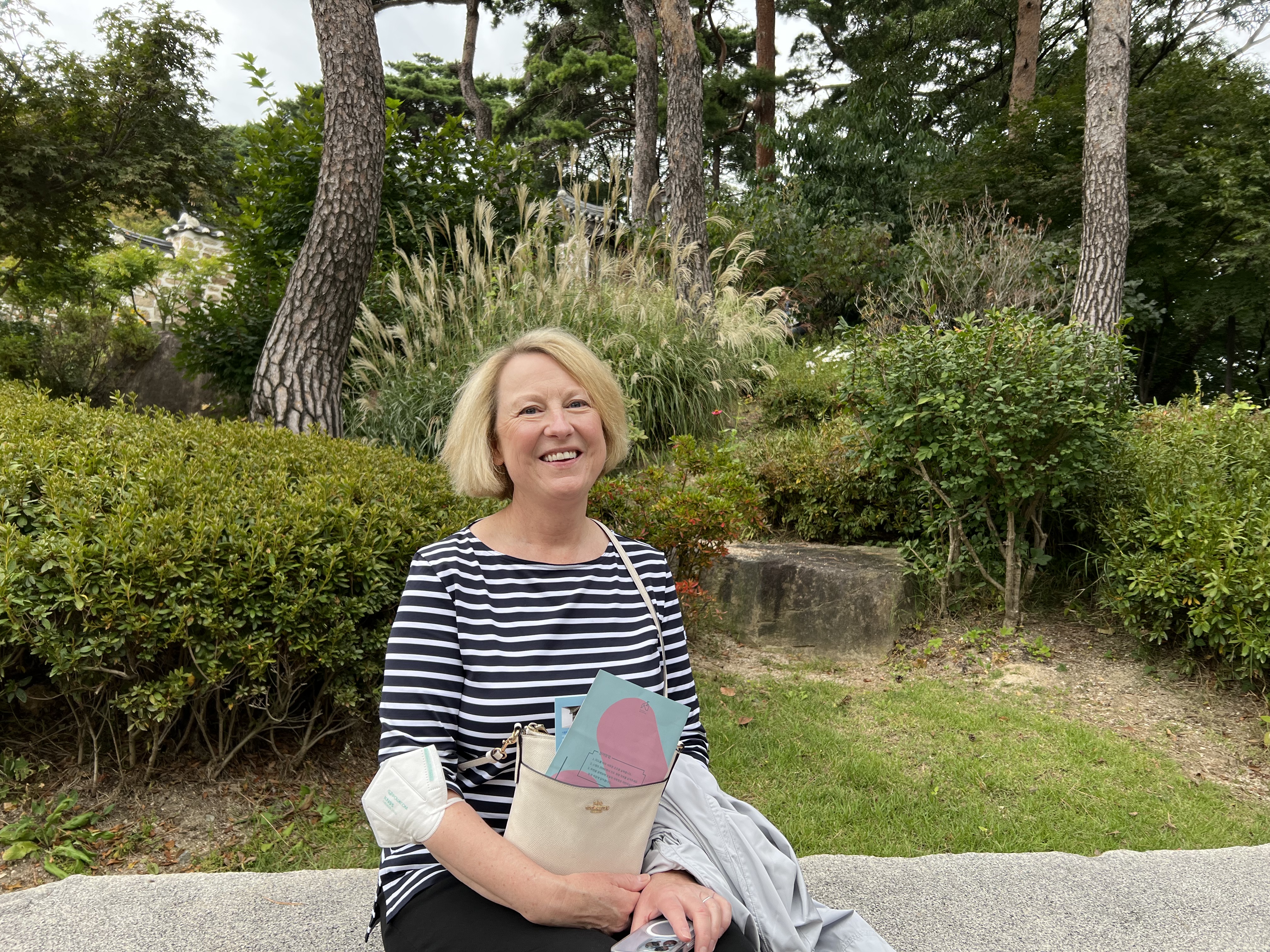
And what a museum! My family – especially Will – knows how much I love an art museum, and the Seoul Museum now ranks high in my favorite museums ever. It wasn’t large, but held a stunning collection of mostly 20th century Korean art, about which I know nothing. Both Rick and I found so much to love. It really was thrilling to walk from room to room and discover yet more beautiful and fascinating works of art. One room was filled with paintings that we assumed were of traditional Korean scenes, perhaps something from the Joseon dynasty. But as I looked at a group of men gathered around a long table, I thought, something looks suspicious here. This is a Last Supper! In fact, in the 1950s, the painter Kim Kichang had painted an entire cycle of the life and death of Christ, much like the Giotto’s we saw this spring in Padua.
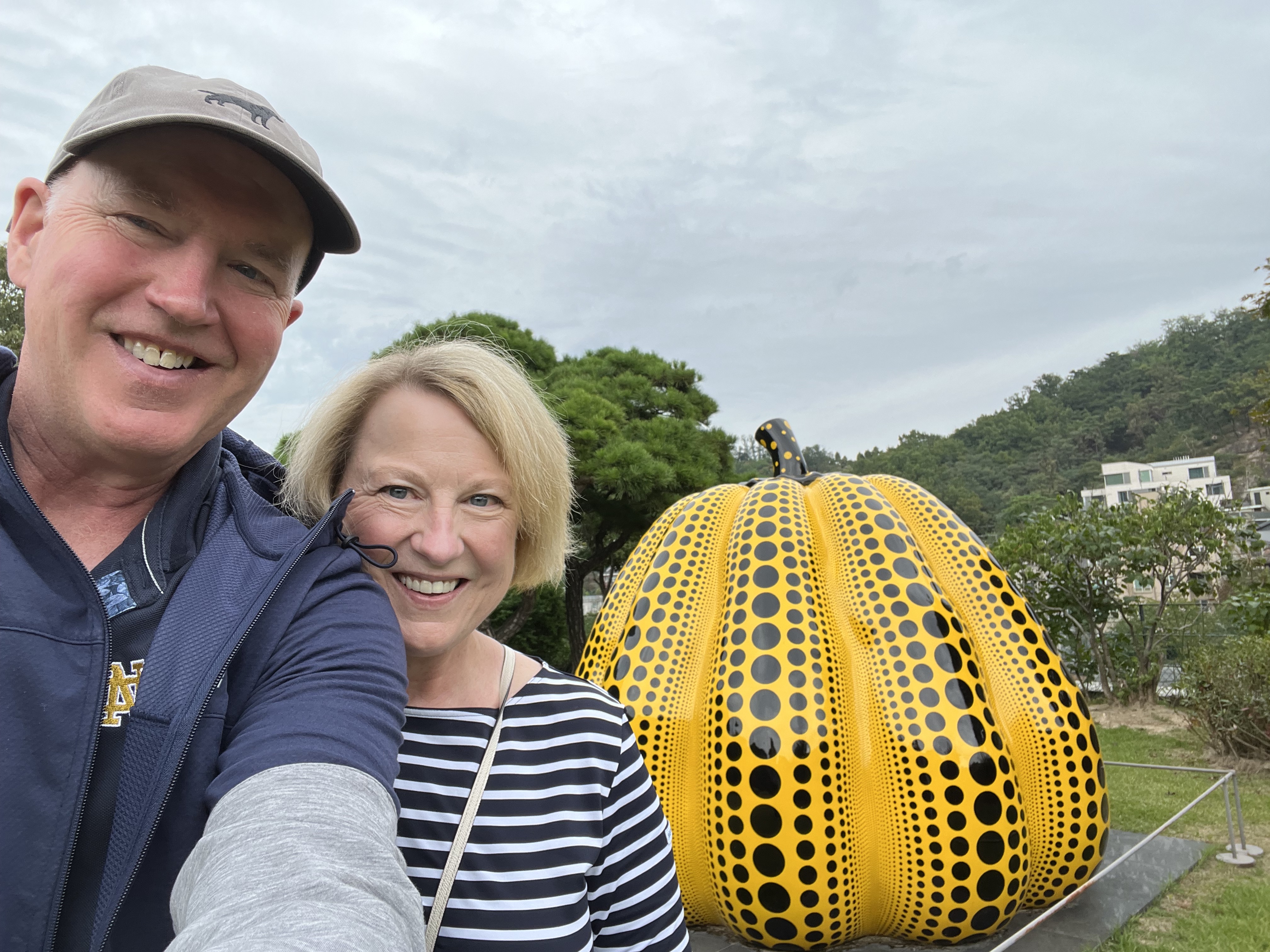
There was an exuberant massive painting of apple trees by Daiwon Lee from 2000, thickly textured paintings of persimmons by Oh Chigyun, a wonderful rooster by Lee Ungno, and some incredible reinterpretations of traditional pottery by Ko Younghoon, King Ikjoong, and Son Seock, whose deeply textured works mysteriously changed colors as you viewed them from different angles. Through the museum, there were incredibly beautiful depictions of nature, evoking the best of Van Gogh, and a real focus on beauty. There was also a deep connection to the past in many of the pieces. Which was so wonderful when you stepped outside into the traditional hillside garden behind the museum, which brought together past and present with a sacred rock at the top and modern Kusama Yayoi pumpkin at the bottom.
With help from a Wesleyan graduate and her mother and brother out for a stroll, we managed to find another of the cafes I had found online – one that promised a view and outdoor seating. It was a steep hike, and our navigation system took us up a weird path and I had almost given up on finding it when it appeared – a funky cafe with a VW bug as entryway art. It didn’t have food for lunch, so we ordered what turned out to be yogurt drinks and an apple tart and carrot cake (Rick is trying to get his vegetables in somehow.) But it did have a fantastic view of the city skyscrapers and the ancient stone walls.
After two failed attempts to flag down a cab, we decided to brave the bus system, which turned out to be incredibly easy, especially with the instant translate feature of Google Translate, which helped us figure out what the end stop would be – miraculously letting us out not far from our next stop, the UNESCO World Heritage Site, the Confucian shrine Jongmyo, where the spirits of Joseon emperors are enshrined. Rick was a gamer to visit the shrine, when I knew he was tired, but we were feeling quite daring after having successfully taken a bus. Sometimes it’s the little things.
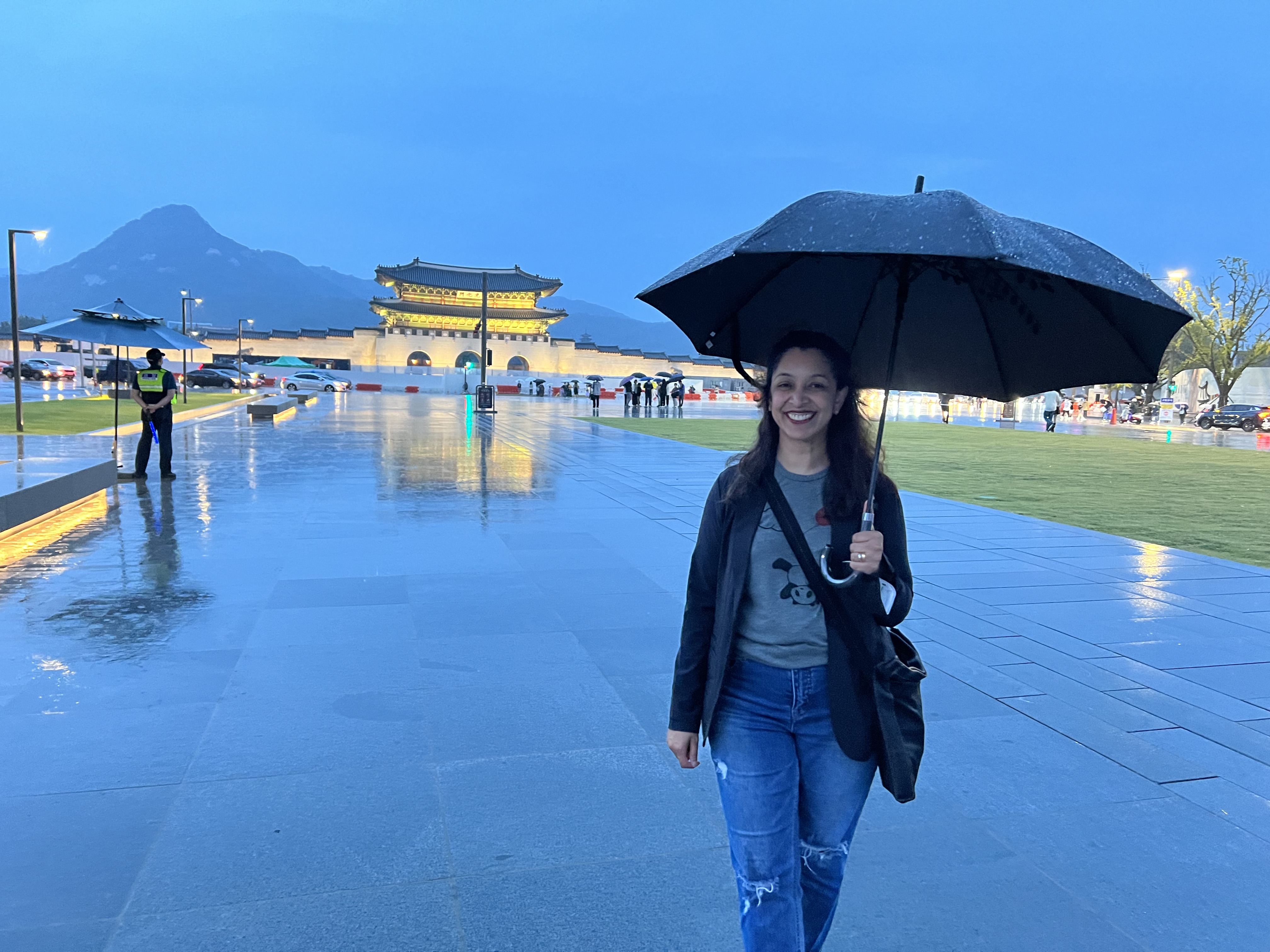
Asma arrived in the late afternoon, just as it began to pour. But she, too, was a gamer and declared that after her exhausting plane ride (coming shortly after a long shift being a doctor), she was up for a walk in the downpour. So off we went down to City Hall, and up to the Gyeongbokgung Palace, past sad clusters of people with rain gear and umbrellas, braving the rain to watch events of the various festivals celebrating modern Korean culture. If the weather had been nice, I think the square would have been crowded with people. I had thought it would be surreal to see Asma here, but strangely, it seemed completely natural to me.
That evening, we had planned to go to the top of Namsan, which has an iconic tower with an incredible view of the city. So instead we stayed close to the hotel – but the only place we could find with a covered porch was …… the fried chicken place! It was a jolly dinner – sometimes what is easiest is best – and then we got Asma back to the hotel for a much-needed sleep.
Monday, Oct. 4, 2022 – We woke to the confusion of a National Founder’s Day – a national holiday celebrating the mythical foundations of Korea and also apparently a day 30,000 demonstrators were scheduled to gather near our hotel for a very loud, raucous rally. The hotel warned us that it might be very difficult to get in and out of the hotel, so we headed to the National Museum of Korea to get out of the rain and away from the noise. The museum was spectacular, and we were able to trace nearly three millennia of Korean history through the massive museum. There were gorgeous pots, gold jewelry, mysterious Buddhist sculptures, beautiful bronze objects such as bells and mirrors. The displays showed the rich connections between the ancient Chinese, Japanese and Korean cultures, and explored influences on the art of all three cultures from the Central Asian Gandharan cultures, which in turn had been influenced by Hellenistic Greek culture via Alexander the Great. That Greek Hellenistic art lead to the Buddha wearing Roman togas as far away as Korea and Japan is to me the essence of being human – we are all so much more connected than we are often lead to believe, that cultures are not so separate. Distinct perhaps, but sharing much history, though we realize it or not.
Oh and the Moon Pots! Here were the actual porcelain pots that inspired the modern Korean artists we saw yesterday.
We took the subway back home, on recommendation of the hotel, given the crowds. But the rain apparently must have kept the numbers down. Men yelled from loud speakers all afternoon, but it is 6 p.m. now and the crowd has gone home and it is quiet again. We are heading out in a little bit to visit the Dongdaemun Design Plaza, a futuristic piece of architecture by the late Zaha Hadid, and have some street food from the Gwangjang Food Market. We are so daring, we will take the subway, which was incredibly easy to use. Wish us luck!
 The Thompson Attigs
Dang….you guys are troopers! So much in one day.
Such beautiful pictures of Seoul!