Saturday, January 21, 2022 – Lisbon, Portugal – We arrived yesterday afternoon in time to check in to a lovely little apartment in a converted textile factory in the heart of old Lisbon, on the border between the hilly Afama neighborhood topped with a castle and the Baixa, with broad promenades built after the entire area was destroyed in the great 1755 Lisbon earthquake. We like being a the epicenter of it all. After dropping our bags and fighting jet lag, we climbed up the Alfama, a neighborhood rich with history dating back to the Phoenicians – it is studded with ancient Roman ruins, followed by hundreds of years of occupation by Goths and Moors. Its winding streets include the old Jewish quarter, the ruins of a Roman amphitheater from the age of Augustus that seated 4,000 and a 12th century Gothic cathedral built on the remains of a mosque. At the top of the hill is a rebuilt castle that dates back to the Moorish rule of Lisbon, between the 8th and 12th centuries.

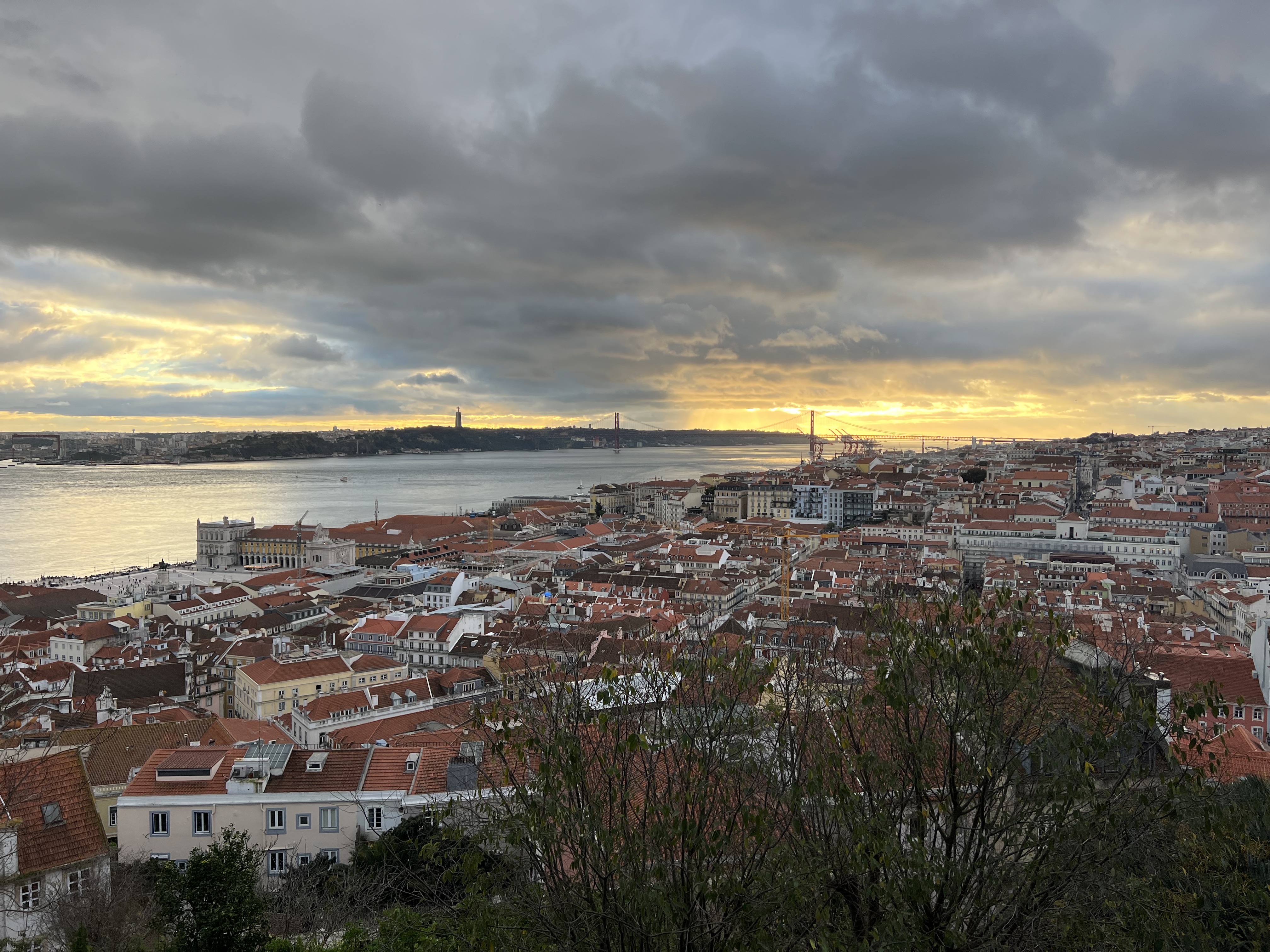
The ramparts, though rebuilt in the past 100 years or so, have a stunning panoramic view of the city, down to the harbor on the Tagus River where the riches of the 15th and 16th century Portuguese empire came to shore. We caught the sunset from the ramparts – it was stunning to see the city spread out below us, the sun and the clouds behind the Bridge of the 25th of April, a Golden Gate lookalike celebrating Portugal’s Carnation Revolution which ended decades of dictatorship in the 1970s. The city is so rich in history, and so atmospheric, with colorful houses, winding streets, and vistas of the water from its many “miradouros” or viewpoints. With its vintage yellow trams and steep streets, it evokes San Francisco, but much more charming and with better views. No offense, San Francisco. But Lisbon is pretty damn cool.
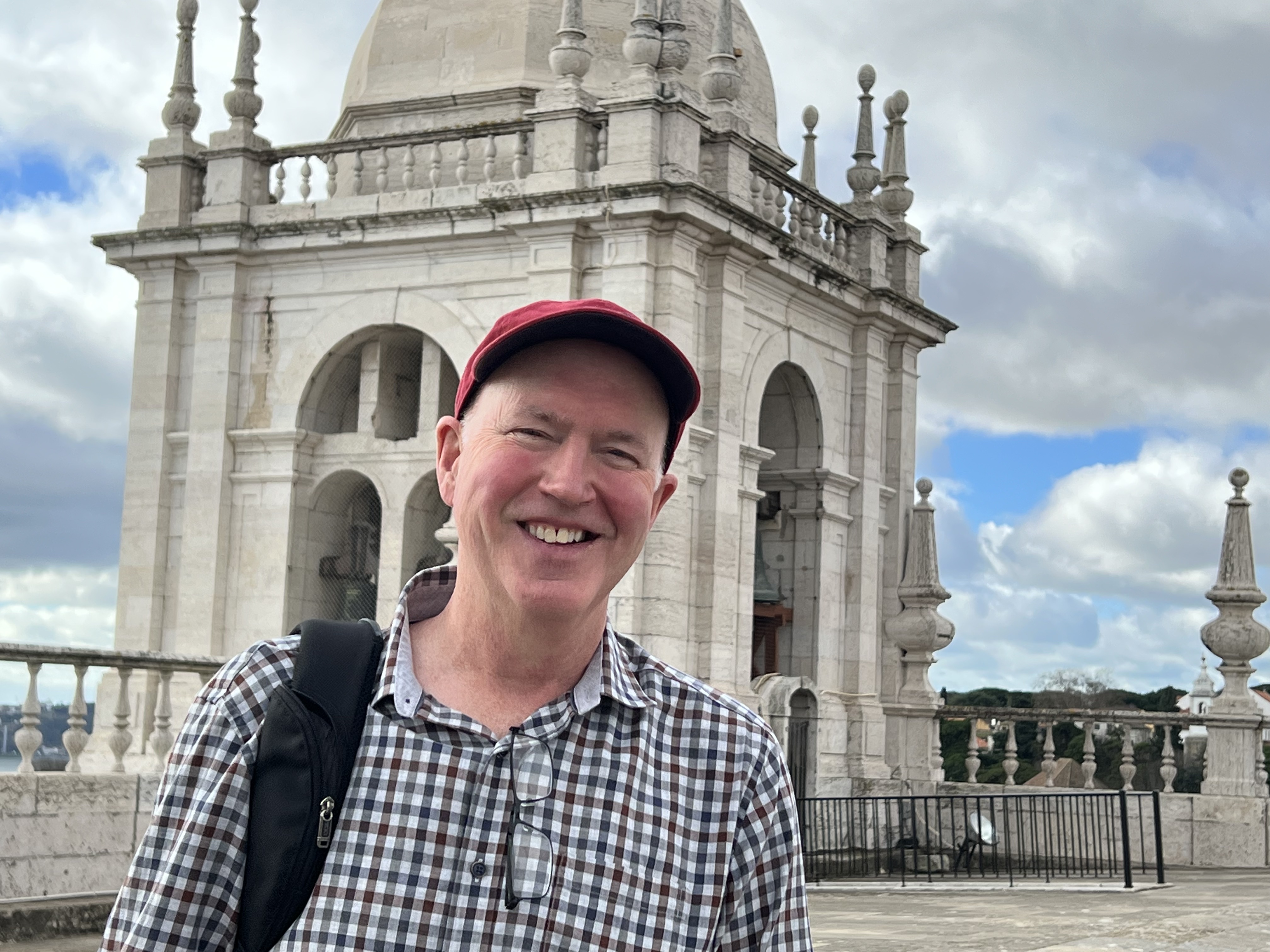
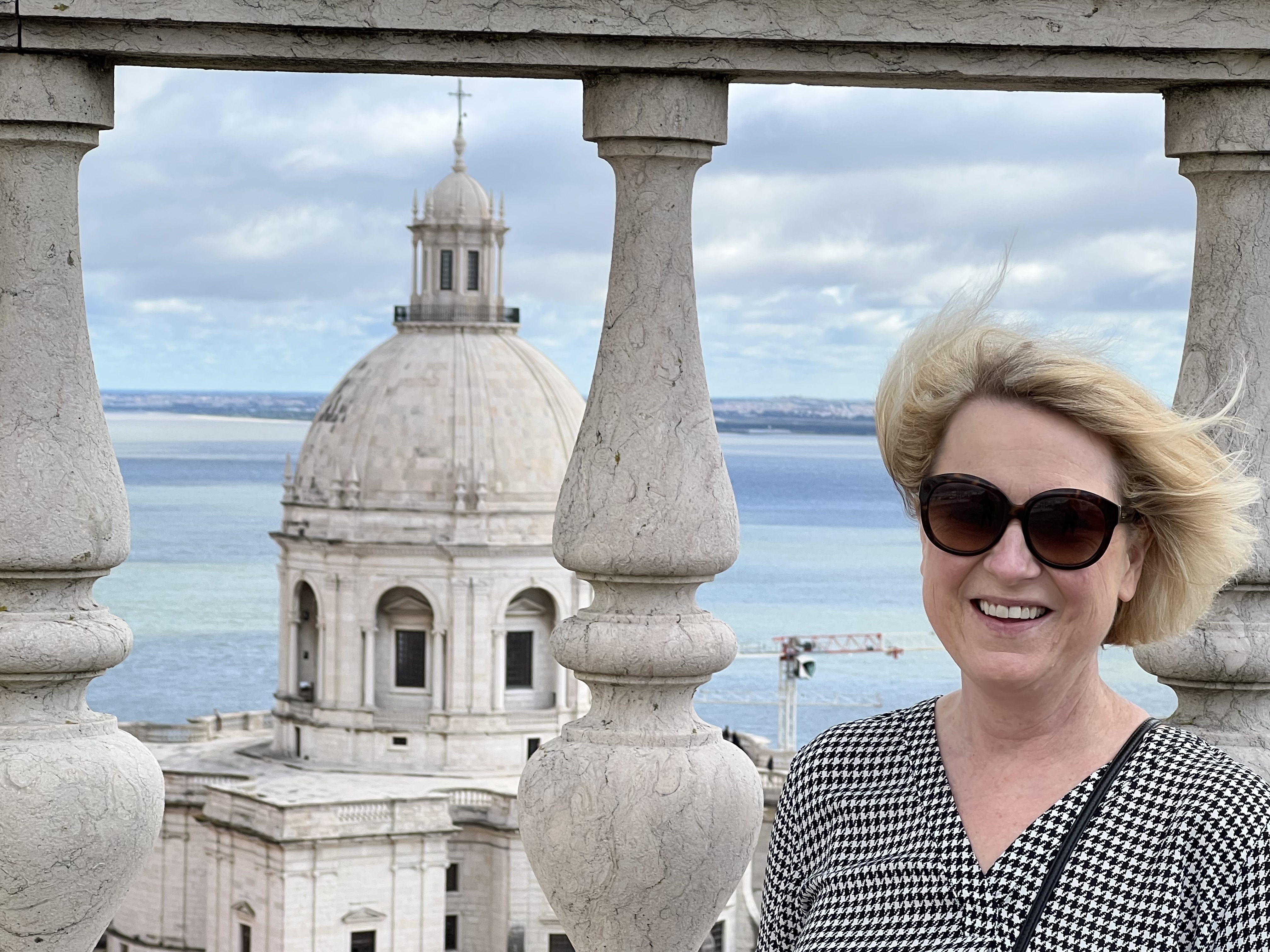
This morning we headed back out to the Alfama, where we visited the Monastery of Sao Vicente, the patron saint of Lisbon. It was here that hundreds had gathered on All Saint’s Day 1755, when a massive 9-magnitude earthquake, tsunami and fire leveled much of the city. Unfortunately, the church also collapsed, killing many inside. It was rebuilt, and the church and monastery are filled with the classic blue and white azulejos, or tiles, that are iconic to Portugal. The art form was adapted from the ceramic tiles that the Muslim Moors had used – they were beautiful and also helped keep the buildings moisture-proof and cool. There were spectacular views from the top of the monastery, looking over the river and the Pantheon nearby.
We had a wonderful walk back through the twisting alleys of Alfama, further from the touristy areas around the castle. At one point, we were walking down a narrow, stepped alleyway and there appeared an old woman in a doorway selling tiny cups of ginjin, the cherry liquor Lisbon is famous for, for 1 Euro. We were charmed by her sudden appearance and bought two. She explained as we sipped that the cups were chocolate and we could eat them – just like on the New Year’s Eve of my childhood! I told my mother this the other day, that she had always given us a shot of some liquor in chocolate cups on NYE and she denied it. 🙂 It was a quiet, charming area of the city, and there were few tourists. The rest of the city is much busier than we had imagined January would be – the “off-season.” If it is this crowded now, I cannot imagine how it will be this summer. It must be that everyone, the world over, is eager to get out and travel again after the pandemic. There are few Americans, but many French and Italians, a few English – mostly college-aged kids – and a lot of Portuguese on tour. But the streets are quite crowded in places. This is good, I suppose, for Lisbon, but it’s not what we expected in the dead of winter.
Speaking of winter, it was 65 degrees today and hot in the sun – cool in the considerable ocean breeze – in a word, perfect. We just got back from a nice dinner at Pateo, a seafood restaurant up in the Barrio Alto, a “downscale” restaurant by the upscale chef Jose Avillez. We had an amazing shrimp, avocado, apple and lettuce taco and some truffle burrata with honey, pine nuts and water cress, followed by a delicious grilled squid entree for me. And Rick, well, he chose poorly, and ordered one of their “signature” dishes – shrimp in a bread mush with raw egg stirred in. It was sadly hilarious. Fortunately, he had a few of my squid. But it was a wonderful place, and meal, and a sign of the serious foodie nature of this city. We had lunch earlier at the trendy Time Out Market -what Portland has always dreamed of – a vast foodie mecca filled with stalls featuring less-expensive fare from Michelin chefs and others. It was absolutely jammed on a Saturday, but we found a table at a restaurant outside and had a fine lunch before I dragged Rick back up another hill to the Chiado to trace the footsteps of a famous character in a novel by Nobel laureate Jose Saramago. Rick still needs to finish the novel, so he wasn’t quite as excited as I was to see the streets and the places the main character inhabited, but hopefully he will be so inspired by our trip that he will finish the novel.
Tomorrow, we are headed to Belem, a neighborhood west of the city, where the Portuguese King Manuel built a monastery with the riches from their early explorations to the East, and where there is a very cool modern art museum, and another museum that has rare Japanese screens with depictions of the Portuguese – “Southern Barbarians” – with whom they traded for a while and then perhaps wisely banned for centuries. We can’t wait.
 The Thompson Attigs