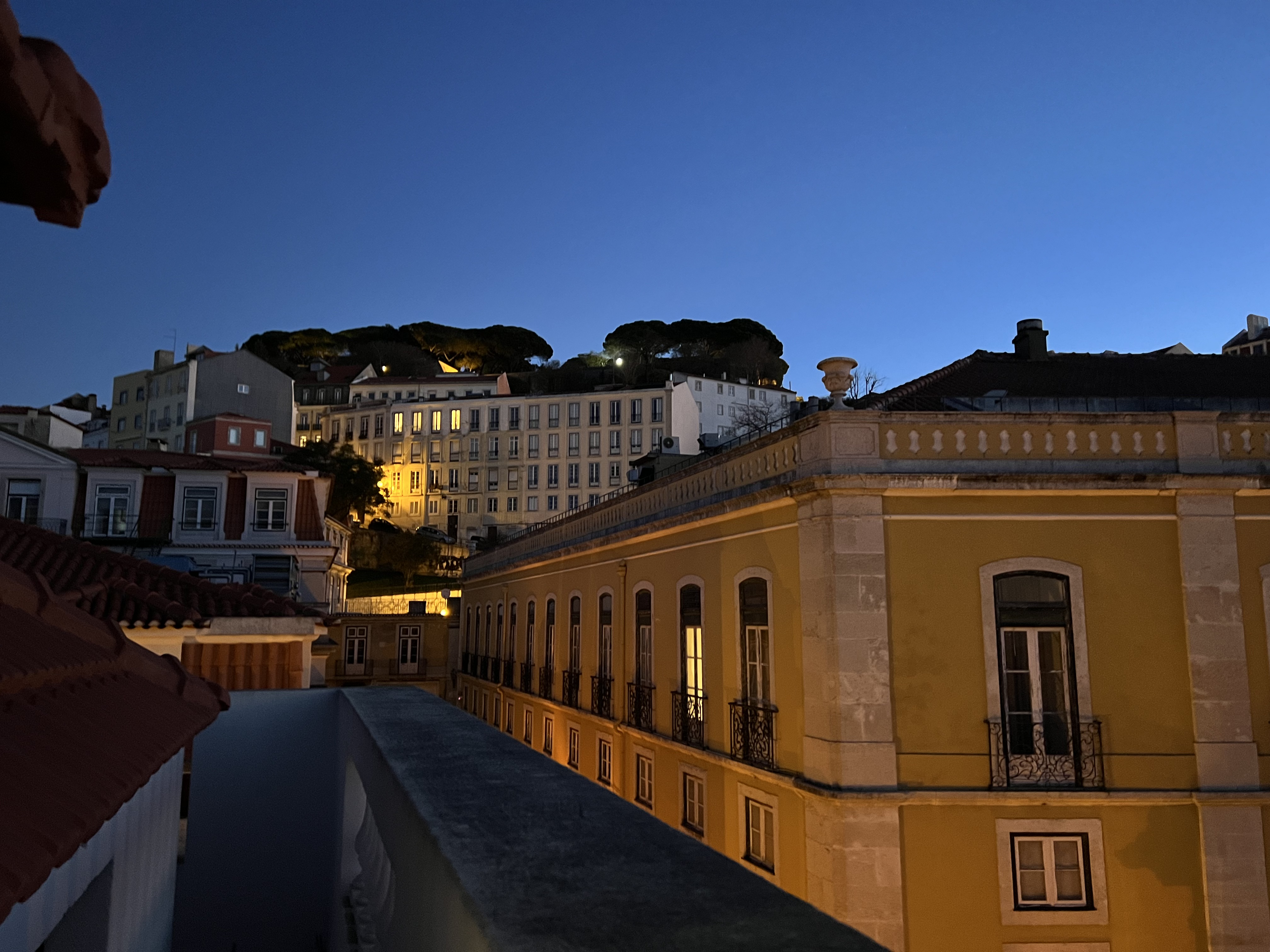
Monday, January 23, 2022, 6:30 a.m. Lisbon, Portugal – It’s still dark in Lisbon, the lights on the towers of the nearby cathedral, glimpsed from one of our windows, have been shut off. To the north, from another window, I can see an old apartment building rising against the Alfama hill that is topped by the castle of Sao Jorge. It has rows of tall windows, each with eight-panes, and just two are illuminated. In one, in an almost cinematic image, I can see the silhouette of a man – he just lit a cigarette – as he gets ready for the day, or perhaps is just getting home. It’s silent in the apartment, except for the coffee brewing.
We had another wonderful day yesterday. Though we hadn’t planned it intentionally, we spent the Lunar New Year exploring Portugal’s ventures to the East during the 15th, 16th and 17th centuries, as Vasco da Gama and other explorers and conquerers found their way around the Horn of Africa to India, Southeast Asia, China and Japan. Rick and I had recently read a book by Roger Crowley, “The Conquerers,” so our thoughts about the monuments we saw yesterday glorifying the nautical achievements of these intrepid Portuguese were tempered by the knowledge that they were also brutal men who used force and cruelty to establish a maritime empire, an empire which they ruthlessly exploited for spices, treasure and slaves.
But I’m getting ahead of myself. We started the day heading west to the Museu Nacional de Arte Antiga, which held a collection of art and artifacts from the so-called Age of Discovery. Included were some fascinating Japanese paintings, known as Namban screens, since they depict the “namban” – as the Japanese called the “Southern Barbarian” Portuguese people who landed on their shores in big black ships. These Kano School screens were familiar from our time in Japan – I remember in particular the gorgeous gold screens in the Nijo Castle in Kyoto. But these screens didn’t just depict beautiful, twisted pine trees – they showed, in closely observed detail, the Portuguese in their puffy pantaloons and funny hats. A caption next to one read: “When we were exotic,” turning the tables on the Portuguese conception of themselves. The faces of the Portuguese were especially interesting – they were uniformly ugly, with comic long noses and strange pointed jaws. To me, they resembled masks, especially the red Tengu masks of Japan, which depict, appropriately, a mythical creature that is both evil and benevolent. Perhaps that is an apt image for the Portuguese explorers themselves – they brought trade, and a new religion – Christianity – but threatened much more. No wonder the Tokugawa Shogunate shut its doors and withdrew from the world.
Among the other fascinating treasures we saw was a spectacularly ornate silver dinner set – I had just breezed by the opulent pieces but Rick noticed that the set had been built by King Jose I after the earthquake of 1755 had leveled his city and he and his court were living in tents in Belem outside the destruction of the city(where we were headed yesterday afternoon.) This is the same man depicted on the horse in Commerce Square pictured earlier (he apparently never wore armor and was apparently a coward) – so as his people were suffering through the worst natural disaster in recent European history, King Jose was busy designing tea sets. Fascinating. (Our “insight” into the king comes from another excellent book, “The Last Day,” by Nicholas Shrady.)
We then walked along the Teju river to the Museum of the Oriente – which had free admission to celebrate Lunar New Year! This was a beautiful collection of art from throughout Asia, including another Namban screen, but also gorgeous ceramics and statuary. Some of the art was influenced by the Portuguese presence, but some was not. There were two 13th century wooden statues from China depiecting Boddhisatvas sitting astride lions that I found particularly captivating – beautiful, peaceful, colorful, calm – the position of their bodies a wonderful study in a kind of seated contrapposto.
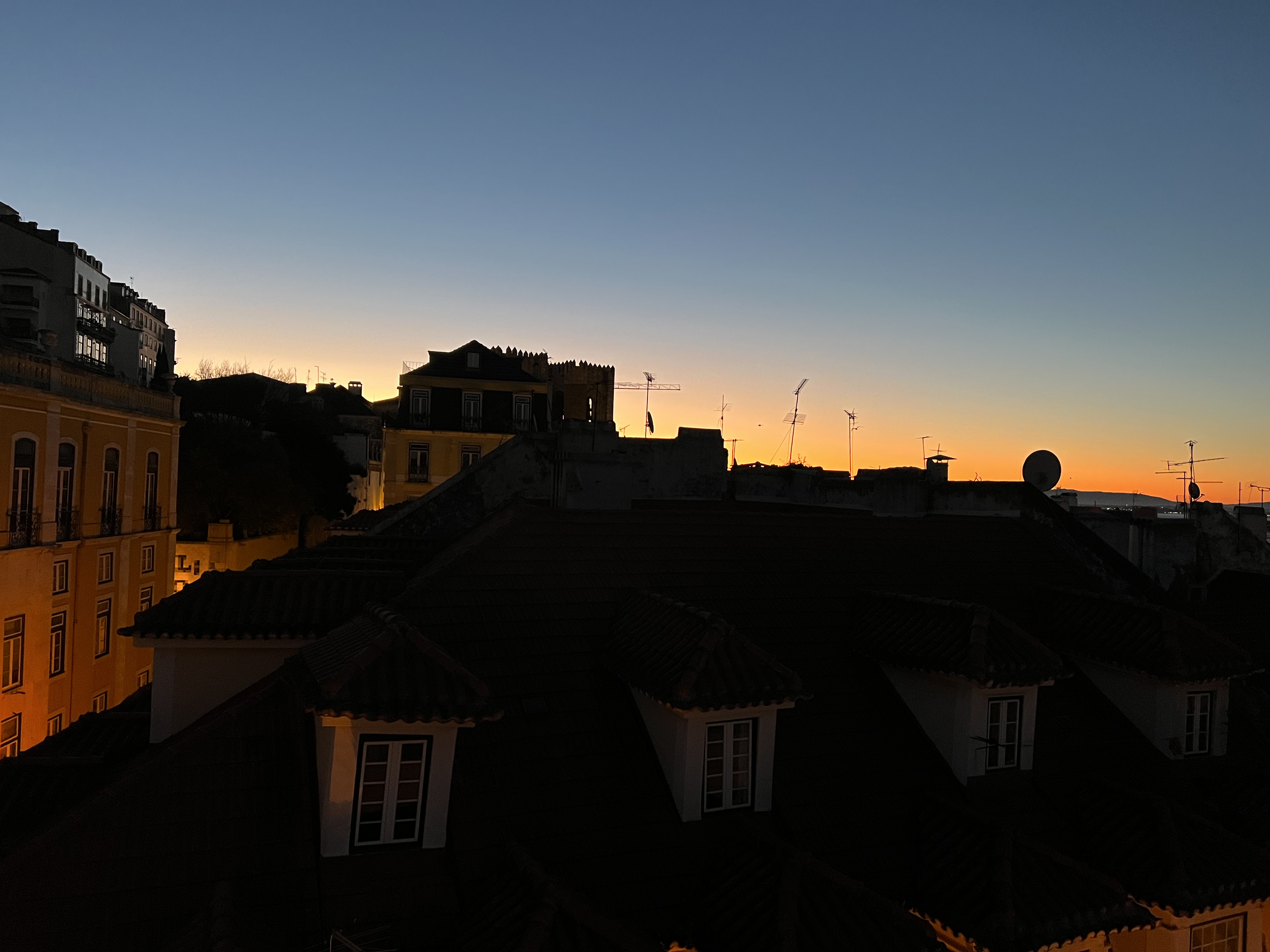
Now the dawn is breaking pink and blue behind the cathedral and the river. But back to yesterday, if any of you are still reading and haven’t dropped off to sleep. We ended the afternoon in Belem, located near the mouth of the river where it meets the Atlantic Ocean. Portugal is “where the land ends and the sea begins,” famously wrote Luis de Camoes, the 16th century poet who is revered by the Portuguese, and whose tomb we saw enshrined in the elaborate Gothic monastery in Belem. The Portuguese explorers and traders embarked from here, and King Manuel I built the monastery and a gothic tower fortress here in the early 16th century to celebrate the wealth and discoveries the Portuguese were making in the East. But yesterday, for most people, it appeared Belem was the best place to escape the city on a gloriously sunny and warm winter day. The sidewalks were crowded with bikers, joggers, and strollers – both the baby and the walking kind – as Lisboans spent the afternoon enjoying the rays, the beer and wine, the view of sailboats on the river. We passed a sailing school with a bunch of kids trying out their boats, and heard what seemed to be a class out on the water – I thought of my niece Anna, who would love sailing here.
We managed to dodge the crowds and saw the beautiful monastery and rather austere church, where both Camoes and Vasco da Gama are elaborately entombed. We ended our day back at the Time Out Market for a quick dinner of fried cod balls and fish and chips, before heading back to the apartment to rest and do laundry. Today, we will catch a train to Sintra, a nearby royal retreat for hundreds of years. I just heard someone leave our breakfast – fresh rolls and orange juice – on our door handle, so it’s time for breakfast. Maybe if I start eating, Rick will wake up. This place is like an AirBnB but much, much better. We will definitely stay here next time we are in Lisbon – and there has to be a next time, because Will would love this place. So would Mitchell and Alex – the twins might need a few more years – I logged 22,000 steps and 55 flights of stairs on Saturday. That would be a rough day in a stroller. 🙂
 The Thompson Attigs
Oh thank you for a great blog Both kinds of strollers tickled me Fun humor I
Have a nice man named Roberto Cleaning up our yucky and unkept yard near the house He works for Chase Payton in his landscaping business.
Gina coming Sunday for three nites She’ll probably get bored out of her mind Love to you both Glad the air B and B is good Ma
Courtenay you’ve got to stop peaking at men in the windows 🙂
This is just amazing!
I didn’t know Portugal had so much beauty.
We loved seeing the pictured of everything, but we still can’t pronounce anything right!
Keep on traveling all is well at home ❤
Mom and Ellie