

Shirakawago, Japan, Wednesday, Nov. 8, 2023 – After a lovely kaiseki dinner last night at an old samurai villa overlooking a garden even older than the famous Kenroku-en, we said goodbye to Kanazawa this morning. We were in a bit of a rush, since our plan to get a breakfast of sushi at the popular Mori Mori conveyor belt sushi restaurant in Omicho market went a little awry. Turns out you really need to show up at 7:30 a.m for the shop’s 8 a.m. opening, so we ended up waiting about 45 minutes for a place at the counter. But it was a wonderful way to say goodbye to Kanazawa, where conveyor-belt sushi was invented – note to the reader – no one actually takes the sushi from the conveyor! Whether this is from Covid, or news reports of naughty teens licking the sushi and going to jail for it, we don’t know, but it was fine because you can order from an iPad, and it was all delicious. More on that later…
After that, we picked up our sleek white Toyota rental car and hit the road for the mountains of Gifu prefecture. Rick handled the drive well, thanks to, and despite GPS. It turns out Japanese GPS can be just as stupid as GPS in the U.S. – and “the lady,” as my mom always calls her, sent us on a ridiculously circuitous route to get to the freeway. I had mapped out a direct one-shot straight route – but the GPS had Rick practicing his “left turn” and “right turn” out through some rice paddies and industrial land until she finally told us to go straight into a road block. We were able to get back to the main road, but it was a reminder to never blindly follow that voice coming from the dashboard. Or from anywhere, really.
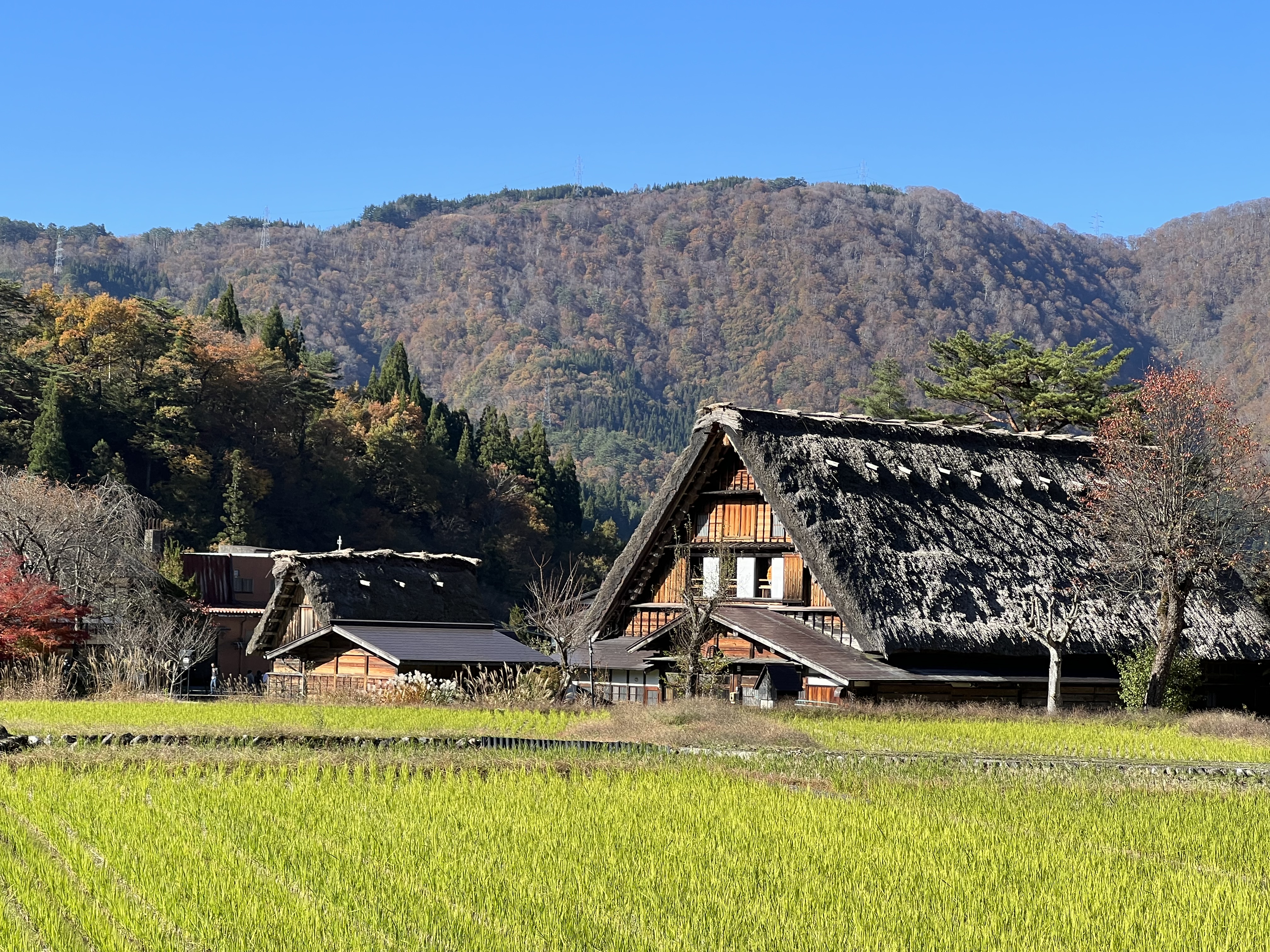
We arrived at Shirakawago in the late morning, along with a fleet of tour buses that disgorged their contents onto the crowded streets of the main town, Ogimachi. There were languages from all over the world, mostly Chinese, European, some Americans and Japanese. It is so picturesque, and it is a little hard to drive in Japan, so most people do come on tour buses. Shirakawago, or old white river, is in the mountains, until recently very isolated because the mountains are so steep and the snow so deep. But tunnels changed all that – we took so many tunnels – I’d have to check but some were pushing 5 miles long – and suddenly we popped out in this little hamlet of beautiful, steep, thatched-roofed homes called Gassho-zukuri, since they resemble hands coming together in prayer. The roofs are a meter-thick with thatch and are extremely difficult to maintain, but they apparently work well in the deep snows that blanket the region in winter. The snow usually flies about now in this region, but today was summer-like, hot in the sun. We toured an old temple, whose roof is also thatched, very unusual, and a large home owned by a wealthy farming family. We preferred the temple house, since it was run-down and very atmospheric. The houses have multiple levels, the very top reserved for the cultivation of silk worms, which were imported and silk became an important local product. The hills above the town rise steeply, and were colored yellow, red, orange and gray from the changing leaves. It may not have felt like fall today in the heat, but the hills are alive with color.
Our favorite time was walking around a little cluster of gassho-zukuri buildings south of the main town, which required an entrance fee. Few people came here, and it was quiet, and the afternoon was approaching, so the afternoon light and calm and sound of water helped you imagine what it might have been like to live here hundreds of years ago. Their lives were hard, very hard. Rice was hard to cultivate, communication with the “outside world” difficult, and the winters were long and hard. We saw the straw coats they wore on their backs for the snow, and all kinds of harnesses for carrying things on your back. There were sleds to haul lumber by hand, and that lumber had to be split by hand. We talked about how my dad, who never wanted to come to Japan, would have actually loved this place, the sense of history, the difficult way of making your way in the world with just some wood and some straw.
 The Thompson Attigs
All caught up to today:) very nice to hear your voice and stories
all caught up 🙂 very nice to hear your voice and stories