ON THE SHINKANSEN, Southern Honshu, Saturday, May 17, 2025 – Our time in Tokyo went by as fast as, well, as fast as the 300-kilometer-an-hour bullet train hurtling us southward right now. We had a long, busy day yesterday, starting with the teamLab Borderless digital art museum/experience at Azabu-dai. It was classic teamLab – digital art projected on walls, ceilings and floors, or from strings of crystals or sparkling globes, hanging from the ceiling, surrounded by mirrors. The installations give you a feeling an infinity, like Kusama Yayoi’s famous pieces. We saw the same tigers made up of moving masses of flowers, and hauntingly weird rabbits and other frog-like creatures we had seen projected on the stone castle walls at Kanazawa back in 2023. (It was much more beautiful, and interesting, projected on atmospheric castle walls – don’t miss it if you ever have a chance.) Our highlight experience was probably the room that had children’s drawings of fish and other sea creatures swirling around the walls and ceilings of one room – we finally figured out we too could make drawings to be projected on the walls. So I made a “Hazel Fish,” and Poppa made a “Rory Fish.” Soon, Rory and Hazel were swimming happily around the room with the other fantastical creatures.
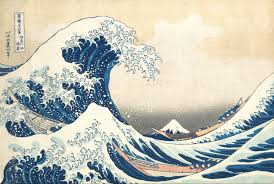
From there, we headed over to the other side of the Sumida River, where we visited a new and interesting museum dedicated to the woodblock print art of Hokusai, most famous for his series of prints “36 Views of Mount Fuji,” including his most famous “The Great Wave Off Kanagawa.” The Sumida Hokusai Museum, which became quite crowded, had excellent displays on how the blocks were drawn, carved, and printed in many layers. These woodblock prints had a big influence on the art of late 19th century France, including the Impressionists – Monet, Manet etc. – as well as Vincent Van Gogh, who collected them whenever he could find them.
After that, we stopped at a famous soba shop, Hosokawa, where the owner makes the buckwheat noodles by hand every morning. We had heard the lines can be long, so we went early, and immediately got a table with several groups of older Japanese women – two had been shopping and one elderly woman was enjoying her noodles all alone – they were that good. It will be interesting to compare them to the soba we have along the southwestern edge of Honshu, which is also famous for its pure buckwheat noodles. We love soba so seek it out whenever we are in Japan.

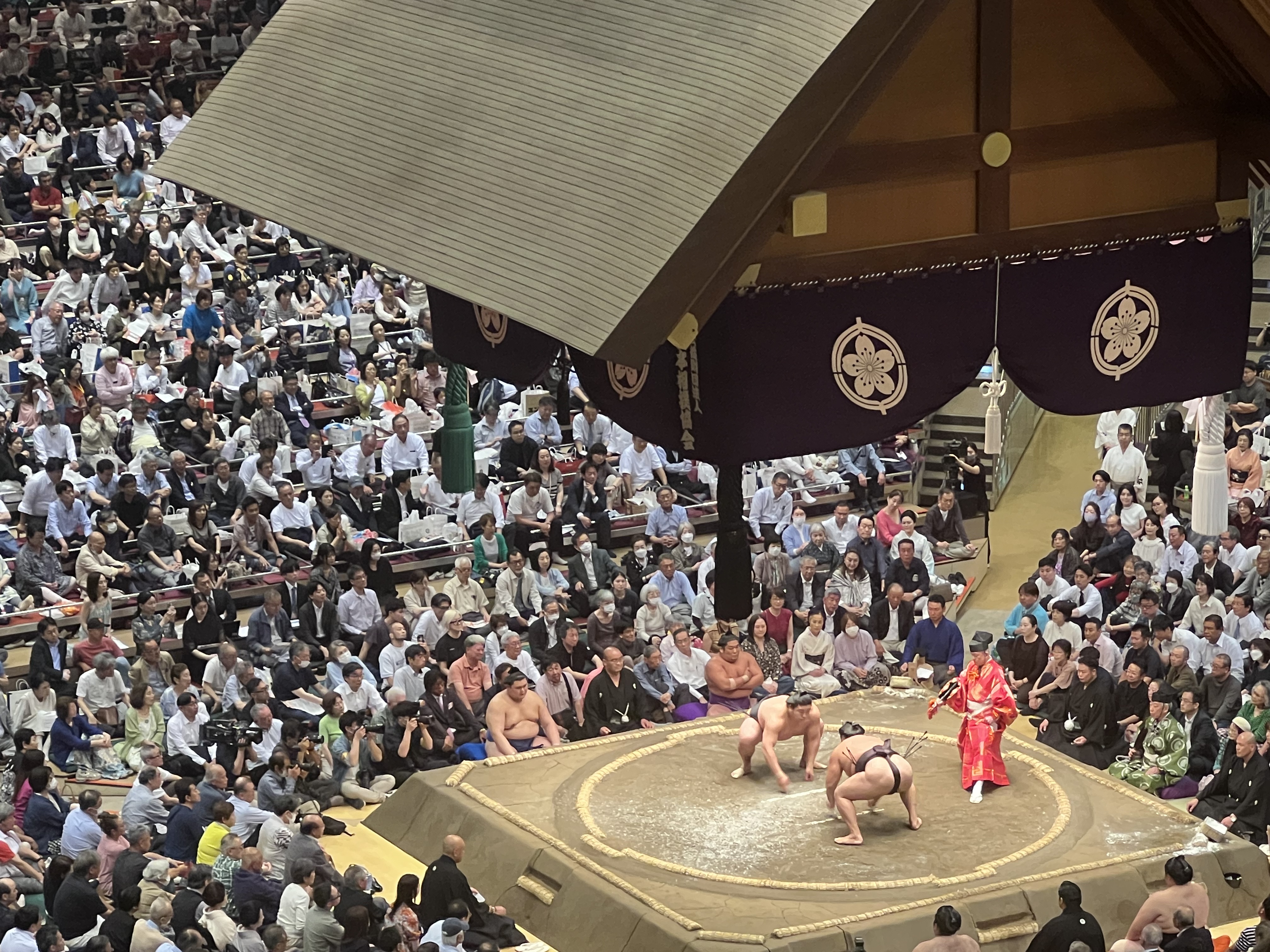
Our last stop was the Ryogoku Kokugikan, or the national sumo arena, a short walk away. It was only 1 p.m. and the main sumo didn’t start for two and a half hours, but we didn’t dare take a cab back to the hotel – the worst thing to do when you are jet lagged is stop moving. So we watched some of the rikishi, or sumo wrestlers, walk into the stadium in their yukata robes and flip-flops. We then took our seats, which were very far from the center arena, or dohyo, in a section that was filled with gaijin, as we foreigners are called here. All of those in our row had gone through the same hours-long process of trying to get tickets the second they went on sale. The website kept crashing, but those of us in row 9 had persevered and finally managed to secure tickets. I joked that the website had identified all the IP addresses outside Japan and stuck us all in the same section, but it was fine. Even the lovely Canadian couple sitting next to us were very sweet and didn’t mention anything about, um, things back home.
I had spent some time reading about the wrestlers – who is on their way up, who is on his way out – and had some fun details about which wrestler had a tiny toy poodle and loved gardening, and which was the bad boy who got caught at hostess bars during the pandemic, and. which was the eponymous “Flying Monkey.” In any case, we have followed sumo over the years, first when I was in Japan as an exchange student in college and then when Will was little and we would watch together in the evenings on one epic trip to Japan. So it was really wonderful to finally see it in person. My friend Hope had said it’s best to sit on the floor in reserved seating where she had gone as a child growing up in Japan, but we didn’t even try for those seats – we couldn’t imagine sitting on the floor for four to five hours straight without perhaps losing feeling in our legs and our legs altogether. So we sat in the nose-bleed seats and were really able to see all the action just fine. It was just too far to clearly see the rikishi’s facial expression or really feel the intensity of the wresting or the size of the wrestlers themselves, a few of whom are up to 6-foot-5 and/or 420 pounds. But to see the rituals and camaraderie of the sport which dates back centuries and is steeped in Shinto spiritual practices was really, well, awesome.

As you perhaps know, I am a cautious traveler who arrives at the airport two hours early and never books an airline transfer under 90 minutes, so I was a bit worried about a six-minute transfer from one Shinkansen to another today in Hiroshima. Six minutes? I mean, in the US, that would be insane for practically any transfer. But I trusted that the Shinkansen website would not lead me astray, and it turns out that six minutes is a loooong time for a transfer in Hiroshima. We just walked across the platform, and after a very long four-minute wait, there came our train – a sleek, pink Hello-Kitty themed train that everyone had their phones to capture its adorableness. So now we are speeding south on that pink cat-covered Shinkansen – which is also awesome. Rory and Hazel would love it. My mother would love it. I love it. I’m so happy to be back in Japan!
 The Thompson Attigs