Sumo and the Six-Minute Shinkansen Transfer

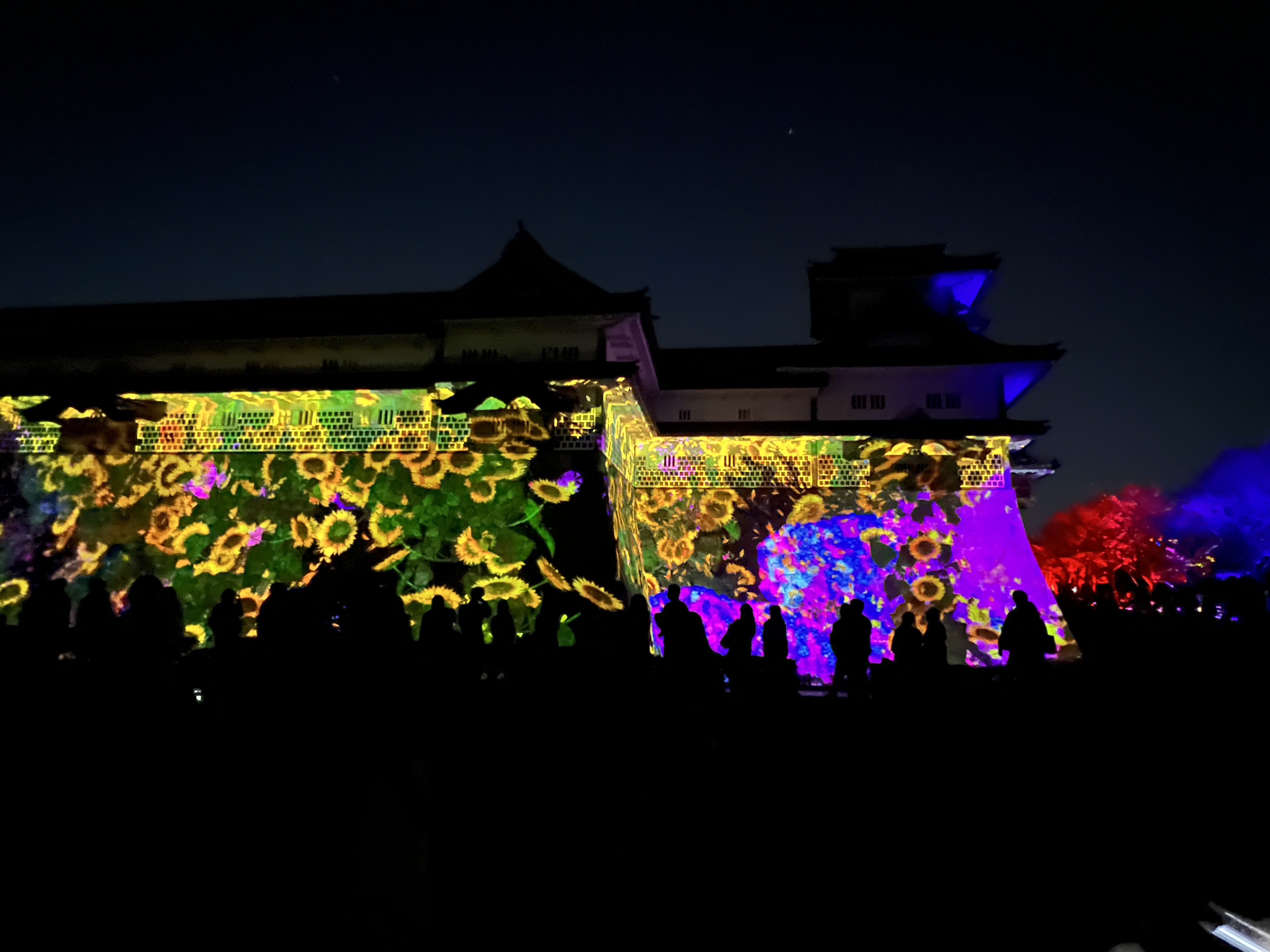
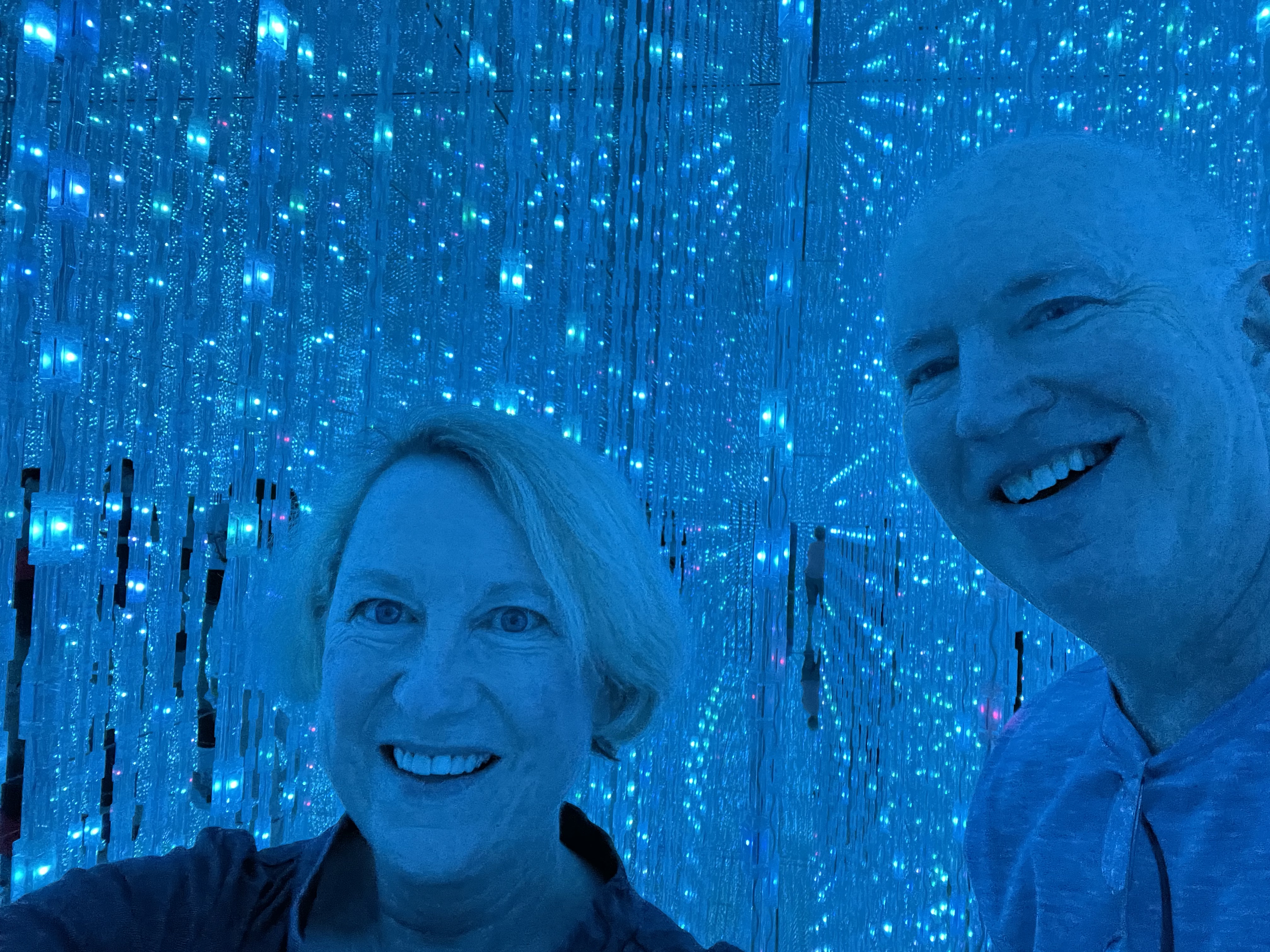
ON THE SHINKANSEN, Southern Honshu, Saturday, May 17, 2025 – Our time in Tokyo went by as fast as, well, as fast as the 300-kilometer-an-hour bullet train hurtling us southward right now. We had a long, busy day yesterday, starting with the teamLab Borderless digital art museum/experience at Azabu-dai. It was classic teamLab – digital art projected on walls, ceilings and floors, or from strings of crystals or sparkling globes, hanging from the ceiling, surrounded by mirrors. The installations give you a feeling an infinity, like Kusama Yayoi’s famous pieces. We saw the same tigers made up of moving masses of flowers, and hauntingly weird rabbits and other frog-like creatures we had seen projected on the stone castle walls at Kanazawa back in 2023. (It was much more beautiful, and interesting, projected on atmospheric castle walls – don’t miss it if you ever have a chance.) Our highlight experience was probably the room that had children’s drawings of fish and other sea creatures swirling around the walls and ceilings of one room – we finally figured out we too could make drawings to be projected on the walls. So I made a “Hazel Fish,” and Poppa made a “Rory Fish.” Soon, Rory and Hazel were swimming happily around the room with the other fantastical creatures.
From there, we headed over to the other side of the Sumida River, where we visited a new and interesting museum dedicated to the woodblock print art of Hokusai, most famous for his series of prints “36 Views of Mount Fuji,” including his most famous “The Great Wave Off Kanagawa.” The Sumida Hokusai Museum, which became quite crowded, had excellent displays on how the blocks were drawn, carved, and printed in many layers. These woodblock prints had a big influence on the art of late 19th century France, including the Impressionists – Monet, Manet etc. – as well as Vincent Van Gogh, who collected them whenever he could find them.

After that, we stopped at a famous soba shop, Hosokawa, where the owner makes the buckwheat noodles by hand every morning. We had heard the lines can be long, so we went early, and immediately got a table with several groups of older Japanese women – two had been shopping and one elderly woman was enjoying her noodles all alone – they were that good. It will be interesting to compare them to the soba we have along the southwestern edge of Honshu, which is also famous for its pure buckwheat noodles. We love soba so seek it out whenever we are in Japan.

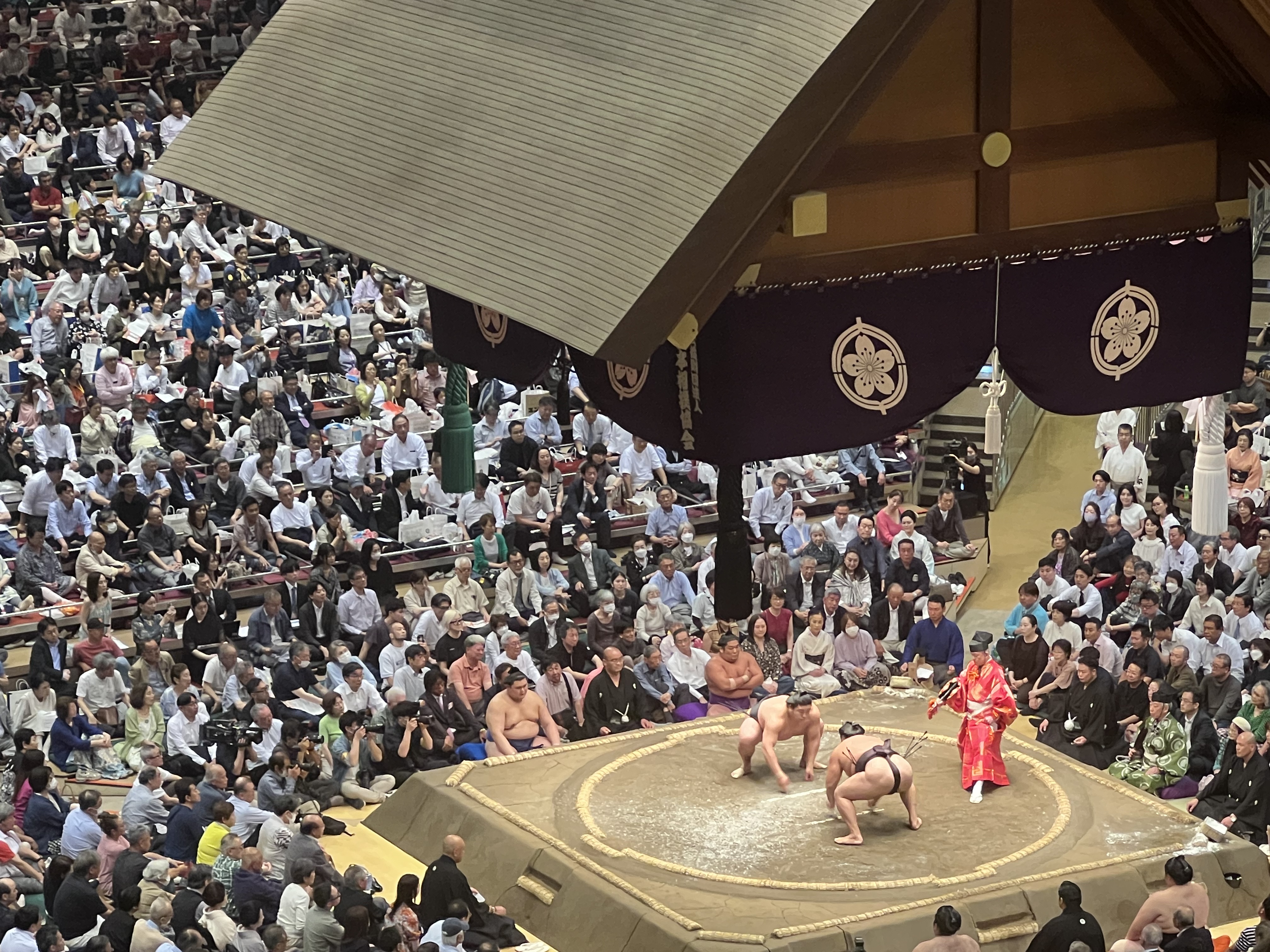
Our last stop was the Ryogoku Kokugikan, or the national sumo arena, a short walk away. It was only 1 p.m. and the main sumo didn’t start for two and a half hours, but we didn’t dare take a cab back to the hotel – the worst thing to do when you are jet lagged is stop moving. So we watched some of the rikishi, or sumo wrestlers, walk into the stadium in their yukata robes and flip-flops. We then took our seats, which were very far from the center arena, or dohyo, in a section that was filled with gaijin, as we foreigners are called here. All of those in our row had gone through the same hours-long process of trying to get tickets the second they went on sale. The website kept crashing, but those of us in row 9 had persevered and finally managed to secure tickets. I joked that the website had identified all the IP addresses outside Japan and stuck us all in the same section, but it was fine. Even the lovely Canadian couple sitting next to us were very sweet and didn’t mention anything about, um, things back home.

I had spent some time reading about the wrestlers – who is on their way up, who is on his way out – and had some fun details about which wrestler had a tiny toy poodle and loved gardening, and which was the bad boy who got caught at hostess bars during the pandemic, and. which was the eponymous “Flying Monkey.” In any case, we have followed sumo over the years, first when I was in Japan as an exchange student in college and then when Will was little and we would watch together in the evenings on one epic trip to Japan. So it was really wonderful to finally see it in person. My friend Hope had said it’s best to sit on the floor in reserved seating where she had gone as a child growing up in Japan, but we didn’t even try for those seats – we couldn’t imagine sitting on the floor for four to five hours straight without perhaps losing feeling in our legs and our legs altogether. So we sat in the nose-bleed seats and were really able to see all the action just fine. It was just too far to clearly see the rikishi’s facial expression or really feel the intensity of the wresting or the size of the wrestlers themselves, a few of whom are up to 6-foot-5 and/or 420 pounds. But to see the rituals and camaraderie of the sport which dates back centuries and is steeped in Shinto spiritual practices was really, well, awesome.

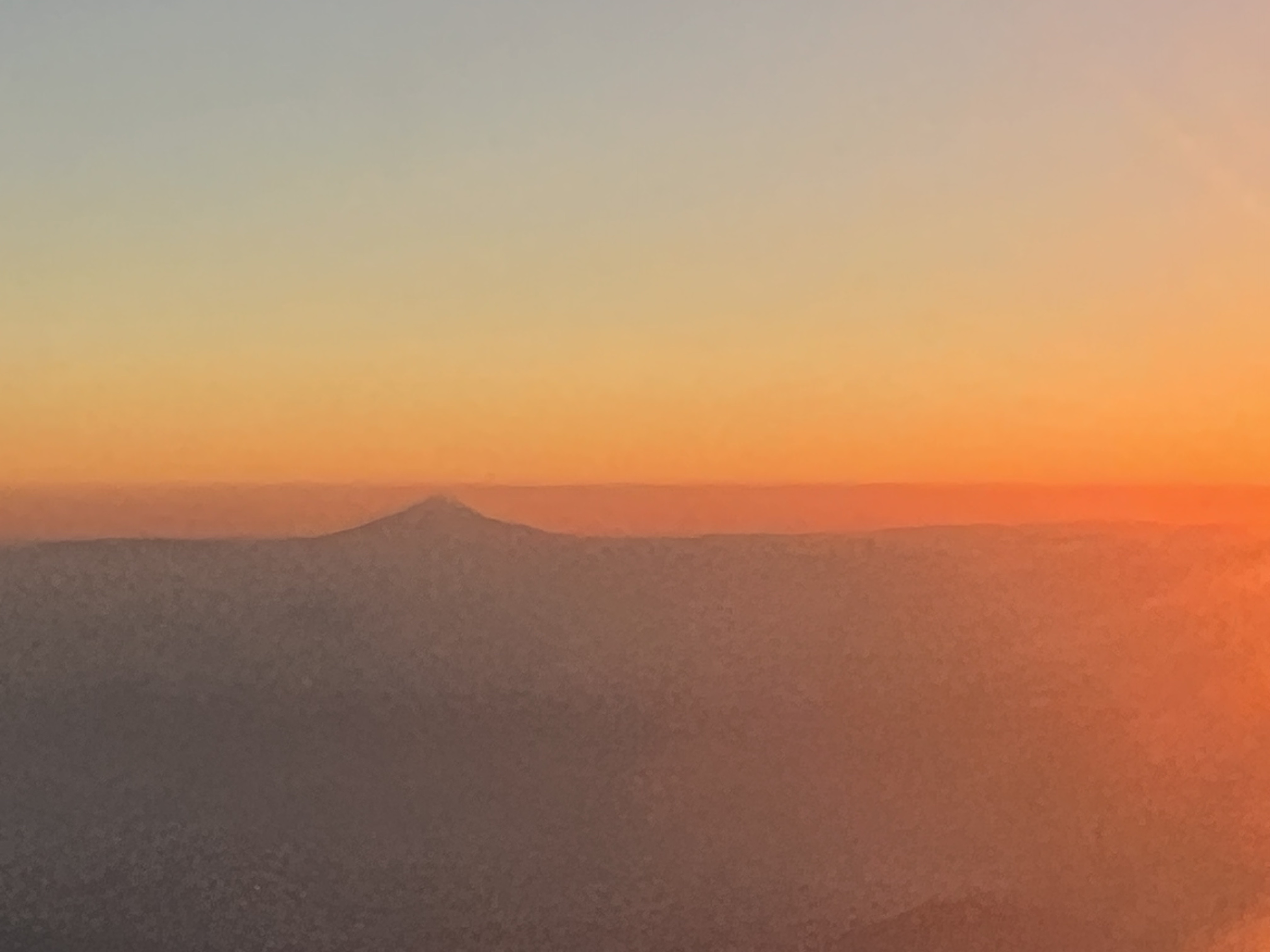
As you perhaps know, I am a cautious traveler who arrives at the airport two hours early and never books an airline transfer under 90 minutes, so I was a bit worried about a six-minute transfer from one Shinkansen to another today in Hiroshima. Six minutes? I mean, in the US, that would be insane for practically any transfer. But I trusted that the Shinkansen website would not lead me astray, and it turns out that six minutes is a loooong time for a transfer in Hiroshima. We just walked across the platform, and after a very long four-minute wait, there came our train – a sleek, pink Hello-Kitty themed train that everyone had their phones to capture its adorableness. So now we are speeding south on that pink cat-covered Shinkansen – which is also awesome. Rory and Hazel would love it. My mother would love it. I love it. I’m so happy to be back in Japan!
From Italica to the White Hills, and Ronda

March 12, 2025 โ€“ Ronda, Spain โ€“ We left Seville yesterday morning, with a wonderful stop at the ancient Roman ruins 10 minutes out of town. Italica was the birthplace of two important Roman emperors, Trajan and Hadrian, who presided over the Roman empire at the height of its vastness and power. That they came from Spain, rich in metals and agricultural goods, is not surprising, and the grandeur of the city of Italica reflects their wealth and patronage. This city, on a rise in the landscape, was once almost forgotten, until its memory was revived in the last few hundred years and excavation began in the past century. Abutting the modern city, archeologists have uncovered a huge amphitheater, remains of a major temple to Trajan, a theatre, and homes graced with beautiful mosaics of birds, gods, and a medusa head. We wandered the rather muddy site, between rain showers, imagining the city of marble and stone now sunk into the ground, and mused on hubris and the fall of empires. It happens. History does indeed repeat itself. 

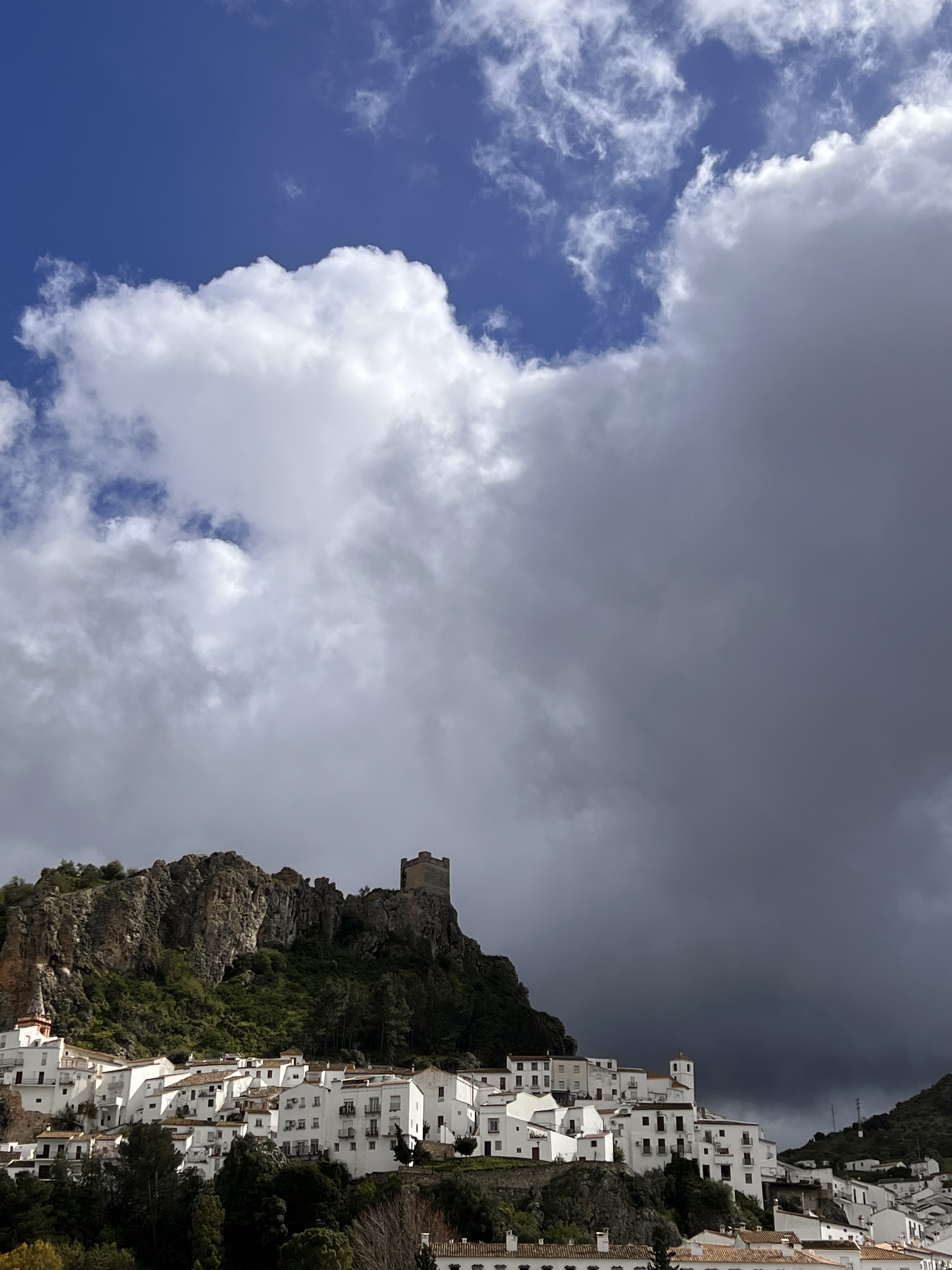
We then piled back into our land-yacht, a sleek black Mercedes van piloted by none other than Rick. It was the only automatic transmission available, so we will be avoiding any city center maze-driving. We then drove across a vibrant green landscape of rolling hills, covered with orchards (almonds? dates? Olives for sure), toward a mountain range with clouds roiling behind. We seemed to be headed into a storm, as we drove to our next destination, a puebla blanca, or white town for which this part of Andalucia is famous. We parked below the extremely picturesque town of Zahara de la Sierra, a cluster of white houses resting like a cloudbank below an old Islamic fortress. We climbed up to the small town square and visited the 17th century church, which was backed by a cliff rising to the fort. Two lovely old women inside greeted us and sat talking the entire time we wandered the small but ornate interior. We saw a papal indulgence given to the local menโ€™s society in the 16thcentury. A papal indulgence! I had never seen on in person, but it was indulgences like these (basically a promise from the pope to get into heaven early, in exchange for a hunk of money) that lead to the Protestant Reformation. Martin Luther, a good Catholic, had had enough with indulgences and corruption in the church, and so lead a revolution against the church, and eventually the Counter Reformation, when the Catholic church tried to reestablish its glory and authority in the splendor of the Baroque.

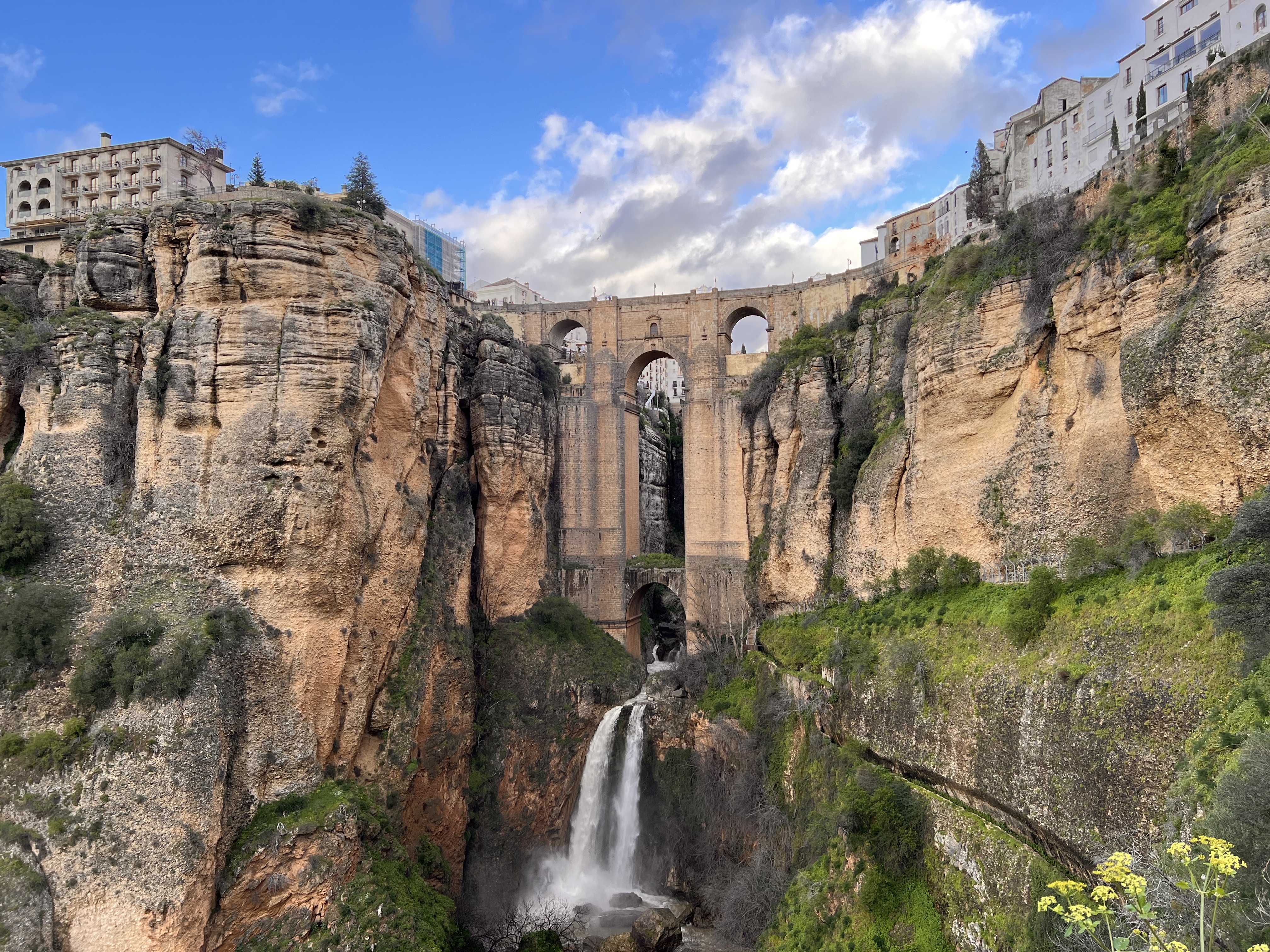
 We had a lovely little lunch in the only restaurant open in town, La Era, then drove on to Ronda, famous for bullfighting and Ernest Hemingway. Both Hemingway and Orson Welles loved Ronda, and spent a lot of time here โ€“ there are busts of the artists in the main park. We dropped our bags at our lovely hotel, which has a spectacular view over the valley and mountains in the distance. Because the weather is stormy and rainy, the mountains have been especially atmospheric. We wandered along the edge of the cliff to the dramatic 18thcentury bridge that spans the 300-foot gorge between the โ€œnewโ€ Christian town and the older Moorish town across the gap. The first bridge collapsed six years after it was built, but this one seems to have survived. We decided to brave the walk down the hill to get a view back up at the bridge, and lucked on a gorge walk that took us to the base of the bridge. It is apparently a new โ€œtourist attraction,โ€ and for 5 euros, we donned hard hats and walked down a stone-paved pathway for some spectacular views back up at the bridge. We were lucky, because we were the last people admitted, arriving 3 minutes before the 6:30 p.m. closure. I had worried on the way down, since it seemed so far, but the hike up was easier than I thought. It helped that Will texted halfway up, so I was able to catch my breath. ๐Ÿ˜Š

We then had a lovely evening (with some mediocre food) visiting a few tapas bars, and ended up back at our hotel for a glass of complimentary champagne on the terrace. All the people inside thought we were crazy for going out in the stormy weather, but it was covered, there were propane heaters, and we are Oregonians and Philadelphians.

 Today, we are doing laundry in Ronda and then heading off to visit an other puebla blanca and further back in history, to some 6,000-year old megalithic passage tombs and dolmens. Spain really has it all, when it comes to history!

Mirrors into the Past

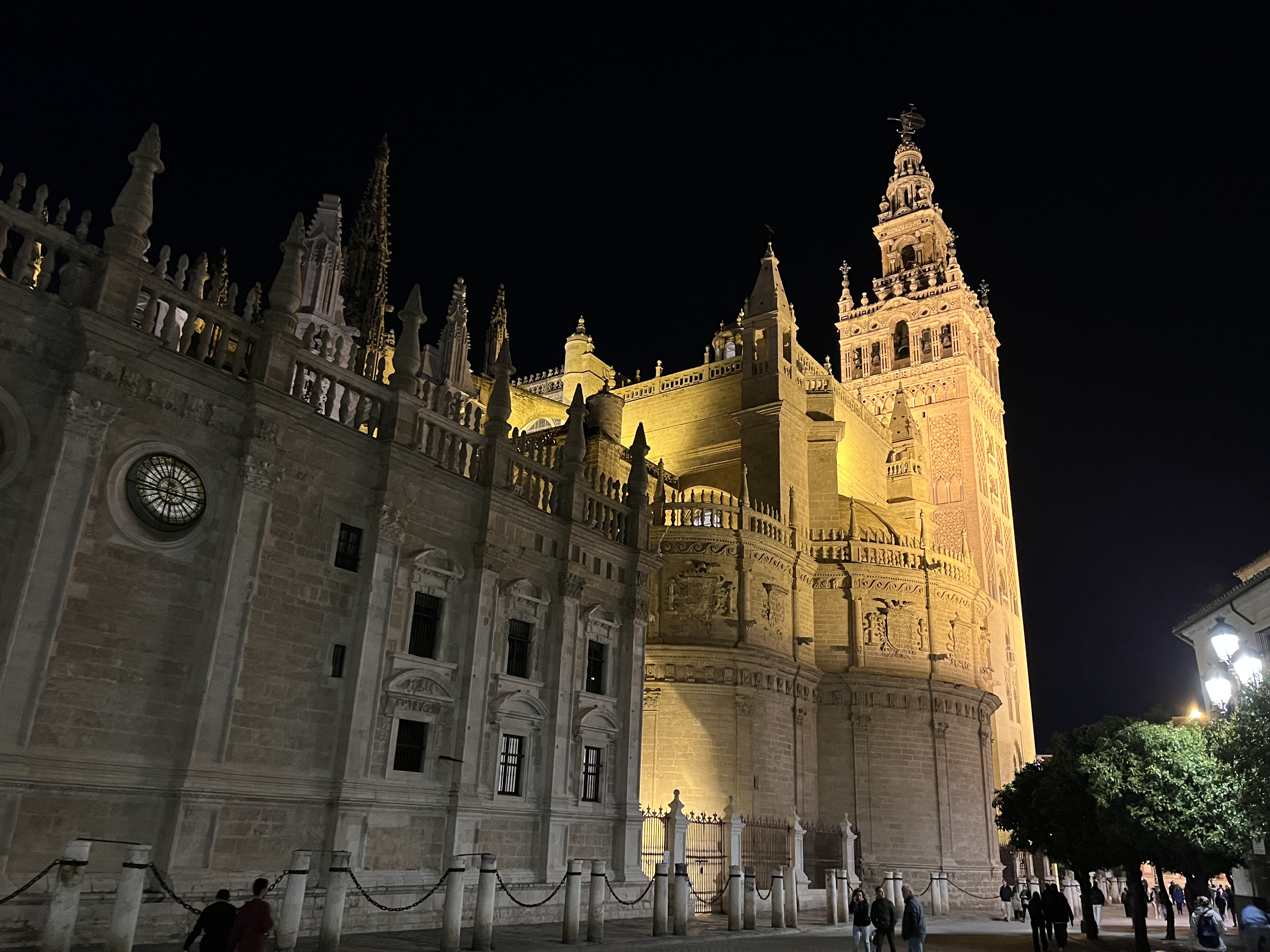
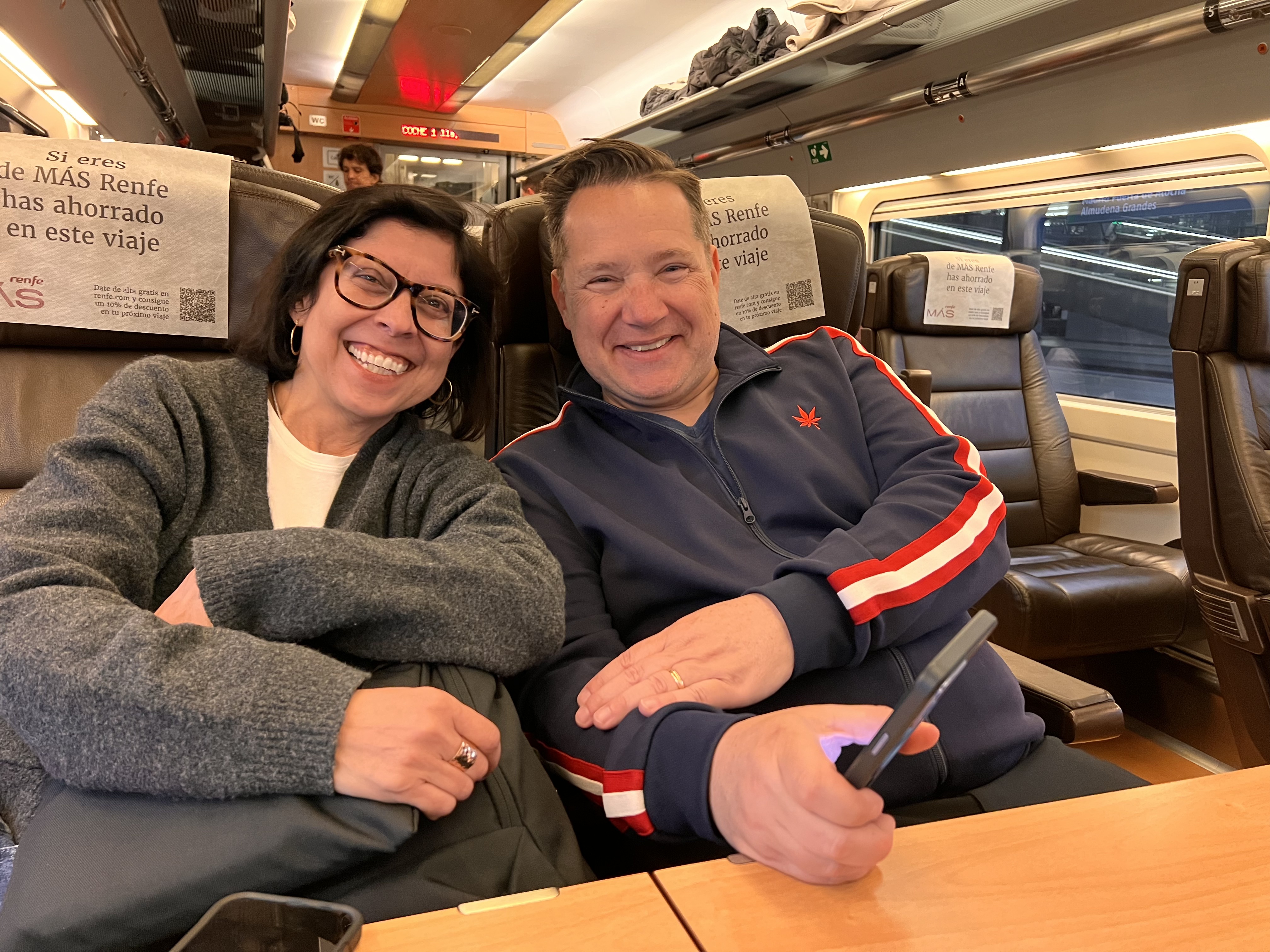
Seville – Sunday, March 9, 2025 – We arrived in Seville last night on a fast-train from Madrid with our friends Helen and Mike, who were fresh off a plane from Philly. We had a wonderful time last night bumbling through three tapas bars – there are shifting mores and customs, depending on the city and the establishment, on how and what to order, how to gracefully snag an open table without enraging the staff, not that that happened!, but that is a whole other topic we can delve into sometime.

But after a short night (yes we have been going to bed at midnight!!! Imagine!!), but waking up at 5 am, I thought I would write a quick post on our museum experience in Madrid. We saw both the Thyssen-Bournemisza and the Prado, the later with our art historian guide Almu Cros. We have never had a guide for a museum, but she had a unique perspective on the collection – who the rulers were who commissioned or bought all this art – one of the greatest collections in the world – and also on how the artists used the collection over the centuries to inspire their own work. For example, perhaps the most famous painting in the collection is Las Meninas, Seville-born Diego Velasquez’s iconic 17th-century painting of the artist painting the king and the queen, when their little girl bursts in on the scene with her maids and her dog. Later artists, including many modern and contemporary artists, including Francis Bacon, have been obsessed with this painting and painted their own “versions.” What I hadn’t realized, is that there is another extremely important painting that had been in the collection in the 17th century, Jan Van Eyck’s Arnolfini Wedding from two centuries earlier, that Velasquez had been looking at. Famously, there is a mirror in both paintings, with a tiny, hard-to-discern reflection of the artist, or in the case of Velasquez, the subject of the painting – the King Philip IV and his queen. In the painting, there are other elements from the Van Eyck – a dog, the light shining in at a slant, many little elements that Velasquez drew on to create his uniquely modern (for his time) portrait of an artist at work. Another example, Picasso’s massive Guernica (which is at another museum in Madrid), the Cubist artists cry against the horrors of modern warfare on civilians following the Nazi bombing of a small northern Spanish town in the Civil War of the 1930. Though he was in exile from Franco’s fascist Spain, he drew on his memory of Goya’s depiction of the street fighting in the streets of Madrid during an uprising against Napoleon’s occupation in 1808. Once you look at the massive Goya painting in the Prado, you can see it – the horse (there were no horses in Guenica), the raised arms of the woman, the body on the ground with the broken sword. Another mirror into the past, and into an artist’s mind.

And you think the Spanish surrealist Salvador Dali is weird? Well he is actually just channeling his much, much weirder predecessor, 16th century Dutch painter Hieronymus Bosch, whose famously strange Garden of Earthly delights is a highlight of the Prado. Dali literally quoted from the Dutch painters strange and disturbing hybrid creatures who act out the follies of human behavior. But as Almu pointed out, even Bosch was looking to other strange minds for inspiration – the monks who drew strange hybrid (and sometimes obscene) monsters in the margins of the sacred texts they were copying.

That is looking at art with your mind – it’s magical working through the intellectual puzzles with your mind. But there is a far different way to experience art, something that the Stanford professor Alexander Nemerov (affectionately known to his undergraduates as the “Art Preacher”) opened me up to. You look a piece of art with your heart, not just your mind. You never know how a piece of art will affect you, and I am sometimes just so moved by something that I find myself in tears. That is the power of art to really reach through the centuries and strike you at your heart. Such a thing happened at the Prado, in the Goya room. We were standing in front of his painting of May 3, 1808, showing the execution of Spanish resisters to Napoleon’s invasion – the peasant raises his hands like a Christ-figure as he faces the firing squad. I have been haunted by this image since I saw it as a child, in my parent’s Time-Life history of Western art. But as I looked at the painting, thinking about the history, I glanced to my right and saw a painting I had only seen in art class, called the Drowning Dog, though I don’t think Goya named it that. It shows a small dog in a vast canvas of almost Byzantine gold, looking up as if he is swimming to keep his head above a wave that threatens to submerge him. It took my breath away – the tiny dog has the look of despair, or of hope, or of both – but it was an emotion I recognized, and recognize as I write this. The sense of that the world is out of one’s control, that feeling when you have to confront your own end, the terror, the horror and yet somehow, the hope. I had seen that look the day before, at the Thyssen, in the face of an El Greco Jesus, looking up to heaven with a look of despair, as if saying Why Me? Is this all there is? Seeing our friends again after all these years, when we have all faced life and health challenges and scares, when we face futures filled with uncertainty, uncertain diagnoses, uncertain futures, the gold, and the face of that sweet little dog from Goya’s dark period, gives me hope.

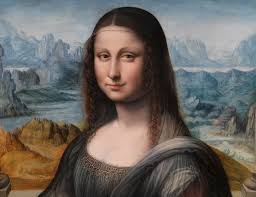
Last thought – don’t tell anyone, but the real Mona Lisa is not at the Louvre. It’s at the Prado Shhhhhh!!!! Almu has us convinced – the Prado’s Mona Lisa looks just like the one at the Louvre – except they cleaned it, revealing beautiful greens and blues in the background. Her iconic smile is there, the same clothes, the same pose, the same lack of jewelry. The label on the side says “Workshop of Leonardo,” but Almu has some wonderfully persuasive arguments that this, in fact, is from the hand of Leonardo. It was painted on more expensive wood, walnut, for example, using more expensive paint. Could this have been the version that the patron chose, leaving Leonardo with the other copy, which he would carry with him to France, where he died with it in his possession? She wears no jewelry, much like another Renaissance portrait of a young wife, painted after her early death. Could Mona Lisa be the painting for another grieving widower, and he chose the more exquisite of the two versions? Almu thinks so, and so do we. But God forbid that the word gets out – NO ONE was looking at the Prado Mona Lisa – ok, maybe a few people casually walked by while we were discussing it. But you cannot imagine how the experience would be ruined if the selfie-taking hordes descended on this Mona Lisa. Meanwhile, you can enjoy Leonardo’s wonderful creation in the relative peace of the photo-banning Prado.

Art – where you find a mirror into your self, into the past, into your emotions.

A first (weary) walk around Madrid’s Old Town

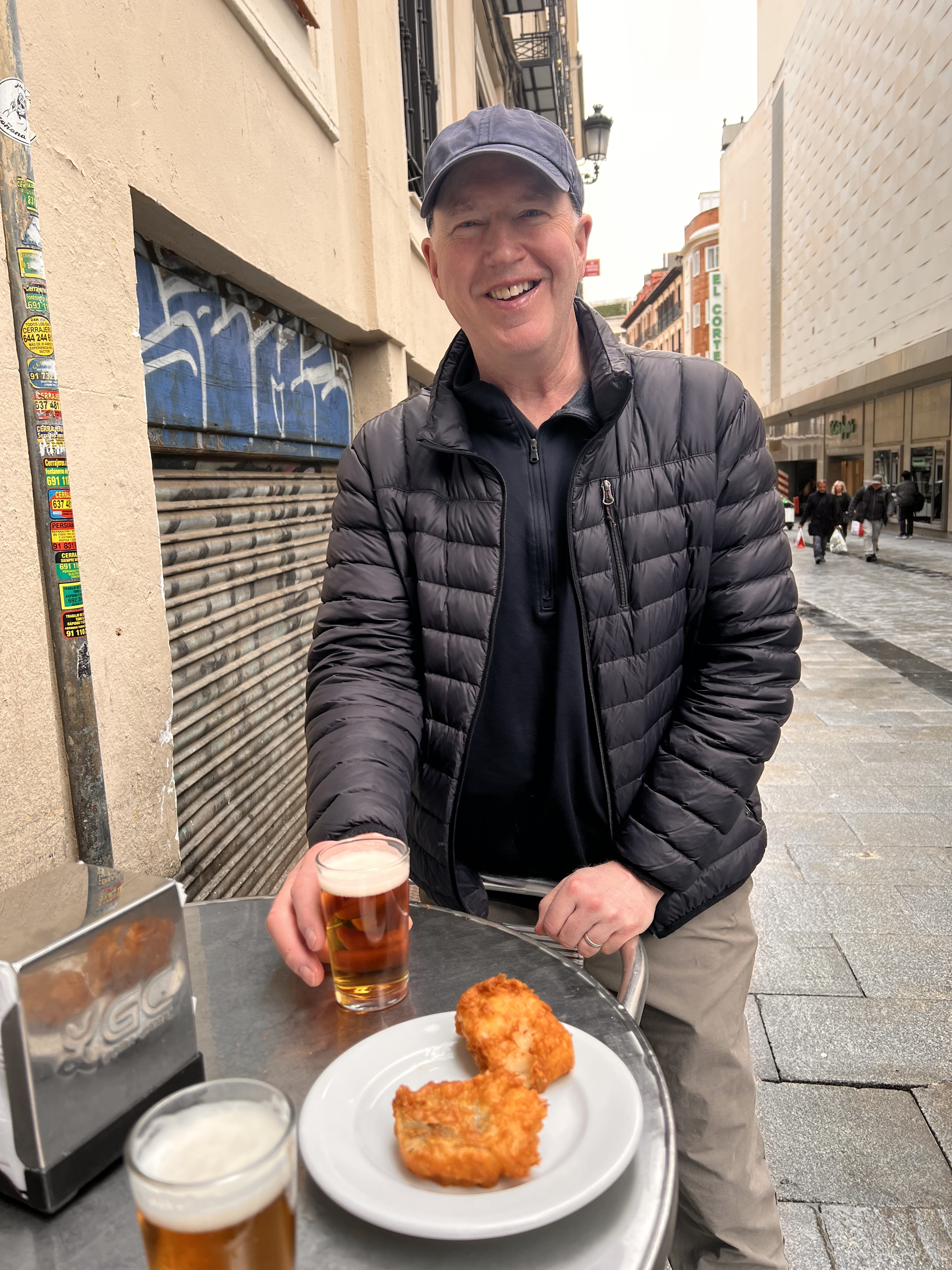
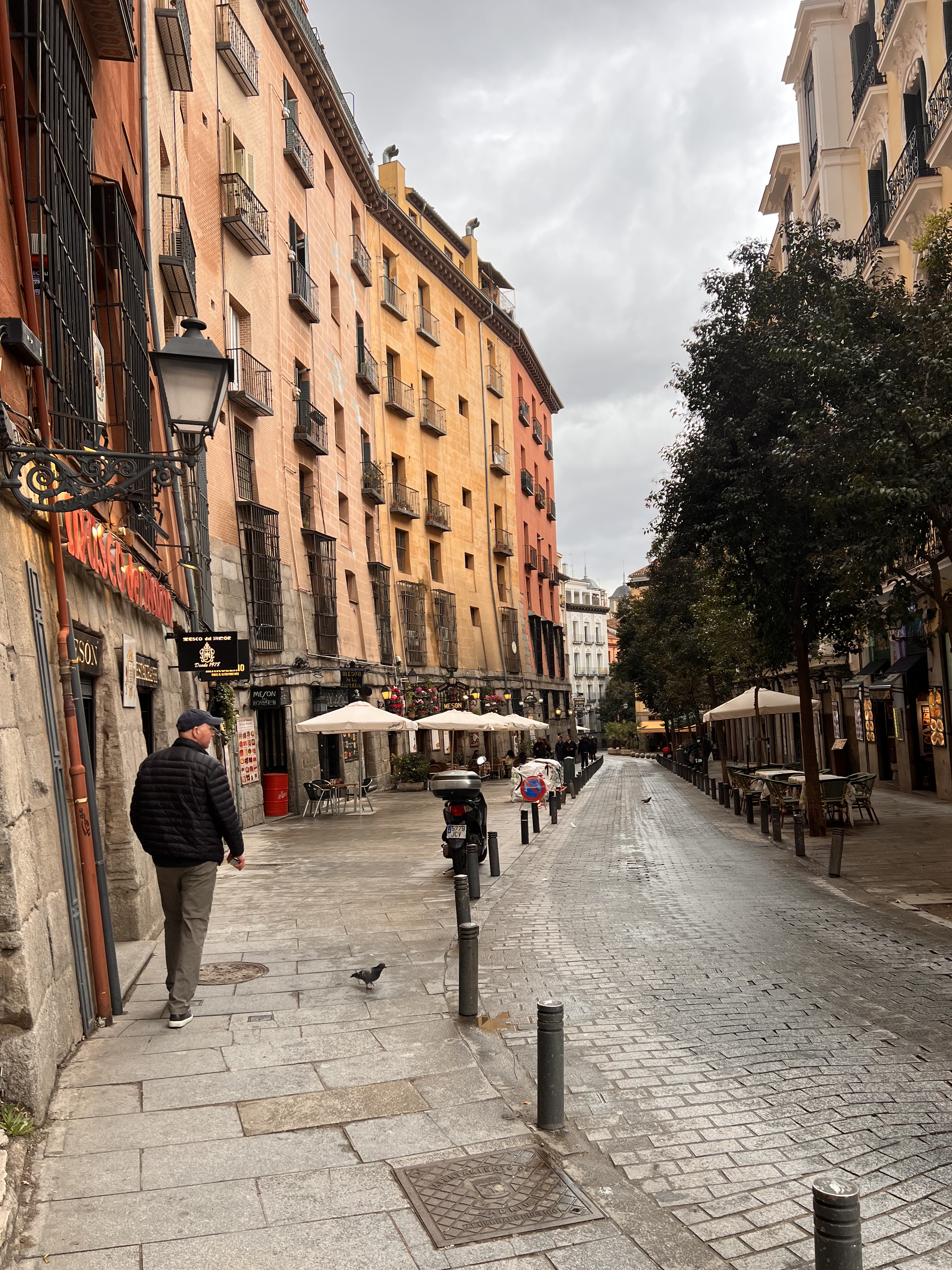
We have arrived in Madrid! It was sprinkling rain, but warm, so we had a nice walk through the historic city center. We stopped for some rather amazing fried bacalao at a wood-paneled tavern dating back to 1860, where political rabble rousers of the 19th century plotted against the government, and where the cellar was used as a bomb shelter during the the 1930s Civil War.

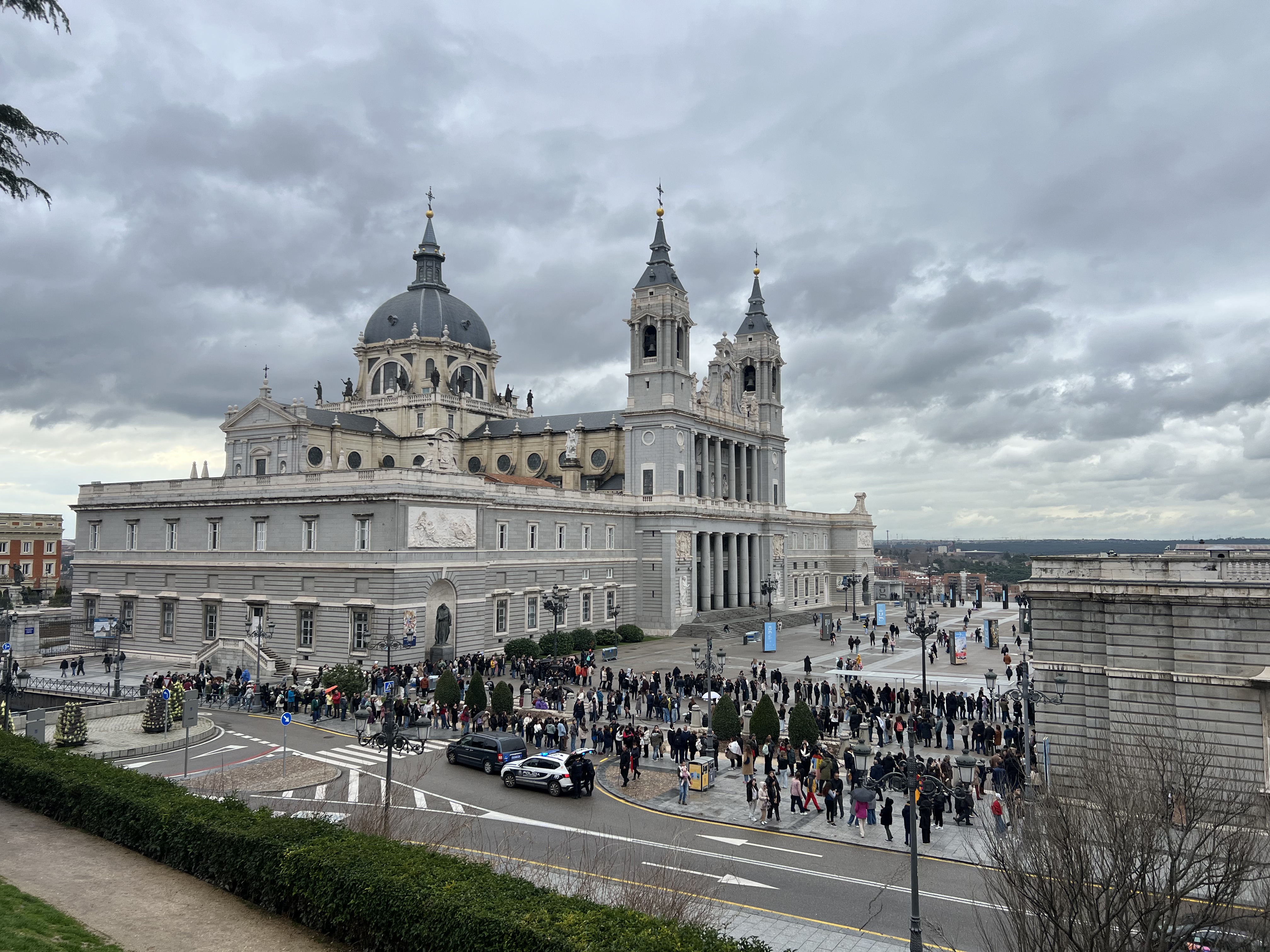
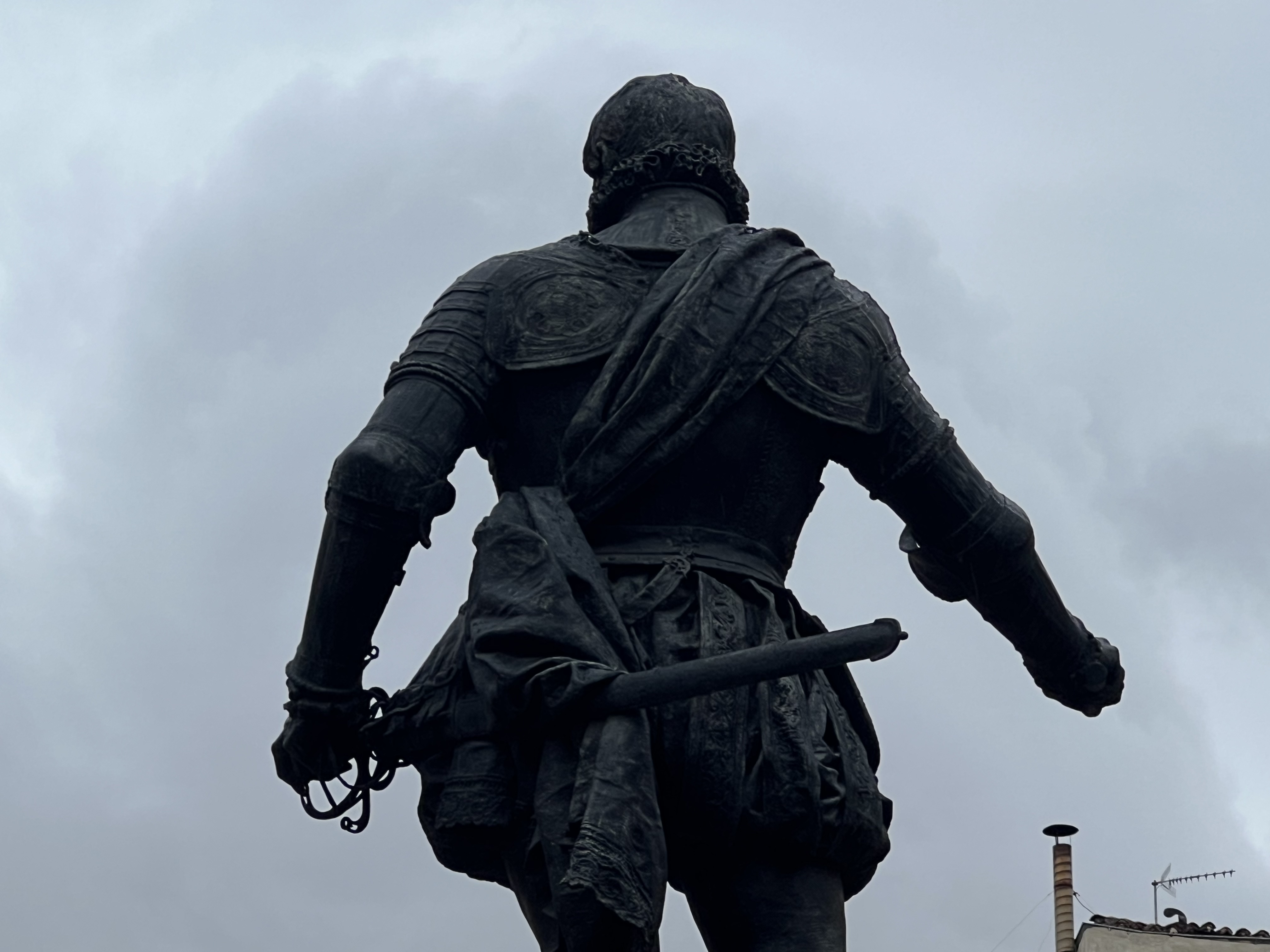
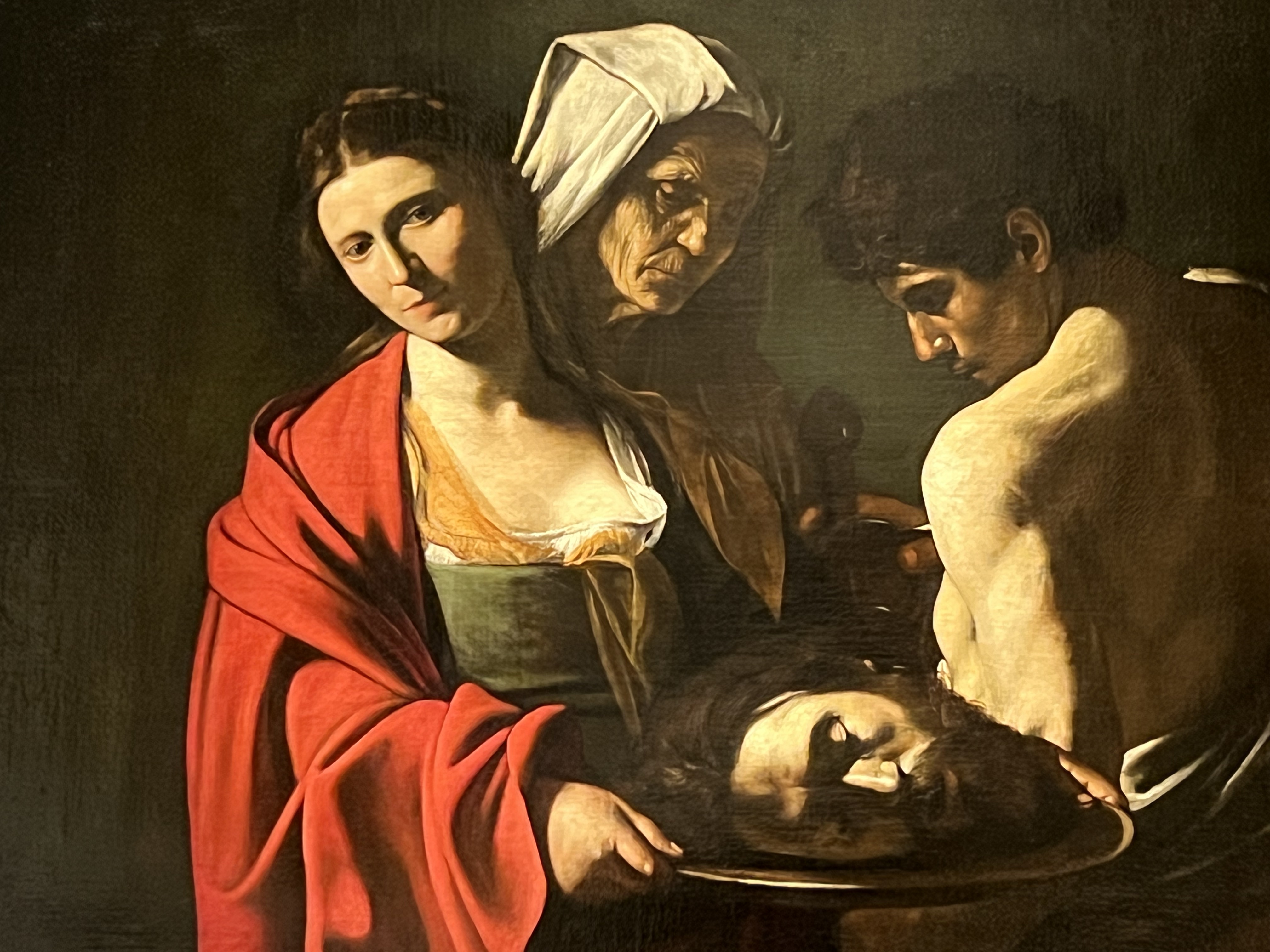
We visited the Royal Collection, which included the Caravaggio painting of Salome and the head of John the Baptist, and saw the huge lines leading into the nearby Royal Palace (cuz the admission was free from 4 p.m on today!) Madrid is a walkable city – we passed a plaza where bullfights were once held, a convent where the cloistered nun sell cookies “incognito” via a turntable, and a 15th century square where the hero of the Battle of Lepanto of 1577 has a statue – see above. So much history, so many King Charleses and Ferdinands and Phillips that we will have to get some rest and try to sort them out tomorrow.!

Of Exploding Tigers made of Flowers, Scaling a Samurai Castle’s Ancient Stone Walls

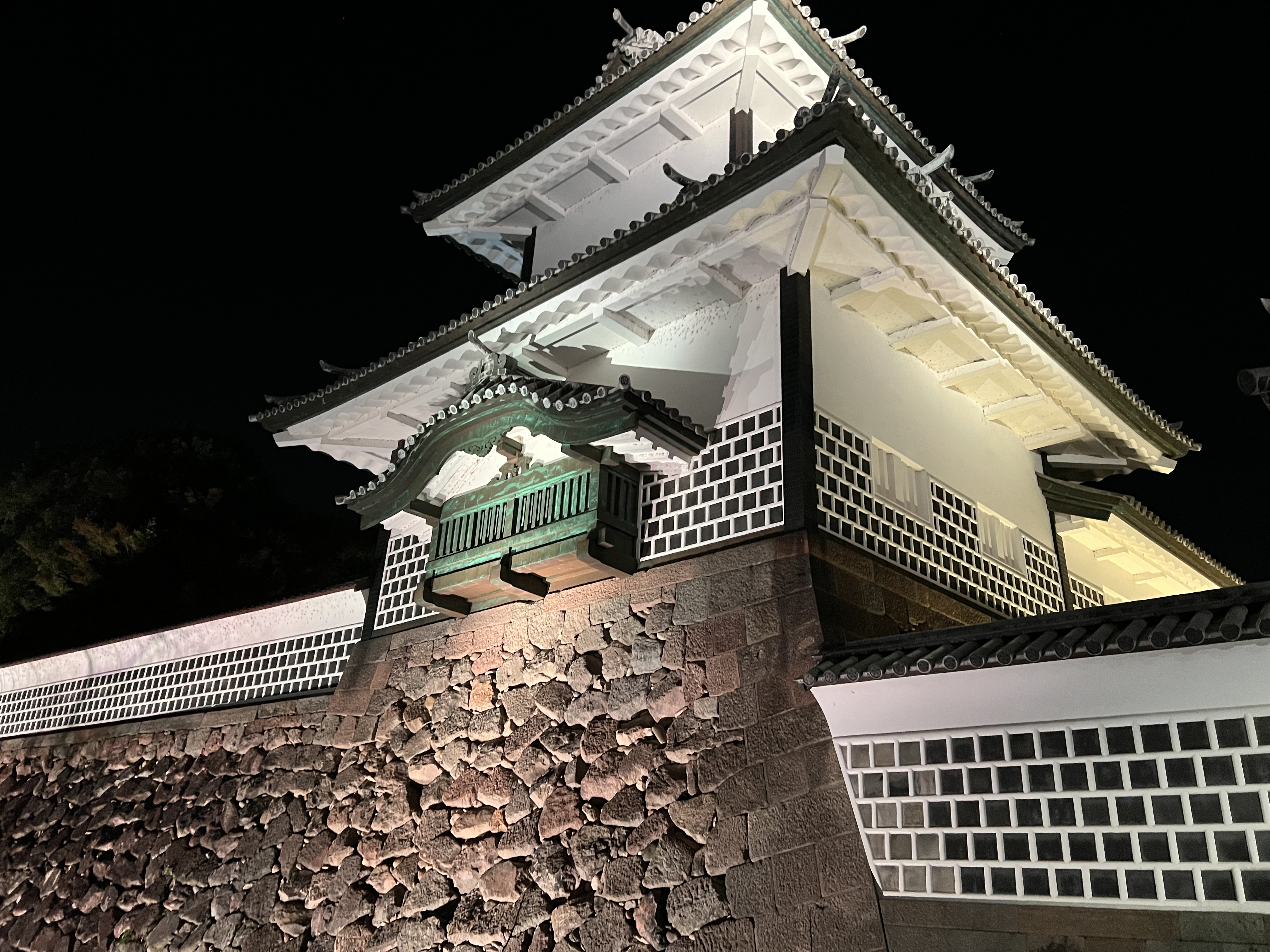
Kanazawa, Japan, Monday, Nov. 6, 2023 – It’s hard to even begin to describe the incredible spectacle that greeted us to Kanazawa, a culture-rich city on the Sea of Japan, home to beautifully preserved wooden houses, atmospheric geisha quarters, and mysterious temples used as a wily samurai lord’s secret defense weapons. We expected to experience the history of a city built by the Maeda samurai clan back in the late 16th and early 17th centuries. But we did not expect to find the castle grounds, and its surviving stone defensive walls, turned into a rich and moving digital art display, in turns amusing, inspiring, creepy, and beautiful, sometimes all at once. TeamLab, whose installation we saw in Tokyo Sunday (apparently everyone from BTS, to the Kardashians, Justin Bieber and U2 have also visited), is a somewhat mysterious collective of artists who produce digital art installations around the world. But this temporary exhibit in Kanazawa was much more powerful than the tourist-filled Instagram crowd in Tokyo. Crowds of hundreds of young Kanazawans climbed up the steep paths to the castle, which overlooks the city, to see spaces transformed by the magic of sound and light.

The first installation was of a famous Zen calligraphy practice known as Enso, where a Buddhist practitioner paints a circular shape using an ink brush as a form of meditation. The spontaneous act of painting embodies complicated religious concepts of impermanence and imperfection and being and nothingness, enlightenment and eternity, but this particular ink drawing was the projection of a ink painting on the massive stone walls – the image changed, and morphed, turning into fantastical shapes, before disappearing – and then it would start again.

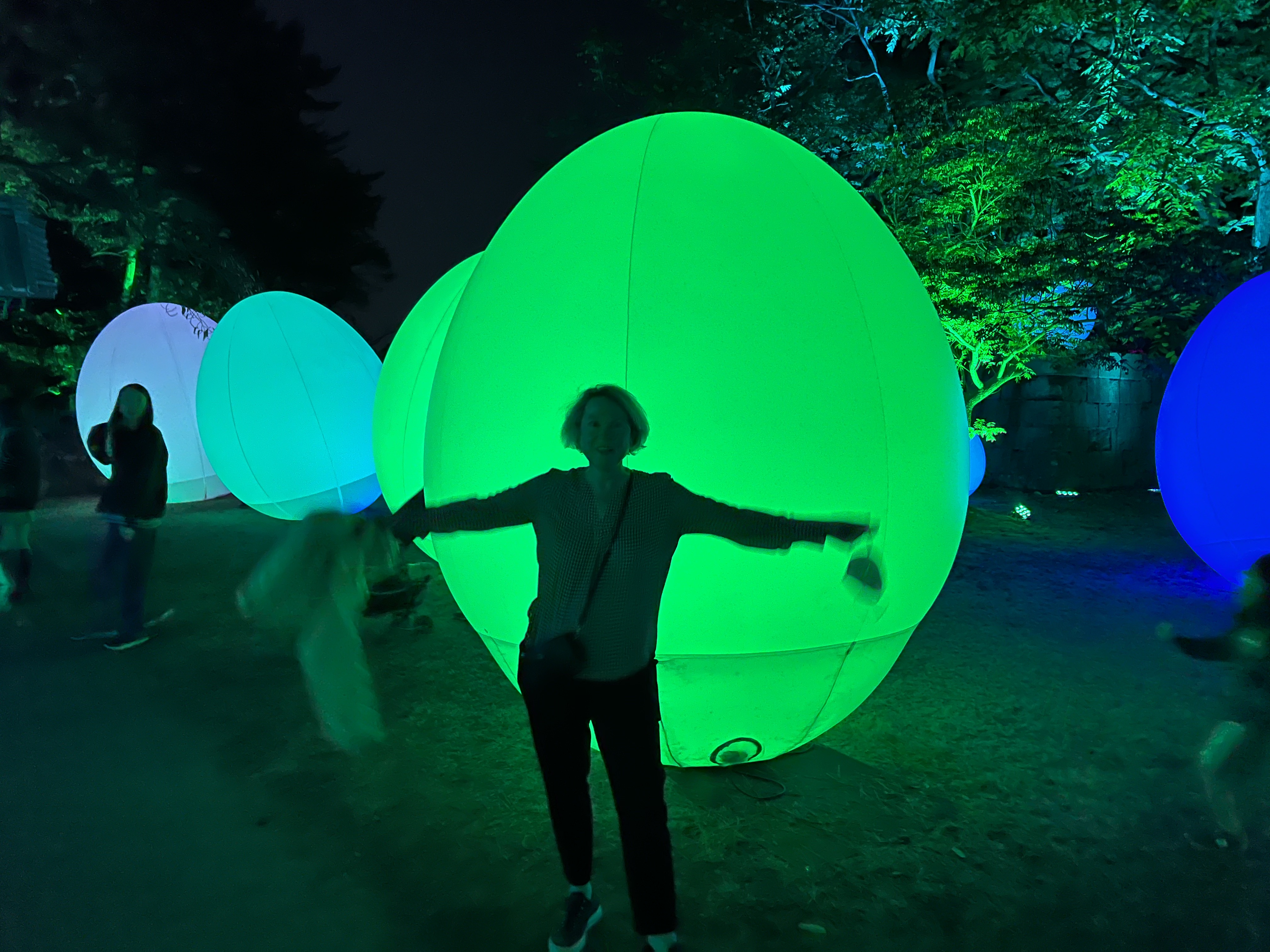
It’s hard to even describe what it was like to walk (sometimes stumble on the uneven surfaces in the dark) through the castle grounds, watching a row of trees lit up and humming with sound and color that changed as people walked by. There were strange ovoid shapes in a grove that would change colors and shape when you touched them. One stone corridor was filled with lines of marching creatures – frogs, and rabbits and humans wearing masks – in a very disturbing and vaguely martial procession. The images never repeat exactly, yet they repeat and repeat and repeat. Especially since they are projected on a castle’s walls, with its own violent history, they felt like a depressing reminder of how we humans can’t seem to break free of the cycle of violence.

But the piece de resistance was at the end, when massive images of creatures, from tigers to birds and various animals of indeterminate species – all made of flowers – cavorted on the stone walls of the castle. There was so much to love – the Enso was moving. The egg shapes in the forest were just delightful – everyone was breaking out laughing, and children were running wild, and the adults were also acting a little childlike. Japanese, American or European – the surprised and delighted laughter sounded exactly the same. The rabbit procession simply disturbed me, while the flower-tigers were gorgeous, if still a bit threatening. Though this is just a temporary display, I hope they make it permanent – ha, listen to me! Impermanence is the point… In any case, we loved it, and we love Kanazawa.

That was yesterday. Today we visited the famous Kenroku-en and the Myoryuji, or “Ninja Temple.” But those are stories for another day. Now, we have a omakase sushi dinner to get to….

Tadaima Tokyo!

Saturday, Nov. 4, 2023 – After 11 years and at least three canceled trips, we finally made it back to Japan yesterday. It felt like a real triumph just to step off the airplane at Haneda. Six and a half years ago, we had already checked into our flight to Tokyo when a doctor told me not to get on the plane because I had blood cancer. I never thought I would make it back to Japan, or anywhere, ever again. Then a stem-cell-transplant a few harrowing years later, we planned a second trip in March 2020 with Mitchell, Alex and Will – that was obviously abruptly canceled by the pandemic. We tried again in 2021, but Japan still hadn’t opened back up to the world. I was increasingly anxious in the days leading up to this trip, certain that something horrible was going to happen. At the Seattle airport, we were told there was problem with our flight – a volcano in Russia blowing its top and sending a huge plume of ash into the sky, cancelling all flights into Seoul and Shanghai. I thought once again we would be foiled, but our flight made it, via a 2-hour detour south, stretching our trip into more than 12 hours. We were so grateful to make it. “Tadaima” is what you call out when you return home – and your family calls back “Okaeri-nasai!” or welcome back. I feel so lucky to be here.

I will try to keep this short, since we are exhausted. Rick reminded me today how I pushed our friends Helen and Mike so hard on our first day in Tokyo 11 years ago that Helen actually cried because her feet hurt so bad. I still feel terrible about that, but Rick said I almost pushed him as far today! Not really, but it was a long day that started about 1:30 a.m. when Rick popped awake and never was able to go back to sleep. I think I woke up about 2:30 and called it a morning, fixed coffee and did laundry (no lines at that hour, conveniently the coin laundry was across the hall.) We are staying at a great hotel in Toyosu called the Matsui Garden Hotel Toyosu. Great design, absolutely phenomenal views from our 34rd floor room. It is small but perfect, and located very close to the new Toyosu wholesale seafood and produce market that replaced the old fish market at Tsukiji (more on that later). The hotel is also a short walk to the TeamLab Planets immersive digital art experience. (Elon Musk visited recently and loved it – it was also just named the leading attraction in Asia – yes, all of Asia.) We had no trouble making it to the tuna action at Toyosu Market at 5:30 a.m. We had won the lottery (only about 25 people a day win the lottery to get close to the daily tuna auction, where fish from all over the world are auctioned to the highest bidder and fish can go for over a hundred thousand dollars – per fish.)

From there, we got in line at the digital art experience a half hour before it opened at 9 a.m. Though there were probably three dozen people in front of us in line, somehow we managed to get our shoes and socks stored in the lockers before everyone else and were the first people in. It gets very crowded so we felt lucky. We first navigated a hellish room with an uneven surface of collapsing marshmallow fun-house pillows – I fell at least three times – and from there it got better. There was an insanely beautiful “infinity” piece, where thousands of LED lights created gorgeous and dizzying light shows all around us. The mirrored floors and ceilings heightened the effect. It felt like Kusama Yayoi’s infinity pieces made infinite. Rick’s favorite was a room filled with water that reached up to our knees and was filled with digital fish swimming all around our legs. It was beautiful and so colorful. The images reacted to our movements, which was a little freaky. Perhaps the most gorgeous, but dangerous was the room where you were literally inundated with digital images of flowers. It was crazy – beautiful at first but then both Rick and I had severe vertigo – the whole room was spinning- and we fled.

From there, we headed north, and stopped off in Tsukiji to buy a knife for Rick. I said, oh it’s close to the station, let’s just pop in to the Aritusgu knife shop. Well, we and about 100,000 other people were just “popping by” for lunch. The tiny streets around Tsukiji were crammed with holiday-goers, lining up in what looked like insanely long lines for sushi and ice cream and ramen and grilled anything. It was actually hard to even move at times it was so crowded. That experience drained us a bit, but not deterred we headed for Kappa-bashi, a street in the old part of Tokyo near Asakusa that caters to restaurants and chefs looking for everything needed to run a kitchen or a restaurant – knives, dishes, aprons, plastic fake food for display in the window, the signs and the curtains hanging over the entranceways to restaurants. It was so fun, but very hot and humid (in November!) and we wilted a bit. We bought some “Daigaku imo,” or university potato, a sticky-sweet roasted potato from what looked like an ancient shop, but could find no place to sit and eat them. You cannot eat on the street in Japan, which is hard when you want to eat street food! Rick was a gamer and we then took a subway to a neighborhood called “Kuramae,” described as the “Brooklyn of Tokyo.” It was filled with super hip coffee shops – on every block, filled with mostly fashionable young women – and expensive purse shops. It was a lovely, quiet neighborhood, the kind of place where a man noticed we were having trouble finding a subway station and walked us about 10 minutes to the correct entrance. Lovely.

Near Kappa-Bashi – view of SkyTree

We finished our day eating one of the “5 heritage rice dishes” of Japan – kamameshi – or the old fisherman’s dinner of clams over rice in the Kiyosumi-Shirakawa neighborhood on the east side of the Sumida River. We found a wonderful old hole-in-the-wall, famous for its kamameshi and just down the street from one of our favorite museums ever – the Fukagawa-Edo Museum. We brought Will here when he was little, and Mike and Helen a few years later. This was the first neighborhood where we saw Japanese women out walking in kimono – not the tourists in the rented “kimono” which were all over Asakusa, but just regular people out visiting the museum and temples in their neighborhood. (When I was here in the 1980s, kimono seemed much more common.) Here it seemed just normal. No one was taking selfies.

We are now back in the room – with our stunning view of skyscrapers stretching south along the Sumida River to the Toyosu Market and the bay beyond. Tomorrow – we head to Kanazawa. Hold onto your hats and stay tuned!

In Search of Vincent (Van Gogh)

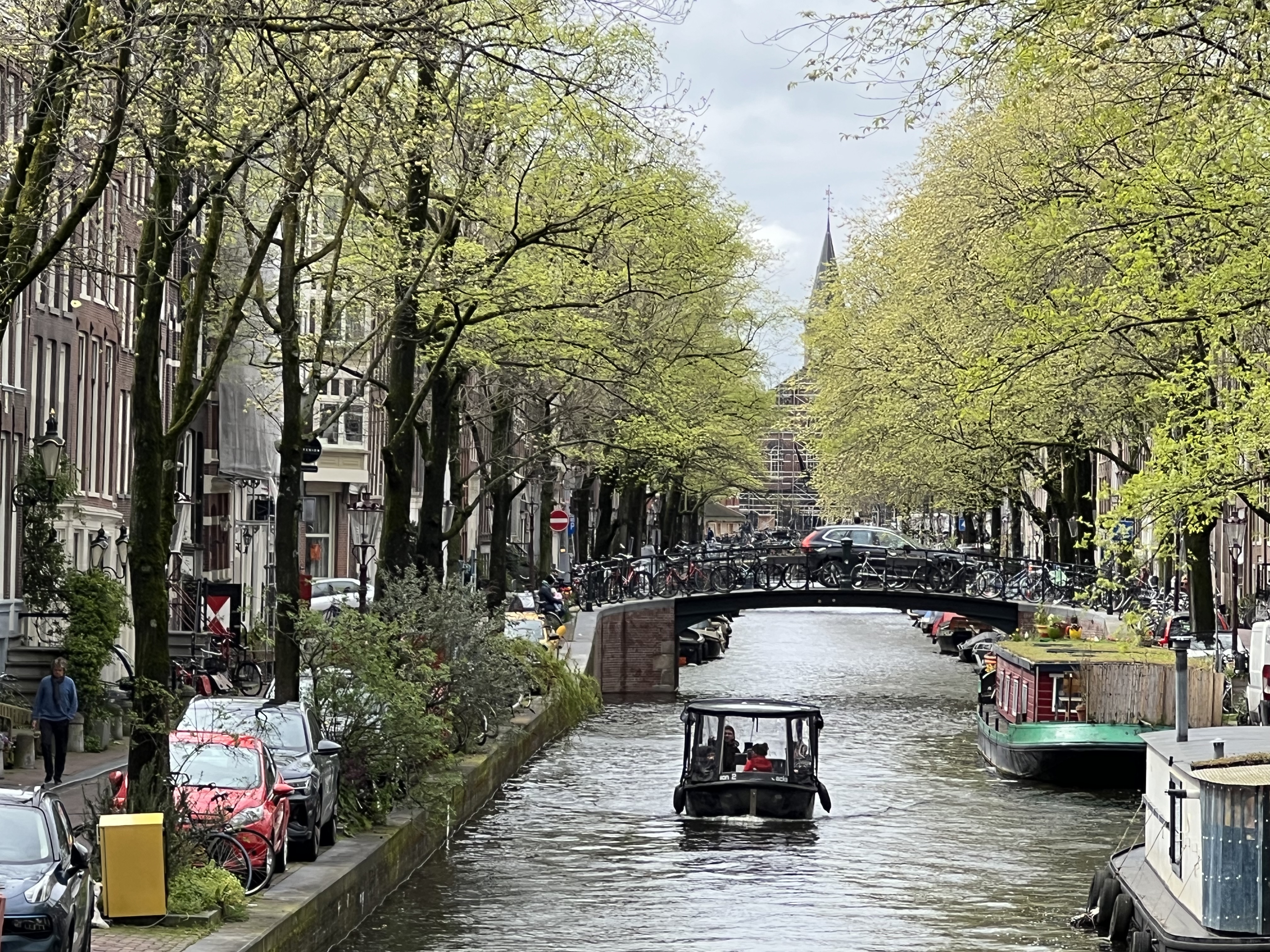
Tuesday, April 25 and Wednesday, April 26, 2023 – Amsterdam – We started our morning with an early tram ride to the museum quarter – a little too early it turns out since it was cold and a bit rainy and we had 45 minutes until the Van Gogh Museum opened. But it was also fortunate, since we decided to wander around the neighborhood and discovered the pleasant area along the canals near Spiegelgracht – where beautiful brick homes with polished black doors and gleaming red shutters line the canals. There was none of the seediness, or crowds, that we had experienced our first day, and the streets were cleaner, but still surprisingly not that clean. I know that coming from Portland, where the downtown is basically a garbage pit, I donโ€™t have any grounds to criticize anyone. But still, itโ€™s a bit of a mine-field here – you have to watch your feet to avoid stepping in something while at the same time keeping your eye scanning for the ubiquitous bikes. Especially deadly are the harried moms who hurtle down the street at full speed, a bobsled full of small children attached to the front, car seats and helmets be damned.

Ok, back to Van Gogh. We arrived back at the museum with our timed-entry tickets just in time – to get in a massive line. Since the museum was sold out for the day, these were all ticket holders like ourselves, eager to get in to see the largest collection of the Dutch artist’s work in the world. It is an unlikely collection, mainly from the many paintings Vincent sent his brother Theo, who believed in and supported his older brother’s artistic endeavor. Theo kept his brother’s paintings, since no one was buying, and when he died months after Vincent, Theo’s widow, Jo Gogh-Bonger, dedicated her life to preserving and promoting Vincent’s legacy.

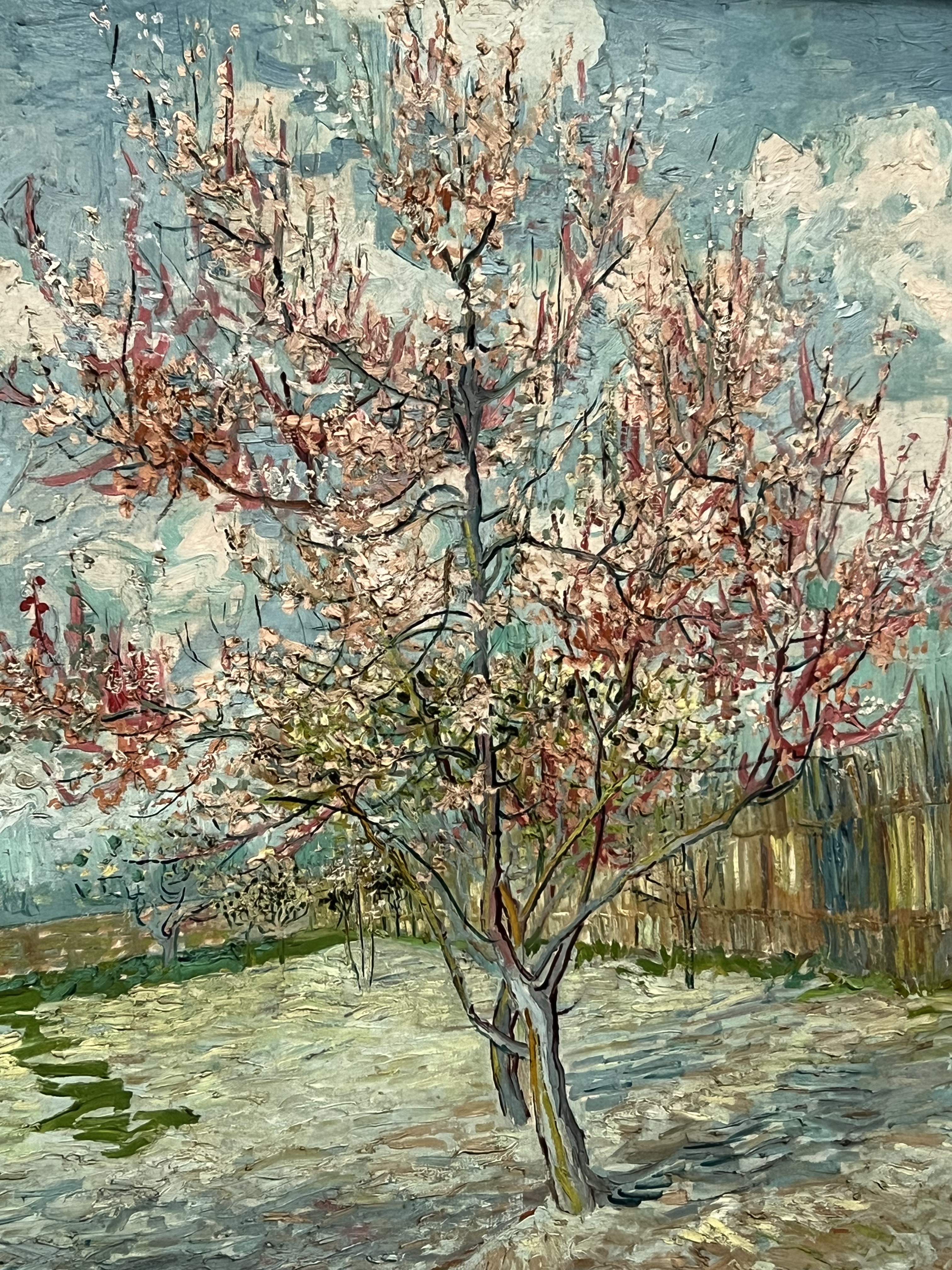
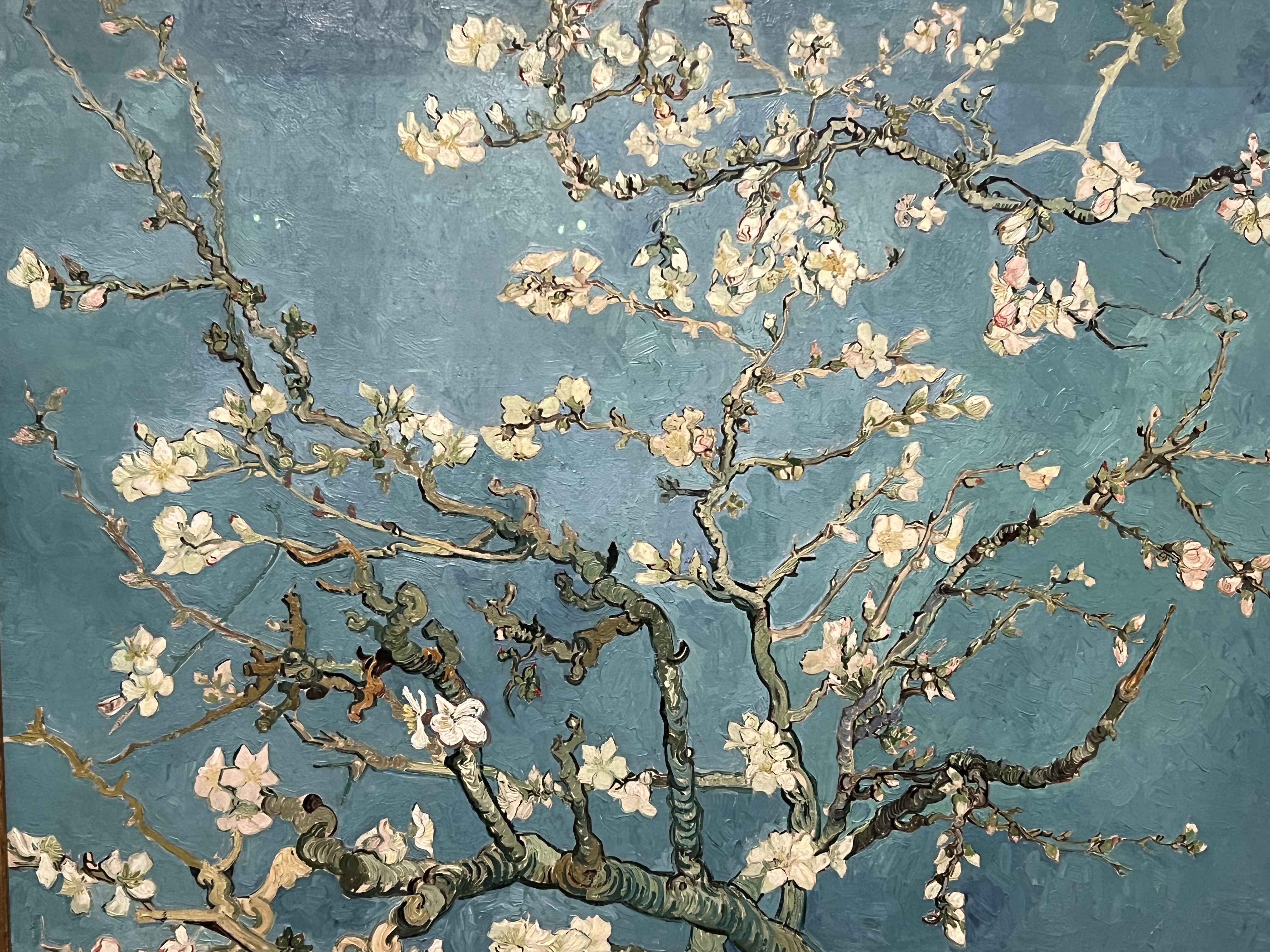
Van Gogh may have been hated in his own time – dismissed by other artists, feared by small children, a misfit who couldn’t keep a job and quarreled with his parents incessantly – but he certainly is adored today. As the crowds poured in to the lobby, scrambling for audio-tour guides and the coat check, I had a moment of true inspiration. I looked at the map and saw there were four floors to the museum. It is chronological treatment of Van Gogh’s life, starting with his dark, clumsy early works and his self-portraits on the lower floors, and slowly rising, floor by floor to his masterpieces from the end of his life displayed at the very top. I looked at the crowds, and at Rick, and said, follow me – we are headed for the fourth floor! We raced up the stairs and found the galleries populated only with a few chatting guards getting ready for the hordes to ascend. We had a glorious 30 minutes practically alone with some of Van Gogh’s most beautiful and iconic paintings — seascapes, fields in Provence, a peach blossom in a glass of water, his glorious almond blossoms on a blue background (made for his newborn nephew who would one day help inaugurate this museum), a man sowing grain against a halo-like golden sun and green sky, the twisted and almost surrealist tree roots he painted just before his suicide at age 37. We wandered through the galleries and were able to spend some time alone with each painting, before descending into the lower floors, sort of like Dante descending into various rings of hell. The next level down wasn’t too crowded, but by the first level, the crowds were unbearable – it was impossible to see or even get close to the paintings, especially the many self-portraits. It was a Mona Lisa moment. As in, nothing about art at all, but mostly about the selfies.

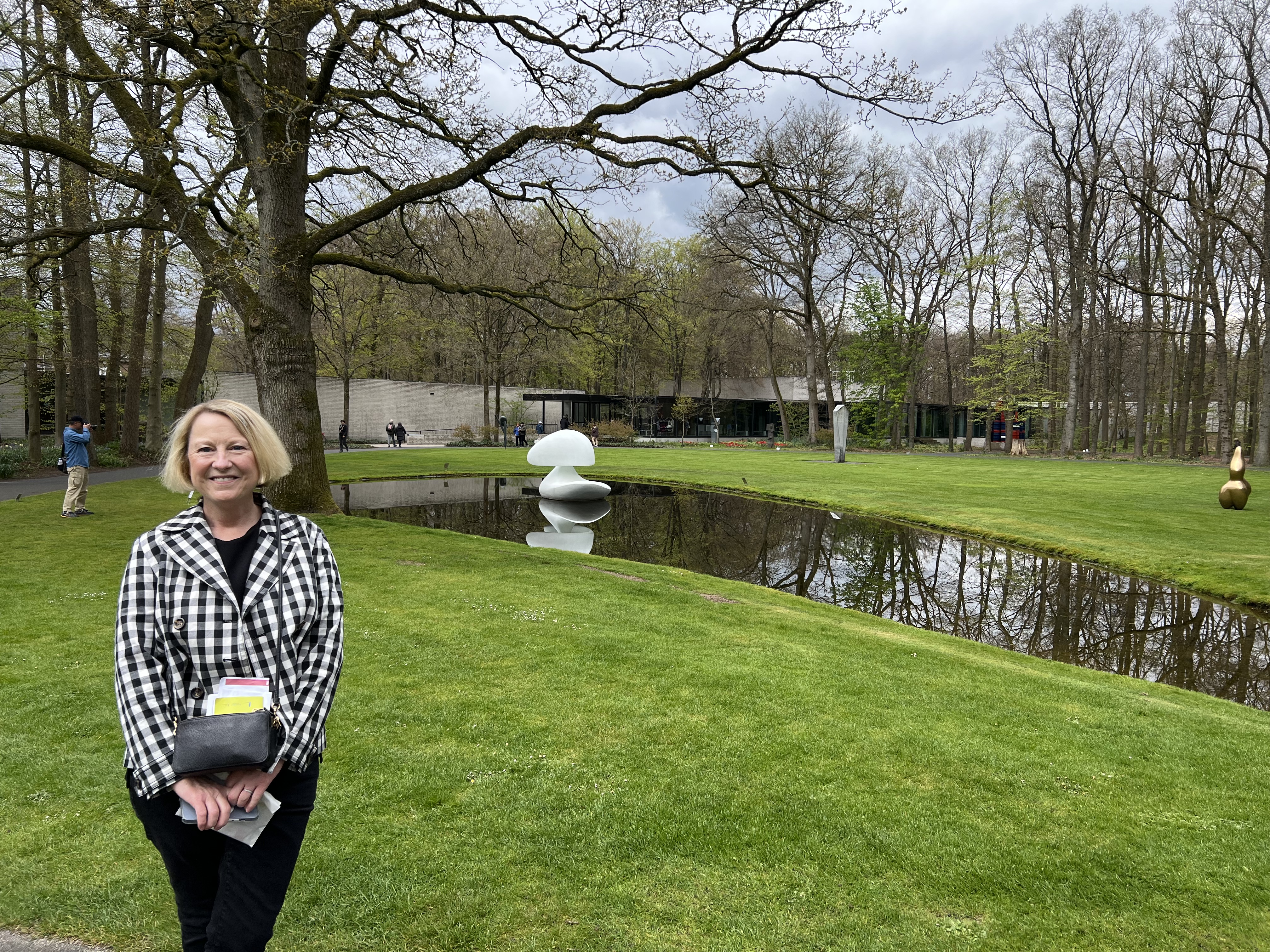
The sculpture garden at the Kroller-Muller Museum

We were fortunate to follow up our museum visit yesterday with a road trip today one hour east of Amsterdam to see the Kroller-Muller Museum, which has the world second-largest collection of Van Gogh paintings, as well as an extensive modern sculpture garden set in a huge park. We had hoped (and had read) that because the museum was so far off the beaten path, that it would be quiet. But we found out, as we arrived a half hour after the museum opened, that we had been beaten to the punch by no less than five tour buses and several smaller minivans, including a large tour group of Chinese speakers, a few Japanese families and lots of Italians and French. Van Gogh is a global phenomenon. Fortunately, his work is phenomenal, and we had some lovely time in the galleries dedicated to him. Helene Muller, an early 20th century heiress, had purchased a number of Van Gogh paintings, as well as other modernist art, and this museum in the countryside was built to house it all. We loved the collection – a peach tree in bloom dedicated to his recently deceased uncle, a drawbridge in sharp, limpid colors, iconic portraits of his friend the postman and his wife, haunting cypresses, enigmatic haystacks, a reaper under a yellow sky and sun, lost in the golden yellow wheat field. Each painting seemed to express Van Gogh’s emotions – you could almost feel his passion in the fast brushwork, the thick paint, the movement that seemed to make objects like the trees vibrate. I can look at paintings endlessly online, or in classes, but standing in front of them and seeing the surface and the intensity of color, is like nothing else. You have such a sense of their physicality, that this strange and brilliant and very tormented young man had created them. It was very moving.

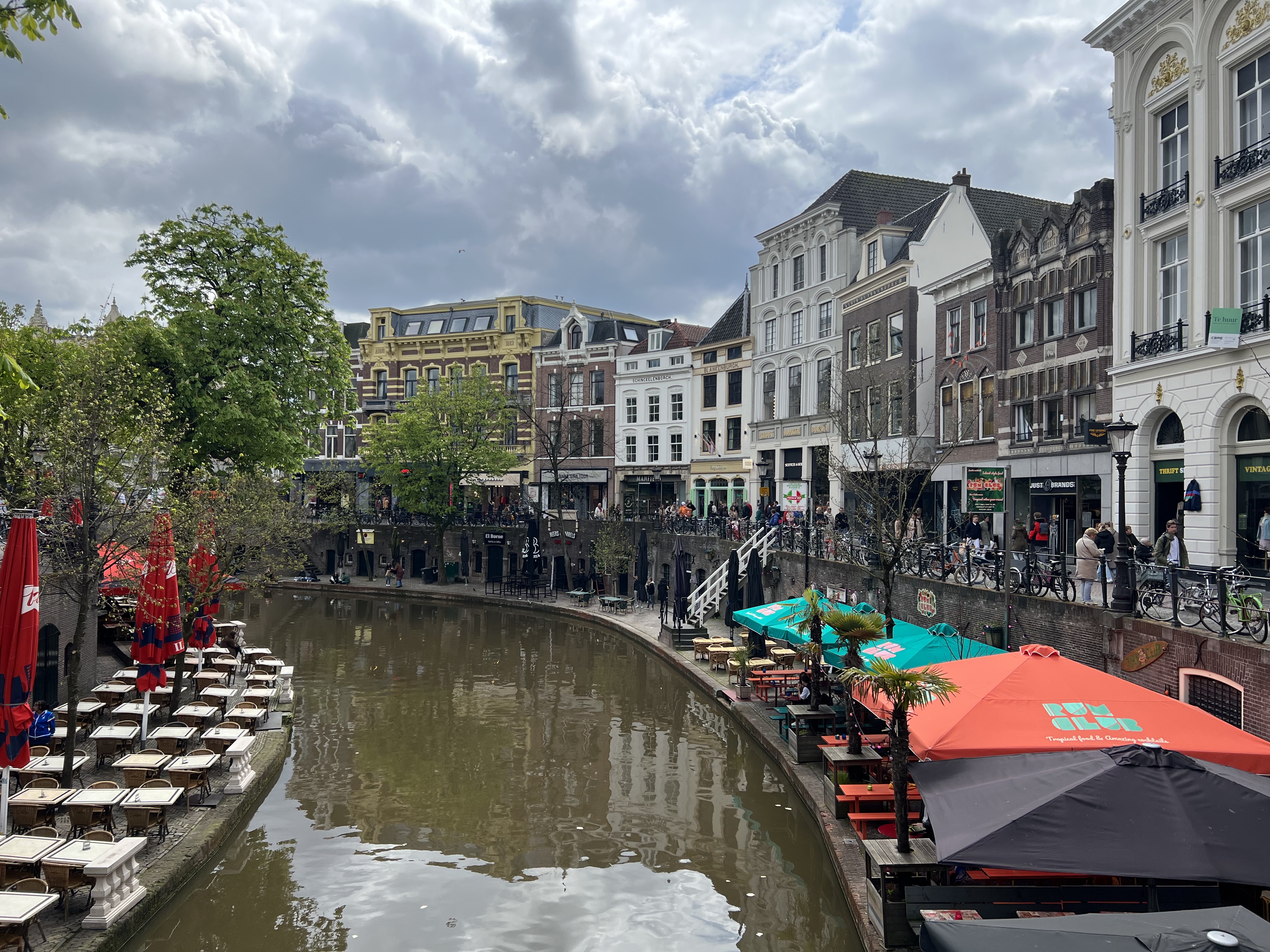
The canal in Utrecht, before the party

We decided to skip the planned bike ride in the park, since it was cold and rather bleak out. So we drove to Utrecht, a university town (and the fourth largest city in the Netherlands) that dates back to the ancient Romans. We wandered the beautiful canals, admired the houses dating back to 1300 and watched the 21st century inhabitants set up their stalls for the biggest party of the year – King’s Day, tomorrow, April 27, the birthday of King Willem-Alexander and apparently a day when the whole country goes berserk, wears orange (for the Princes of Orange), and loses its collective mind. In Utrecht they apparently start a day early, explained one young mother laying out her old clothes for sale. But despite the main squares being filled with huge beer pavilions and tents and stages of unknown purpose, we were charmed by the medieval winding streets, the busy street side restaurants – all filled not with tourists (like ourselves) but with locals out enjoying their city. The average age seemed to be about 21, no doubt because of the university, so it felt vibrant and fun. We loved Utrecht and would have loved to spent more time there. Next time…

Amsterdam: In Search of Rembrandt

Monday, April 24, 2023 – AMSTERDAM, The Netherlands – We arrived in Amsterdam early this morning after our overnight flight, but only one of us managed to get any sleep. So we faced a looooong day of staying awake until we could check in to our hotel this afternoon. It wasn’t a problem for me, since I was the one who catnapped across Greenland and Iceland, but poor Rick was dragging, though rather cheerfully, I must admit. We dropped our bags at our hotel and set out for Rembrandt’s house, a grand house in his day, the place where he lived and painted for nearly two decades before debts and overspending drove him to much humbler quarters and a pauper’s grave somewhere in the floor of the Westerkerk. So we devoted our day, this first day of our art tour of Netherlandish and Flemish art, to Rembrandt.

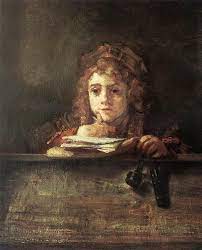
Rembrandt’s painting of his son, Titus, at his desk

Rembrandt was just 33 and a successful painter when he moved into the house in 1639. The red-shuttered building has been restored and furnished using a list of his personal property sold when he was forced out at the age of 52. It was very crowded when we arrived, so we didn’t linger in the small, crowded rooms and tight spiral staircases. For me, the two highlights were a small drawing of a canal and boats he had made as he himself wandered the streets of Amsterdam, and a gorgeous, pensive portrait of his son, Titus van Rijn, at a desk with writing paper and implements. The dark background, and the lovely touches of an earthy red (the color, it turns out of the ceiling of the Oude Kerk, the oldest church in the city dating back to the 12th century), brought life and poignancy to the portrait of his young son, who was to die before Rembrandt. His drawing of the boat, set alongside drawings made by Rembrandt’s contemporaries, was by far the most beautiful, a calmness expressed in a few swirls of ink in the sky.

We escaped the crowds at the Rembrandthuis only to find that the only place you could escape the crowds in Amsterdam is to actually go into a church. Both the 13th-century Oude Kerk, “old church,” in the red light district, and the Nieuwe Kerk, in the Dam, or central square of the city, charge admission – so many tourists take a pass! The “new church” dates from 1409, when it was, in fact, new, and it is beautiful inside. It no longer serves as a church, but as an art exhibition space, as well as serving royal functions such as the inauguration site for the king of the Netherlands, Willem-Alexander, back in 2013. Right now, the building is hosting the World Press Photo Exhibition 2023, honoring the best news photography in the world last year. We thought of our friend Elizabeth Dalziel, a photographer who has spent a lot of time in war zones. Much of the photography was painful – haunting images of the war in Ukraine, suffering in Myanmar, a 15-year-old from Afghanistan who had sold his kidney for $3,500 to the U.S. to help his family survive. But there were also photos of great hope, including of a young woman in Tehran, head uncovered, ankles peeking out between her jeans and her shoes, in a courageous act of defiance against the laws forcing women to cover themselves completely. There was also a wall remembering all the journalists killed since 1992 – a staggering number of names on a stark black slate rising high up against the gothic windows of the church. You can explore the winners at their website: https://www.worldpressphoto.org/collection/photo-contest/2023/Ahmad-Halabisaz/1

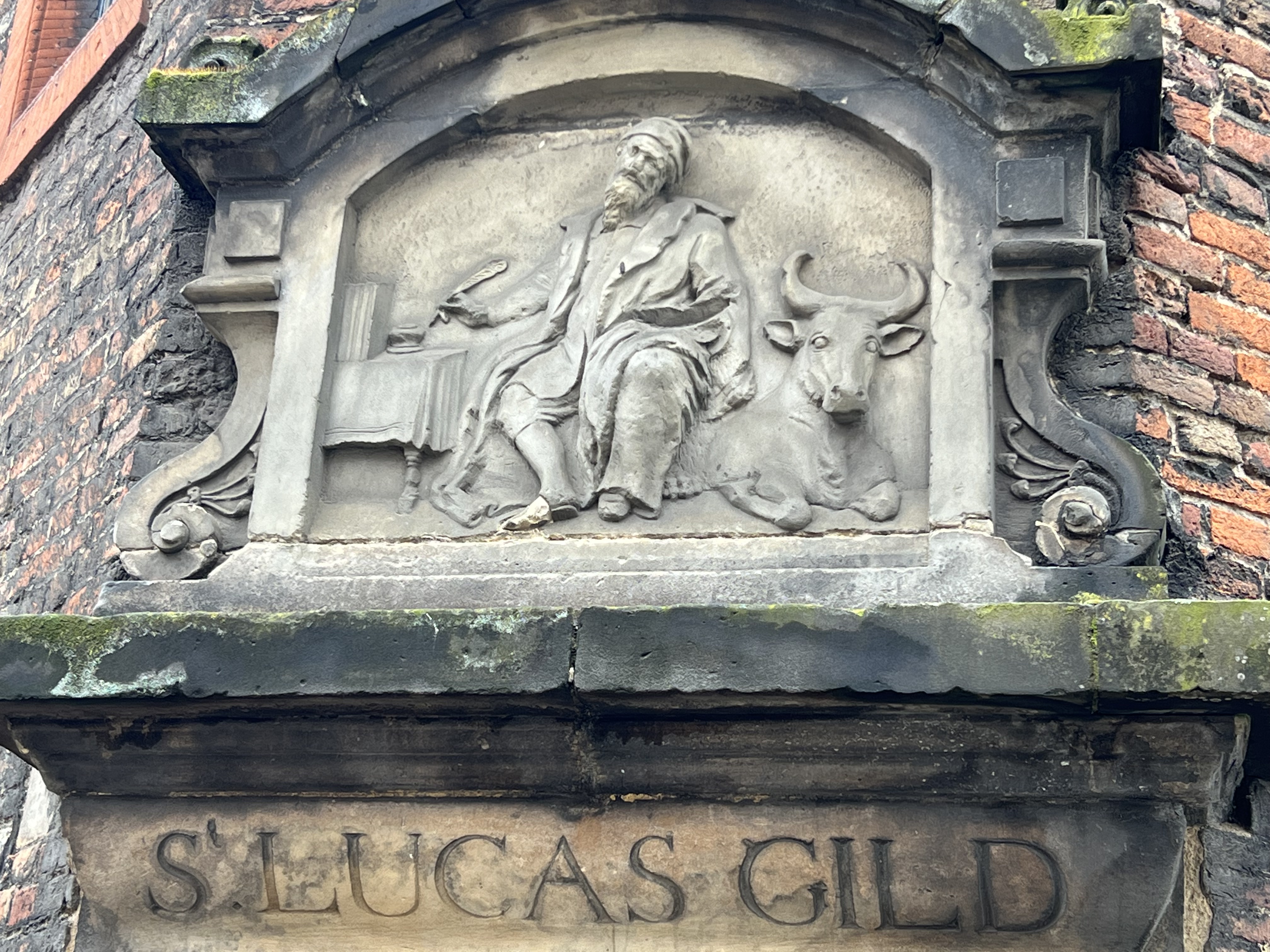
St. Luke, the patron saint of painters, over the entrance to the painter’s guild in the canal district.

After that, we needed some air. We wandered in the footsteps of Rembrandt, past the house in the canal district where he bought his paints, past the entrance to the painter’s guild where he belonged – the guild of St. Luke, the patron saint of painters, in the old gate house where Rembrandt painted his famous portrait of a doctor doing an autopsy on a criminal’s cadaver. Though it was a showery, cold day with a blustery wind, we managed to stay dry. The streets were crowded with tourists, speaking so many languages, and it was difficult to walk – you had to be on guard for the trucks, and the cars, and the bikes, and the garbage that seemed to be everywhere.

We finished our walk at Anne Frank’s house. We didn’t go in – tickets are sold out for days. I had gone years ago, and Rick decided he would honor her by reading her diary before our trip, rather than trying to see her last home and hiding place, which attracts thousands of visitors a year. He was moved, and depressed, by her diary – the senselessness of her murder, and that of millions of others in the Holocaust. The evil. The capacity of humans to harm one another, and the innocent. Like the photographs we saw earlier in the day. The only possible redemption was the power of this young woman’s words, like that of the power of the young Iranian woman’s courage, to stand as witness that the human spirit is strong, and very very beautiful.

We finally were able to check in, and Rick took a nap before dinner. We need to gather our strength for Vincent Van Gogh tomorrow – we have tickets for a 9 a.m. entry and then will (hopefully) spend the afternoon biking through the tulip fields outside the city!

Postscript: We had an absolutely lovely dinner at our hotel, in a window seat overlooking a canal. The cherry blossoms were in full bloom, and the wind turned the terrace outside into a pink snowstorm of blossoms. We are staying in a hotel out from the center, and we are glad to be away from the craziness of central Amsterdam. We loved being in an actual neighborhood, and we spent dinner watching the people walking their dogs along the canal, groups of women sculling on the canal, an occasional runner. We watched two men work for nearly two hours trying to get an old beat-up boat to start. They were still working when we finished dinner and went out to join the others walking the canal.

One other postscript: Portland Trail Blazers head coach Chauncy Billups was on our flight this morning. I speculated maybe he wanted to catch the Vermeer show too, but Rick said their general manager was at the Amsterdam airport when we arrived. Rick and Mitchell were abuzz with excitement that he might be trying to recruit some French superstar, or someone else unknown. Perhaps Coach Billups will also make time for Vermeer on his way home. I hope so.

Happy Lunar New Year!

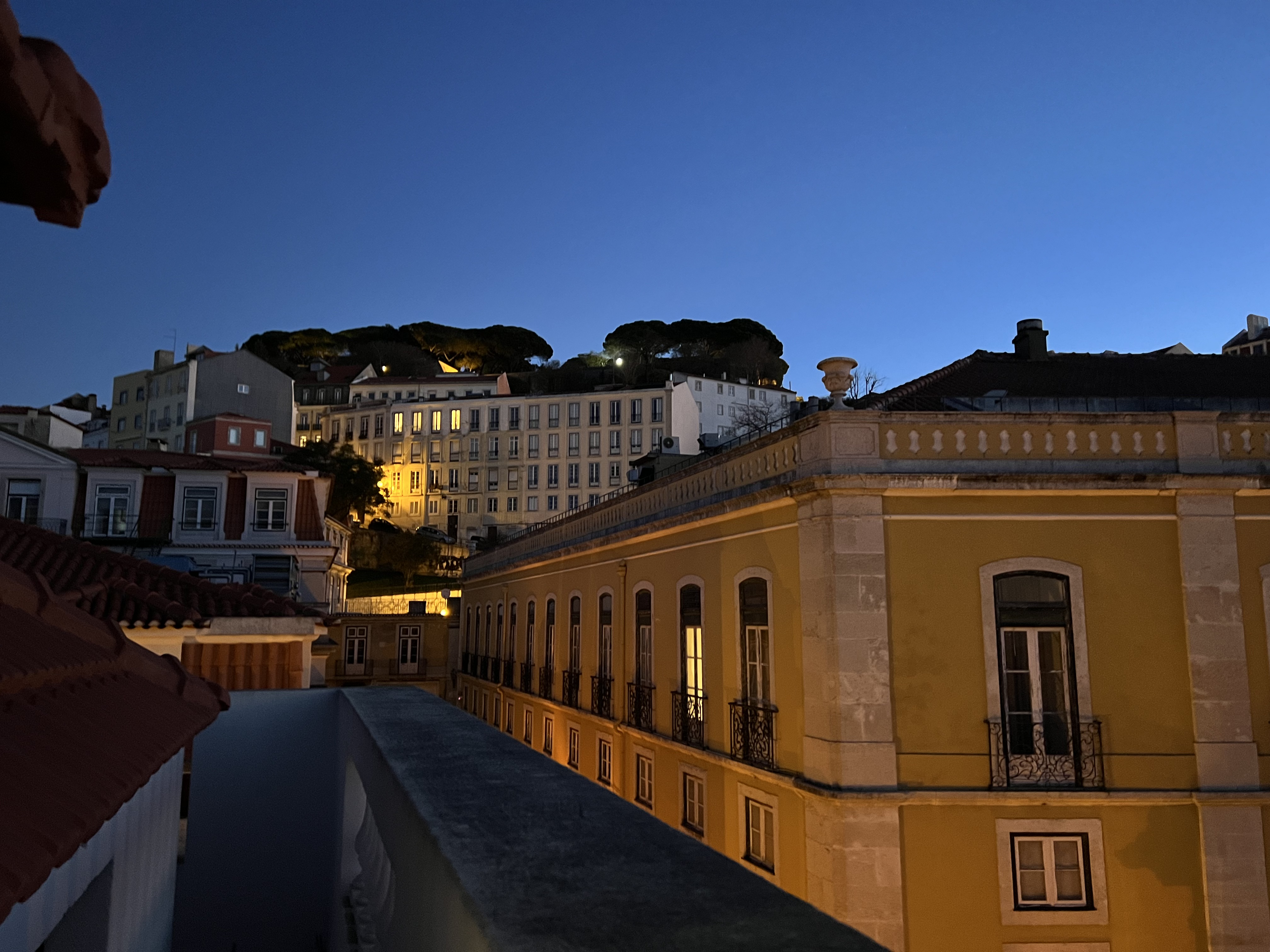
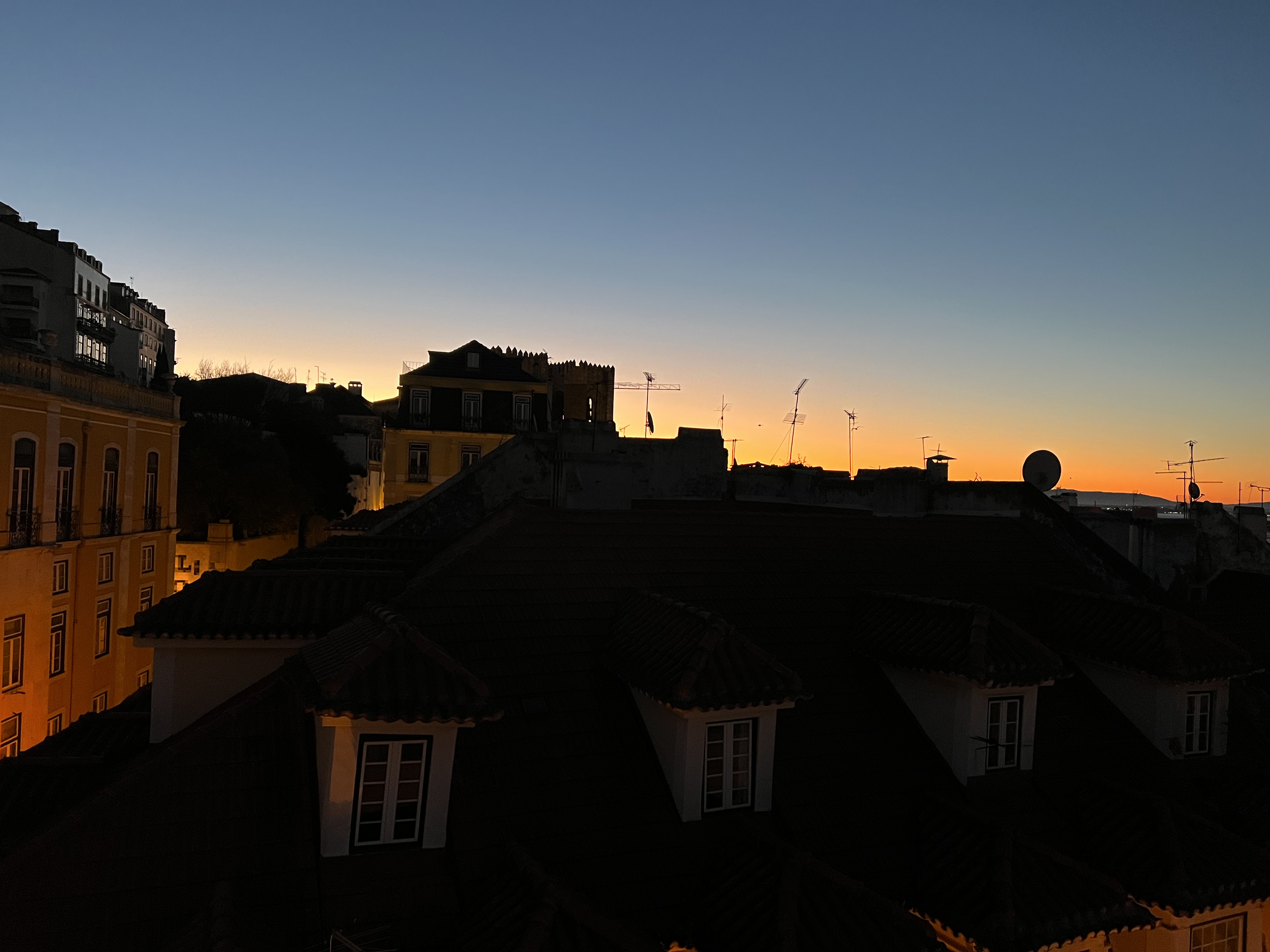
Monday, January 23, 2022, 6:30 a.m. Lisbon, Portugal – It’s still dark in Lisbon, the lights on the towers of the nearby cathedral, glimpsed from one of our windows, have been shut off. To the north, from another window, I can see an old apartment building rising against the Alfama hill that is topped by the castle of Sao Jorge. It has rows of tall windows, each with eight-panes, and just two are illuminated. In one, in an almost cinematic image, I can see the silhouette of a man – he just lit a cigarette – as he gets ready for the day, or perhaps is just getting home. It’s silent in the apartment, except for the coffee brewing.

We had another wonderful day yesterday. Though we hadn’t planned it intentionally, we spent the Lunar New Year exploring Portugal’s ventures to the East during the 15th, 16th and 17th centuries, as Vasco da Gama and other explorers and conquerers found their way around the Horn of Africa to India, Southeast Asia, China and Japan. Rick and I had recently read a book by Roger Crowley, “The Conquerers,” so our thoughts about the monuments we saw yesterday glorifying the nautical achievements of these intrepid Portuguese were tempered by the knowledge that they were also brutal men who used force and cruelty to establish a maritime empire, an empire which they ruthlessly exploited for spices, treasure and slaves.

But I’m getting ahead of myself. We started the day heading west to the Museu Nacional de Arte Antiga, which held a collection of art and artifacts from the so-called Age of Discovery. Included were some fascinating Japanese paintings, known as Namban screens, since they depict the “namban” – as the Japanese called the “Southern Barbarian” Portuguese people who landed on their shores in big black ships. These Kano School screens were familiar from our time in Japan – I remember in particular the gorgeous gold screens in the Nijo Castle in Kyoto. But these screens didn’t just depict beautiful, twisted pine trees – they showed, in closely observed detail, the Portuguese in their puffy pantaloons and funny hats. A caption next to one read: “When we were exotic,” turning the tables on the Portuguese conception of themselves. The faces of the Portuguese were especially interesting – they were uniformly ugly, with comic long noses and strange pointed jaws. To me, they resembled masks, especially the red Tengu masks of Japan, which depict, appropriately, a mythical creature that is both evil and benevolent. Perhaps that is an apt image for the Portuguese explorers themselves – they brought trade, and a new religion – Christianity – but threatened much more. No wonder the Tokugawa Shogunate shut its doors and withdrew from the world.

Among the other fascinating treasures we saw was a spectacularly ornate silver dinner set – I had just breezed by the opulent pieces but Rick noticed that the set had been built by King Jose I after the earthquake of 1755 had leveled his city and he and his court were living in tents in Belem outside the destruction of the city(where we were headed yesterday afternoon.) This is the same man depicted on the horse in Commerce Square pictured earlier (he apparently never wore armor and was apparently a coward) – so as his people were suffering through the worst natural disaster in recent European history, King Jose was busy designing tea sets. Fascinating. (Our “insight” into the king comes from another excellent book, “The Last Day,” by Nicholas Shrady.)

We then walked along the Teju river to the Museum of the Oriente – which had free admission to celebrate Lunar New Year! This was a beautiful collection of art from throughout Asia, including another Namban screen, but also gorgeous ceramics and statuary. Some of the art was influenced by the Portuguese presence, but some was not. There were two 13th century wooden statues from China depiecting Boddhisatvas sitting astride lions that I found particularly captivating – beautiful, peaceful, colorful, calm – the position of their bodies a wonderful study in a kind of seated contrapposto.

Now the dawn is breaking pink and blue behind the cathedral and the river. But back to yesterday, if any of you are still reading and haven’t dropped off to sleep. We ended the afternoon in Belem, located near the mouth of the river where it meets the Atlantic Ocean. Portugal is “where the land ends and the sea begins,” famously wrote Luis de Camoes, the 16th century poet who is revered by the Portuguese, and whose tomb we saw enshrined in the elaborate Gothic monastery in Belem. The Portuguese explorers and traders embarked from here, and King Manuel I built the monastery and a gothic tower fortress here in the early 16th century to celebrate the wealth and discoveries the Portuguese were making in the East. But yesterday, for most people, it appeared Belem was the best place to escape the city on a gloriously sunny and warm winter day. The sidewalks were crowded with bikers, joggers, and strollers – both the baby and the walking kind – as Lisboans spent the afternoon enjoying the rays, the beer and wine, the view of sailboats on the river. We passed a sailing school with a bunch of kids trying out their boats, and heard what seemed to be a class out on the water – I thought of my niece Anna, who would love sailing here.

We managed to dodge the crowds and saw the beautiful monastery and rather austere church, where both Camoes and Vasco da Gama are elaborately entombed. We ended our day back at the Time Out Market for a quick dinner of fried cod balls and fish and chips, before heading back to the apartment to rest and do laundry. Today, we will catch a train to Sintra, a nearby royal retreat for hundreds of years. I just heard someone leave our breakfast – fresh rolls and orange juice – on our door handle, so it’s time for breakfast. Maybe if I start eating, Rick will wake up. This place is like an AirBnB but much, much better. We will definitely stay here next time we are in Lisbon – and there has to be a next time, because Will would love this place. So would Mitchell and Alex – the twins might need a few more years – I logged 22,000 steps and 55 flights of stairs on Saturday. That would be a rough day in a stroller. ๐Ÿ™‚

Seoul Searching, and Finding

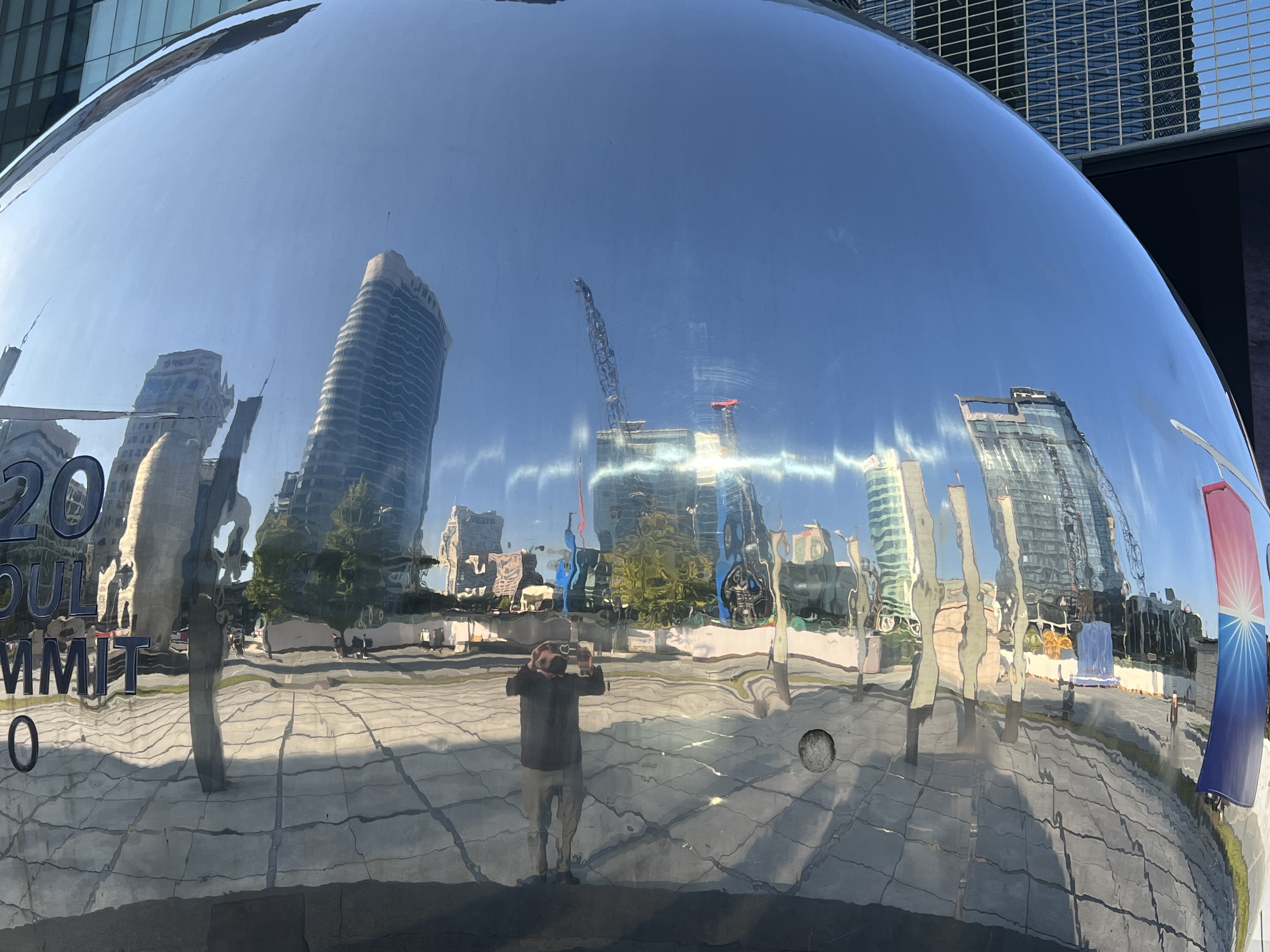
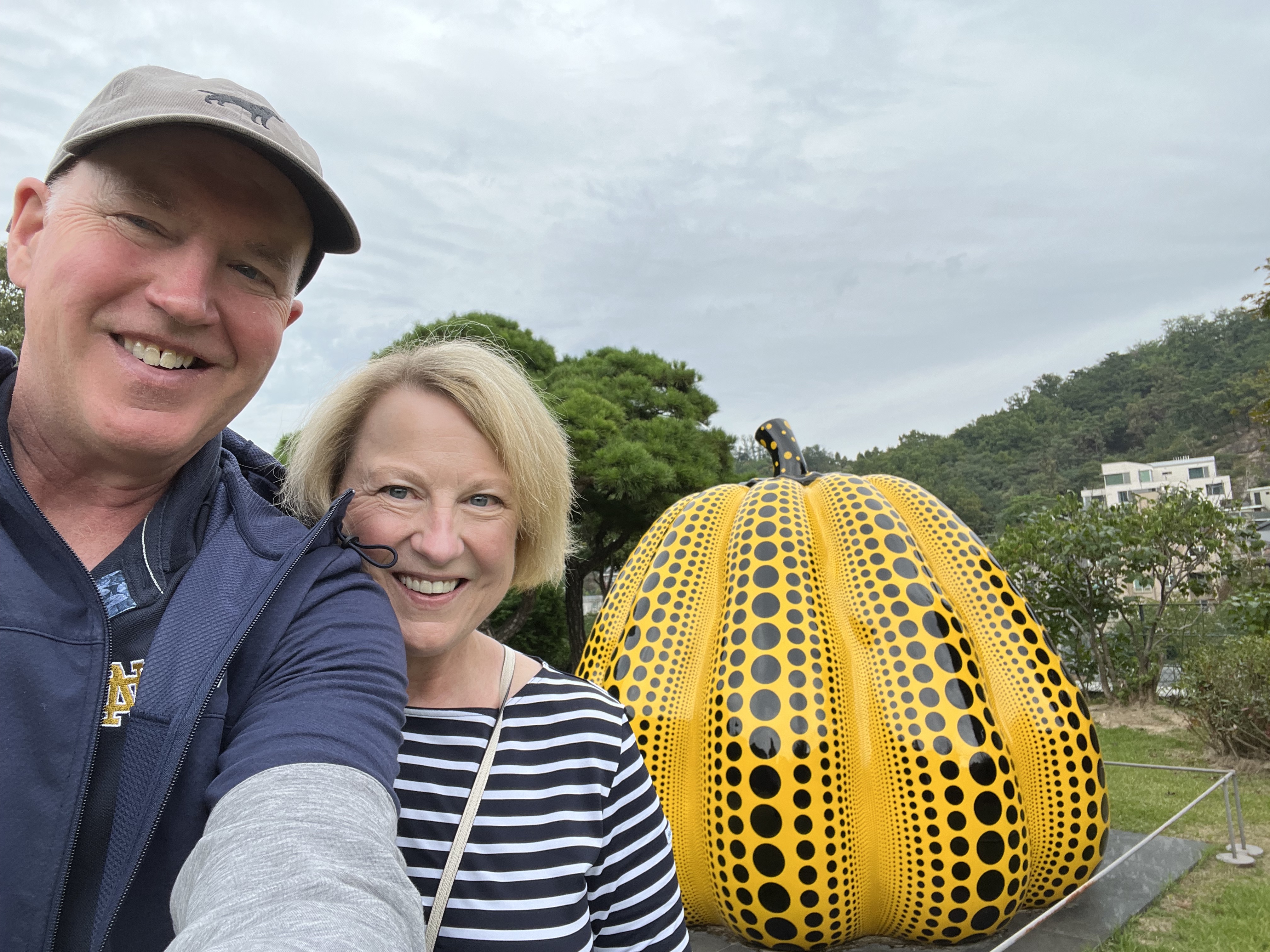
Wednesday, Oct. 12, 2022 – Seoul – ์•ˆ๋…•ํžˆ ๊ณ„์„ธ์š”!!! Anyeongigeseyo!!! On Wednesday, we said goodbye to Korea. (We are home – it is Saturday in Portland). But on Wednesday – I mean ์ˆ˜์š”์ผ – we were so busy that I didnโ€™t have the brain wave length to write. It is hard to recap all my feelings about the trip. It already feels unreal. 

Our last night in Korea was our most special, which we spent with our friend Sunghee (you will know her from her husbandโ€™s frequent comments on this blog – Sungmin basically guided our trip from afar, worried about us throughout, and is looking forward to getting back to work now that we are safely home). Sunghee, who had arrived in Seoul from their home in California on Saturday to spend the autumn visiting family, took us out for a fabulous Korean meal in Gangnam. She drove two hours through terrible Seoul traffic on a trip that should have taken a half hour at the most. These were her old haunts, but she said she had forgotten how bad traffic can be, since the pandemic had cleared the streets of Seoul, as it had many other parts of the world. But Sunghee arrived in good spirits and shepherded us into a private room at a restaurant near our hotel – it was so thoughtful of her to choose someplace where I could eat without stressing out over getting sick in a crowded restaurant. 

 I hadnโ€™t seen Sunghee for years, so it was wonderful to catch up. We used to see the Parks nearly every month at one fencing tournament or another. Our sons have fenced together since they were about 11 years old, and they were always a joy to see out on the road. Rick had been in Europe a few times when Sunghee was accompanying Donghwan, and I think they had shared some bad hotel food together. This night, though, the food was amazing, though I cannot tell you the names of the dishes. Sunghee had pre-ordered a banquet basically. She made little Korean crepes filled with vegetables; there was a large pot of meltingly tender beef and mushrooms, cold noodles for Rick, a tower of fresh raw fish, many, many side dishes, and raw, minced Korean beef. Mind you, I have not eaten even sushi – once a favorite of mine – since my stem cell transplant, and generally ask Rick to overcook all meat. But I guess there are certain moments, and experiences, in life when you just have to throw caution to the wind. And so rather than doing the โ€œsafeโ€ thing, I ate a little sushi, and more shockingly, the raw beef. And Iโ€™ll tell you, that raw beef, which had little bits of what tasted like crunchy onion mixed in, was delicious!!! 

 There is something that comes from pushing yourself out of your comfort zone – something I have had a hard time with, both since being diagnosed, and since the pandemic doubled down on all my anxieties over health, sickness and death. To go nearly overnight from being a presumably healthy person who ran four miles a day to being a blood cancer patient for whom every cold, every virus, holds the potential of a hospital stay, or worse, is a trauma I am still working through. And in 2020, just when I seemed to be emerging back into a normal-ish life, the pandemic hit, amplifying those feelings of vulnerability and fear. At times, my life felt as if it were tied up in knots, constricted, paralyzed. As vaccines and antivirals made the world much safer, it has still been hard for me to let down my guard. My family and friends have been incredibly caring and patient with me, helping me take small steps. Our trip to Italy last May was a big one, but even then, I am not sure I ever really relaxed.

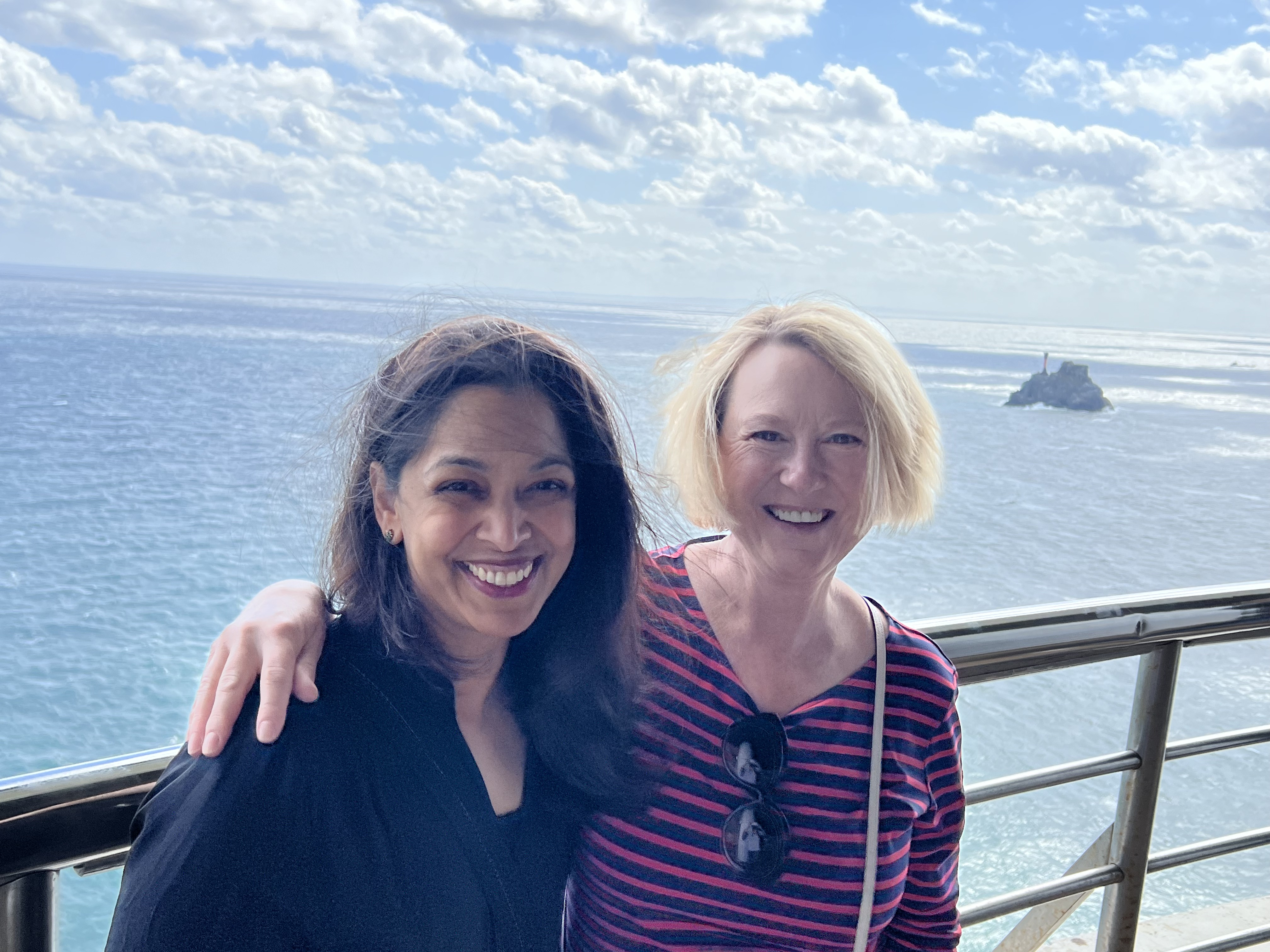
 But something happened on this trip to Korea that to me felt like a turning point, like a loosening of those knots – it was filled with moments of what I can only describe as utter happiness. No stress, no worries, nothing but a sense of adventure and joy, even fun. Even if just for a few minutes. Once was eating the raw beef with Sunghee, but there were many others on the trip. Like when Rick and I hopped on the funny little capsule train cars in Busan and puttered our way along a beautiful coastline when suddenly the skyscrapers and beach of Haeundae appeared – pure joy. Riding bikes past the ancient tombs of Gyeongju – utter fun. Or when Asma and I, laughing, struggled to stay upright on the sketchy cliffside stairs as a wild wind threatened to knock us into the sea – pure exhilarating joy. Or the glimpse of the beautiful, calm 8th century Buddha statue at Seokguram Grotto – pure joy. Or discovering modern Korean art at the Seoul Museum in the hills above Seoul – you got it, pure joy. 

  I will still mask when others do not; I will still be cautious about dining in crowded spaces; I will still stay away from sick people, most sadly our grandtwins, until they are better. But Korea helped me find a place in myself where I can relax and breath again. ๊ฐ์‚ฌํ•ฉ๋‹ˆ๋‹ค! Kamsahamnida Korea!