Written by Courtenay
Monday, Oct. 10, 2022 – Gyeongju – We have had two wonderful days experiencing Buddhist temples and ancient Korea, renting a car in Busan and driving up to the “museum without walls,” the ancient capital of Gyeongju. We had envisioned a rather calm, spiritual end to our two weeks in Korea, when we could slow down from the sights, sounds and bustle of Seoul and Busan for some peaceful, you know, Zen time, at the ancient (7th century) Silla capital of Korea. Little did we know that the national holiday on Sunday, celebrating the 15th century invention of the Korean script, was also a school holiday on Monday. And everyone – I mean everyone! – from all over Korea seemed to have converged on Gyeongju, and our hotel, to celebrate the three-day weekend with their families. It was a madhouse.
But first – we left Busan yesterday and rented a car. Rick was, as always, the intrepid driver and got us out of the city with one clutch, last-minute lane-change onto the correct highway north. On the way to Gyeongju, we stopped at two Zen temples – Beomseosa and Tongdosa. Tongdosa was our favorite – just a stunning setting and a beautiful 20-minute walk up along a river to reach the temple itself. We had a lovely bibimbap lunch just before at a restaurant I had found online – and it was a miracle that they not only could seat us, but that it was by a large sliding door, so we ate inside but had plenty of breeze. It was one of our best meals in Korea so far – and I was gently scolded for eating my rice with chopsticks, when I should have been using the spoon. So much to learn! It had been raining hard during lunch, but it had cleared up by the time we walked up to the temple, and we had a wonderful time. When we arrived at our hotel in Gyeongju in the late afternoon, we were met with a cacophony of children – they were everywhere. We were the only people who did not have a stroller in tow, or a grandmother. Literally.
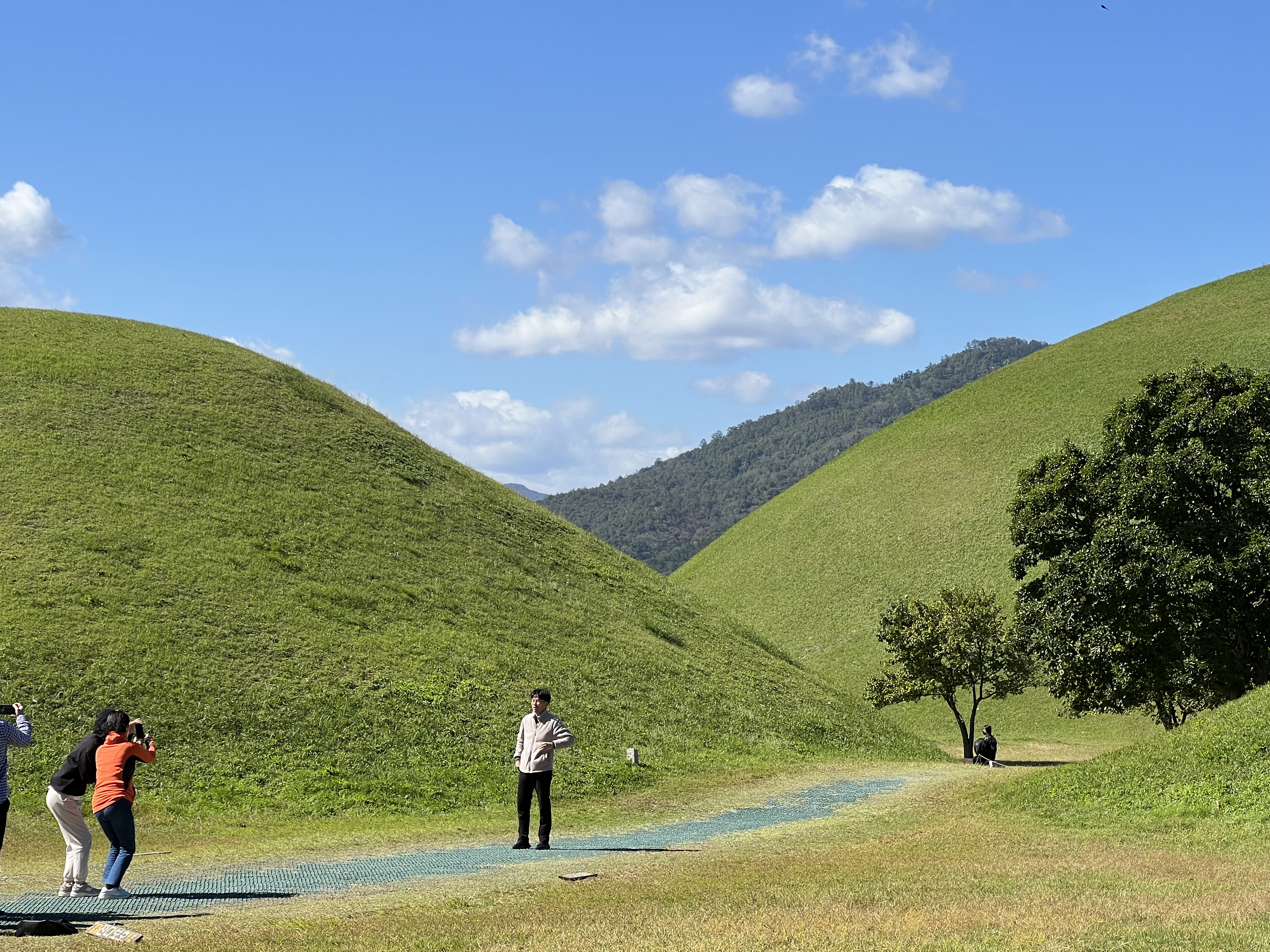
This morning, we still didn’t realize the scope of the crowds, or the fact this was a major family weekend getaway. We drove into Gyeongju proper, where the 7th-8th century burial mounds and sites are located, and we found ourselves in standstill traffic. Rick, fortunately, was able to pull another clutch move and took a side alley and found a parking space next to a bike rental outfit. We rented three bikes and took off on a tour of the historical sites. The guide books had talked about how magical it was to cruise freely through the ancient, grassy burial mounds, but there were so many people, and children, that we had to gingerly make our way along the paths, hoping we wouldn’t take out any small children or elderly people who veered into our way. But the air was fresh and the wind was brisk, and the grassy mounds – containing the graves of emperors and noble people from centuries past – the pines and maples, were all fluttering in the breeze. We made our way to the National Museum, where we saw beautifully wrought gold crowns and jewelry, grave goods found in the mounds, and stone pagodas and other treasures collected from around the ancient capital of Silla.
We finally made our way back to the parking lot – the location of which we remembered from the hilarious restaurant nearby called “What the Burger!?” – and we found a seriously dysfunctional situation: everyone was trying to leave from the same exit, into the same clogged street, and there was a bit a road rage, and we sent Rick out on his bike to scope out the escape routes. Again, he had a clutch move, and we found a back exit and were on our way to the beautiful temple of Bulguksa, and the nearby grotto of Seokguram.
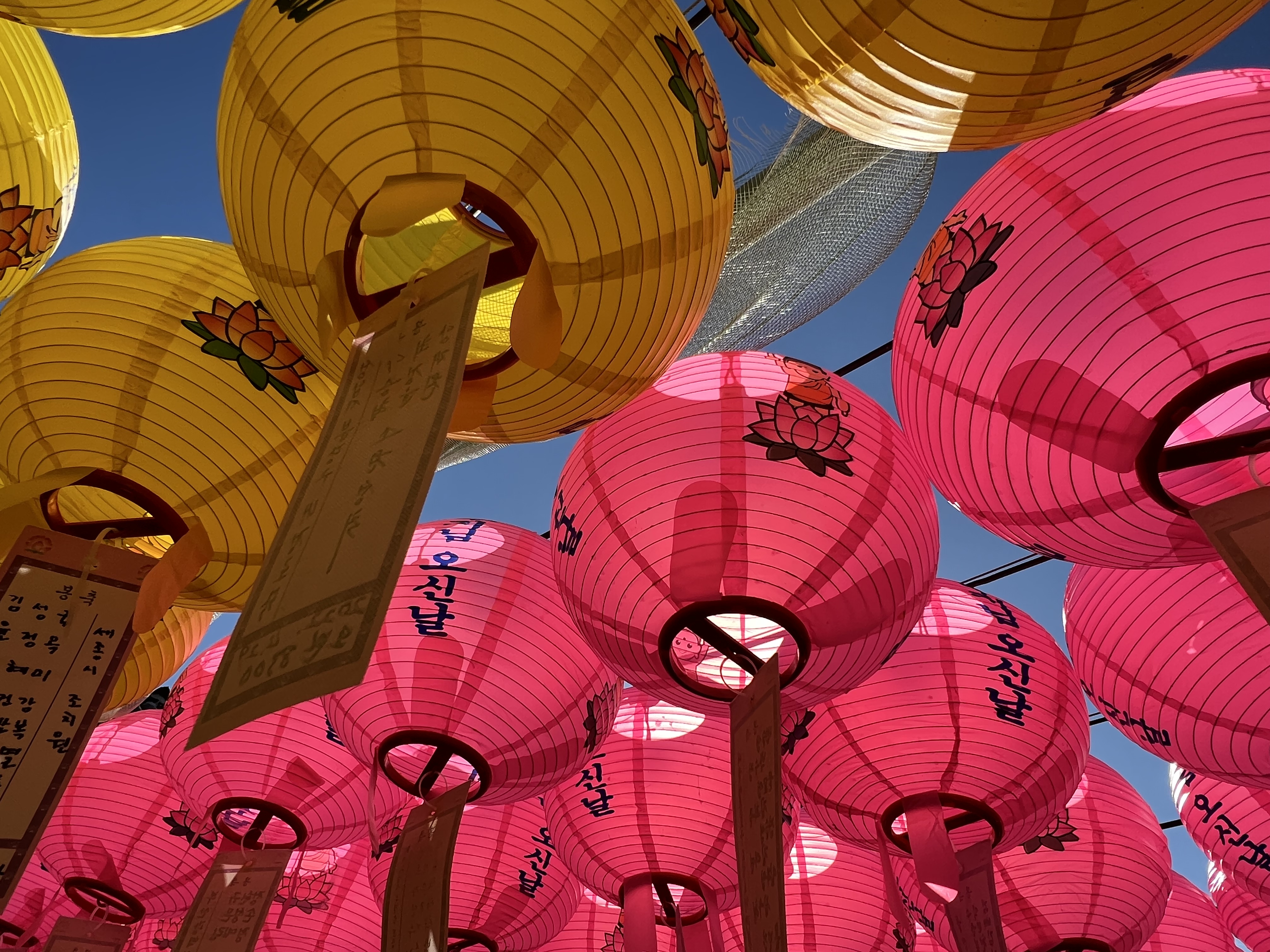
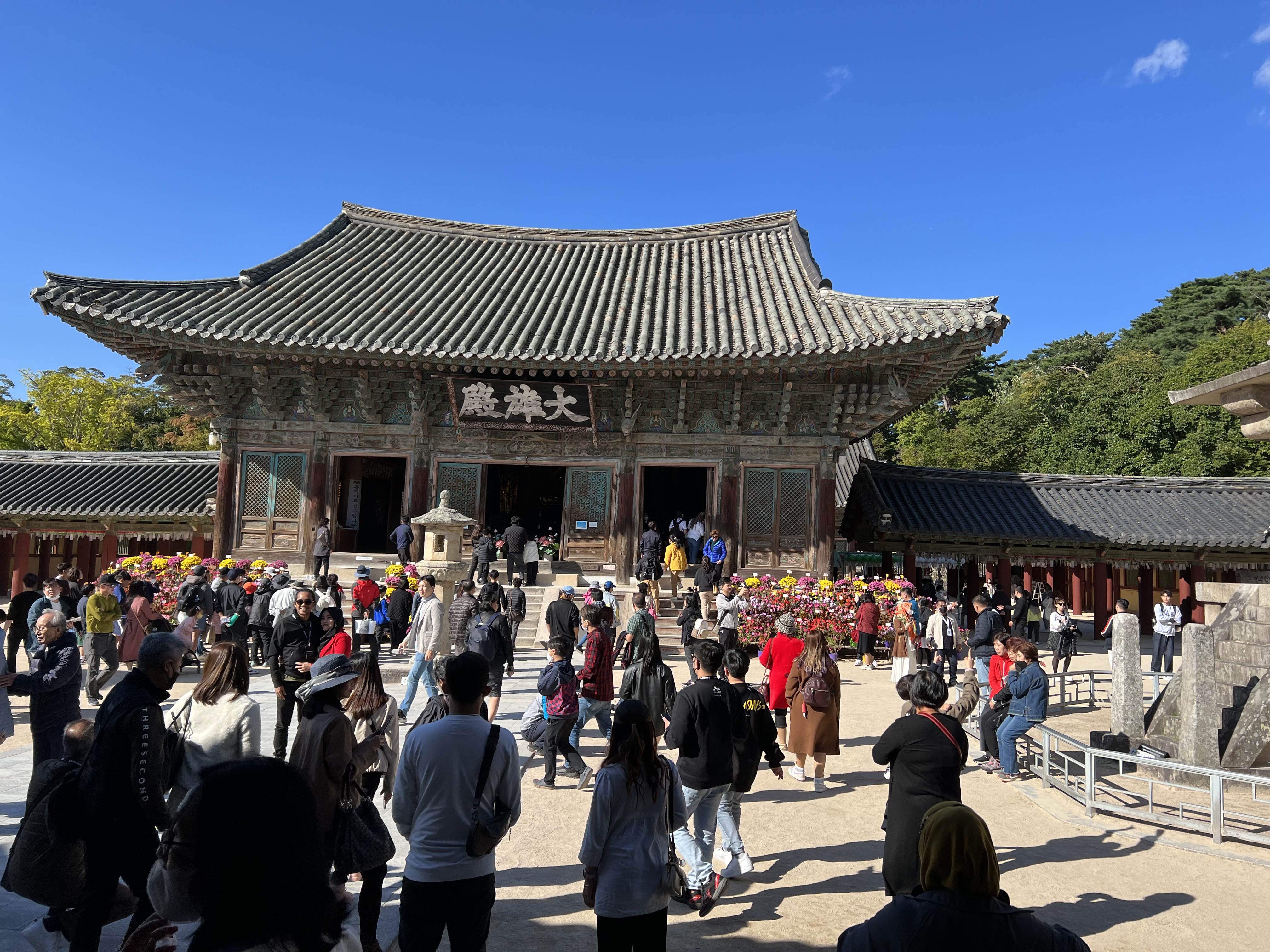
Bulguksa was lovely, nestled on the side of a mountain, a 7th century temple that was vibrant with offerings from the 21th century – flowers and paper lanterns fluttering in the wind, holding the hopes and wishes of modern people from an ancient tradition.
Seokguram, on the other side of the mountain, had an amazing view of both the city and rice fields of Gyeongju and the sea beyond. I made a small offering and was allowed to ring the huge bronze bell, the sound was astonishing, just lovely. The grotto, perched high up a hill in a carefully engineered, manmade cave, held the most beautiful Buddha, a 9th or 10th century statue, that embodied absolute peace – a Tang-Dynasty-style, with a full figure and graceful drapery. It was my favorite Buddha of the trip. After a long walk back to the car, we made our way back to the hotel, and with most of the families gone, so it is so much quieter tonight.
We head to Seoul tomorrow, and are so excited to have dinner tomorrow with Sunghee, an old friend from the fencing world, who is here visiting family. Her husband, Sungmin, has been our best tour guide and cultural consultant and cheerleader throughout. We are deeply grateful to him for his help on this trip, and for his support over the years, especially through my tough times of early diagnosis. They are a dear family to us, and we are so looking forward to reconnecting with Sunghee, whom we have not seen for a very long time.









 The Thompson Attigs