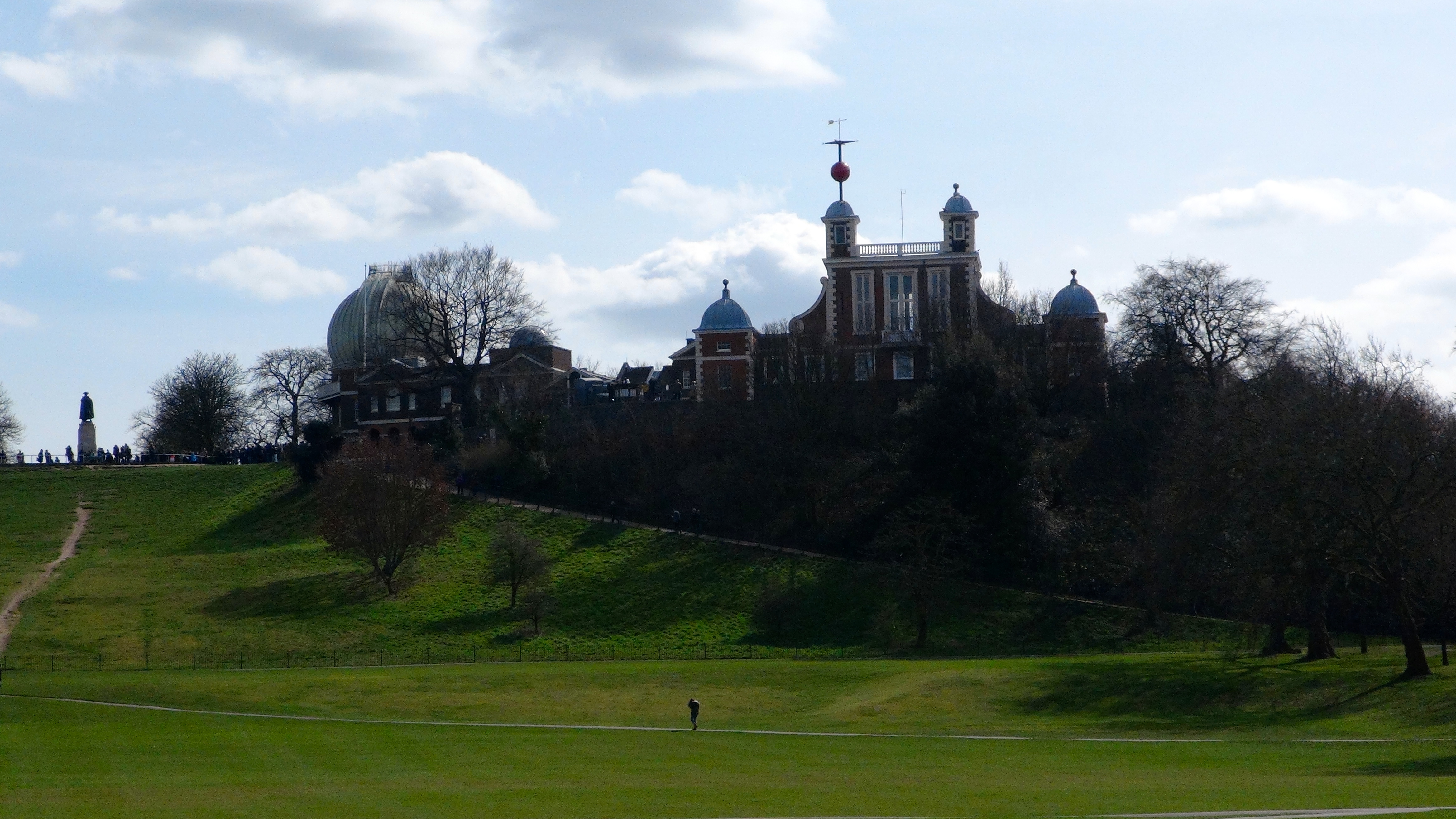
LONDON — Today, the London Eye and a Thames Clipper jaunt to Greenwich, of Greenwich Mean Time and the Prime Meridian. The weather was mostly clear today, so we rode the Eye to see the view. It was OK, but Will and Rick had already climbed St. Paul’s and the Monument, so they were used to the view and weren’t overly impressed. We then jumped on a commuter boat to Greenwich, a few miles downriver, where King Henry VIII and his daughter Elizabeth were born. After a meal in the riverside Trafalgar Tavern — where Dickens used to eat — that darn Dickens keeps showing up at our mealtimes — we headed up to the 17th century Royal Observatory, where Will and I straddled the Meridian, one leg in each hemisphere. We watched the ball drop above the hill observatory — as it has every day at 1 p.m. since the early 19th century so that seafarers could set their clocks for navigation.
We saw the development of the first time piece that made navigating longitude accurate and sailing much more safe. Carpenter and amateur clockmaker John Harrison took on the challenge in the 1700s and developed a series of four clocks — the first three large as a birdcage, the final one — and the successful design — a small and beautiful watch known as H4. It reminded me of Steve Jobs and the quest for the perfect design. Anyhow, I want an H4.
The Royal Observatory
Rick then wanted us to go to the “Deer Park” at the far end of Greenwich Park, a former royal hunting ground on a high place overlooking London and the Thames and the skyscrapers of Canary Wharf. A kind of Pearl District with Major Banks. We teased Rick as we walked, and he asserted that the deer park — which he claimed Rick Steves had called a “must-do” — would sure beat those boring paintings I wanted to see in the Queen’s House back down by the Thames. We walked and walked and walked and walked. Rick was hoping for a Nara-style friendly deer petting zoo experience, I think, but it was more like a bunch of mangy fallow deer behind barbed wire. A little English girl was squealing — “I saw a mouse! Or a rat! I’m not sure which!” when we arrived so that made it a little more exciting. We laughed all the way back through the sunshine to the Queen’s House, which turned out to have some AMAZING paintings, even Rick agreed. The 17th century house had been built for the wives of the Stuarts, and there were some iconic portraits of the Tudors and the Stuarts, as well as a famous Spanish Armada painting and many many others. The house itself, now a popular wedding venue, is famous for being the first perfect home designed by Inigo Jones in the Palladian Italian style.
We cruised through the Maritime Museum, which was designed for an age group we didn’t understand — toddlers? pensioners? both? — so we took the light rail and Tube back home to recuperate for dinner. A stroll down King’s Road to Rabbit, which had the cool woodsy vibe of Ned Ludd without the amazing food. The smoked trout with clotted cream was delicious, as was the mushroom ravioli, but all the “small bites” left Will hungry for a bagel with lox and creme brulé back at the hotel.
We rode home on our first London bus. We had the familiar Tube-vs-Taxi “discussion,” decided to walk, and then a bus pulled up alongside us — it was just like the Grateful Dead song — a bus came by and I got on, that’s where it all began — and we leaped on. It would have delivered us to our door had we not gotten off a stop too soon in an overabundance of caution. Better than a taxi. Better than the Tube. Figured it out two days before we leave. Sigh.
A play, a tour of the reconstructed Globe Theater, and a take-home meat pie for dinner.
Instead, we ended up in what Will termed a “passive-aggressive” argument at dinner in the shadow of the Tower about whether the take the Tube home at 7:30 p.m. or a cab. Obviously, we again tried to do too much. But that is the joy of travel, n’est-ce pas?
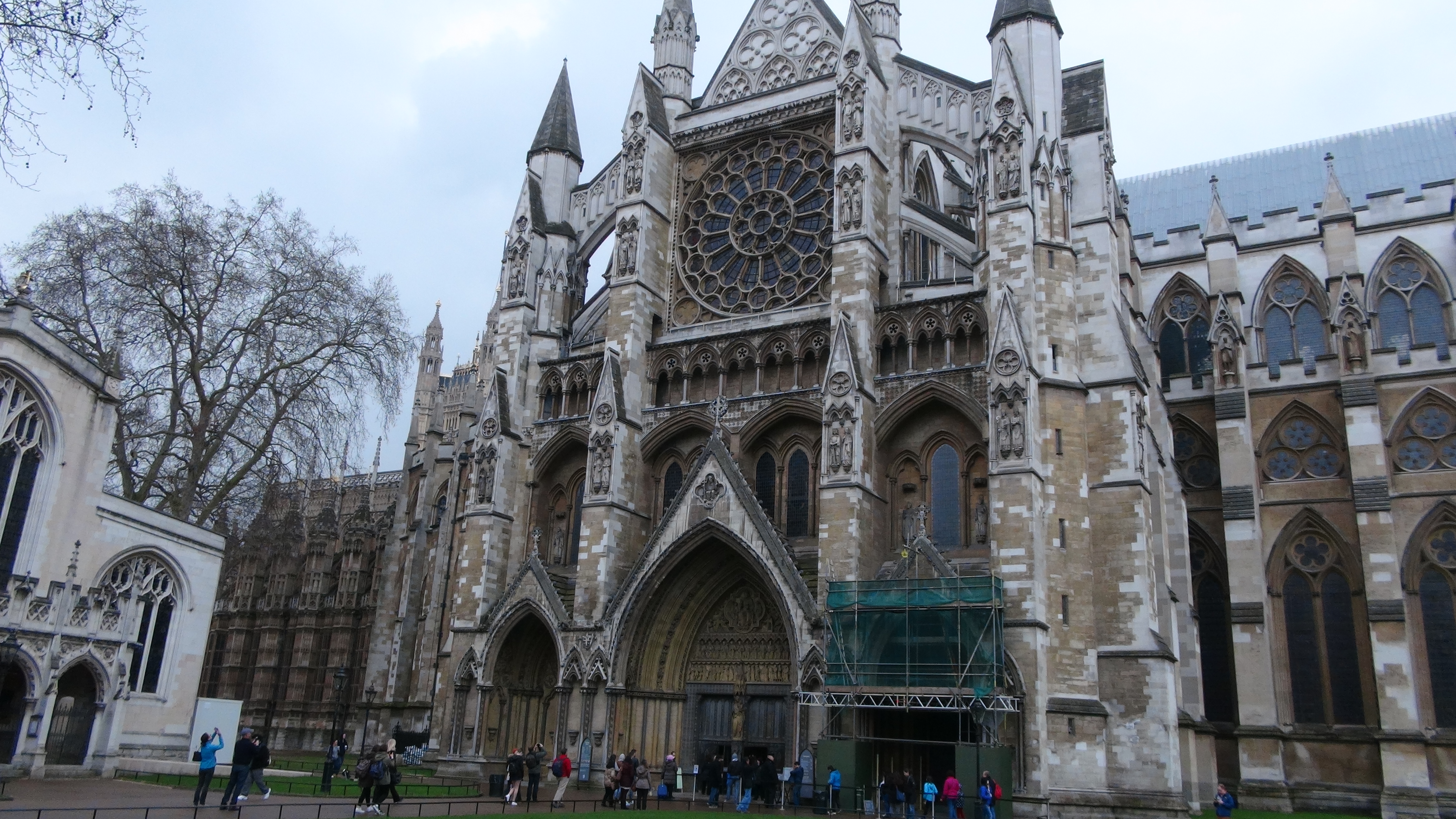
We started the day at Westminster Abbey, the 11th century former monastery that is the old English heart and soul. Here is where the kings and queens are buried, where poets are honored, where the Royal Air Force is commemorated and the Tomb of the Unknown Soldier lies. Its sense of history is overwhelming.
But the highlight of our visit was to the very heart of the abbey itself — the sanctuary of St. Edward the Confessor — the holiest spot in the abbey, a place not on the guided tour, the place the Pope himself came to pray on his visit to London. A sweet old volunteer told me, when we entered the abbey, that we could visit the shrine of the only English saint still intact and still buried in his original spot if we joined the 11 a.m. prayer. We thought it would be crowded, but only about eight of us showed up, to be ushered into the sanctuary, where lay the Confessor, the 11th century king who built the first abbey here. His tomb had been desecrated and stripped of ornament during the Reformation, but the chaplain told us King Henry VIII didn’t dare disturb the saint. Other saints were not so lucky, and their remains “scattered to the wind.” Richard II and Edward III, as well as Edward I Longshanks and Henry III were also entombed in striking bronze tombs in this elevated area.
We joined the chaplain in the Paternoster, and prayed for, among other things, peace among nations, end to strife, the health of the Queen and the realm, and asked Edward to hear us. It was quite lovely.
We then saw the tombs of Queen Elizabeth I, who shares her tomb with her Catholic half-sister Mary, who had once imprisoned her in the Tower. On the opposite side of the chapel lay Mary, Queen of Scots, who had been executed on the orders of her second cousin Elizabeth. They are all laid to rest together. As I said, it’s all a little overwhelming.
Will stood on tombs as diverse as Charles Darwin, whose seat he had taken yesterday at Ye Olde Cheshire Cheese, to Clementi, whose music he has played on the piano. We admired the lovely ceilings of the Henry VII chapel, as well as the Chapter House, where parliaments met from the 14th to the 16th centuries.
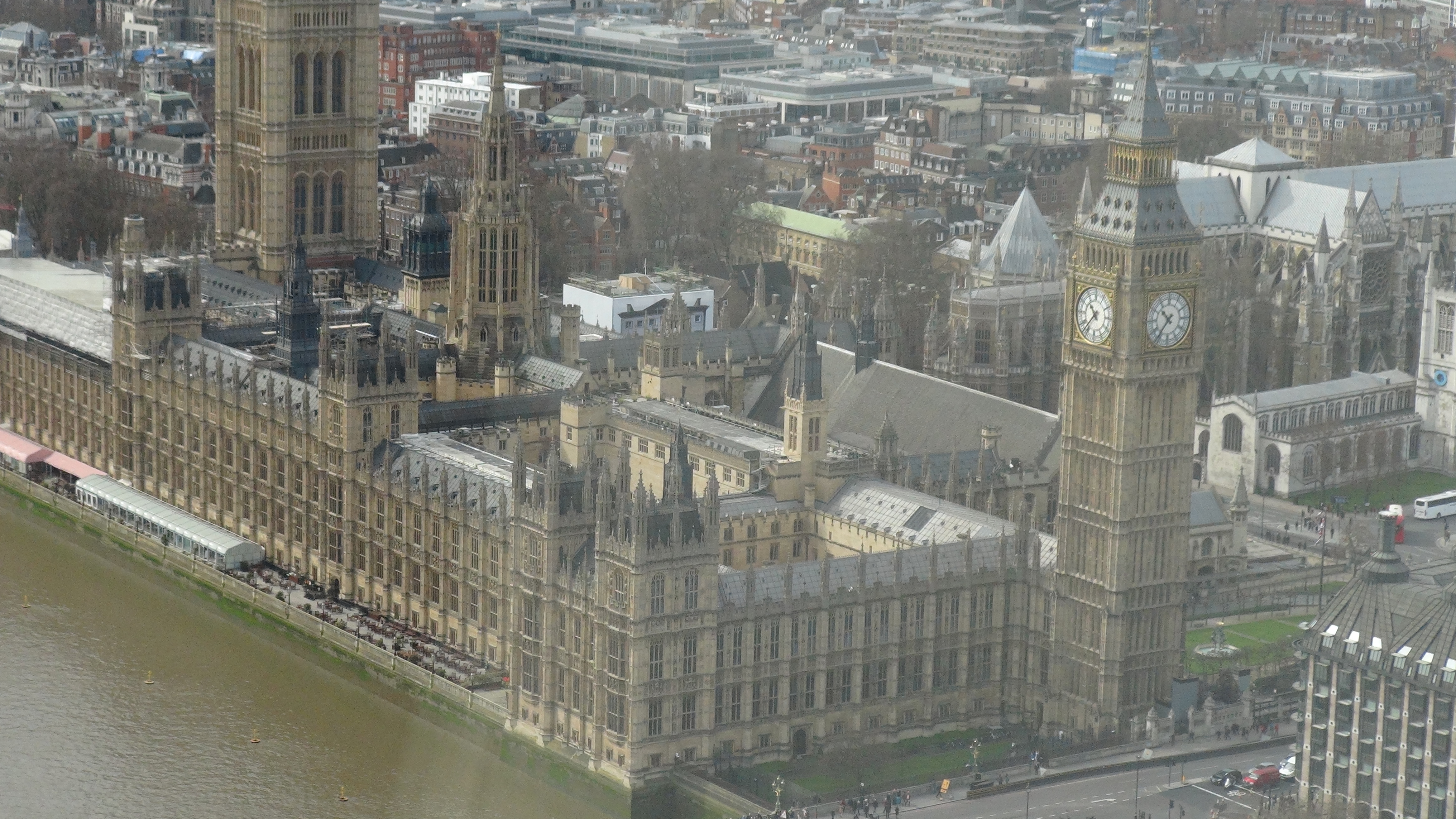
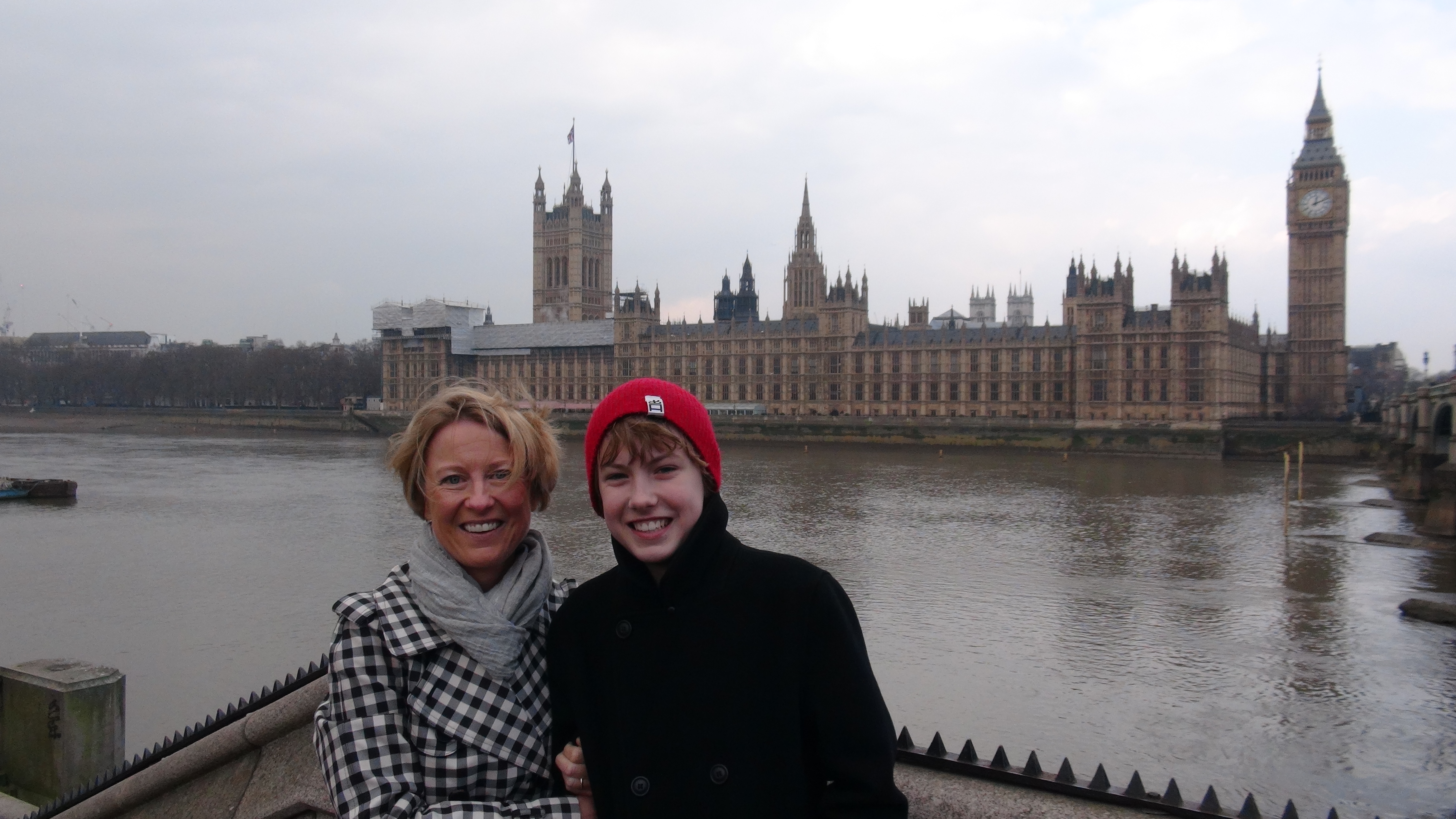
Lunch was in the old County Hall building across Westminster Bridge, a lovely lunch of crab cakes with a view across the Thames at the north bank. We then walked along the south bank, dodging the State Fair atmosphere at the base of the London Eye, and made our way to the Olivier Theater at the National Theater — we had just seen Olivier’s tomb, so it seemed fitting to be seeing a play in his theater. Treasure Island had some terrific sword-play, as well as the most incredible set that rose and fell into the stage, rotating, sprouting pirate ships and islands. Someone told us it’s one of only two such stages in the world — I think the other may be in Ashland. Remind me to check on that. Anyhow, the acting was good, but the second half got a little bloody, which was hard to square with the comedy. Also fittingly, Will’s favorite character was a ship crew member named Grey, whose name no one could ever remember. Grey, Will’s favorite painting at the Tate Modern, now Grey, the nondescript comedy relief.
Our favorite line in the play was just before one of the ships’ mates, a hefty woman very fond of pies, declared just before she died, “Thanks for the pies and adventuring.” Exactly our thoughts.
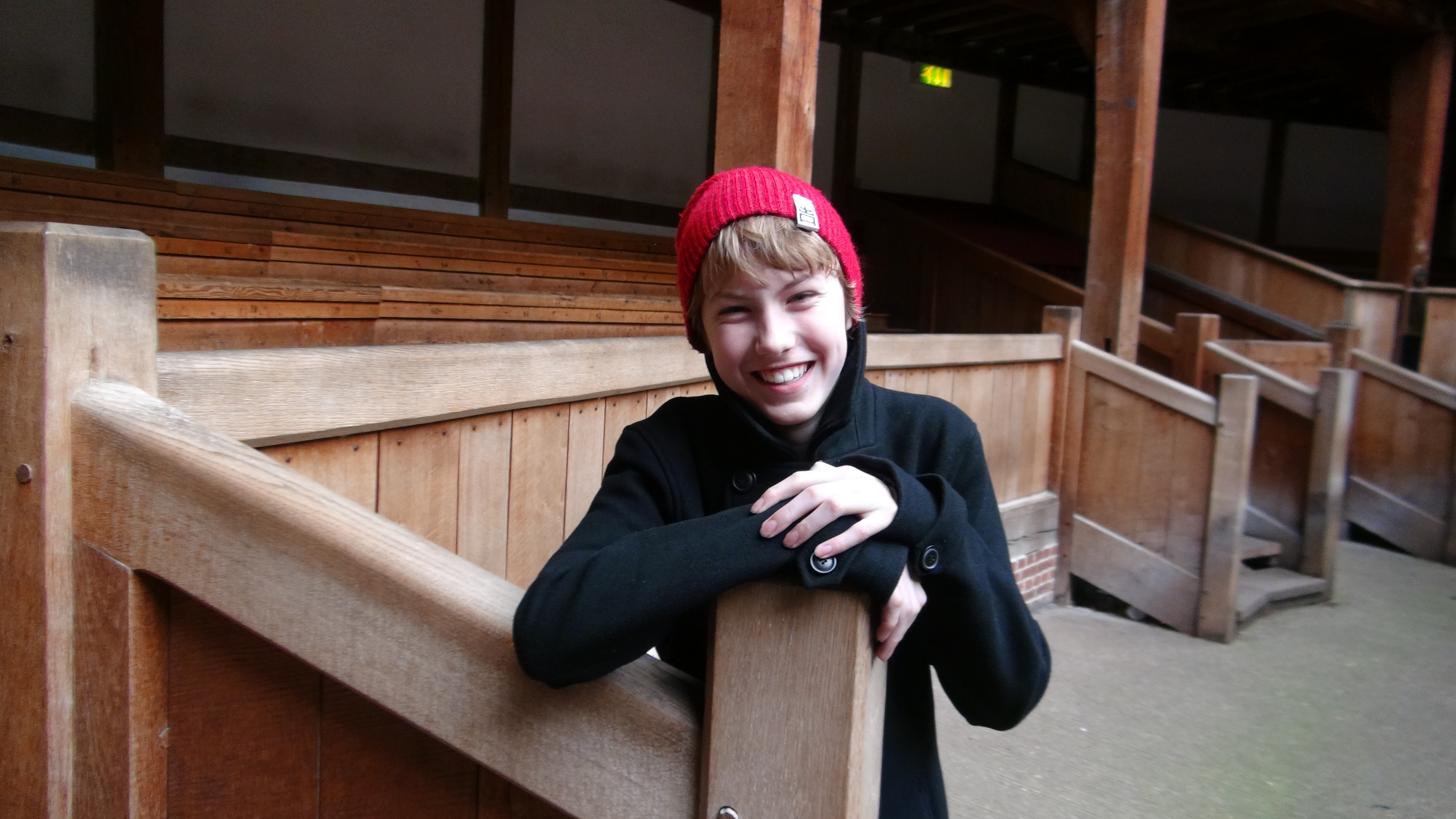
We then raced down the Thames to catch the last tour of the Globe, the vision of American director and actor Sam Wanamaker, built in the 1990s to recreate the theater that Shakespeare wrote for, down to the animal hair in the plaster walls. Rick was disappointed with the tour, since he wanted to hear how it was constructed, but it was interesting and wonderful to see. The guide talked more about the experience of the theater for a 16th century audience, who would pay one penny to stand in the pit at the base of the open air theater. More pennies got you a seat and better comforts, such as a pillow. The groundlings, or the 1,000 who crammed into the pit, apparently smelled quite atrocious, what with the lack of bathing and the penchant for eating raw garlic to ward off the plague. When they roared at the action on stage, apparently they let off a big stink, thus they were called the Pennystinkers. Rick thought the same name suited a certain boy we know and love, as well as a certain black Labrador. Our little Pennystinkers….
Looking back over the day, it seemed incredible we saw the tombs of the kings who appear in the plays by the playwright whose 400-year-old theater we just saw reconstructed. The Oregon Shakespeare Festival just announced they will put on Richard II next season, and here Will saw his tomb and his famous portrait at Westminster, as well as the memorial bust to Shakespeare. It all weaves together…
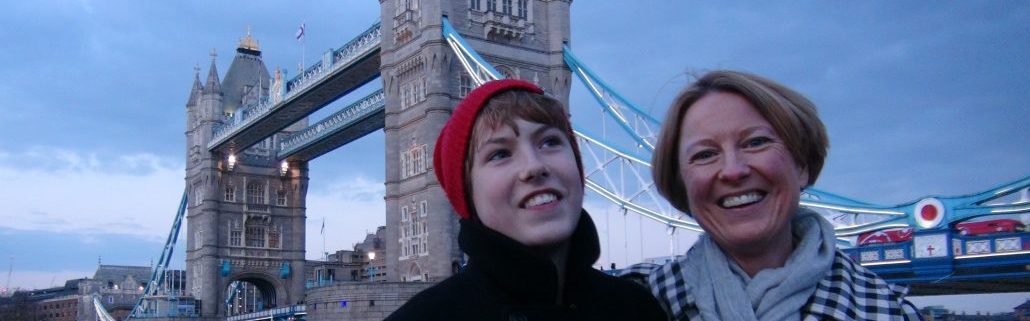
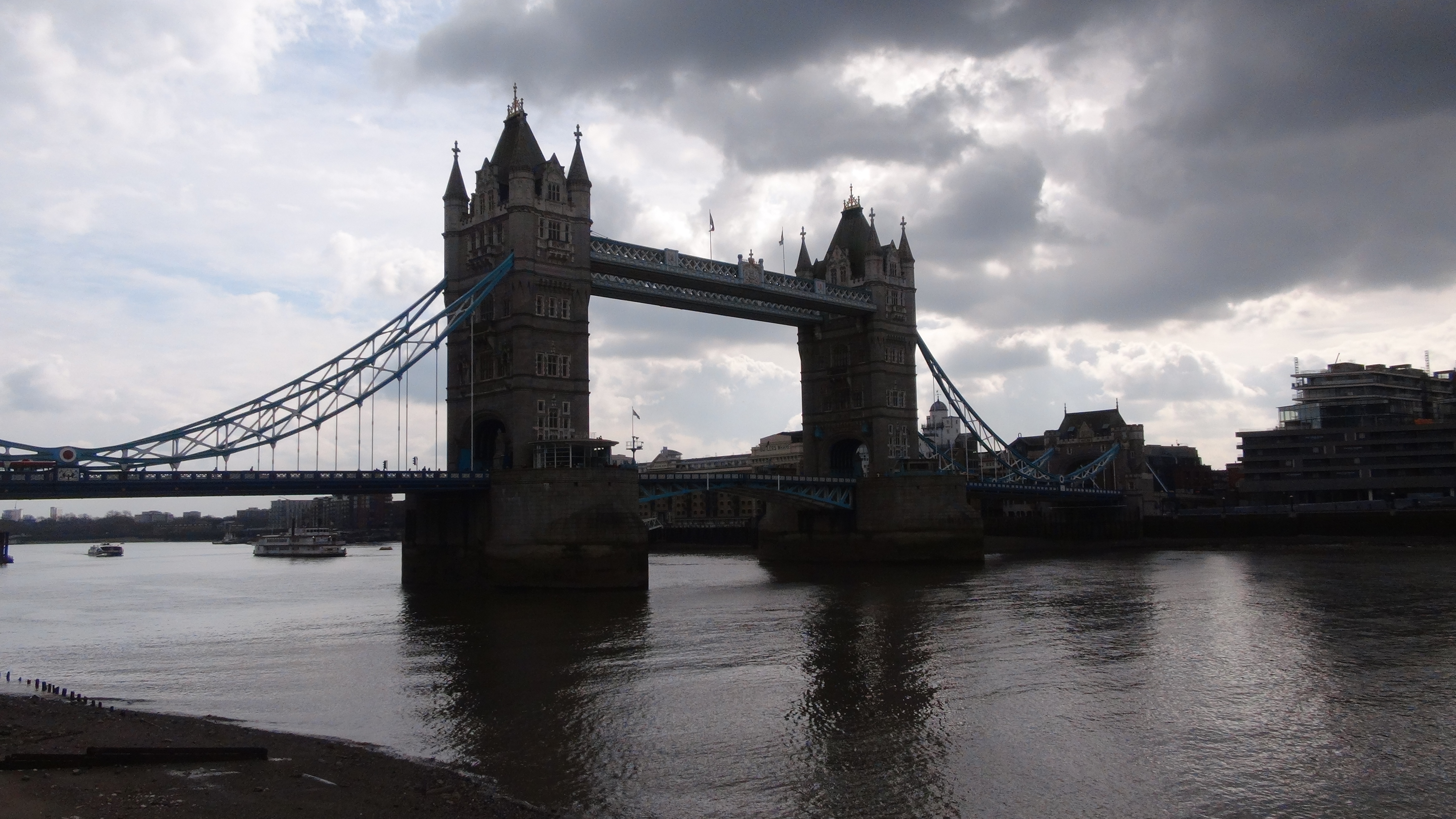
We were then off to dinner at the Perkin Reveller on the recommendation of our friends’ the Riches, and we had a wonderful dinner (yes, meat pies again, with Will eating half of mine, again) with evening views of Tower Bridge, the creamy stones of the Tower itself, and the Thames.
We ended with the fateful passive-aggressive argument — resolved when we took both the Tube and a cab. Good night all and cheers from London!
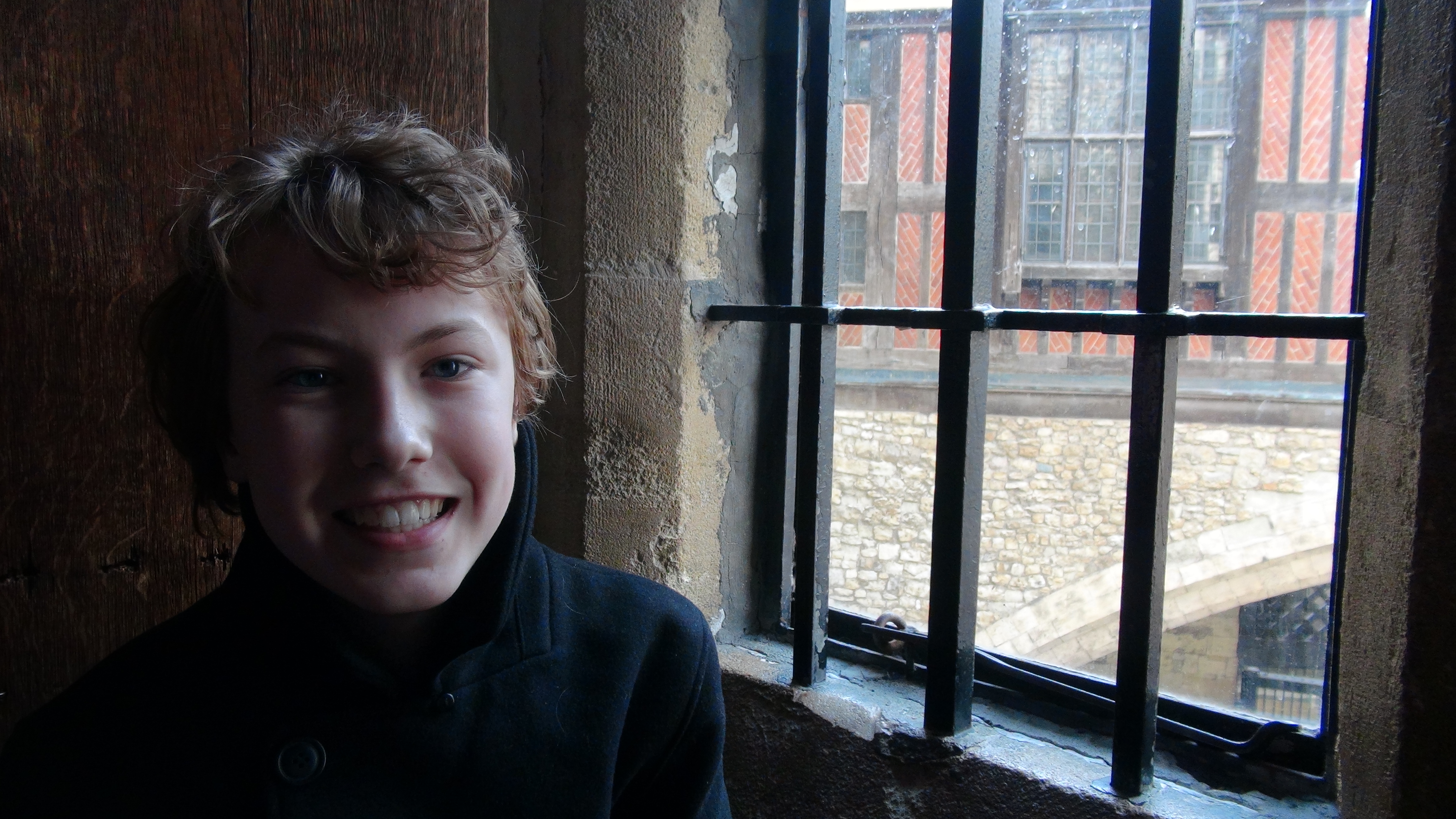
LONDON — We got back to our traveling roots today, a genuine Thompson Torture Tour from start to finish, even though we skipped the torture exhibit at the Tower of London. Which is where we started our day. After a short tube ride in commuter-packed trains, we emerged into the crisp morning at Tower Hill, big puffy clouds threatening rain. The guide books aren’t kidding when they say arrive early at major sites — it was quiet and peaceful as we crossed the ancient moat into the 11th century fortress. For all disturbing history and terror associated with the Tower, it looked benign and beautiful on a fresh spring morning. Will was wary of what lurid tales the Yeoman Warders might tell, so we skipped the official tours and struck out on our own.
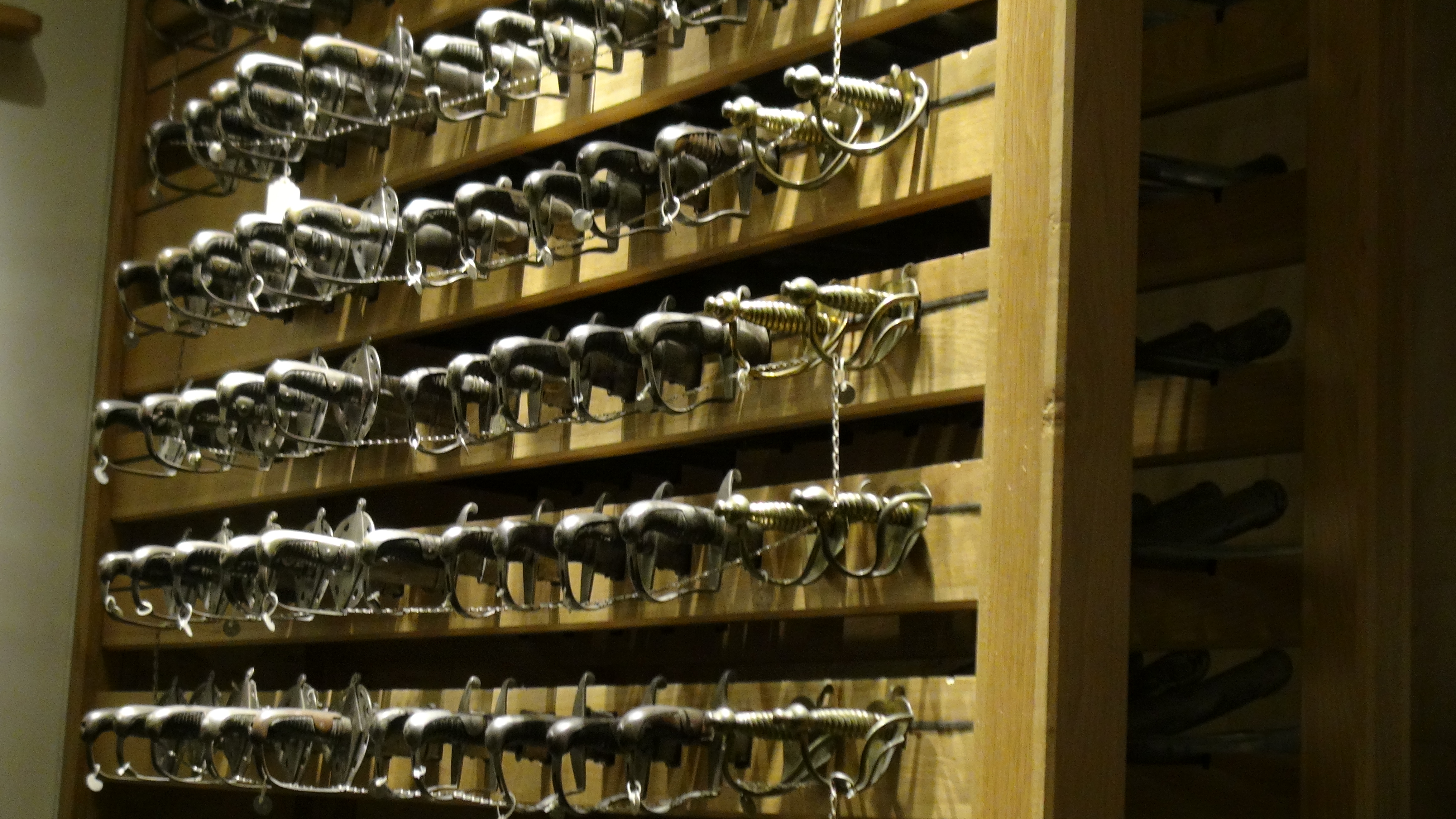
The armor display was probably the highlight for Will — more so than the gargantuan Crown Jewels or the recreated medieval palace rooms of 13th century Tower benefactors King Henry III and his son Edward I. Rooms were filled with swords, and suits of armor for jousting, and walls of chest protectors and sabers — just like at home. We learned fun little facts like jousters joust blind at the last minute before impact, as they tip their heads and their masks (it’s still hard to call them helmets) back and peer through a small crack as they charge, then jerk their head forward at the last minute so the eye-holeless mask protects their faces.
We were moved by the 500-year-old graffiti carved in stone by condemned prisoners held in the Salt Tower. A Norman Romanesque chapel in the medieval palace was perhaps the most beautiful space we’ve seen, with its graceful arches, golden-hued stone and light-filled windows. We decided, however, that in place of the six black ravens that must be kept in the Tower at all times, they should rather have six fat black English Labradors to lounge on the grassy open spaces and prevent the realm from collapsing. One final note on the Tower — Will was playing a video game to show kids how hard it is to calibrate the angle of a cannon to shoot an oncoming army. Every time Will shot short, and hit a poor cow in the foreground instead, a voice would intone “Mind the cow!” (Kind of like, “Mind the gap,” when exiting a train.) We’ve decided this is the new thing to shout out at fencing bouts, when a fencer falls short, it’s “Mind the Cow!” Then another short subway ride to the columnar Monument to the Great Fire of 1666, that started at the King’s baker’s house on nearby Pudding Lane. Will wasn’t allowed to go to the top because it was packed with school kids, but we will try again later in the trip. Everything is so close to everything in central London, that we are sure we will pass close by again.
We then wound our way over to the preserved 18th-century home of Samuel Johnson, often called Dr. Johnson, though as I write this I’m not sure why because he wasn’t a doctor. I’ll have to google that later. He was a journalist and writer who compiled the works of Shakespeare as well as the most complete dictionary of the English language in 1755. He was apparently quite a character, rude and untidy and witty and hilarious. Just our kind of guy. We’d seen him dressed up in togas in St. Paul’s Cathedral — clearly not the Samuel Johnson of real life — I’d read in one guide he looks like he’s been disturbed from his shower to answer the door in a towel. We had fun looking up fencing terms in a reproduction of his dictionary — John Locke apparently used fencing in a sentence this way, under the heading Fencing School: “If a man be to prepare his son for duels, I had rather mine should be a good wrestler than an ordinary fencer, which is the most a gentleman can attain to, unless he will be constantly in the fencing school, and every day exercising.” So that pretty much sums up Oregon Fencing Alliance! Under Fencer: (I’m guessing George) Herbert: “Calmness is great advantage: He that lets another chase, may warm him at his fire, mark all his wand’rings, and enjoy his frets; as cunning fencers suffer heat to tire.” And Digby: “A nimble fencer will put in a thrust so quick, that the sword will be in your bosom when you thought it a yard off.” I’m sure Maestro Ed and Coach Adam would agree.
We then headed over for lunch at Ye Olde Cheshire Cheese, a pub tracing its history back to 1532; the current building is post-Great-Fire, 1667. When we told the elderly caretaker at Dr. Johnson’s House we were planning to eat there, she wrinkled her face up in disgust and said we didn’t have to actually eat there, we could just stick our heads in. “It’s a spit and sawdust place,” she said with distaste. Guide books and friends had told us it was not great food, but guess what? It was THE BEST MEAL OF THE TRIP. We entered the dark, clearly very old restaurant, and the waiter asked, oracle-like, if we wanted the pub or the restaurant. We felt like it was a test, and we didn’t know the right answer. We said the restaurant, which was apparently the right answer, because he seated us in the choicest seats in the house, next to a fire. It wasn’t until after we sat down that we realized Will was sitting in Charles Dicken’s favorite seat, and I was sitting in Dr. Johnson’s. OK, so maybe they weren’t actually their favorite seats, but hey, there were brass plaques, and they were facing the door, which is where I imagine any good writer would want to sit — near the fire, with an eye on the comings and goings of other people. Then the food — there was only one other person in the place, which made us nervous, but he was eating a meat pie, and he told us it was good, so Will and I both ordered one, and IT WAS AMAZING. I love all caps. I’ve had some rotten meals on this trip, so it was delightful to order right for the first time. Halfway through the meal (Will ate all his and half of mine), it suddenly dawned on Will that he was having 1. Pie 2. Beef Stew. and 3. Gravy — all his favorite food groups in one meal. Poor Rick had soggy fish and chips — so I guess that’s what all the restaurant reviewers had ordered. We then walked through the lawyer-heavy Lincoln’s Inn, one of the four Inns of the Court, to which barristers of England and Wales belong. It was grassy and quiet, with funky old buildings that look like they inspired the Harry Potter movie artists, all turrets and brick. As we walked under a covered area, we all of a sudden realized we were walking on tombs — an unlabeled chapel. We ended up at Sir John Soane’s museum, which we had been told not to miss, but we left a little perplexed. He was an architect, so late18th century/early 19th centuries, and designed the old Bank of England building. He was also an eccentric, a lover of antiquities and art, and he crammed his home full of his collection. The only problem was we could barely see the red figure Greek vases set high on the library shelves (real? copies? huh?), and Will was freaked he would somehow knock over the statuary and busts crammed everywhere. There were mirrors throughout, curved surfaces intended to magnify the light. The effect at night by candlelight is apparently stunning. Somehow, we were more interested in his own architectural drawings, both of his own buildings and of ancient Greek and Roman buildings. It was a quirky fun visit.
And it was only 2:40. What is a family to do? Go back to the “flat” to rest? Oh, no, we decided to walk to Covent Garden, then Trafalgar Square, then to the Churchill War Rooms — the underground bunker where Sir Winston Churchill and his staff carried out the war as German bombs rained down on London (we learned later that a 5-foot-long unexploded bomb was found the day before near Tower Bridge — the past ever present.) But on our way there, we just HAD to stop at the 17th century Palladian Banqueting House by architect and classics-lover Inigo Jones. The site of King Charles I execution in 1649, as well as the triumphal return of his son, Charles II, after nasty crown-jewel-burning-Ireland-persecutor Oliver Cromwell was out, the Banqueting House is famous for the ceiling painting by Rubens of the apotheosis of Charles I’s father, James. The hall is still used for large events (it’s the only structure of Whitehall Palace that survives), but the best thing about it, and the reason it gets the TOURIST SITE OF THE DAY award from Will, is that there are beanbag chairs on the floor so you can lie down and look at the ceiling. Which Will and I did, and analyzed the art. It looked like the cherubs were all swimming in a pool above us, their fat little legs dangling, foreshortened, down toward us. If more museums would put in beanbag chairs, I assure you that kids like Will would learn to love art a heck of a lot faster.
OK, it’s getting late and you are probably not even still reading, but we ended our day at Rules, on our friend Mary Jo’s recommendation, reportedly the oldest restaurant in London 1798 — yes, we wanted old food today. And the food was amazing. Will had a Steak and Kidney Pie, and I had lamb. Rick, inexplicably, ordered scallops (at a restaurant specializing in game?) So Rick was of course still hungry when Will offered him the “mushrooms” he had picked out of his pie. I had eaten one, and been rather surprised to find it was a kidney, but kept my mouth shut in case it had a gross-out factor for Will. I winked at Rick, but he scarfed down the mushrooms, until I started laughing until I cried. We all did. Then we walked home because 1. we couldn’t face trying to find the Tube (Will’s preferred transport) and 2. everything is so close in London! By the time we staggered into our lobby, facing three flights of stairs, Rick grumbled that he would take the elevator but that it was always on Floor 6. But then I pointed out the 6 was actually a G, and it was always there, waiting for him. We laughed our way up the stairs, exhausted, full and happy.
LONDON — We rode the Midland train this morning about twenty miles north of London to the beautiful English village of Berkhamsted, home of our friends Elizabeth and Rob, and their two young sons, Ben, 5 and Joe, 2. They met us at the train station and drove us out to a wooded park that was busy with families–with scores of kids and dogs–romping on a crisp, sunny March morning under a bluebell sky.
I tucked into a full English breakfast–eggs, sausage, tomatoes, toast and beans–while the rest of the family showed slightly more restraint. When I went back for coffee, I met a local man with a good-sized English lab, a chocolate, and struck up a conversation while I petted his dog and missed our Pippy. His chocolate, named Zack, was a mid-sized male. When he asked me about Pippy, I confessed that she weighed close to 80 pounds. “That’s quite a big girl,” he declared. Well, yes. Full English, is the term, I suppose.
The boys soon locked on to Will, and he to them, and once we left the table they were right on Will’s rather large heels. (We first met Elizabeth and Rob when Will was 5, Ben’s age, so it was amazing to see how fast time goes for children, while it seems like just yesterday for us.) As we walked across a grassy meadow to a well-beaten trail through the woods, I started an argument with Ben about whose shadow on the grass was whose. He was pretty insistent that the smaller of the two shadows was his, no matter what I argued. “That’s mine, I know it is,” he said.
Will and his climbing partner, Joe
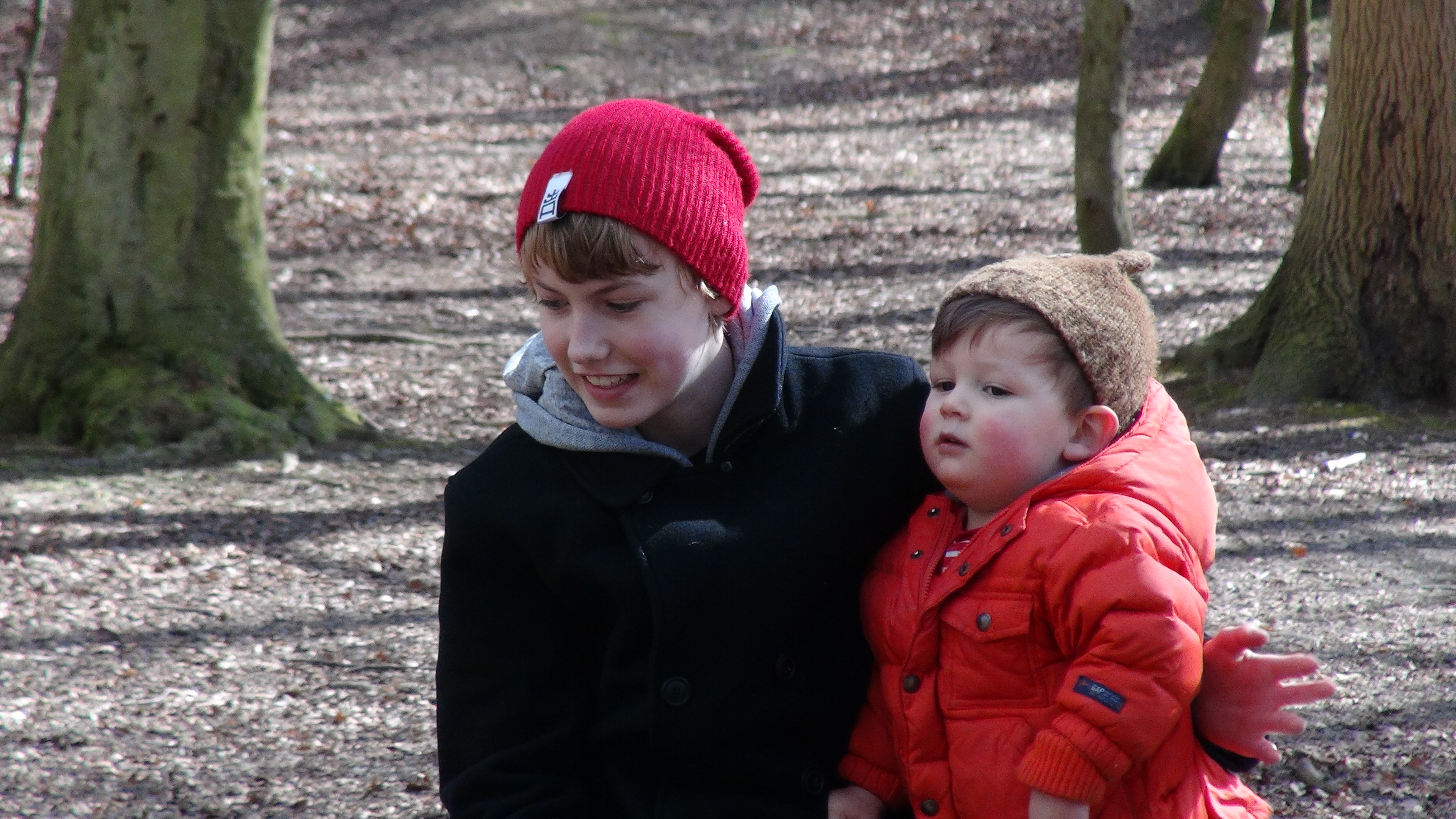
Will climbed the stairs on a tall columnar monument next to the cafe, and when he came down the young boys had caught the climbing bug. They kept after Will to help them climb the fallen beech trees in the woods. With his arms raised high, two-year-old Joe begged Will to help him up on a fallen log. “We’ve already done it twice,” Will pointed out. Again, again. And again. We hiked for about an hour and a half after breakfast, and with all the climbing, made it about four hundred yards through the woods. The boys were adorable.
Afterwards, we drove to their home on a steep hill overlooking Berkhamsted, a town of about 25,000 people. Rob’s childhood hometown, it was charming, rural, and felt more than a half-hour ride from London. On the surface picturesque and peaceful, bits of its history kept popping up in conversation. Oh yes, Graham Greene was from Berkhamsted and set some of his novels here. That former monastery over there — the one where Rob once bartended — that was the manor house of a man who developed many of the canals in England. The ruined castle? A favorite of Edward the Black Prince (1330-76). And then there was that siege in 1216 – you know, right after the barons forced King John into signing the Magna Carta, that thing that helped lead to our modern constitutional democracy — oh, yes, King Louis of France, backed by the barons, he laid successful siege here. More recently, more to today’s point, Ben and Joe were born here as well.
We shared tea and a chocolate cake that Ben had baked the previous day. It was every bit as good as — in fact better than — Fortnum and Mason’s, even though Ben only put in half the chocolate. While Joe, exhausted by all the climbing, struggled to take a nap, Ben trooped up and down the stairs fetching toys to bring down to play with Will. Courtenay went up with him once to see his bedroom, and as Ben showed her around, the five-year-old announced, “As you can see, I’m a very lucky boy.” Yes, indeed.
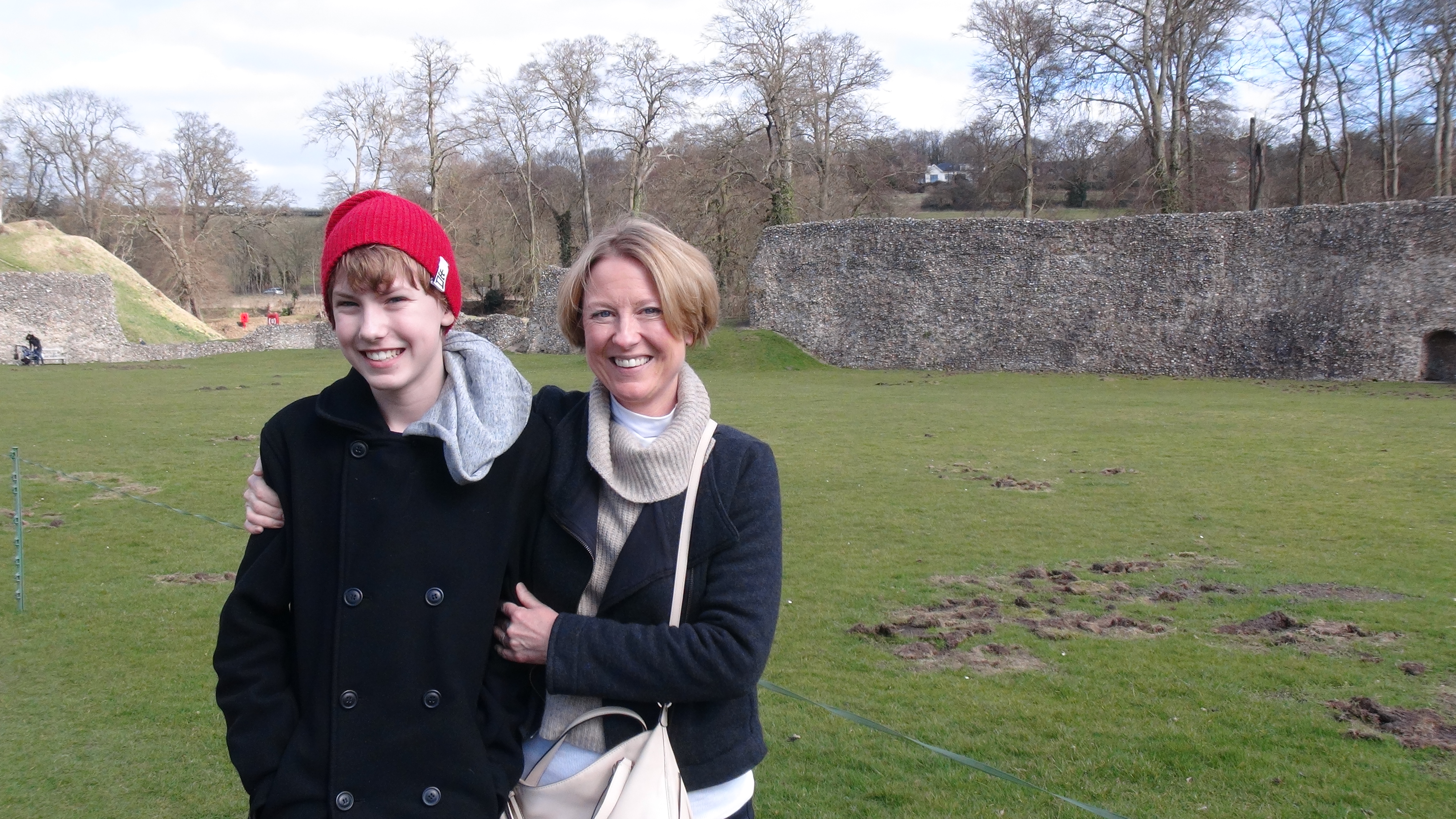
Courtenay and Will on the grounds of the Berkhamsted Castle
It was wonderful catching up with our friends, Rob’s job as a foreign news editor in London, and hearing about Elizabeth’s project to document motherhood through a series of amazing photos — check out #thesecretlifeofmothers and #bringinguptheboys for some unforgettable images. Stunning photographer and artist, Elizabeth is. We said our goodbyes, and Rob delivered us to the the ruins of the castle built in 1066 mentioned above that lie next to the train station. The castle belonged to the half brother of William the Conquerer. The remnants of the thousand-year-old stone walls are surrounded by rolling grasslands and a deep moat filled with cat tails and sedges.
On the train home, we met a young woman from Oklahoma State University who was returning from the Harry Potter Studios, which is our destination tomorrow. She described herself as a lifelong Harry Potter fan and confessed to being so excited about the tour of Harry Potter movie sets that she had “chills” the whole time.
We finished the day with a walk through London’s Hyde Park, which was packed with people jogging, boating, cycling, feeding the swans and enjoying the late-afternoon sunshine. We swung through Harrods, the over-the-top department store in Knightsbridge, where we saw the memorial to Lady Diana and bought meat pies and pieces of cheesecake for tomorrow night’s dinner when we return from Harry Potter.
As Ben would surely agree, we are very lucky boys and girls.
LONDON — Thirteen hours of sleep is apparently the magic number for an almost-13-year-old — just enough after a trans-Continental-Atlantic-North-Pole flight to rejuvenate Will’s soul. Or at least his energy level.
We started late today (much to Rick’s chagrin — two hours late! How will we ever make our lunch reservation?!? First day of our itinerary, and we’d already blown it!), but managed to still get to St. Paul’s Cathedral by lunch. The cathedral, of course, is historic, gorgeous, inspiring, the site more than a thousand years of history — fires, weddings, bombings, funerals, burials. What struck us was both its grandeur, but also its restraint — not as flamboyant as St. Peter’s in Rome, but still with enough bling and soaring space to inspire you to look, and think, of the heavens. Will especially liked climbing the 500-plus stairs to the top of the dome (Courtenay only made it halfway, to the Whispering Gallery, since the stairs to higher galleries were tight and claustrophobic. A guide helpfully told me that no one has ever gotten stuck, and quite large people are even able to squeeze their way up, but I didn’t want to tempt fate and a panic attack.)
The soaring stained glass windows and memorial at the end of the church, commemorating Americans lost fighting in World War II, was also beautiful and moving. As were the stories of the several hundred Londoners who took shifts holding vigil, night after night, to put out the incendiary bombs that rained down on this symbol of British resolve during the German Blitz of 1940-1.
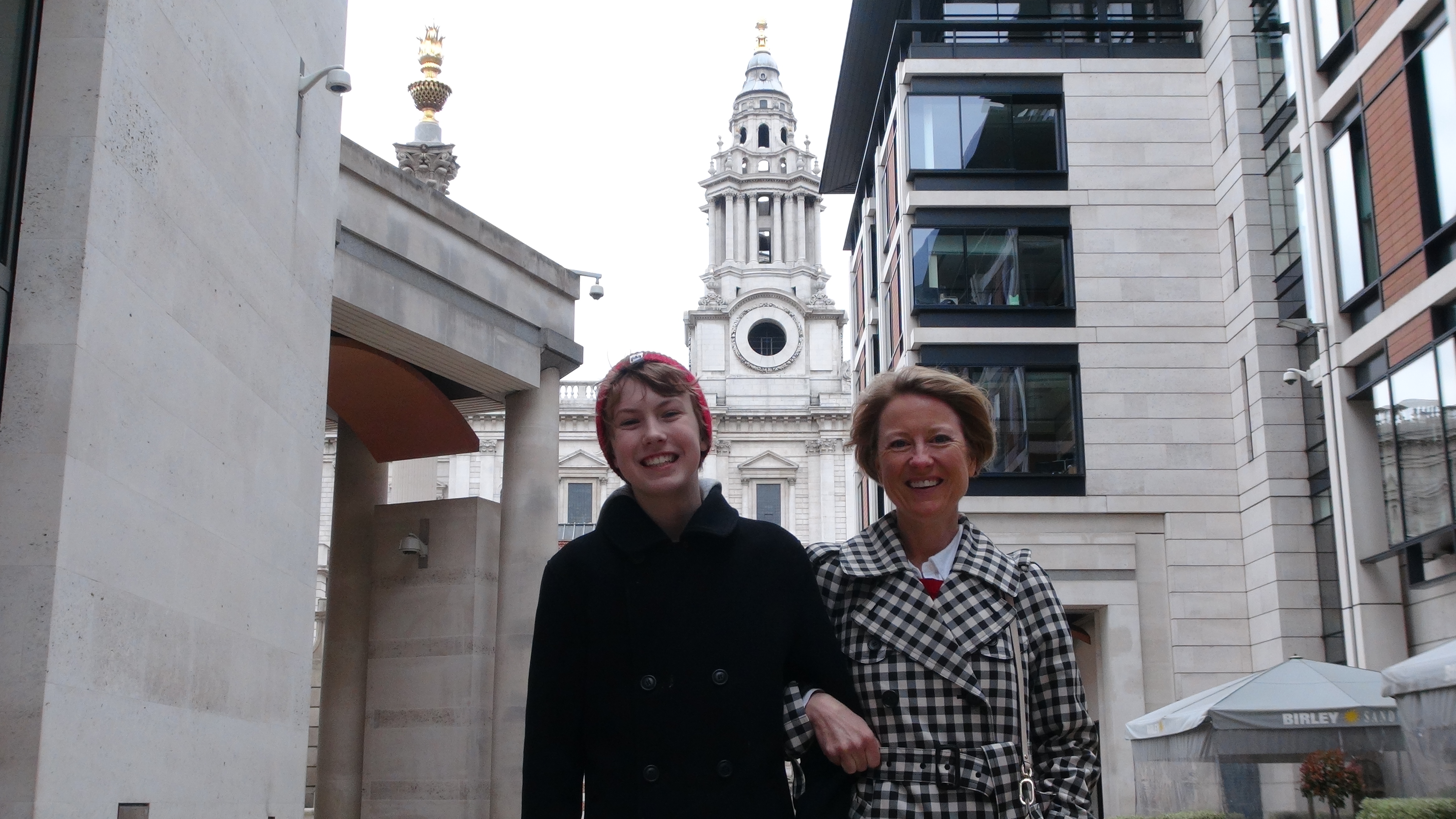
Will and Courtenay with St. Paul’s in the background
Rick had reserved us a hot table at a chop house nearby — only to find out when we showed up that he had reserved it at a pub of the same name — and that the chop house of the same name was closed on Saturdays. Will declared the pub smelled bad, so with a hunger-storm-food-mood brewing, we took off for the appropriately named Bread Street and chanced upon a Burger and Lobster joint (surf and turf taken to extremes) that Will declared was our lunch spot. The lobster was rubbery, but hey, Will ate at least half of his bacon-and-cheeseburger we were able to forge on …. to the Museum of London.
Nothing is very far away in the center of London, so we sauntered over to the museum, built just on the edge of the 2,000-year-old Roman wall that once ringed the city. The museum traced the city’s pre-history, through the Roman times circa 55 BC to 407 AD, Anglo-Saxon settlement, Viking invasion, medieval, Renaissance, Restoration, up to the present. It was well worth a visit — though Will said he’d seen all the medieval stuff already in his fall Cultures class (thank you Paul Monheimer). I loved the Roman artifacts, while Will preferred the reenactment video of a gladiator fight. Rick seemed most fascinated by the medieval history, up to the great fire of 1666. We marveled that since Will has taken up saber fencing, he no longer demands we buy foam or wooden swords to lug around with our luggage. “I have enough swords now,” he said.
You will not believe this, but as I am talking to these yahoos about what they liked about the museum, they claim I, me, Courtenay, was the one who forced them to speed through the Victorian and modern ages. I was only trying to be nice, since Will seemed to be DONE with the museum experience. Rick says, “God, we spend an hour just looking at chipped stones, and then we had to get out of there…”
Next we headed off across the Millennium Bridge to the Tate Modern, a converted power station, which was extremely crowded, this being a Saturday. Rick interpreted the works, and we made a game seeing how close he was what the artist actually intended. He actually did pretty good — a lot of artists struggling with modernity and technology. Will found a painting called, “Grey,” which was very grey, and really only grey, most interesting. Rick liked a neon blue rust-encrusted engine that spoke to his soul. Or something. I guess we were getting tired and a little loopy.
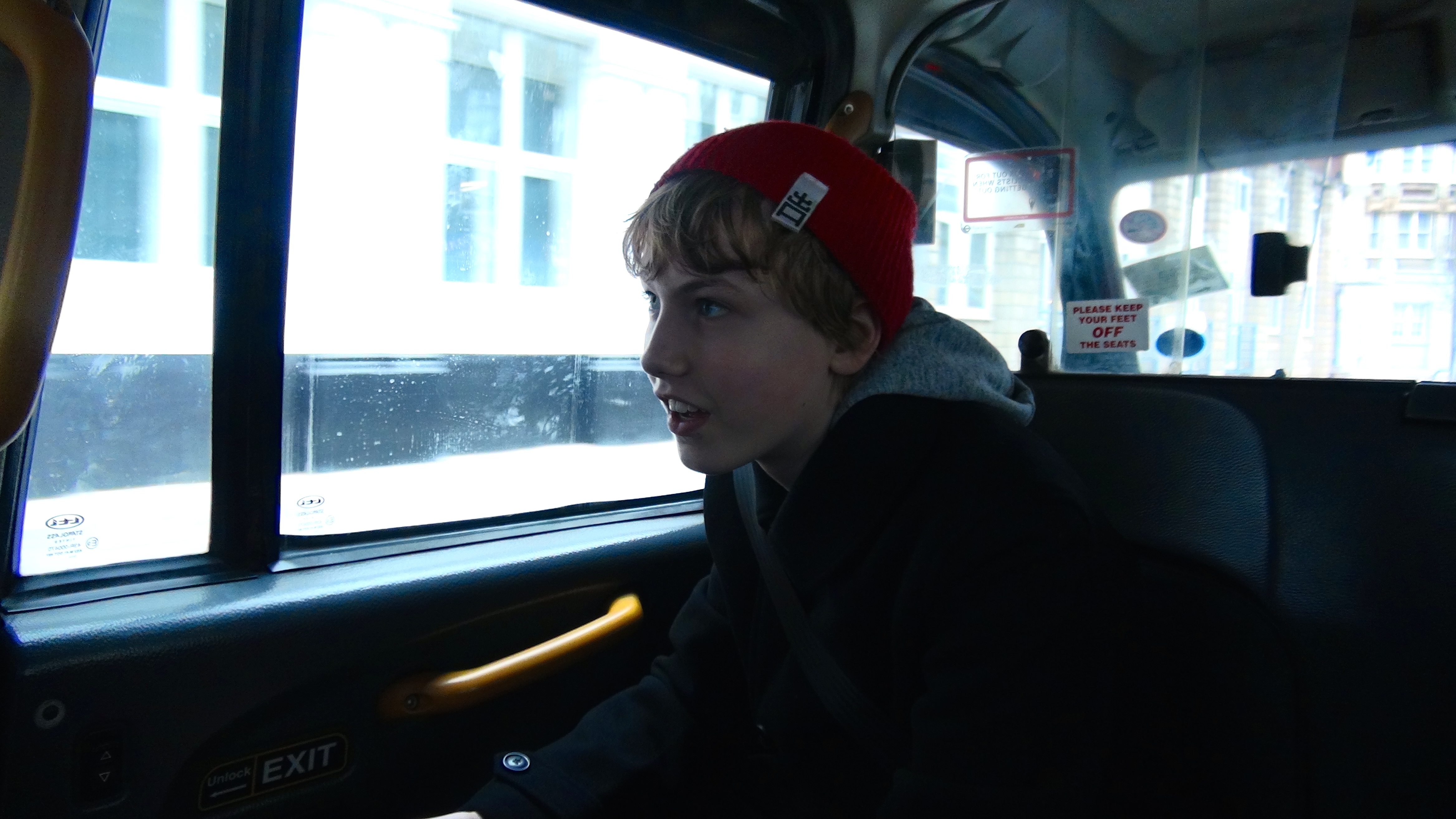
Will in the jump seat of a Black Cab (Working on the checklist of must-do things that his friend Ian gave him)
We ended our day in a black cab, where Will rode in the jump seat, on the recommendation of his friend Iain. And at DaCorradi Italian restaurant, where Will ate enough Spaghetti Bolognese to send him into another 13-hour sleep. Buona Notte from London!
Kilkenny, Republic of Ireland, Monday, August 5, 2013 – Heavy rain showers and wind overnight muffled the sounds of pub nightlife as late as 3:30 a.m., as shouting revelers “pub-crawled” the streets of this medieval city. But we slept well in our wonderfully located B&B, a historic manor house used by the local Earls while their nearby castle was being renovated. You can see the castle from our windows, which overlook a large garden and the restored horse stables of the castle. Both the Butler House, where we are staying, and the horse stables – now a wonderful local craft center – were restored with public dollars, and are now run by some sort of trust.
Renovation was the theme of the day, as we toured Kilkenny Castle. The Anglo-Norman stone castle was originally built in the 12th century, and has been remodeled extensively over the 600 years that the Butler family was in residence as the local noble family and landowner. The family finally auctioned off all their furniture and books in 1935, as they left Ireland for England in the wake of Irish independence and Irish hostility to the Anglo-Irish overlords of yore.
The place fell into ruin until the 1970s, when renovations began. Today, the castle is being slowly restored, room by room, and the results are beautiful. Guides explained how the history of the castle reflects the tensions of Irish history – Kilkenny residents today are very proud of their castle, a major tourist draw. But not long ago, it was a painful reminder of the English domination of Ireland. It is a painful to think about the juxtaposition of opulent Chinese and Moorish decorations added in the 19th century – the same time as the Great Irish Famine of the 1840s. Apparently, the ruling noble Butler at the time, who kept a meticulous diary, never once mentioned the famine, though dying people would have been visible everywhere had he left the castle, noted one guide.
We then ventured through the streets of Kilkenny, down narrow medieval alleyways and shopping streets. We ate in Kyteler’s Tavern, famous as the home of a noble woman named Alice Kyteler, accused of being a witch. She escaped to England, but her poor maid was burned at the stake on the site of the town hall. Today, the pub is famous for its music, and marginal bar food – Dad stuck to a strict whiskey-and-apple-pie diet, just to play it safe.
We then wandered past the Black Friary, named for the black robes of the Dominican friars, and ended up at the Cathedral Church of Saint Canice, for which Kilkenny was named. Will and Rick climbed up the 100-foot-tall tower built in 849 AD. They said it was the scariest tower they have ever climbed – the wooden steps were narrow and crooked and very cramped. It’s amazing it is still standing. The cathedral itself was built between 1202 and 1285. It has an evocative graveyard, and the cathedral itself is filled with sarcophagi. We found one particularly interesting one, containing a Butler nobleman and his wife, one Margaret Fitzgerald. It turns out she is a daughter of the Earl of Kildare, which means she is probably related to Will’s friend Kazu Fitz-Gerald, who is also related to the earls of Kildare. Cool Kazu! We said hi! And her husband carried a huge sword! Perhaps he fenced sabre, we are not sure.
Rick and the kids are now headed to the beautiful green lawn of Kilkenny Castle, a wonderful park, to play “hurling” with Will’s new hurling stick and ball. I don’t know much about it, but it appears to resemble cricket somewhat.
We were supposed to take a short drive this afternoon to see some famous monastery ruins, but slowness was the word of the day and the black Mercedes remained firmly parked in the car park. Tomorrow, off to Glendalough, the Wicklow Mountains and Trim, ancestral home of the Plunketts (but perhaps not our Plunketts.) Stay tuned.
KILKENNY, County Kilkenny, Aug. 4, 2013 – We began our day in Dingle, my favorite Irish town so far, remembering the sweet sounds of traditional Irish music and the screams of laughter from two groups of costumed young women out for bachelorette parties that crashed O’Flaherty’s Pub last night. It was another travel first, sipping Irish beer while watching young women dressed in “Where’s Waldo?” red-and-white stripes guzzle Coors Lite over ice and play ring toss with a three-foot-long inflatable BEEEEP! Mitchell declined to take a toss.
Today was a day mostly spent on Irish roads, from the narrow mountain road over spectacular Connor Pass on the Dingle Peninsula to the controversial M8 superhighway that skirts too close to the ancient Rock of Cashel. (Note from Courtenay – it was a super great freeway! Best road in Ireland! J Rick says I’m an un-eco-conscious ugly American, but I guess I’ll have to live with that label.) We left Dingle at 9:30, retraced our route to Tralee, cut past busy Killarney and buzzed through Marrow and Mitchelstown, whereupon we took a brief break. Will, already road-weary, took advantage of this timely roadside stop to puke. That makes two Western European nations—Italy and Ireland—that he has graced in this manner. Not to mention Japan…
We rolled into the town of Cashel about 2 p.m., had a minor tired-couple argument over the choice of parking lots, endured a fairly bad pub lunch and made our way up the hilly town to the Rock of Cashel, an acropolis topped with the ruins of a castle, an ancient cemetery and three different eras of Christian churches dating back to 1100 AD. The sun was shining as we sat together on a rock wall at the edge of the cemetery, an iconic round tower above us, sweeping views of Irish farms below, taking in the place that has been at the center of so much Irish history. (Note from Courtenay: we only got to sit there for about five minutes. Then we got to get back on that super-good super-fast super-convenient M8 freeway and scream off to our next B&B)
With Mitchell navigating, an hour or so later we entered Kilkenny, a mid-sized Irish town that dates back to medieval times, and made our way down busy narrow streets lined by shops, bars and restaurants, to our hotel, the Butler House. (Note to Yosuke: I drove this on Google Maps before we came and it rocked to know where we were going!) The hotel backs up to Kilkenny Castle, one of Ireland’s great restored castles. We huffed our bags inside and up several flights of stairs, the friendly hotel proprietor, Richard, gently steered us away from our planned dinner destination (bad pub grub, he said) and found us two tables at a terrific Italian restaurant, Rinuccini’s. After a big meal including handmade pasta and much liquid refreshment, Gene headed for a self-guided tour of the huge wine cellar beneath the main floor of the restaurant. We were worried that the fire trucks outside had been called to deal with this intruder.
After dinner, we wandered across the street to the beautiful grounds of Kilkenny Castle, which was carpeted with Irish-green grass and stately oaks and maples. We approached a low stone wall that looked down on the river that makes a slow turn in downtown Kilkenny. A lone kayaker made his way downriver. It was all beautiful and serene, and then Mitchell looked across the river and saw something floating on the far bank. It was, naturally, a large foam BEEEP!, one even lengthier than the unit that was in play in Dingle. What is it with this country?
As if in answer, the funny, gregarious guard named Matt O’Neill who ushered us off the grounds of the castle as the park was closing told us the key to understanding Ireland. His country, he said, is like one of those stubborn door locks that is reluctant to open. So here’s the secret, he said, to gaining access to the real and true Ireland. With a big grin, miming shaking a key in a frozen lock, he said, “You just have to give it a jiggle.”
Dingle, County Kerry, Ireland, Saturday, Aug. 3, 2013 – Back to the Dingle Penninsula. Today we had a wonderful day touring Slea Head on the Dingle Penninsula. We set off in our two cars with the sky, as always, threatening rain. The proprietor of B&B said it was the best possible weather to see the pennisula, because the clouds and rain showers make it all the more dramatic and beautiful. She was right.
We visited a sad little “Prehistoric/Celtic” museum and then some beehive stone buildings. Both were privately run and required admission, and both were disappointing. “Piles of rocks,” Grandpa declared them as he climbed up the treacherous path strewn with rocks and sheep poop.
We did like Dun Beg, a prehistoric stone fort set on a cliff above the sea. It was almost dizzying, with the bright green hills lined with stone walls rising dramatically above a remarkably blue and green sea.
We fought traffic on the narrow, twisting road to a lovely hidden beach, with stunning views of the nearby Blasket Islands. We finally stopped at a pub, Tigh Bhric Pub, recommended by Rick Steves, which was deserted and hosted by a woman who was frosty at first and unhelpful.
We sat down, and then figured out that we had to order at the bar. It turned out all the food was homemade, and delicious, and she wasn’t unfriendly at all, but just trying to hook up a new beer keg.
She said she was from Dublin, “Blown In,” as the locals would say. “You are forever blown in,” she said. Even though she had lived there for years, she said that people would still say of her grandchildren, “Their mother was from Dublin, you know.” She said you also had to be very careful of who you are talking to, since everyone on this peninsula seems to be kin of some kind. She was extremely kind, and brought me a book on local archaeology to read over lunch, and told me all the directions to all the local ruins, which was very confusing. She kept saying I had to make a horseshoe, and that made me even more confused. But because of her, we did visit all those sites, even though our group was getting tired and itching to head home.
And it turned out they were the best ruins of the day. There was the Gallarus Oratory, a perfect, rain-tight, beehive-shaped church 1,300 years old – an early Christian church, basically. Perhaps 12 priests could sit in the tiny interior space. We also saw the low stone ruins of a monastery, extremely evocative with an ancient Celtic stone stele remade into a Christian cross with some creative carvings. This site overlooked the gorgeous sparkling bay, where 300-plus years ago a Spanish armada ship ran around and its 600 occupants massacred were by the English.
We finished at the ruins of an old church, Kilmalkedare, and its haunting graveyard, not to be missed, with ancient writings on steles and tombstones worn down to nearly nothing. It was a 12th century Romanesque church used by the Normans, though the site dated back to much earlier Christian worship, and before that to pagan rituals and rites.
The landscape all over the peninsula was lush, dotted red by fuschias from Chile, growing like weeds. It felt like Hawaii at times, with its vast vistas and lush vegetation. It had apparently once been covered by oak forests, but it was hard to picture that now. So much from the past is so hard to imagine, but so magical to think about.
Editor’s note: These posts are without Rick’s camera because it got wet in LaHinch and died. We’ll try to post some of Alex’s great photos.
Bunratty, County Clare, Ireland Friday, Aug. 2, 2013 – Coming up for air on Day 5, late afternoon, after a full day of touring the stunningly beautiful Dingle Penninsula; Mitchell and Alex visiting the Dingle Brewery for their free pints; Rick, Will and Grandpa shopping the narrow streets of this tiny touristy fishing village for train stuff and a hurling stick; Grandma and I catching our breath in the lovely Emlagh House B&B overlooking Dingle Bay.
Whew. Yesterday, we drove from Lahinch to Dingle, stopping at the Bunratty Castle and Folk Park between Shannon and Limerick on the way. We’d read that the Bunratty Castle was a “tourist trap” and “Disneyesque” for its recreations of 19th century buildings and costumed “re-enactors,” but it turned out the criticism was unfounded. The castle itself, dating to 1425 AD, was restored in the 20th century and gives visitors a wonderful glimpse into how high society lived in medieval times. In short, it looked pretty grim to us. Yes, the Earl and his family would be safe behind the massive walls and drawbridge, up on floors beyond the “murder hole” where boiling pitch or oil could be poured on invaders/visitors and the trap-door 16-feet above a bunch of spikes, and the dungeon and the soldiers and all that. But for all that, they lived in cold stone, with claustrophobically winding spiral staircases between chambers, and huge smoking fires. The air quality must have been atrocious.
There were wonderful guides on hand (no costumes in sight), explaining how the massive furniture was brought up the winding stairs in pieces (like Ikea, noted one visitor), and how they heated their wine in special iron stands by the fire – Mom loved this detail. We saw antlers from the massive and now extinct Giant Irish deer. The recreated village itself – while lacking the mud and poverty and misery of 19th century Ireland — was a pleasant stroll and a great chance to stretch our legs. We even dared eat at the on-site pub, run by the McNamara family, who are apparently descended from the original castle builders. And it was a delightful meal, with extremely friendly staff and great food.
We’ve been laughing this whole trip at how grumpy Grandpa is (those of you who know him know what we are talking about) and how forgiving the Irish are of his temperament. The night of our interminablly long seafood dinner in Lahinch, when asked what he wanted for dessert, Grandpa managed to rudely grunt, “Uhhhhh, fudge,” indicating the brownie. Instead of looking at him askance, the Johnny-Depp-look-alike-waiter laughed.
Then at lunch yesterday at McNamara’s Pub, Grandpa loudly declared he wanted a “12-year Bushmills” whiskey. When Daragh, the waiter, said they did not have 12-year Bushmills, Grandpa shouted back that he did, he’d seen it in the window. (Actually it was a dust-covered bottle that was part of the “antique” display). Daragh offered him a local whiskey, which Grandpa refused, again insisting on the “12-year Bushmills!” We overrode Grandpa and told him to order the local whiskey.
“He’s really not grumpy,” I told the waiter, sardonically.
“Oh, he’s in the right place,” said the waiter, winking and heading off to get Dad his whiskey, Dad’s new Irish favorite, Knappogue.
So we’ve come to the conclusion that yes, Grandpa really has returned to his roots, to his people, who instinctively understand him. Although he’d never known until the past few years that he was of Irish ancestry, and had always identified as a Scot, now he is broadening his identity, I like to think. Irish whiskey, which he had never before tried, is actually “good,” according to Dad. Thanks to our cousin and geneaologist Patricia Plunkett Holler, we now know that Dad’s family on his paternal grandmother’s side traces back to the Plunketts born in the 18th century in northern Ireland near Belfast. We will visit there at the end of our trip, but I think Dad has already found his homeland.
Lahinch, County Clare, Ireland, Wednesday, July 31, 2013 – The sound of rain and the comforting voices of my parents quietly murmuring in the room above us woke me this morning in this beautiful spot by the sea. We all slept well, feeling much more clear-headed than yesterday, almost like it was really our first day in Ireland.
We ate a delicious Irish breakfast around a big oval table in the dining room – pancakes and berries, a bagel with coils of locally smoked salmon from Lisdoonvarna, fresh pastries, eggs benedict, lots of hot coffee – just what we needed to steel ourself for Rick’s first day as our tour guide. His description of the day ahead: “We are going to see some old stuff, and then some really old stuff.” Thank you, Tour Guide Rick.
We boarded our cars, one with a brand new 140 Euro front tire, thanks to an amazing mechanic in Ennis named Brian (M&M auto shop in case you are ever in need), and set off for the Burren, an expansive landscape of rock that is an ecological and archaeological treasure in Ireland. The limestone, from the Irish word “borieann” for big rock, is an example of (for you geologists out there) a glaciated karst with underground caves and rivers.
We walked through Kilfenora Cathedral, which has roots back to 560 AD, just after St. Patrick legendarily entered Ireland to bring Christianity to the island Some locals in Kilfenora recently spent eight months researching the tiny town’s history and have documented 1,500 years of trauma and drama in what looks like a very sleepy town today. A volunteer guide (and one of the researchers), whose pale but bright blue eyes and shock of white hair looked quintessentially Irish, told us the legend of a local woman warrior who married a succession of men, who quietly disappeared, leaving her with all their lands. The cathedral itself dates to the 10th century, and there are beautiful, weathered Celtic crosses from the same era. It was raining hard the whole time we were there.
We then visited a 10th-century ring fort built of stone, of which 45,000 are found in Ireland. They were not really forts but places for families and livestock to live. Apparently, the bigger the ring fort the higher the status of the family. By this time, the rain had really taken hold. All of us were soaked. Will, who wore shorts that we had warned him not to wear, was the only one who didn’t have pants soaked from the knee down for the rest of the day!
We then visited Poulnabourne, an amazing neolithic burial dolmen dating to around 3,800 years BC. Thirty-three children and adults were entombed there, under a tripod of stone holding a massive capstone. Almost 6,000 years old, earlier than the pyramids and Stonehenge, they are oriented toward the rising sun. Other dolmen in the Burren are oriented to the setting sun. It was lovely, but the rain was so hard that it was almost comical as we slipped across the deeply cracked limestone. It was once a spiritual place, and I could see that, but for the tour buses disgorging the umbrella-sheltered tourists. I think the time to see it is perhaps in dead winter, with no one else around.
We then drove to the lovely town of Ballyvaughan, the most picturesque village we have seen so far. We wished we could have spent time there, but we had a lunch reservation (thanks to Tour Guide Rick) at the Tea and Garden Rooms, which was the perfect shelter from the storm. The food was delicious, and we realized we were the wettest people there – except for the poor couple in bike gear who were truly soaked. After driving these roads, I can’t imagine biking them. There are signs that say “Speed limit 100 kph, Drive safely” right before the road narrows to basically bike-path width and stone walls close in on you from both sides just before a sign announding “Severe Bends Ahead.” And you’re like, really? 100 kph, drive safely on a hot wheels track? And don’t even talk to me about the tour buses. Dad keeps screaming at me that I’m getting too close to the rock walls, and I’m like, well, it’s better than hitting the oncoming traffic.
On to the highlight of the day. We were discussing at lunch whether to go to some 50-degree caves in our wet clothes and shoes or whether to go to the B&B and get dry clothes or whether to go to the Cliffs of Moher – the most iconic sight perhaps in all Ireland, and one which Mitchell declared he would not leave Ireland without seeing – and Will declared in his turn, “Let’s do it now and get it over with.”
We drove through a lovely green landscape dotted with unnamed (to us) stone ruins and cottages and destroyed castles to the Cliffs of Moher, which hundreds of thousands of people visit a year. We all walked up to the O’Brien Tower, which I thought looked like a cheesy recent construction for tourists but turns out to be an early 19th century attempt for a local landowner to impress his friends. Will and Grandma climbed the tower to view the 600-foot high cliffs, which curved away to a dramatic drop to the ocean below. Rick and the kids then walked a two-mile loop south to see other dramatic view of the “angry sea,” as Tour Guide Rick descibes it. By the way, he broke his toe yesterday on a chair in the B&B, and he didn’t even complain all day until we got home, and we could see that the blue contusion is reaching up his foot like gangrene. “Angry gangrene,” as Tour Guide Rick describes it.
To be serious, the Cliffs of Moher were one of the more beautiful natural sites we’ve ever seen, despite the tour buses. It was great to hear all the different languages of the visitors, and to know that this was not crowded by Beijing standards. By those standards, it was a ghost town.
 The Thompson Attigs