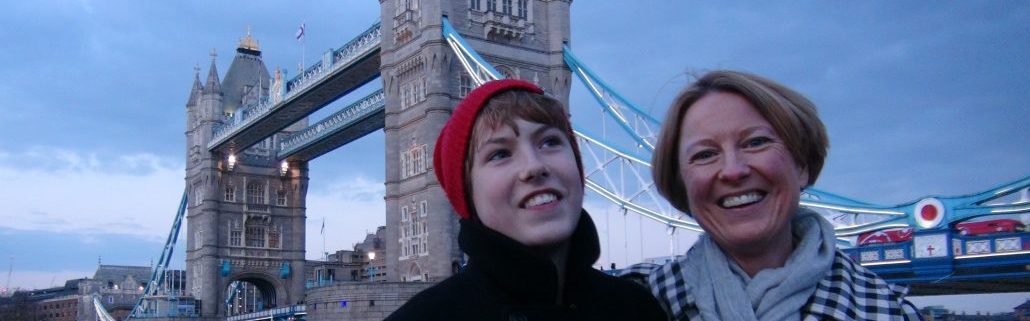
Baruto and his Bathroom Slippers

Friday, March 27, 2009

 Well, we checked out of our Tokyo hotel this morning and boarded the “Odoriko” Express train for Shuzenji, an old and famous onsen, or hot springs, town 2 hours southwest of Tokyo. It’s called “Odoriko,” or Dancing Girl, for the famous short story by Nobelist Yasunari Kawabata called “The Dancing Girl of Izu.” Shuzenji is located in the center of the Izu Peninsula and is famous for being the stage-set for various bloody family infighting among the Kamakura shogun families of the 12th to 14th centuries. These stories include a mother ordering the assassination of her own son, and another of a brother betrayed, imprisoned in the temple, and who later committed seppuku, or was poisoned by lacquer in his ofuro, or bath.
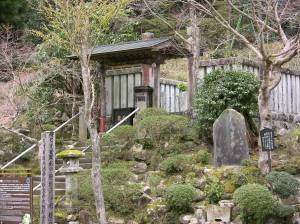
Yoriie Minamoto's Tomb
Yoriie Minamoto’s Tomb

 In addition, Kobo Daishi, a famous Buddhist priest, supposedly founded the Shuzenji temple in town and caused a hot spring to erupt from the ground at the spot where he saw a young boy bathing his father’s feet, trying to heal his illness. (The spring, called Tokko-no-Yu, is being rebuilt in the center of the river that runs through town, so the entire stream bed is torn up –not very picturesque, but it will be nice when it is done.)

 Much later, in the 19th and 20th centuries, Shuzenji became a favorite haunt for various famous writers and artists, including Natsume Soseki and Kawabata.
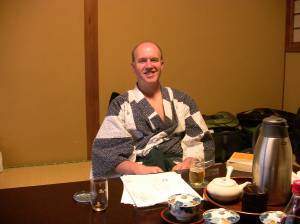
Rick-Ruto relaxing with Beer-o

 Enter a 21st century writer, Baruto, or as we like to call him, Rick-ruto, after the massive Estonian sumo wrestler who is either tossed on his ear from the ring, or who literally picks up his opponents, carries them to the side of the ring, and deposits them unceremoniously outside the sumo ring. Baruto is a little hairy, a little easy to mock, and Will and I like to tease Rick that Baruto is his alter ego.

 So we arrived at this hot springs town this morning, and left our bags at an old ryokan dating back more than a century. All of the buildings are national cultural assets, which means among other things, they are old. And cold. We toured the town, its temples, shrines, gift shops and tombs of the various slain Minamoto family members, and then settled into the ryokan for our first dip in the hot springs. We went to a private “family” bath in the basement, where I could show the boys how to bathe and not get soap in the onsen. The drill is you bathe sitting down on little plastic stools, get totally clean, rinse off and only then do you enter the communal hot bath. Well, Rick got it almost right, except he tried to shower standing up, and then, God forbid, squeezed his washcloth onto the rocks that flowed into the hot onsen. I mean, that’s like, super bad. But what everyone after us doesn’t know, won’t hurt them, right?
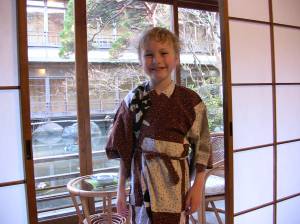
Will in ryokan room overlooking koi pond

 Then I had to stop another disaster when Rick wanted to use the tokonoma as a luggage rack. The raised tatami matted area called the tokonoma is a special area of the room, which features artwork such as a scroll and ikebana, or flower arrangement. Oops. Not a luggage rack.

  Our room is a large tatami-mat room, complete with attached private bath and toilet, and a little sitting area looking out on a koi-filled pond. Once we’d settled in, had our bath and were lounging in our robes, Rick-ruto pulled his gravest faux pas ever. I’d told him perhaps five times in the days leading up to the trip about the “bathroom slippers,” plastic slippers that are used in and stay in the toilet area of a bathroom. I’d been afraid he’d go answer his door at the hotel or something and have on the “potty slippers,” which would be super bad. Anyhow, I’m sitting in the tatami mat room and here comes Rick, holding the potty slippers in his bare hands, saying “Someone forgot their slippers in the potty,” implying Will had made a big transgression. I screamed, “No not the potty slippers!” Ok, so I’m being dramatic, but it was incredibly funny. And it showed how much Rick doesn’t listen to me when I’m talking.
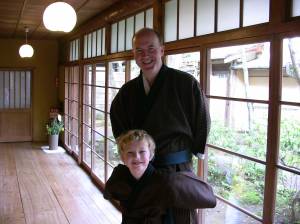
The hall outside our room

 Will has been loving the ryokan experience and looks quite adorable in his little yukata robe and tanzen jacket. He grooved on being served dinner in our room, which was a long and elaborate meal. Rick was slightly, but not totally, freaked by the grilled pregnant fish full of eggs (he may not have known they were eggs and I didn’t have the heart to tell him, though Will noted they tasted like the tobiko on sushi); but it was the other grilled fish head, which was quite delicious, that nearly got all of us. Rick asked Will if he wanted the eye, to which Will answered that he was adventurous. However, when Rick popped the eye out with his chopsticks and it went squirting through the air, all of our gross-out meters went off. The eyeball was not eaten.

  Whenever we couldn’t finish something, it seemed to disappoint the woman who looks after us here. They have an army of kimino-clad women whom Will has dubbed “tea travelers,” because they can been seen hurrying down the corridors bringing tea to guests. Rick doesn’t want to disappoint our tea traveler, a lovely woman who serves us meals in our room and makes up our beds, so he is planning to throw what we can’t eat at tomorrow nights dinner to the carp outside. He’s just kidding, of course, but the image got us all to laughing. And then Rick said he was going to take the video camera to the all-men’s communal bath, and tell them he was going to make a Youtube video of the men’s bath,  and then he would cannonball into the onsen, and ask all the other men why they weren’t wearing their potty slippers, which being plastic are waterproof and thus perfect for the onsen. OK, maybe you had to be here, but we were all rolling on the tatami mats weeping with laughter. Perhaps we need some sleep. But much to Rick’s dismay, we have to wait for our tea traveler to lay out our futon so we can sleep. Things are tough all over.

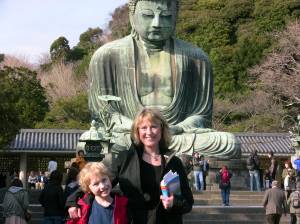
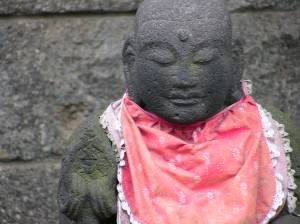
Shuzenji Buddha
Shuzenji Buddha

52 Floors Up, Up and Away

Thursday, March 26, 2009

I’d forgotten how impossible it is to find restaurants in Tokyo. Though, as I mentioned before, it’s infinitely easier than it was before the Internet. Twenty years ago, I remember my friend Laura Silverman and I wandering the streets literally for hours, looking for a restaurant we’d heard about, before finally giving up and eating at some cheap yakitori-ya near the train station.

On Top of the World, 2005

 Well, we suffered from the same predicament last night. We’d chosen Bird Land, a yakitori place in Ginza recommended by several books and websites, and set out after the sumo tournament ended. Streets are not marked here, nor are there numbered addresses. (It was funny; today, I asked a police officer where Akasaka-doori was, a totally major street, and he didn’t know. It was the street we were on.) Anyhow, we had a map, but couldn’t find the place because there was no sign on the street. I finally remembered to figure out what building it was, Tsukamato Biru, and was able to make out the kanji on a sign. We took an elevator to the basement, and lo, there was Bird Land. But it was manseki — no seats available. 

Hieijinga, Akasaka

So at 6:45, with a very hungry child, we set off for the yakitori shops under Yurakacho station. But none looked right, or I couldn’t read the menu well enough, and we finally found one near our hotel. But most of the offerings, as I inquired as to what eat item meant, were liver, heart, skin, gizzard — AAAAGh. Perhaps I’d eaten these things blissfully in the past, but somehow knowing what they were made them less appetizing. We ate some skewers, including some very delicious shiitake mushrooms — no rice, no sprite  — and came back to the hotel and crashed.

Today was Rick’s last day of his fellowship, and it was a glorious blue-sky day, though cold, and clouds moved in midday only to dissipate later. Will slept until after 9:30 (apparently the 20,000-plus step days are getting to him, not to mention that my legs are sore from hiking up and down all the subway staircases — Will refuses to let us use the escalators to increase our pedometer counts). Because we missed breakfast at the hotel, I went on-line to figure out where I could get an American-style breakfast for Will. We went to Akasaka to find a 24-hour breakfast place called Anna Miller’s, but of course, after searching, and stopping a very nice woman who used her cell phone to help us find it, we found out it had gone out of business. So we went to a creperie, ordered Will a crepe with eggs and ham on top, and of course, it was weird for Will, and he did his best to eat the eggs and ham without touching the crepe. He’s picky, but he’s becoming much less freaked out by strange food. Two years ago, he would have burst into tears. Today, he made the best of it. He’s growing up.

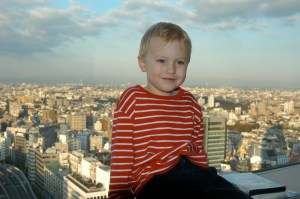
On top of the World 2009

We then went to our favorite donut shop, Neyn, bought another six donuts, and wandered through Akasaka to Tokyo Midtown, which is this enormous, weird skyscraper/shopping mall/art museum/park/Ritz Carlton complex that defines new Tokyo. Unfortunately, the museum was closed, much to Will’s disappointment. So we walked to Roppongi Hills, a slightly older weird skyscraper/shopping mall/art museum/park/hotel complex. There, we took an elevator to the 52nd floor of the Mori Tower, which took a bit of courage on my part, because I am afraid of heights, and skyscrapers, and earthquakes. I was picturing how wildly we would sway if a big earthquake hit! But the view was totally amazing, 360 degree view of the city stretching out as far as you could see. We could see all the places we have traveled these last seven days — it was a great capper.

 We then returned to Akasaka to find a recommended Udon restaurant, but of course, couldn’t, so we settled for a Chinese restaurant where Will devoured the fried rice and charmed the staff, though the waitress couldn’t tell if Will was a girl or boy. Perhaps he needs a haircut???

 So we’re back at the hotel, watching Yamamotoyama face an opponent half his size. He’s not been doing well, so we’re hoping for this 252-kilo underdog. (no way that’s his weight, it must be in pounds.)  Hope you are all well. We’re off tomorrow for Shuzenji and the hot springs/Japanese inn experience. Tonight, kaiten sushi, or kuru-kuru zushi, Jimmy Maslen’s favorite, on a conveyor belt. It’s usually not the best sushi, but we figure 5 minutes from the Tsukiji market, it’s gotta be way better than anything back home.

Old Edo, Oregon Wine and Sumo!

Wednesday, March 25, 2009

Will visits Sumo Museum and Stadium

Today was a more mellow day here in Tokyo. It was rainy, and we had Rick to ourselves today, because his interview wasn’t until this afternoon. We visited the Fukugawa-Edo Museum, which is a lovely, deserted museum across the Sumida River. Inside, a small block of the Edo (former name of Tokyo) of 200 years ago is recreated in life-size buildings. We were the only visitors to the atmospheric place, which had recorded sounds you would have heard, mood lighting and buildings like the home of a sawyer, a tavern, a rice-seller’s home – all of which you could enter to explore the tatami-matted rooms filled with old furniture, straw “raincoats” and the everyday artifacts of Edo life. A 24-hour day, complete with sunrises and sunsets, passes in 25 minutes. We met a lovely woman who worked there who was excited to tell us all about the place and life 200 years ago in Edo. We were the only visitors this morning, which made it seem even more special and mysterious.

After that, we zipped up the subway line to nearby Ryogoku, where Will and I had visited the Edo-Tokyo museum yesterday. We wanted to visit the Sumo grand stadium and the small museum there. We have become sumo-crazed on this trip. We’ve decided that the next time we come to Japan, we will come when there is a sumo tournament we can attend, and when all the school children will be safely in school so we can visit Disney Sea. The museum was small, but interesting, and I got to see my favorite sumo, Chiyonofuji.

On the Subway

This afternoon, while Rick was off visiting a rooftop garden in Roppongi Hills, Will and I went back to the restaurant court at Shin-Marunouchi, where Will picked out the restaurant with a view over the Imperial Palace. Raw horse sashimi was on the menu, and I was tempted, but we went with more traditional sashimi, miso soup and rice. After that, we wandered Ginza looking for a wine shop selling Oregon wine, because Rick wanted to get some for his guide, who loves wine. There are many wine shops in Ginza, but the only American wines are Washington and California. Finally, we were able to get the name of one shop nearby. Thanks to the Internet, I was able to find its location, and I later went out and bought the only two bottles of Oregon wine in the place – a Sokol Blosser and a Willamette Valley pinot. They told me Oregon wines are too few and too expensive. But I was able to have the wine wrapped, and I told Rick to tell his guide, Suzuki-san, that both the Oregon Democratic and Republic parties are represented, a balanced wine flight.

 Will is now drawing sumo cartoons while we watch the sumo tournament, and the sky is turning to evening. Tonight, yakitori for dinner. If we can find the restaurant, Bird Land.

The Big Buddha Hiking Course

Tuesday, March 24, 2009

 In the morning, Will and I went to the Tokyo-Edo museum near the sumo headquarters in Ryogoku, about 20 minutes from our hotel. The museum, which traced the history of Tokyo, was fun for Will, with its reconstructions of old houses and displays of samurai armor and swords.

A truly Big Buddha

  We then met up with Rick for an impromptu trip to Kita-Kamakura, an hour’s train ride south, in an attempt to get away from the hordes and enjoy the start of spring at some beautiful Zen temples. The Engaku-ji temple was beautiful and peaceful, a world away from Tokyo, and Rick declared himself to love temples.

 We then embarked on the “Big Buddha Hiking Course,” which my guide book billed as a “meandering 2.2 kilometer path” to the 40-foot-tall Big Buddha in Kamakura. Not. It was more like hiking in the Wallowas over rutted out tree roots that threatened to trip you plunging over cliffs a hundred feet high. I was wearing a skirt and my city shoes. Oh, also, we had planned to eat lunch in Kita-Kamakura, but oh, there wasn’t any place to eat. So we set off, without lunch or drinks, on this nasty path, meeting people in dress clothes and high heels all the way along. They all looked totally unfazed.  I’d forgotten how bizarre Japan is. Fortunately we bought some tea from a vending machine halfway through the forced march. Will had a blast, however.

 We finally got to the Big Buddha, crawled inside its hollow 40-foot hull, took a few photos, and  took a train back to main Kamakura, grabbed sushi at the train station to eat on the way back to Tokyo, only to find ourselves on a commuter train, where it was impossible to eat. I made Will eat his inari-zushi, though he was embarrassed. He perked up about 45 minutes later, as we approached our station.

 We picked up food at Shimbashi station near our hotel and ate in our room, watching the end of sumo, the news and now a totally corny and wonderful variety show with a bunch of wacky Japanese. Also coverage of Ichiro, who batted in the winning run for Japan in the World Baseball Championships. Woo hoo!!!


Dodging a Disney missile

Tuesday, March 23, 2009

A happy explorer

 Well, Will broke the 30,000-step pedometer sound barrier yesterday, racking up 34,804 steps in one day. Somehow, I only came up with 29,000 steps, but we were both duly exhausted at day’s end.

  We started the day out with an attempt to go to Sea Disney, a theme park next to Tokyo Disneyland. We knew it was a risk, since some school children are out for spring break this week, but we hoped that enough of them were still in class to make a visit worthwhile. We’d gone to Disneyland three years ago, and were appalled by the 2- to 3-hour waits for rides like the Teacups. It really isn’t fun to wait 3 hours for a 3-minute ride.

 So Will and I struck out for Tokyo station – which at rush hour was an experience in itself for Will. His eyes were literally wide as he clung to me and watched the ocean of people pouring out of the trains, onto the platforms and down the stairs. It’s hard to describe the feeling of trying to swim across such a mass of moving people, thousands of them rushing to get to work, as you try to get to a safe eddy out of the literal cascade of people down the stairs. After we braved the commuters, we had to walk a long way to the platforms for the train headed toward Disneyland, and I could see from the number of young people that we were in trouble. A woman with a bullhorn was making some announcement that sounded dire, but I couldn’t understand it very well, so we soldiered on. Finally, we reached the stairs (and these are WIDE stairs) leading down to the platform and I saw something I’d never seen before: the stairways themselves were a traffic jam. No one could even get onto the platform, which was jammed. Will and I turned around, and Will was amazingly zen about the disappointment.

  “We dodged a bullet,” I said, as we walked past hundreds of young people still headed toward the train.

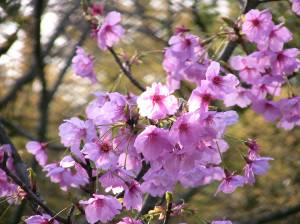
Cherry blossoms

 “More like a missile,” Will quipped, cracking me up. I love my son.

  We then decided to go to Yoyogi Park instead near Shinjuku, a park I remember as lush, green, filled with families cavorting on the verdant lawns. Instead, it was bleak, muddy and filled with homeless people. Perhaps it’s the season, with winter just behind, or lack of city finances to maintain it, or just the need for someplace for homeless to sleep, but it was depressing. Sweet Will chased the wind, not seeing it for the dreary place that it was, and kept spotting the few branches of cherry blossoms that were in bloom. We then visited Meiji Shrine, the most important Shinto shrine in Tokyo, where 20 years ago my brother, future sister-in-law, and my homestay family visited on New Year’s Eve, along with 1 million other people. It wasn’t nearly so crowded Monday.

 After that, Will and I had sushi on the 13th floor of the Takashimaya department store in Shinjuku, with an amazing view of the skyscrapers of West Shinjuku. We then tried to visit another park to see cherry blossoms, but it was inexplicably closed. We ended our afternoon by taking the Yukikamome monorail out to a futuristic and rather depressing area called Odaiba – a reclaimed part of Tokyo Bay filled with bizarre architecture, expressways and Las Vegas-style shopping experiences, complete with fake Renaissance architecture and painted fake ceilings.

 We finally joined Rick for a long rustic dinner at a restaurant in Ginza near our hotel. A charcoal brazier was stoked at the table, and various unidentified vegetables, meat and fish were cooked on the coals by women in traditional dress. A group of loud, drunk English, German and Japanese pharmaceutical executives occupied the only other table in the tiny restaurant, diminishing the experience for us, but it was fun, nevertheless.


Fashion, history, art, donuts and sumo

Saturday/Sunday

It’s now 4:30 p.m. Sunday, and we’re chilling in the hotel room indulging in Will’s newest obsession – sumo. No, the room isn’t big enough for a sumo match between him and Daddy (there’s barely room for our luggage), but there’s a tournament on in Osaka, so from 4 p.m. to 6 p.m. all week, sumo is broadcast on TV. Needless to say, we are planning our days around it, which works quite well because we start our days so early we are exhausted by 4 p.m. Yesterday, we did the Harajuku-Shibuya fashion tour, walking down Takeshita Doori with its crazy young crowed, and hit Omotesando to visit Kiddyland, the 5-story toy store where Will’s favorite stuffed animal, Snowby, was born three and a half years ago when we were last here.

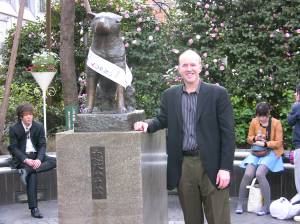
Rick with Hachiko

Things seem so familiar here, yet look on the surface very different from when I lived here more than two decades ago. Yes, many people still wear white masks over their faces to protect themselves and others from germs; yes, people still seem to prefer to keep their distance from gaijin in subways and restaurants; but there is much more English spoken now and foreigners don’t really stand out that much; the variety of clothing and hair color is vastly more varied; things seem more relaxed. But it’s hard to say. I just wish there weren’t so many Starbucks, Tully’s Coffees and Makudonarudo Hambaagaas.

After visiting the statue of Hachiko — the loyal dog to waited for his master to return from work long after the master was dead, and an essential Shibuya meeting place for people in the pre-cell phone era — we were rather beat and headed back across Tokyo on the subway to relax in our room and watch sumo and eat Japanese crackers and some surprisingly good Gouda cheese and California wine that Rick had sweetly bought for our arrival. Evening, we ventured out to a sushi bar recommended by Rick’s interpreter – it was delicious, though by the end Will was totally sagging. He is an unbelievable trooper. Will slept all the way to 5:50 a.m. today, much to my relief, given that I woke at 4 a.m., still not adjusting to the time. Out of our hotel window, we could see workers setting up the Tokyo Marathon route a block from our hotel. We ventured out and watched the start of the marathon, with the wheelchair racers zooming by first, followed by the runners. It was extremely windy, and the neat rows of cardboard garbage cans kept blowing into the race route, along with the matching hats of the hoards of race volunteers. Will thought it was all hilarious.

Temple figure

We then took the train to north Tokyo, where we wandered around a very old section of Tokyo, Yanaka, one of the only, if not the only, sections to survive both the 1923 earthquake and subsequent fire, but also the bombings of World War II. It’s a hilly area, with narrow winding streets, old wooden buildings and many temples and shrines, along with tiny shops offering beautiful Japanese paper, bamboo carvings, and “College Potatoes” – a sweet confection of sweet potatoes eaten by students at a nearby university – and by our own Rick Attig, who today accepted an offer to became a graduate student of fine arts at Pacific University. Boy, I buried that lede, didn’t I? We are proud of him.

Outside the temple

It started to rain, so we grabbed a taxi to Ueno, where we searched for a tiny soba shop through the seedy, garbage filled alleyways near Ueno station. We had to wait in line for about 20 minutes with a half dozen well-dressed Japanese who laughed at Will’s antics jumping from flagstone to flagstone outside the restaurant, and then ducked inside for delicious buckwheat noodles. Next was the National Museums at Ueno, where Will oohed and aahed over the ancient clay “Haniwa” figures, rusted bronze swords, Buddhist sculptures, and of course, armor. Rick was most excited about the beautiful writing boxes, with their ink stones and beautiful lacquered surfaces. He loved that so much care would go into the ritual of writing. I, of course, loved the Buddhist sculpture, a throwback from my college days at Waseda University, but was disappointed that much of the collection was closed for the month of March. It’s funny: Will has come to really enjoy museums, much to our delight, and for the first time in his life, he was OK with not buying something at the gift shop!!!

We also glimpsed the spring’s first cherry blossoms in the garden outside the museum — and today was declared the first official day of cherry blossom season in Tokyo — a full week early this year. We are looking forward to being here for Ohanami, an important cultural ritual of enjoying the beauty and ephemeral nature of sakura blossoms. 

Finally, the most important stop of the day: we took a subway halfway across Tokyo to find Neyn, a gourmet, semi-cult donut shop Rick had found online in Akasaka. We caught a subway back to the hotel with a dozen donuts in hand; we sat next to a dozing young Japanese woman, who like us, had a big bag of Neyn donuts at her feet. And we made it back to our room in time to catch the sumo tournament. The tournament started with some “nostalgia” clips from long, long ago – much to my delight, because it was the era when I came to love sumo, 20 some years ago. So here we sit, Will drawing cartoons of sumo wrestlers and marathoners, including one about a sumo wrestler who visits a donut shop and knocks a bunch of stuff over, Rick is doing laundry in the bathtub, and I’m typing this. We’ll venture out later for yakitori – Will’s choice tonight.

Will’s First Morning in Tokyo

Saturday, March 20, 2009

Will's ready for the day, at 3 a.m.

We woke this morning to the chirping of Will, who declared it was 6:45 and time to get up. I felt a glimmer of hope he was right, but knew it my heart he wasn’t. Indeed, he’d read the glowing lights of the room thermostat, which declared it was 64.5 degrees in the room. Actually, it’s 3:25 a.m., though it feels like 11:30 a.m. Portland time. Ah, the joys of jet lag.

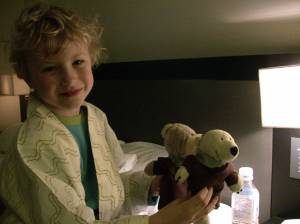
 While Courtenay struggled to make “Drip-On” coffee using an origami-esque folding technique that was WAY too difficult at 4 a.m., especially because it involved boiling hot water, Will wrapped his stuffed animals Snowby and Iceby in mock-kimonos using the sashes that came with our robes. We are now preparing to go to the Tsukiji Fish Market, the largest seafood market in the world. Why? Because it is the only thing in Tokyo open at this hour, except for the hookers around Shimbashi Station.

 It’s now 12:45 p.m. and what feels like three days later. We ventured out to Tsukiji at 5 a.m.; it was unbelievable. It’s a vast seafood market – the largest in the world. We arrived in darkness, unsure of where to go.When I asked a sake seller where the main fish market was, he pointed in the direction and said, in Japanese, “Be careful. It’s dangerous.”  And it was. What a scene – it reminded us of a James Bond movie where the bad guys are zipping around in little carts through a hyperindustrialized warehouse. But the bad guys here were men in rubber boots and rain coats driving little forklifts  and dragging handcarts here and there; you literally had to watch your back, your sides, your front at all time in the tiny corridors of the mazelike market.

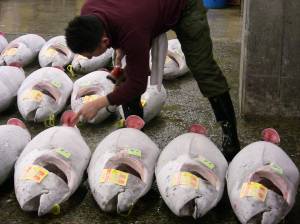
A buyer examines tuna at Tsukiji Fish Market

We finally found the main fish market where upwards of 450 different kinds of seafood from around the world is sold. We saw live eels, fish, clams, scallops, you name it. At the tuna auction, we managed to squeeze into a small viewing area to watch the 5:30 a.m. auction, where wholesalers bid on the whole, frozen tuna that lay like torpedoes on the floor of a warehouse. Each auction starts with a man wildly ringing a bell and then shouting ensues and the fish are sold, ready to be shipped to restaurants around the city.

 We luckily made it out of the market without getting squashed by a forklift. We made our way back to the hotel for breakfast since we figured Will couldn’t handle raw fish for breakfast. We then walked around the Imperial Palace, bought some train tickets at the main Tokyo Station, walked around the expensive shopping area of Ginza, had coffee and croissant, and it still was barely 9 a.m. We were killing time because the highlight of our day – the visit to the Pokemon Center – wasn’t open until 10 a.m.

Pokemon Heaven

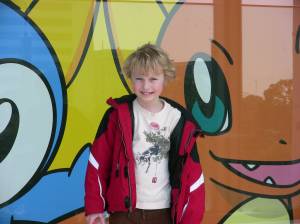
A train stop away, Will knew we were at the rain station because he saw a group of young people wearing Piplup hats waiting to flood the train station to direct visitors to the center.  When we arrived at 10 minutes to 10, Pokemon Center had a line snaking outside the door with anxious Japanese families waiting to get in when it opened. We joined the line, and at 10, burst into the world headquarters of the Japanese equivalent of beanie babies. They sold everything from Pokemon cards, to Pokemon stuffed animals, Pokemon seaweed, Pokemon curry rice, Pokemon chopsticks. Will was in nirvana.

We just had lunch at an amazing tempura shop, where Will wowed the kimono-clad wait staff with his appetite and his polite “Gochisoosama deshita” at the end of the meal. We sat at a counter, as at a sushi bar, and watched the chefs prepare the sushi, piece by piece. We ate way too much – we didn’t want to appear rude, of course!

And it’s only 1 p.m. We’re about to head out to Harajuku, where young people dressed in crazy clothes go to blow off steam and be rebellious out of the sight of their parents on the weekend. The weather is gorgeous and warm today, so we want to take advantage. Hope all you are well!!!


Wedding Day in Oaxaca

It’s Sunday morning, Feb. 7, and members of the wedding party are straggling in slowly to sit around the pool in the sun and recover from the 12-hour wedding extravaganza yesterday. Will is splashing happily in the pool, and Rick is sipping water in the shade.

 The wedding day began yesterday with Will cementing his new friendships with Max and Fred, the 5- and 7-year-old sons of the “best boy,” as they called their father, a university friend of Rob the Groom. Will and the boys ran wildly through a huge empty room in the hotel/nunnery, perhaps once a chapel, now a performance area.  Fred and Max fascinated Will with stories of their school uniforms in London, where they wear a tie everyday to school and a “jumper.” Seemed totally wild to him.

 We then dressed for the wedding, which began at noon in the ornate 16th century Temple of Santo Domingo. The elaborate cathedral was nearly entirely gilded inside, even its fluted columns glinting with gold. Popes, cupids, angels and early church fathers covered the arching ceiling. As it is a major tourist destination, tourists wearing shorts and sporting cameras rather rudely wandered up and down the aisles during the ceremony.

 The ceremony was entirely in Spanish, with Rob even speaking his parts in flawless Spanish. The bride Elizabeth was gorgeous, in a classy, form-fitting silk gown. Since bride and groom are both journalists (Elizabeth a photographer for AP in Beijing, the groom a TV producer for Aljazeera based in London) the place was bristling with top news photographers from around the world – Agence France Presse, AP,  Getty – all scrambling like paparazzi to photograph their friends’ wedding. It was a wonderful scene.

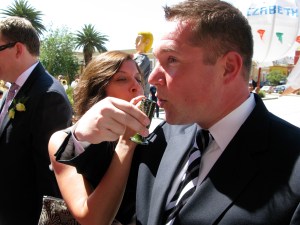
 After the mass, which Will weathered beautifully in his little pinstriped blazer that Rick said made him look like a rock star trying to dress nicely – we left the church to find a Mexican band and huge, 8-foot-tall dancing puppets depicting the bride and groom. Women in colorful Mexican costumes handed out tiny green pottery cups and poured mescal for guests in the blazing sun. The square swarmed with trinket sellers, beggars, tourists, the wedding party and tourists snapping photos – it was quite a scene. Eventually led by the band and the bride and groom, those of us wearing high heels tottered our way down the cobbled streets back to the hotel, where we gathered for the civil ceremony in one of the hotel’s grassy courtyards.

  After that champagne, followed by “mescalitis” or margaritas made with mescal, a multicourse meal featuring Oaxacan specialities such as mole, another live mariachi band, tequila, toasts, dancing to everything from raggaeton “Gasoline” to old Madonna standards. There was even a reporter and photographer from the local press doing a story on the acclaimed Mexican journalist (Elizabeth) getting married in town. Will alternatively danced and chased his friends – all of them wearing Lucha Libre Mexican wrestling masks and swinging small rubber chickens – gifts from the bride and groom. Helen, Mike, Rick and I sipped tequila and took in the scene.


Helen and Mike sampled the mescal.

 Will logged more than 30,000 steps on his pedometer. Finally, about 9:30, he couldn’t take it any more and asked to go to bed. Since our room was right next to the action, he bathed to the sound of the now-returned mariachi band and wrote three pages in his journal before falling asleep with the music still blaring.

 This morning, Will declared it was the best wedding ever.


Exploring Oaxaca and Monte Alban

Today we slept in, for a total of 11 hours! We got up and had a leisurely breakfast in the bouganvilla courtyard, where there is an amazing buffet. Will had French toast and papaya (so good, he says), while the adults tasted the tamales and local cheeses.

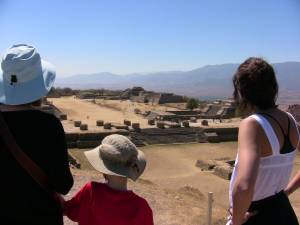
 We then hired Arnold, a local guide, who drove Helen, Mike and us up to Monte Alban, at 6,500 feet in elevation a full 1,500 above the city on a hill the ancient Zapotecs flattened to build a vast ceremonial city. It was amazing. We descended into a tomb, saw the ruins of domestic homes under whose floors the families buried the bones of their family members, and a ceremonial ball court that Arnold said had to do with fertility. We think Arnold had his favorite theories about things, not necessarily based on archaeology, since it didn’t always jive with what we read in our guidebooks or on the explanatory signs along the route, but who knows?

img_1268

 We walked among the remains of huge temple platforms once used for sacrifice and other ceremonies and the vast grounds that had amazing acoustics so the priests could address the assembled masses. The day was clear and the views of the valley were amazing. Arnold, who is 82, also told us about the mathematical and astronomical sophistication of the Zapotec people, who lived in the areas some 3,000 years ago, according to his reckoning, which we are not sure of. The ruins date from 500 B.C, so around the time of classical Greece, the Parthenon and Greek tragedy. We saw the glyphic writing, along with carvings in stone of contorted human figures called “Los Danzantes,” or the Dancers — though modern archeologists speculate they may be sacrifice victims or defeated kings. It was hot, and Will started to droop, but gutted it out for the full proverbial three-hour tour. Will also found a carving on a stair, which was his first major archaeological find!

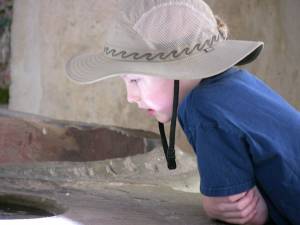
We ended up back in town by 2:30, nearly the local time to have the main meal of the day. We ate at a lovely, relaxing restaurant called, appropriately, “Los Danzantes.”  It was a beautiful indoor courtyard, surrounded by soaring architectural stone walls that echoed the ruins we had just seen. Will insisted we sit near the large pool surrounded by artistically arranged mortars and pestles. We had good food – coconut shrimp for Will, which he snarfed – a few Coronas and wandered back to the hotel to relax before the first official event of the wedding, a cocktail party on a rooftop terrace overlooking the Cathedral of Santo Domingo and the sunset on the distant hills.

We met many of Elizabeth and Rob’s family and friends, and Will made two new buddies, 5- and 7-year-old brothers who are sons of the best man from London. Courtenay freaked that they would catapult off the terrace (there were no rails whatever) or plunge into a cactus or crash into the open fires where chefs were cooking tortillas. Fortunately, no one was hurt. Then home to our hotel, a block away, for baths and cuddles and the sound of guitar music from some evening party we hope ends soon! Good night all!

Greetings from Oaxaca, Mexico!

img_12301

It’s Thursday evening, Feb. 5, and we’ve had our first full day in Oaxaca after flying in Wednesday evening. Our flights from Portland to Houston and from there into Oaxaca were uneventful – Will was a peach, despite a 6-hour layover in Houston. We met our good friends Helen Ubinas and Mike Dunne in the Houston airport, and came into the city with them. Our hotel, the Camino Real, is a really beautiful old hotel that is a major historical site in itself, a former convent built in the 16th century – at the time of Shakespeare, Will likes to relate. It is a stunning place, with exposed brick, crumbling stucco on walls several feet thick, a labyrinth of passageways, arches and hidden courtyards lush with flowering trees and bouganvilla. There is also lovely, chilly pool that Will took a dip in this afternoon. Outside our room is an ancient gazebo-esqe structure called the Lavendera. It’s where the nuns used to do the laundry, and there’s lovely running water into a series of basins.

Last night we cooled off after we arrived with a couple beers and a big Sprite for Will in one of the courtyards (the whole place is open to the sky), and a plate of cheese, meats and deep fried grasshoppers, which were spicy and, actually we decided, not all that tasty. This morning we went exploring on foot with Mike and Helen, starting with the Zocalo, the main square in the center of the city, through the massive gothic central cathedral and on to the central market, which is this enormous, sprawling collection of tiny booths all packed under one roof. Everything was for sale, from huge slabs of meat, whole dangling saffron-colored chicken, and entire mahi mahi and other fish, to toys, jewelry, pots, art, fruit and vegetables, and piles and piles of those grasshoppers. Row upon row of chilies in burlap bags were stacked next to piles of fresh herbs and spices. It reminded Courtenay of the indoor markets she visited years ago in Vietnam. It was a wild, fun place, and Will’s eyes were wide the entire time.

img_12391

We went from there to a chocolate factory. Oaxaca is famous for its chocolates; after all, cacao was first cultivated here by the ancient peoples, where it was made into a drink for royalty. Chocolate is now used in the many and complex moles for which Oaxaca is famous. We bought several kinds after trying some of the tasting-size pieces. Will put a pretty good size dent in the tray of tasting pieces before we pulled him away. We went from there to the big regional museum a block from our hotel at the Cathedral of Santo Domingo. The collection of ancient artifacts dating from the time of Classical Greece are housed in another gorgeous former convent, a huge stone building surrounded by an amazing cactus garden and full of ancient artifacts from the nearby ruins at Monte Alban and other sites.  The artifacts ranged from prehistoric spearpoints to intricate gold and jade jewelry found in a tomb at Monte Alban to relics of the Spanish invasion. Numerous interior courtyards and open external windows gave us a view of the surrounding mountains and the sprawling low-slung city.  It was a great museum, and we had almost the whole place to ourselves.

We went from the museum to lunch at a restaurant sporting modern art, when we sampled the mole sauces for which Oaxaca is famous – verde, Colorado, tradicionel, and three others whose names we’ve forgotten. After that, it was back to the hotel to hang around the pool, and meet more of the friends and family of Elizabeth Dalziel and Rob Hodge, the couple getting married on Saturday.

Tonight we’re all going out to dinner with the wedding party at a traditional restaurant looking out on the zocalo, and tomorrow we’re hiring a driver to take us out to Monte Alban, the ancient ruins. Hope all’s well back in Oregon.