
COPENHAGEN — When I told friends that I would be seeing King Lear on our second night in Copenhagen, and that the performance would be in Danish, that I wouldn’t understand a single word of the three-hour tragedy, the only advice I got was this: Don’t laugh.
I settled into my seat (second row, smack in the middle), still feeling the jet lag and a long full day of trailing Courtenay through the National Museum, a sculpture museum, some kind of museum to the royal family’s horses, a canal tour and some other stuff.
Laugh? The question was how soon I was going to cry.
Well, it wasn’t that bad. No, I didn’t understand anything anyone said, except for a couple too-brief appearances by one actor speaking English, but then I’ve had somewhat similar experiences with
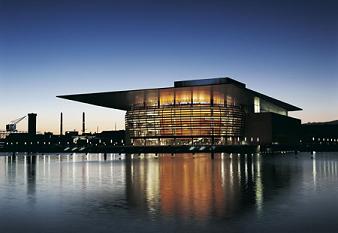
Royal Danish Playhouse
the Shakespearian English at the Ashland Shakespeare Festival. I am, if nothing else, an old pro at staring blankly at theater performances and somehow, someway, almost holding my own in the conversation with Courtenay at intermission and afterwards.
We agreed that Gloucester was kind of weak in the first act, that Cordelia and the Fool, played by the same actress, lacked the charisma and moral standing needed to pull the play together at the end, or something like that. Anyway, I didn’t fall asleep and didn’t fall apart.
And I didn’t laugh.
But here’s the thing: Everyone else did. Apparently it was an unusually funny performance of King Lear, at least up until they gouged one guy’s eyeballs out and tossed them around stage. I averted my eyes and longed for worse seats. Second row!
There was scattered laughter through the play, but I felt like I did when I was about four years old and watching TV with my Dad, trying to laugh when he did.
Some of the highlights, from a non-Shakespeare, non-Danish-speaking theater-goer:
–It was a cool, compact playhouse, with interesting lighting and uneven brick walls that cast interesting shadows everywhere.
–A decent sword fight between Edmund and Edgar. Will would have been impressed with some of the parrying.
–An unusually nasty and bloodthirsty Regan.
–An impressive performance by the actor that played Lear, who got crazier and sicker as the play went on, and got the final speech just right. It was moving, kinda, almost, in any language.
–Spoiler alert: Almost everyone dies. That’s how I knew the end of the play was near.
Anyway, I’ve survived the toughest day of our vacation. It’s all downhill from here.
At least until next week’s opera performance of Falstaff. It’s going to be performed in Italian. I don’t speak Italian.
But there will be Danish subtitles.
Go ahead and laugh.
(Postscript: It was a beautiful day here, cold, with a bluebell sky. We had a great day. It’s late tonight, but I’ll post pictures tomorrow.)
LONDON — It’s a few minutes after 10 o’clock on Sunday night and we’ve all just finished packing to come home. It will be a little sad to leave our lovely London flat behind, but we’re all eager to fly home and hug Pippy.
LONDON — Will slept until after 10 a.m., and we still managed to make it through the National Gallery and the National Portrait Gallery by 1:15 p.m. With a stop for breakfast of Cream Tea. Not that I am proud of this. But when you have a 12-year-old in tow, even a relatively patient one, it’s sometimes all you can do to make sure he has seen several dozen important works that will hopefully seep deep into his brain, like rainwater through gravel.
So he saw the skull in The Ambassadors, the evil pig stare of Thomas Cromwell, the forever battling troops in Ucello’s Battle of San Romano, Van Gogh’s electric yellow Sunflowers. Will particularly liked several small Raphael’s; I loved the Tudor portraits, especially of Cranmer and Wriosthesley; Rick loved a painting with a chubby cupid being bitten by bees, the Raphael, the Van Gogh. The boys lucked out that there was a strike of museum staff, so several large galleries were closed.
After a bit of shopping, Will scored a new jacket from the very British Topman, near Oxford Circle, which was insanely crowded. The sidewalks were packed a la Harajuku in Tokyo; we could hardly get back down into the Tube station. The only real benefit was we could join the mass of jaywalkers and defy the homicidal bus and cab drivers. Covent Garden, too, was a crazy mass of humanity and street performers, which creep Rick out. Kind of like clowns. Or mimes. We fled.
After shopping, we split up — Rick and Will to the Natural History Museum, and I to the Tate Britain. They loved the dinosaurs; I loved the Turners and the Pre-Raphaelites, especially the Ophelia of Millais. I had seen the painting many times in books on Shakespeare, but seeing it in person brought unexpected tears to my eyes. Something about the flowers, the bird, the faraway look in her eye, echoes of Hamlet, and also of Midsummer Night’s Dream.
We managed to meet back up for dinner at the hotel. Good to be back together again!
LONDON – So there is a cure for museum fatigue: Aphrodite’s bottom.
There she was, crouching at her bath just inside the entrance to the British Museum’s special exhibit, “Defining Beauty,” which opened in London today. It was the first glimpse of what would become the best experience I have ever had in all the years of trailing Courtenay through museums around the world.
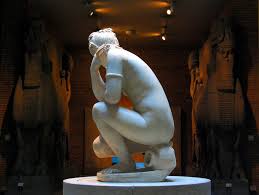 There was room after room of amazing and sometimes colossal objects not only from the British Museum’s huge collection of Greek art but also from the Pergamon Museum in Berlin, the Metropolitan Museum in New York and the Glyptothek in Copenhagen.
Nothing on loan from the new Acropolis Museum in Greece, though, and more on that later.
There was vase after amazing vase with images of myth, war, love and sex created hundreds of years before Christ. There was a bronze youth with a lithe, powerful body recently found in the sea off Croatia. The youth even had copper highlights on his lips and nipples There was the Discus Thrower of Myron in his throwing pose. There was a touching, life-sized bronze baby holding his arms out for love.
And there were some of the Elgin Marbles, the spectacular sculptures that once ringed the top of the Parthenon on the Acropolis that sits high above Athens. They are perhaps the most beautiful and controversial sculptures on Earth, and ones that Courtenay and I have argued about many times.
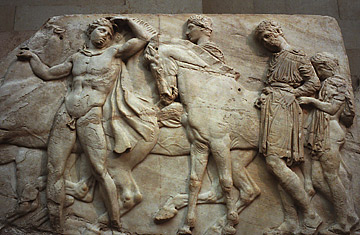 They were removed from the Parthenon for “safekeeping” by Lord Elgin in the early 1800s, and have been held, preserved and displayed in the British Museum ever since. Greece wants them back, and it is so insistent that it refused to contribute any objects to the British Museum’s major Greek exhibition. I understand the arguments for keeping the Elgin Marbles here: They are integral to the British Museum, and returning them to Greece would set a precedent that would send shudders through the great museums of the world.
And yet, I believe they should one day be displayed in the beautiful new museum that Greece has built at the foot of the Acropolis. The panels are amazing, including heroes grappling with centaurs and horses so lifelike, with veins bulging in their legs, that you can almost imagine the thunder of their hooves.
We went on to spend several more hours in the British Museum, which has millions of pieces displayed in miles and miles of hallways and exhibit spaces. We saw incredible things, including Eyptian mummies and the remnants of a man whose body was preserved in a bog for more than two thousand years. Eventually our legs tired and the huge groups of roving schoolkids took over the museum, and we made our way outside.
The rest of the day is largely a blur — the English fish and chips for lunch, the special exhibit in the nearby British Library of the actual copies of the Magna Carta and other documents of what would become democracy, the tattered sheets of paper with the Beatles lyrics, the 300-step climb with Will up the monument to the Great Fire, the bustle and smells of meat pies, cheese and breads of the Borough Market.
All I can see clearly tonight is that frightening Centaur, those stampeding horses, those muscular boys with the impossibly tight stomachs, that baby reaching out with chubby arms, that crouching Aphrodite.
Beauty does last.
But this is now Courtenay, and I get the final word on this post: does anyone remember the esteemed art critic, E. Buzz Miller? That’s all I have to add…
 The Thompson Attigs