Author Archives: Rick Attig
Speaking of Irish time: Stuck in Dublin on US Lateways
UPDATE — DUBLIN, Ireland, late Monday, Aug. 12: Our flight home through Philadelphia ultimately was canceled and Courtenay scrambled to book new flights, with our group of seven forced to fractured into three different routes. We had a long, frustrating day that ended in disappointment. We all hope to be home by the end of Tuesday, but we face uncertainty and tight connections. Wish us luck.
DUBLIN, Ireland, Aug. 12, 2013–It’s a mess at Dublin International Airport today, with all of US Airways flights to Philadelphia backed up. Hundreds of people are waiting on two delayed flights, including ours, and many people have been here since yesterday, when their flight was canceled. It’s a tense scene, with lots of anger, and a trio of cops here to keep the peace. Since we can’t make our Philly connection to Portland (a four-hour window wasn’t enough, for US Lateways), we’ve been rebooked through Phoenix. At last word, we hope to get into Portland about 1:30 Tuesday morning–five or six hours later than scheduled–but that’s not assured right now. If we don’t get out of Dublin at 4 p.m., we’ll miss our new connection to Phoenix, and then we’re not sure where we’ll go.
It’s been a great trip, but we’re all tired and anxious and eager to get home.
Marking time, the Irish way
HILTON PARK, Ireland, Aug. 9, 2013 – Sitting in a remarkable manor home that has been in the same family for almost three hundred years, a day after standing breathless in the pitch darkness of a five-thousand-year-old passage tomb, and coming inside from helping a five-year-old boy catch his first pike, I marvel at how Ireland compresses time and the long reach of history.
Everywhere we have gone we have seen things that are startling, and unbelievably old. The passage tombs of Newgrange and Knowth, buried deep beneath mounds with hundreds of tons of earth and stone that ancient peoples somehow dragged dozens miles, are more than five hundred years older than the great Egyptian pyramids, and were built one thousand years before Stonehenge. We all were moved by the complexity and mystery of the passage tombs, which give lie to the idea that the people of prehistoric times were simple, ignorant people. The passage tombs are amazing feats of architecture, engineering and astronomy—made as much with brilliance as with brute strength—somehow oriented precisely with the rising sun on the winter solstice in case of Newgrange and fall and spring equinoxes at other tombs.
At Newgrange, the sun rising on the shortest day of the year enters a narrow box between giant boulders, shoots through a slim, 20-meter column deep into the center of a mound, shimmers as it moves slowly across the stone floor until it reaches the back of the passage and illuminates a series of suns and other symbols carved into stone. No one knows how or why these passage tombs were built all over western Europe, but it seems they were meant at least partially to celebrate the passing of the seasons—of time, again. The light flashing into Newgrange meant that another year had passed, that the days would again grow longer, not shorter, and that the darkness would slowly, steadily, begin to lift again. The ashes of the dead were also discovered inside these tombs, suggesting that perhaps these mounds were places where the spirits of the dead were carefully placed so they would be lifted, in the shimmering sunlight, into the next world.
Newgrange and Knowth, the two passage tombs we explored at the ancient site more broadly known as Bru Na Boinne, were among the most moving historic sites we have ever visited. Another nearby hill dotted with passage tombs, Loughcrew, was similarly powerful. We made the long, slow climb up the hillside to Loughcrew where an Irish guide led our family alone inside a passage tomb, and she shined her flashlight on a descending row of sun symbols, precisely oriented to catch the moving sun once, and only once, each year.
At a moment when my life, and those lives of the people I love, seems to be hurtling past, it is reassuring to experience Irish time, where history just seems to go backwards forever and forever, and around the next corner, or the next stop, I will see something that is unfathomably old. One moment I am drinking ale in the second oldest pub in Ireland, with its two-foot-thick stone walls, the next I am sitting in the drawing room of an estate house that was built more than a century before Oregon, my home, was even settled by pioneers.
On the way to Loughcrew we pulled in to visit the ruins of the church and gardens where St. Oliver Plunkett was believed to be born and first raised. St. Oliver was falsely accused of treason and drawn and quartered by the English, and the roofless church ruins had a tragic feeling. It was an exceptionally dark and evocative place, with English ivy climbing the shattered stone walls and weathered headstones leaning this way and that in knee-high grass. Will discovered what looked like an open tomb in the thick grass. The place seemed so very Irish, a country that is, by turns, beautiful and sad, stunning and spiritual.
But then there was that little boy, representing the tenth generation of the Maddens, the family that built Hilton Park in 1734, taking the rod after showing me where to cast, the silver lure arcing through the gray Irish sky, and setting the hook on the hungry pike, reeling wildly, shouting with excitement, then dropping the rod on the little dock and running to tell his parents about his catch. I was left holding the rod while the pike lazed on the surface, worried that this boy’s first fish was going to get away before he returned, and counting the minutes, which seemed to go by so very slowly, in the way they do in Ireland.
Day 3 Ireland: Pitch, Putt and s’Pelunk
DOOLIN, County Clare, Ireland, Wednesday, July 31, 2013 – With a light rain falling, and three curious onlookers lining the stone wall along the fairway, Mitchell addressed his ball at the fourth tee of the Doolin Pitch and Putt. The hole, protected by two bunkers the size of ancient graves, was fifty-one meters away. Using a wedge, Mitchell blasted a shot high into the iron-gray Irish sky – and landed the ball only about a foot from the hole, earning a thumbs up from one of the watching tourists.
Today was a story of fortunate near misses. There was lazy talk at the morning breakfast table about riding out the anticipated rainy day by lounging around the cozy Moy House, which overlooks beautiful LaHinch Bay, with O’Brien Tower and the Cliffs of Moher far in the distance. However, we decided instead to at least venture out to Doolin and Lisdoonvarna, two tiny villages that play big roles in County Clare. (Note from Courtenay: I’ll have everyone know I was the one – yes ME, known as the instigator of Thompson Torture Tours – to suggest we take it easy. The weather reports threatening severe rains and flooding helped prompt my well-informed opinion. But back to Tour Guide Rick…)
Doolin is a launch point for the ferries to the Aran Island and a center of traditional Irish pub music. In the late morning when we arrived (after a near-miss when I pulled right in front of a car I didn’t see in the oncoming lane), a heavily loaded ferry was pulling away while beer trucks were lined up restocking the pubs. Two deliverymen accidentally turned over a pallet loaded with empty bottles, filling the street with broken glass. And not just any street: The one-lane street we were going to have to travel over to escape the town.
A motley foursome—Alex, Mitchell, Will and I—teed off at the Doolin Pitch and Putt, a rolling course with holes averaging about 50 meters and tiny, postage-stamp greens. We got in eight holes—the last of them providing an awesome view of the Cliffs of Moher and an unidentified castle—before the rain came pounding down and chased us off the course.
Soaked for the second day in a row, we made our way to Doolin Cave, which seemed to hold the promise of shelter. Everyone except claustrophobic Courtenay followed the chatty guide and descended the slippery 125 steps into the cave, where we put on hard-hats and followed a gushing underground stream through a low tunnel about 100 yards. The tunnel opened up into a large cavern, where Europe’s largest stalactite, which look like a dirty-white curtain pulled open, hung more than 20 feet from the ceiling. It was actually pretty cool.
We were hurried out by the guide, who kept warning about the gushing water and said we’d be safe unless it got more than knee high. We thought he was kidding, but when we came back the underground stream was only inches from a grated bridge and water was everywhere in the tunnel. After we climbed out, they closed access to the cave, canceling all further tours for the day. (Note from Courtenay: I sat in the lovely café sipping tea on a sofa, read a book and watched the waters rise. By the time the spelunkers returned, the water had pooled around the rental car so bad I had to get in through the back car door and crawl over the seats.)
We made our way to Lisdoonvarna, my favorite name for a town so far. We had a great pub lunch of inch-thick hamburgers, fish and chips and beef stew. As I write, the kids and Grandma are playing dominoes, the blue sky is edging back in over Lahinch Bay and O’Brien Tower is a dark bump on the horizon. Sun is streaming in through the windows, and it’s almost uncomfortably warm and extremely muggy. Summer has returned for a moment, and dinner calls.
Postscript: Dinner at the noted seafood restaurant, Barrtra, was quite good, but extraodinarily slow-paced. We were there for several hours, much of it looking into a bright setting sun. Afterwards, as we stumbled out nearly three hours after we arrived, Mitchell commented that it was the first meal that he ever had that left him with jet lag.
Boating and bicycling through Japan
By Will
Today we woke up to have a good breakfast at a random coffee bar in the fancy district of Karashiki. The person there served us really good fresh-squeezed orange juice. Then we had eggs followed by toast, bacon and tea.
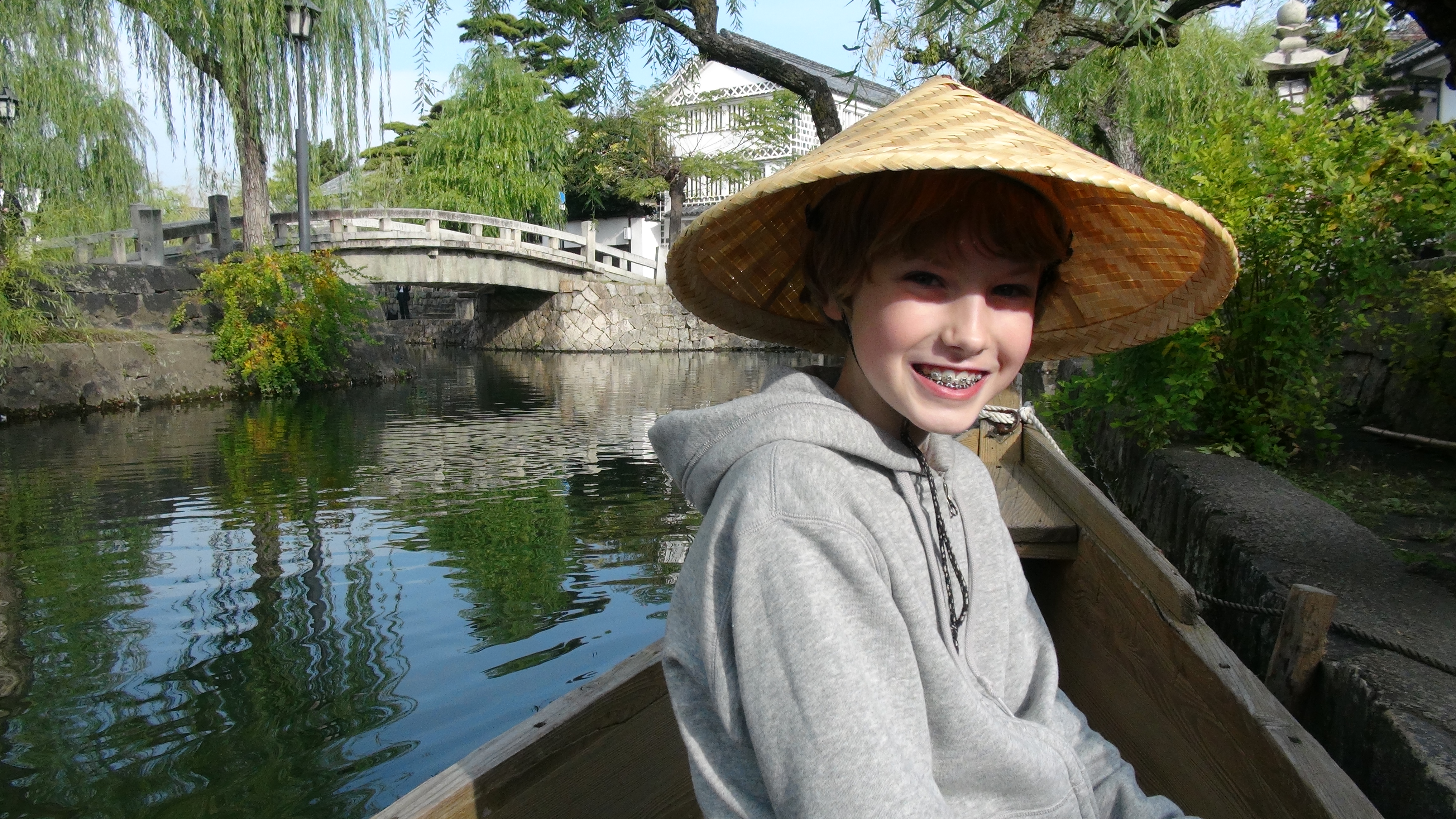
We walked along the canal when we saw a bunch of guys with rice hats next to boats. They were offering rides. We did it and got to wear rice hats like them. It turns out those hats were REALLY uncomfortable. But I wore it anyway because they looked cool. Our boat driver talked to us about baseball. It was really cool.
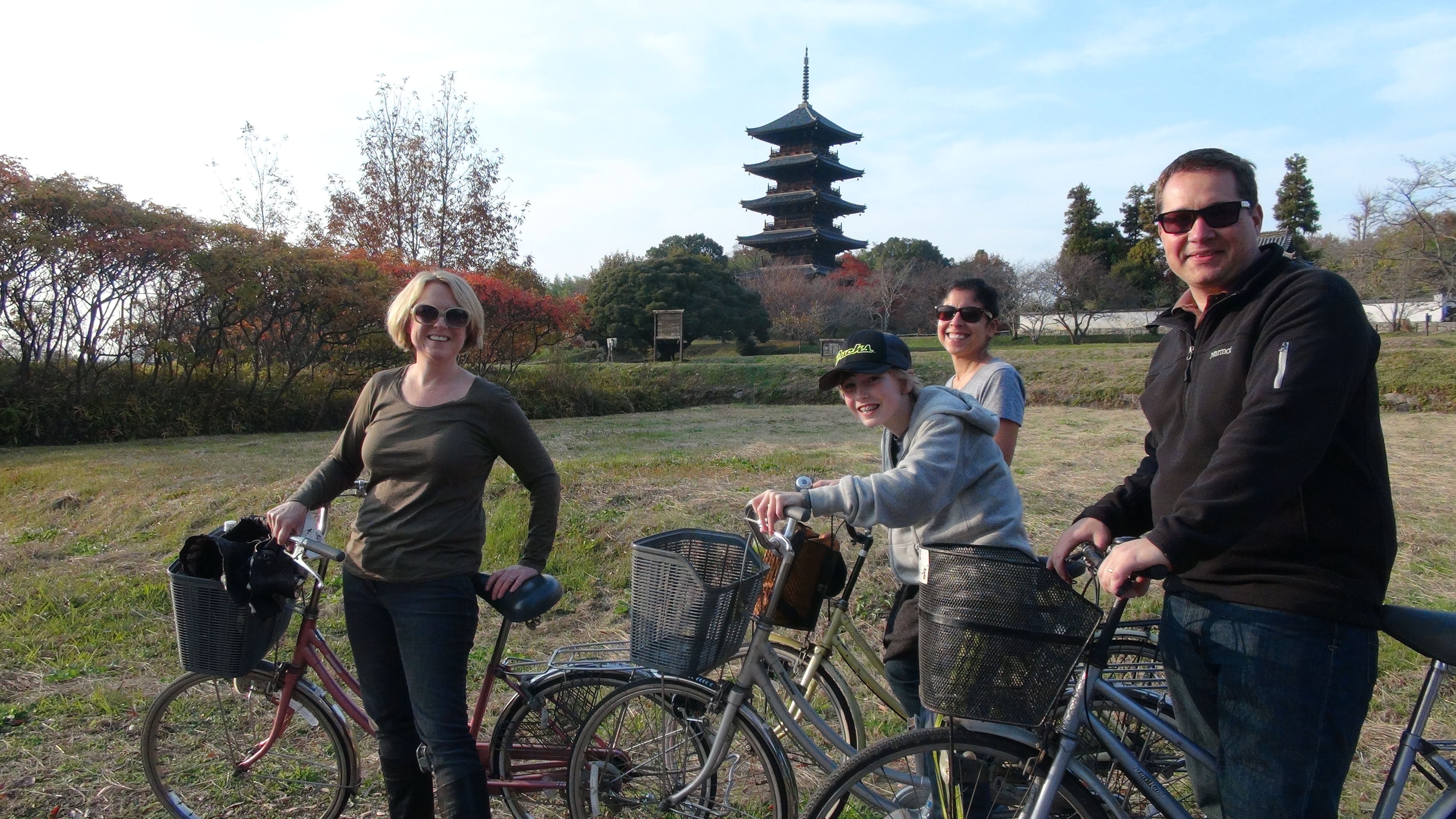
We wandered around for a while before getting on a train to go biking. We rented some old rickety bikes from the little old lady who worked at the shop. She told us to follow the little bike signs and we will be fine (yeah right!). The last time I rode a bike was like…uh… two years ago. So I bet you can guess how THAT started. Of course we had no helmets so It was a little different. We followed the signs for a while before getting lost my mom and dad argued for a while before Helen said “Uh guys?” She pointed out where to go and we finished the next three miles smoothly (Trust me three miles are not hard on a bike.) We stopped at a little temple and Helen got a good luck charm. We were almost to the end when Helen fell into a rice paddy while taking a picture. She got up fast and said, “Is there straw on my back?” We returned our bikes and went to dinner at a pizza restaurant (I know in Japan? Ha!). It had really good pizza. After that we went back to the hotel.
THE END
Our whirlwind tour comes to a close; we will be China’s next exports
Monday, July 23, 2012
SHANGHAI – We have moved so quickly, and with such full days, through
Beijing, Xi’an, Chengdu and now, Shanghai, that none of us has had the
energy at day’s end to produce a blog post. Everyone is a bit
nostalgic for Courtenay’s Terrible Thompson Torture Tours, which at
least give everyone a few hours break before dinner, our favorite time
to blog.
But we came back to the hotel on our last afternoon in China to the
news that Beijing has suffered its heaviest rain and worst flooding in
years, with more than 37 deaths, and realized we should let our
families and friends know we are happy and safe here in Shanghai.
Tomorrow we catch our long flight home, via Vancouver, B.C.
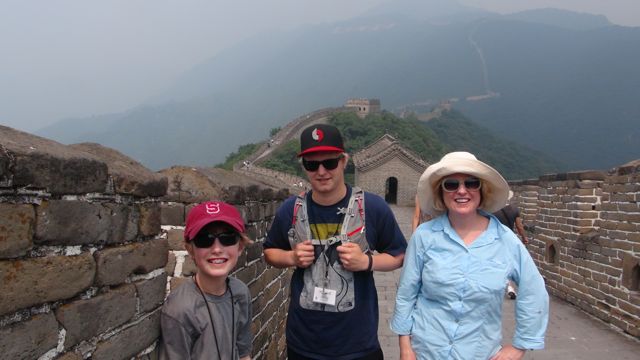
We have many stories to tell: Courtenay and Will enjoying a quiet walk
together on the Great Wall far away from the madding crowds, Mitchell
and I enjoying a young panda skittering through the grass only a few
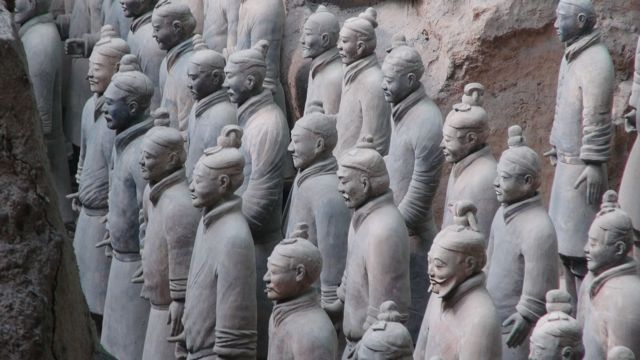
feet away, all of us mesmerized by the 2,300-year-old terracotta army.
It will take us some time to reflect on all that we have seen and
learned in China. For now we all have this blur of memories, ancient
art, acrobats and opera singers, middle-aged dancers and kite fliers
livening up the public parks, the gray pall of pollution over Xi’an —
with its beautiful 400-year-old walls and waiters who giggled
charmingly at the silly Americans as they attempted to eat local
dishes — the lush greenery of Chengdu, the stunning yet zany and
futuristic skyline of Shanghai lit up at night.
There will be time to write later about the food we have experienced,
some of it hot, some of it unidentifiable, much of it beautifully
created and presented. And Will and Mitchell return with a trove of
Chinese treasures—masks and warrior statues, chopsticks and chess sets.
“Everything new is good,” our guide cheerfully announced as we drove
among the massive highrises of Shanghai on our way in from the airport
yesterday. Well, yes. We have great new friends we have made among the
Stanford travelers. We have fresh memories, new stories, moments in
our lives that will remain in our memories. And finally, we have a new
appreciation of China, this rapidly changing country that we have
merely glimpsed over the past two weeks.

 The Thompson Attigs