.
Category Archives: China
Our whirlwind tour comes to a close; we will be China’s next exports
Monday, July 23, 2012
SHANGHAI – We have moved so quickly, and with such full days, through
Beijing, Xi’an, Chengdu and now, Shanghai, that none of us has had the
energy at day’s end to produce a blog post. Everyone is a bit
nostalgic for Courtenay’s Terrible Thompson Torture Tours, which at
least give everyone a few hours break before dinner, our favorite time
to blog.
But we came back to the hotel on our last afternoon in China to the
news that Beijing has suffered its heaviest rain and worst flooding in
years, with more than 37 deaths, and realized we should let our
families and friends know we are happy and safe here in Shanghai.
Tomorrow we catch our long flight home, via Vancouver, B.C.
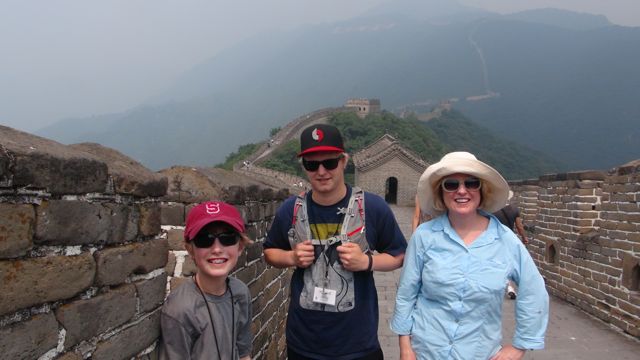
We have many stories to tell: Courtenay and Will enjoying a quiet walk
together on the Great Wall far away from the madding crowds, Mitchell
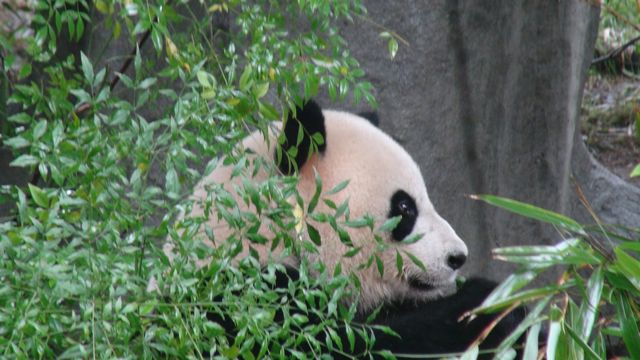
and I enjoying a young panda skittering through the grass only a few
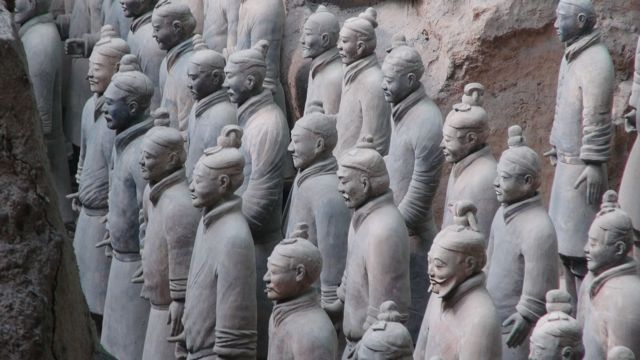
feet away, all of us mesmerized by the 2,300-year-old terracotta army.
It will take us some time to reflect on all that we have seen and
learned in China. For now we all have this blur of memories, ancient
art, acrobats and opera singers, middle-aged dancers and kite fliers
livening up the public parks, the gray pall of pollution over Xi’an —
with its beautiful 400-year-old walls and waiters who giggled
charmingly at the silly Americans as they attempted to eat local
dishes — the lush greenery of Chengdu, the stunning yet zany and
futuristic skyline of Shanghai lit up at night.
There will be time to write later about the food we have experienced,
some of it hot, some of it unidentifiable, much of it beautifully
created and presented. And Will and Mitchell return with a trove of
Chinese treasures—masks and warrior statues, chopsticks and chess sets.
“Everything new is good,” our guide cheerfully announced as we drove
among the massive highrises of Shanghai on our way in from the airport
yesterday. Well, yes. We have great new friends we have made among the
Stanford travelers. We have fresh memories, new stories, moments in
our lives that will remain in our memories. And finally, we have a new
appreciation of China, this rapidly changing country that we have
merely glimpsed over the past two weeks.
They call it the Forbidden City, but they let us in anyway
Sunday July 15, 2012
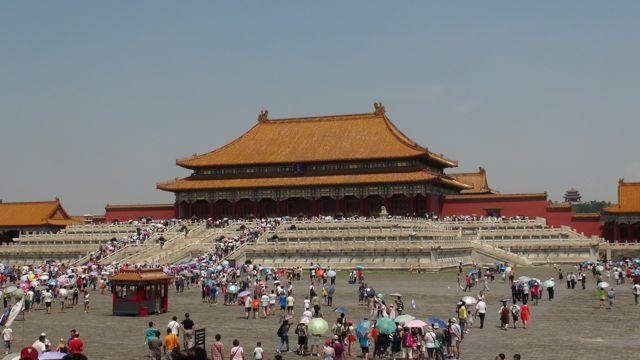
BEIJING – On a hot Sunday morning, with the temperature nearing 90
degrees, we walked with tens of thousands of other people across
Tiananmen Square and into the main gates of the Forbidden City, which
for more than 500 years served as home for Chinese emperors, their
families and concubines. The crowds were incredible—imagine everyone
leaving a college football game through the same few large gates, but
for hours and hours and hours. It was a beautiful scene, though, a sea
of brightly colored sun umbrellas moving across the stone walkways and
into elaborate, brightly colored palace buildings. The Forbidden City
is a collection of more than 900 buildings, and we toured fewer than
two dozen of them over a period of several hours. It’s a massive
place, on a scale that is hard to grasp even as you are being swept
through the place with the sea of other visitors. During the trip,
Will made a new friend in the group, Nicholas, who is here with his
grandparents, and the two 10-year-old boys navigated the Forbidden
City and its crowds together, chatting and pointing out things to one
another.
From the Forbidden City, we went to a group lunch at a small hotel
near what is known as the Drum Tower, which served as a night-time
clock tower in old Beijing, with drummers pounding out the time in
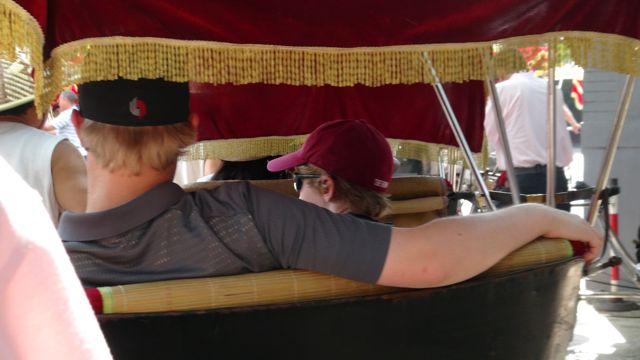
intervals of every two hours. After that, we climbed two by two into a
flock of pedicabs that had assembled outside the restaurant. Mitchell
rode with Will, and after the driver took our camera and snapped a
picture, Courtenay and I rode away on another cab. We rode slowly in a
long line through a series of hutongs, the small alleyways of
Beijing. We rode by Chinese cooling their infants in pots of water
and old men playing board games. The cabs didn’t seem to have working
brakes, and every time the group slowed for a corner, or a passing
car, we’d bump the cab in front of us, and get a corresponding tap
from behind. Yes, it was a touristy little ride that went out in 20-
minute circle, but it was fun and interesting to rattle along through
the hutongs, where there are piles of sand, dirt and brick everywhere,
people working on their homes and tiny businesses.
The bus ride back to the hotel took us by dealerships for luxury
cars such as Maseratis and Jaquars, and it was jarring to go so
quickly from the sight of men driving rusting pedicabs to those
shopping for some of the most expensive cars on earth. Beijing is both
desperately poor and incredibly rich, sometimes within the same couple
blocks. Everywhere you look you see the deep economic tensions in this
country, which were described to us in an hour-long lecture late
Sunday. The speaker, Frank Hawke, a Stanford grad who has spent most
of his life in China, says it can go either way—with a hugely changed,
reformed China joining the community of nations with a free and
democratic economy, or a China in chaos. But it cannot go on this way,
without change in some way.
By late-afternoon, we were back at the hotel, and Will hit the pool
with some of his other new buddies among the Stanford travelers, while
Mitchell and I took refuge at the hotel bar. It’s a great treat for me
to have both of my sons here together, sharing these experiences. For
Courtenay, today also was a new experience, the first that we have
ever had together as part of an organized tour. It’s probably not
something we’ll always want to do in our traveling, but it was clearly
a relief for her to leave the organizing and the communicating and the
decision-making to others, and just wander along taking everything in.
We go next to the Temple of Heaven and the next day to the Great
Wall, before we say goodbye to Beijing and head for Xi’an, the home of
the terracotta warriors. Whenever I think of Beijing, I will remember
the mass of people streaming into the main entrance of the Forbidden
City, the brilliant umbrellas flowing like a river through the blazing
sun.
Mitchell makes it at last
Saturday June 14, 2012
BEIJING – Mitchell rolled into the Peninsula Hotel about 1:35 a.m.
after a 36-hour odyssy that included flying from Vancouver, B.C., to
somewhere above Anchorage, where the plane’s water system failed,
forcing the flight back to Vancouver. After a several-hour wait, that
included Mitchell’s second trip to the same airport bar in one day, he
said goodbye to his new bartender friend and flew 11 and a half hours
to Beijing. Incredibly, Mitchell seemed to suffer no ill effects, and
popped awake a few hours later ready to explore Beijing.
We started the day with a taxi ride to King Gong’s Mansion, arriving
amid a throng of pedicab drivers shouting to us about their services.
The mansion itself was a cool collection of colorful buildings set
amid a beautiful garden of pools and stones. People were hand feeding
gold, orange and yellow koi in ponds of lotus plants. Mitchell and
Will explored a cavern that angled between several buildings.
Outside, we walked a lengthy hutong that was lined with construction
projects while dodging pedicabs. We took refuge along a shady path
that led to a good-sized lake where people in paddle boats were
ramming one another. At this lake, and the next one we ambled along,
fishermen lined the shore, some with huge rods, at least 30 feet long,
balanced on rod-holders. They were fishing for carp. We saw one caught
fish, a carp of about two feet.
After touring a small temple that towered over the corner of one lake,
we took the subway back to the hotel. We had a great lunch of Chinese
dumplings, Will and Courtenay went to the pool, and Mitchell went for
a workout. He thought he was really hauling on the treadmill—until he
realized he was running in kilometers per hour. Still, given what he
had been through, working out at all was a real-man effort.
In the evening, we met up with the Stanford crew for the first time.
Everyone seemed nice, somewhat cautious socially, and Will had hoped
for more mingling. He’s eager to make new friends. Such a social kid,
just like his father.
After dinner, Mitchell and I made the “Night Walk” along the vendors
hawking street food. We made a list of the bottom five offerings—
sticks of large black spiders, foot-long shark embyros, silk worms and
three kinds of grilled centipedes, large, small and “diet.” The Oregon
boys passed on them all.
Perhaps a little jaded in Beijing. Awaiting Mitchell
BEIJING – The morning started with a friendly couple in their late 20s
coming up behind us on the sidewalk near the hotel and, in near-
perfect English, engaging us in a pleasant conversation about where we
were from, how we were enjoying Beijing and proudly telling us that
they were art students. It was all very sweet, and then came the hook:
Would we like to take a few moments to come with them and see their
art? No, Courtenay and I said almost simultaneously. We’d read the
warnings in guidebooks and elsewhere about tourists being invited by
people on the streets of Beijing to go for tea or something to
“practice their English” or “see their art,” and then get caught in a
scam that costs them hundreds of dollars. The whole thing made us
laugh – it was reassuring to experience something that we had been
braced for, something that we had expected.
In many, many other ways, Beijing has been a total surprise. It’s a
city of jarring contrasts, five-star hotels backed up against decrepit
tenement buildings, a black Maserati sports car honking to get past a
man on a rusting bicycle, burly rural farmers carrying dirty bed rolls
arguing over the right subway stop while surrounded by sophisticated,
urbane young Chinese.
It’s also a place where we have been treated much better, much more
kindly and welcoming, than we had expected. People make room on the
subways, offer seats, smile and make eye contact. Restaurant staff are
patient with our halting orders. Even the hard-negotiating hawkers at
the five-story Silk Market, where everyone was shouting to us about
their wares, were fun to spar with.
Of course, there are cab drivers who shake their heads and drive
away, refusing to take us where we want to go. It felt personal the
first few times, but some reading reveals that taxi driving is an
especially tough, low-paid job here, and drivers are paid only by the
distance they go, not the time it takes. So when a Western couple and
their young son wants a ride downtown to their hotel, during the teeth
of the rush hour, well, it makes some sense that a driver would
pretend he doesn’t know where they want to go, shake his head, and
drive away.
Today will not be remembered by any of us as an amazing day in
Beijing. The Dazhalan area we visited first thing in the morning was a
disappointment; touristy in an especially bad way, crowded and stinky
and vaguely disturbing. It threw Will into a funk that made him want
to go back to the hotel.
And then in our march to escape we got mildly turned around and
found ourselves funneled in a massive crowd back through several
tunnels and flights of stairs and onto Tiananmen Square. It took
another 30 minutes to get off the square, back into the subway and on
our way to the Silk Market and the U.S. Embassy.
The market was great fun, five or six stories of stalls offering
every knockoff under the sun—ski coats, suits, bras, t-shirts of all
stripes and (faux) brands. Courtenay bought a couple Chinese fans
while Will and I bargained over a small jade Buddha, which started at
380 yuan and wound up, thanks to a certain tough negotiator from
Oregon, selling for 80, or a little less than nine bucks. Real jade!
Or so she said.
From there, we walked around the U.S. Embassy, and got shouted out
for trying to take a picture of Will in front of the embassy gate. No
pictures! The embassy area is a nice, quiet part of Beijing; we wanted
to see it in part to think about the lives of the embassy staff,
including Courtenay’s childhood friend, Lori Thomas, who lived there
with her husband, Clay, for a couple years.
After that, we set off on a search for a dumpling restaurant that
Lori had recommended. It was a real snipe hunt, a longish cab ride,
and then a hot shuffle that went on for nearly an hour, where
Courtenay would stop a passer-by and ask directions, they’d point
somewhere nearby, Will and I would get our hopes up, only to just walk
and walk and walk. Eventually we found it—a nice place yes, with
pretty good dumplings and a very hot dish of small chicken parts
surrounded by fiery pepper pieces, but perhaps not worth the extended
ordeal of getting there.
Afterwards, we were turned down or ignored by a couple more cabbies,
and limped another mile or so to a train station, and eventually made
our way back to the hotel.
This was the last night that we will have access to a club area at
the hotel, where we have made friends with several staff members who
try to coax Will into using his Mandarin, and where I have developed a
deep relationship with the fruit tarts that they put out each evening.
The night ended with all of us limping down to Nike’s flagship store
in Beijing, where I sought shoes that might leave fewer blisters than
the one pair of shoes that I brought. That, too, was surreal—being
across the world but going into a retail store of a company that is so
thoroughly Oregon. One other thing was familiar: the price of Nike
shoes.
Unlike my friends at the Silk Market, they don’t bargain.
The night ends with me waiting up long past midnight for Mitchell to
arrive. He’s had a hellish travel experience—his flight from Vancouver
apparently made it as far as Anchorage, and then had to turn back
because of some failure with the plane’s water system, and I gather,
its toilets. He had to wait for another plane, and is now scheduled to
arrive about midnight – 10 hours later than he was supposed to arrive.
He will have been traveling for well over 24 hours when he finally
arrives. I’ll get him into bed, and give him all day tomorrow to
recover. Our Stanford tour is set to start on Saturday evening, and we
hope everyone is feeling well and rested, including me in my brand new
Nike sneakers.
And now, from Will:
Hey this is Will again. What we did today was wake up, then go out
to a alley to see shops and stuff. I did NOT like that, every one
smoked and the shops were bad. We found a taxi and went to tiannamen
square. By then I was feeling sick from the smoke. We took a subway to
the silk market. A place filled with sassy ladies who sell you stuff.
This person wanted to sell us a coat and just by walking away we got
the price from 500 yuan to 200 yuan. It was cool then we went to a
place were they have dumplings then we went home.
Thursday: Two palaces and a university. And grilled silkworms.
Thursday, July 12, 2012
BEIJING – We’ve just wound up a full, footsore day of exploring that
began with fields of beautiful pink and white lotuses and evocative
ruins of YuanMingYuan, took us up the rocky cliffs and through the
crowds of the New Summer Palace and ended with a nauseous Will asking
to cut short our “Night Walk” along a row of street vendors hawking
everything from grilled silkworms to curled snakes to dog stew.
We loved YuanMingYuan, the Old Summer Palace, also known as The Garden
of Perfect Brightness. We arrived there early, chasing away the last
remnants of jet lag, after a long subway ride. We shared the wide
paths of grey paving stones with walking pairs of older Chinese,
meandering past ponds of hundreds, even thousands, of flowering lotus
plants with thick pink and red buds and wide, stunning blossoms. Will
climbed all over the ruins of the enormous European-style palaces that
were destroyed and looted during the Opium War in the late 1800s, and
robbed of their marble and other building stones several times since
then. The guidebooks had little to say about the Old Summer Palace,
but it was a highlight of our trip so far – moody and memorable, and a
rare place of quiet and introspection in an incredibly crowded city.
We went from there by a slow, slow cab through awful traffic to the
guidebooks’ ballyhooed New Summer Palace, which turned out to be a
first-class tourist trap, overwhelmed by tour groups, including
schoolkids who swarmed Will and wanted their picture taken with him.
The place was devoid of signs or maps, and we wound up going in
through the North gate, which required that we clamber up a steep
rocky cliff to a succession of not-so-pretty temple-style buildings,
in heat nearing 90 degrees. When we reached the top, we looked down on
Kumming Lake, which was jammed with tour boats, paddle boats and all
manner of other craft. Whatever charms the New Summer Palace offers,
they were lost on us, and after a sweaty 90 minutes making our way
along the lake, past a huge and extremely ugly ship made entirely of
marble, we exited the New Summer Palace by running a gauntlet of men
trying to coax us into so-called “Black taxis” (unregulated ripoffs),
people hawking peaches, watermelon and water bottles with unsealed tops.
From there we made our way to highly respected Beijing University,
where we wanted to see the Sackler Museum. The university strictly
controls access to non-students (noisy tour groups had worn out their
welcome), and we had to go to two gates to get inside. Unfortunately,
we entered through the east gate, and the museum and its fine
collection of ancient artifacts was all the way across campus next to
the west gate. It was a long walk, by a trio of tired, hot and hungry
Portland-based tourists. The campus wasn’t a scenic stunner, either,
although there was a pretty lake, and the Sackler building, among a
few others, was a fine-looking building. The collection was just okay,
but we saw some really cool things, including an ancient “oracle
bone,” a cattle scapula thousands of years old, marked by the first
ancient Chinese writing.
We had the damnedest time getting a taxi outside the university gate,
and one driver that we flagged down simply drove away when we told him
we wanted to go back downtown to our hotel. We managed to flag down a
second one, after missing on a dozen or so, and Courtenay was so tired
and flustered that she and the driver had a confusing (and in
hindsight comical) exchange that ultimately led us back to the subway,
where we wanted to go, and we had an air conditioned and nice ride
back. The short walk back to the hotel was interrupted by a too-brief
rain shower, that drove all the locals to cover. We marched bravely
through the hard, warm rain — Oregonians, at long last, in our element.
And now this, from Will:
Hi,
So, we woke up … WAY too early and we set off to this place called the
old summer palace. We got there and it was like a park… a realy big
park. And I’m thinking, where are the ruins? And then mom’s like OMG a
lotus flower. And then we keep walking and there are MILLIONS of Lotus
flowers.We eventually found the ruins and you are allowed to CLIMB and
they are cool.
Then we leave and go to the NEW summer palace and it is SO crowded.
And so we have to climb this HUGE mountain. And I think COOL. But mom
and dad are probably thinking that is way too big. And then we start
to climb and instead of taking the stairs they followed ME and we end
up actually CLIMBING the mountain. After that mom is pretty miffed. So
we leave on the way out I got a copper turtle/lion. It was cool. Then
we get lost and we take the train to this university. And I get MAD we
walk for miles just to find this museum that is not worth the walk.
Then we try to find a taxi we get one but the driver was a JERK and
would not take us anywhere. Then we finally get back.
OK, I’m finally getting tired. Goodbye, Love Will.
Of course, there are many, many small moments captured only as the
fleeting memories of travel – the kindly Chinese woman trying to coax
Will into taking her subway seat, the sweet hotel staff chatting with
Courtenay and Will in Mandarin and English, the hard-to-shake sight of
a man towing a deformed adult child in a wagon and begging for money,
the bright neon of Beijing after nightfall, and the welcome cool and
quiet of our room after a long, hot day of exploring.
The family lands in Beijing: Hutong, Tiananmen and airsickness bags
Editor’s note: The Chinese government blocks access to a number of websites, including any blog with “wordpress” in its domain, thus preventing us from blocking directly from China during our stay here. Our friend Mike Francis has agreed to serve as our “poster” during our travels to China the next couple weeks. Thanks, Mike, for all your help. Without access, we won’t be able to respond to your comments, but we may see them in our e-mail.
BEIJING — Wednesday, July 11, 2002 – Day One Beijing and the boys did great – two temples, two museums (one never found but arduously searched for in 94-degree heat), Tiananmen Square before 8 a.m., hutong back-alley walk to find a closed restaurant, toy store, three subway rides, including a “sardine train” where we had to literally shove our way in. The boys can’t wait for the official Stanford tour the start on Sunday so they can relax a bit (and Mommy won’t be in charge anymore.)
It was a great start to our vacation, after a rough landing yesterday. The plane ride was a bit bumpy the last three of nearly 12 hours, and Rick and Will were green by the time we landed. Like both were clutching barf bags. We made it past customs and were greeted in a very crowded airline terminal by a big red Stanford “S” held by Catherine Zhong, a native Beijinger who will be one of the guides on our Stanford Alumni tour. We were a bit delirious with jetlag, and she cheerfully guided us to a car for our ride to our hotel. She shared great stories about the history of Beijing and her own family – both a father and an uncle who had attended Stanford in the 1930s, only to return to join the war effort against the Japanese. Her dad was an interpretor for the Americans helping in the air strike effort. Her uncle was an engineer who helped raise herself and nearly 30 siblings and cousins in Beijing during the Cultural Revolution, when her parents (her dad an intellectual, a chemistry professor) were sent to the countryside as part of Mao’s craziness. People have been through so much here. Catherine been a tour guide in Beijing for the last 30 years, and was just such a warm welcome to this city of 22 million people. Let’s see, that’s 7 times more people than the whole state of Oregon, right?
So Rick and Will were utterly green and exhausted by the time we fought our way through traffic to our lovely hotel located very near the Forbidden City. Will and Rick went to bed without dinner – Will woke about 12 hours later at 5 a.m. – the best dodge of jet lag we’ve ever had coming to the Far East.
After an amazing breakfast of Chinese dumplings and watermelon juice, Will was ready for the walk to Tiananmen. We thought we were going so early we would avoid the heat and the crowds. Well, we were only partially correct. We had a lovely walk in mild heat along a tree-lined canal along the Forbidden City. Shopkeepers and workers were sweeping the streets with very picturesque brooms made of tree or bush branches. An old woman did her morning calesthenics to the Chinese music on her boom box. We skirted the first of hundreds of police officers ducking across a barrier (Zao shang hao, we said. Good morning. They smiled and said back, Zao shang hao.)
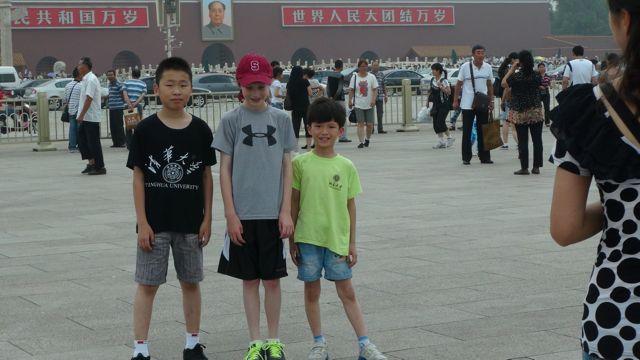
Then we hit Tiananmen. It was hard to get to (it is blocked by barriers on all sides and access tightly controlled). We meandered among Chinese tour groups and finally made our way under the street to the front of the VAST building that is the Great Hall of the People. We then crossed into Tiananmen Square, had our bags scanned, and wandered into the VAST space. It was pretty crowded and not even 8 a.m. There were big lamp posts everywhere, sprinkled with surveillance cameras and loud speakers. We saw a huge line leading to Chairman Mao’s mausoleum, and decided not to go in. We would have had to check our bags somewhere “across the street,” according to the guide books, and we couldn’t face that particular long march. It was overwhelming, really. So much history, and pain, and suffering, and hope have coalesced on this space, it was difficult to take in.
Will wants to add in his part: Yo,
That was what THEY thought this is what I think. As soon as we got to China I felt jetlagged. It took FOREVER to go through customs and when we did we met this guid who drove us to our hotel. There was a bee in the car and MOM was making a very big FUSS about it so dad killed it with a newspaper. It was cool. When we got there INSTEAD of going straight to the room, we had to sit at this table. I was mad then I went to sleep.
Our sweet (suite) is not big. I woke up and we went in to the city It was DIRTY so I got MAD. We went to Tiananmen square bla, bla, It was cool. People wanted to take PICTURES with me. We went to the subway It was WAY too crowded. We went to see the Lama monastery but I thought It was llama, the animal. So when I got in there I saw two turtle/lions(I like turtle/lions—they have the body of a turtle and haed of a lion) and I’m like what? And then I realized that Lama was a person, a Buddhist. Beijing was pretty peaceful we only saw ONE brawl between pickpocket vs police men in the subway we quickly raced up the stairs.
We got lost in a Hootong, and I got mad.
FROM, WILL
Well, I can’t really top that. It was a great day – trip to see ancient bronzes and Buddhist sculpture at the Poly Museum, apparently an offshoot of the People’s Army, which is rumored to be using arms sales to fund the repatriation of ancient artifacts. Gun running and archaelogical smuggling – can’t get any better than that.
And wonderful quiet spaces at the Lama Monastery and the Confucian Temple – but sorry, I’ve got to go. Will is done swimming at the hotel pool and we must get up to sleep, ready for more adventures tomorrow. Hope all is well with you all!
 The Thompson Attigs