Category Archives: Greece
Goodbye, Greece
 After three days of adventures on Crete, including two bewildering drives through the back alleys and weird one-way streets of historic Chania, we flew out of Greece today (Thursday), going from Chania to Athens to Munich, where we are spending the night at an airport hotel. Crete was unexpected, in many ways.
We were surprised by the snow-covered peaks that towered over the coast road as we wound from Heraklion to Chania, about a two-hour drive. We spent this morning at Golden Beach, which would have been beautiful, but for the trash that marred the area back from the ocean. The Cretan sea, though, was clear-blue and perfect for swimming. Will had a great time at the beach.
The day before, we visited the ruins of the Palace of Knossos, the enormous and palatial headquarters of the Minoan civilization. It is also the place of myth where Athenian hero Theseus went to slay the man-eating minotaur that King Minos kept in a labyrinth beneath the palace. Will, who now proclaims that he wants to be an archaeologist and travel the world, especially Greece, when he grows up, looked long and hard for signs of the labyrinth. Will and Courtenay are both somewhat sad that our vacation has come to an end. In fact, Will sobbed yesterday, saying he wanted to live in Greece. We suspect he just wants to stay on vacation, where it’s all fun, all the time. We’re glad he’s turned into the most amazing travel kid. He even tolerated the museums, tugging on your arm the second you started to actually read a label, saying “Mommy, look at this!” So much for reading about the art… Dad is somewhat more eager to head for home, or Palo Alto, at least. But all of us have had a wonderful time, and return with many stories to tell, and images and memories to last a lifetime, remembering both ancient and modern Greece. (P.S. Rick says it’s great to be in the homeland… his ancestors lived a few hours away in south-central Germany.) Besides, we’ve run out of both clean clothes and woolite….
Hanging in Heraklion
We survived the parade, no riots, no nothin’. It was actually quite cool, with row after row of uniformed school children marching in the annual Independence Day parade. We then explored the city, which is surrounded by centuries-old Venetian-built stone walls. The wind was howling on the waterfront, sending waves spraying over the fortress that guards the small harbor here — once one of the most important in the Mediterranean. The ancient Minoans (5,000 years ago) used this harbor, as did various and sundry occupiers up to the time of Independence for Crete, less than 100 years ago. We had lunch in a taverna overlooking the water; we’re finally getting with the Greek program, lunching at 2 p.m. and spending several hours waiting, first for the food, then another hour or so for the check. The cafes lining nearly every street in Heraklion were packed with holiday-goers. One pedestrian street near our hotel that has fabulously chic cafes (very cool scene last night) were today crowded with teeny-boppers flirting with each other amid the roar of motorcycles. The scene harshed Rick’s mellow.So we escaped back to our hotel. It’s now late afternoon, we’re gathering our energy for tomorrow — we’re off to face the Minotaur at the labyrinth at King Minos’ palace at Knossos (at least the story goes — we’re learning a lot about imaginative and wishful-thinking archeology) and then on to Chania, our final Greek destination.
From Olympia to Delphi to Heraklion
 It’s late Monday night, the 24th, in Heraklion, Crete. We’ve had a wild couple days since we last posted. We left Ancient Olympia just as the first few hundred of what eventually would total more than 1,000 Greek policeman took over the ruins and the little town for the official torch lighting ceremony for the 2008 Olympics in Beijing. The cops shut down the ruins, ordered everybody away and seemed highly uptight and nervous. We had a moment of dismay as one officer told us the museum and everything was shut down until 3 p.m. — meaning we wouldn’t have seen one of the most important museums in Greece. (Rick was intrepid and found out we just had to find another route to the museum — but thank Zeus we had toured the ruins the afternoon before, or we would have been out of luck.) As we left, we met busload after window-barred busload of police officers rolling into town. As it turned out, they were right to be tense: The next day, during the official torch lighting, in front of the president of Greece, top officials from China and everybody who is anybody in the International Olympic Committee, Tibetan protesters disrupted the ceremony, including a woman covered with fake blood who threw herself in front of the first torch carrier. We can’t seem to stop getting tangled up in major news events. Please, this is supposed to be a vacation. Anyway, yesterday we drove to Delphi and Arachova, this tiny village on a cliff below Mount Parnassus, where they are still skiing this spring. All the traffic is funneled into a twisting one-lane street through the center of town, tour buses, giant construction equipment and all. And the sidewalks are virtually non-existent — imagine a leisurely apres-ski stroll leaping away from careening buses…. We drove through it twice looking for our hotel, and a place to park — also virtually non-existent. We lucked on to a parking place on the outskirts of the village, then dragged our luggage up and down cobblestone alleys and stairways, looking for our hotel. We asked for directions twice, and might still be looking for it at this very moment, if Courtenay had not deciphered the Greek lettering, written in calligraphy style, a name written on a little piece of wood on a nondescript door. It was our hotel! It was really cool inside, with odd-shaped small rooms, fireplaces and, in the basement, the first heated, open pool that we have had since our vacation started. Will was thrilled. Will and his father later went swimming, and shared the pool with a comely European woman, whom Will later advised his mother, was wearing a swimsuit that was “too small.” So it was. We went from Arachova to the ruins of Delphi, which were flat-out the coolest thing we’ve seen in Greece, just a spectacular place, a spot of sacred worship for millenia, carved out of towering mountains. This is the mythological center of the earth — the place where the two eagles that Zeus turned loose at each end of the earth met as they flew around the world. The Delphic Pythia (an oracular priestess) gave oracles for centuries, including to Oedipus Rex. We walked past the temple of the Apollo, and climbed to the top of the site, where there is a nearly intact stadium from thousands of years ago. It was a remarkable morning — sunny, beautiful, full of birds and wildflowers, with few people at the ruins as early as we were. The slide show above this post shows some of the things we saw. We left Delphi and its museum in the late morning, and drove back to Athens. We killed several hours in the airport, and then flew to Heraklion, Crete. We’re here the next two nights. Tomorrow is Independence Day in Greece, and there will be a parade here in Heraklion. We’re hoping for a quiet day, with no news, no strikes, no protests. Just this once. Early morning note: Courtenay opened up the curtains to the room to see a row of policemen marching through the square — we’re hoping they are participants in the parade, and not that the flame will be run through town, or George Bush has decided to vacation in Crete (like he did when we were in Kyoto.) Cheers! We’ll let you know…
Arcadian meanderings and the Olympic Flame
We had trouble with our Internet yesterday, but somehow managed to get on this morning, so here’s a quick update. We drove through the amazing mountains of Arcadia yesterday, a place of myth and legend, a drive we’d been dreading. It turned out to be lovely and well-marked. We explored a 13th century castle perched above a hillside hugging village of Kretena; Will loved imagining he was being a Knight, shouting “clang, clang, clang” as he ran through the deserted ruins. (No tour buses here). Somewhat to our dismay, he was imagining torching the castle, not defending it. We lunched in a tiny, one-lane village, the only other customers a Greek family drinking ouzo and Coke. The few trucks that came through town nearly hit the shops on both side of the road; the view was amazing. After we left that town, Andritsena, we drove through miles and miles of burned olive groves and pine forests, the devastating results of last summer’s fires, which almost burned the ancient Olympic grounds. It was rather heartbreaking to see all that destruction, though the grass was growing and wildflowers everywhere. Most homes seem to have been saved in these isolated mountains. We got to the site of Ancient Olympia mid-afternoon and were able to walk through the ruins — amazing, the biggest we’ve seen. Will ran through the keystone arch onto the Olympic stadium grounds and ran up and down the famous stadium where athletes competed from as far back as 10th century B.C. until the 4th century A.D. The ruins were extensive, with all the administrative buildings and gymnasia and baths, not to mention the huge temples to Hera and Zeus. We saw where they will light the Olympic Flame for the 2008 Beijing Olympics — tomorrow! It’s Rick’s one great failure in travel planning, missing the flame by a day. We’d noticed the town teeming with Chinese, and Chinese TV journalists, and this is the reason. But we’ll watch it on TV with the rest of you. It’s stormy today; we’re going to visit the museum here this morning and then drive to Delphi. Then off to Crete tomorrow! We’ll try to post another slideshow when we have better Internet access, perhaps in Crete.
Your lane is my lane: Driving in Greece
We’re told Greece has the highest car accident rate in Europe — and after a couple days of driving here, believe it. There are no rules of the road here, at least no rules that anybody bothers to follow. People pass on corners, hills, wherever. It seems like half the people drive very fast, and the other half very slowly, which is a combustible combination. The small towns are packed with double-parkers, and people trying to get around. There are intersections with four to six streets converging, but with no stop signs, or lights, for anyone. It’s just a free-for-all. There are no bicyclists, at least no living bicyclists, that we can see, other than the occasional old man riding slowly through a small town. There are towns, such as Argos, where the streets just go willy-nilly, in all directions, suddenly changing from two-way to one-way. It doesn’t help that nearly all the road and directional signs have been so defaced with graffiti that they are almost unreadable. We didn’t get lost today, or seriously lost anyway, thanks to my trusty map reader and driving advisor, Courtenay. Will spent the whole ride blissing out to Scooby Doo on his video player. Tomorrow is another day — and a long drive over the mountains to Ancient Olympia. So look out Greeks: Here comes an Oregon driver.
A light rain and the ruins
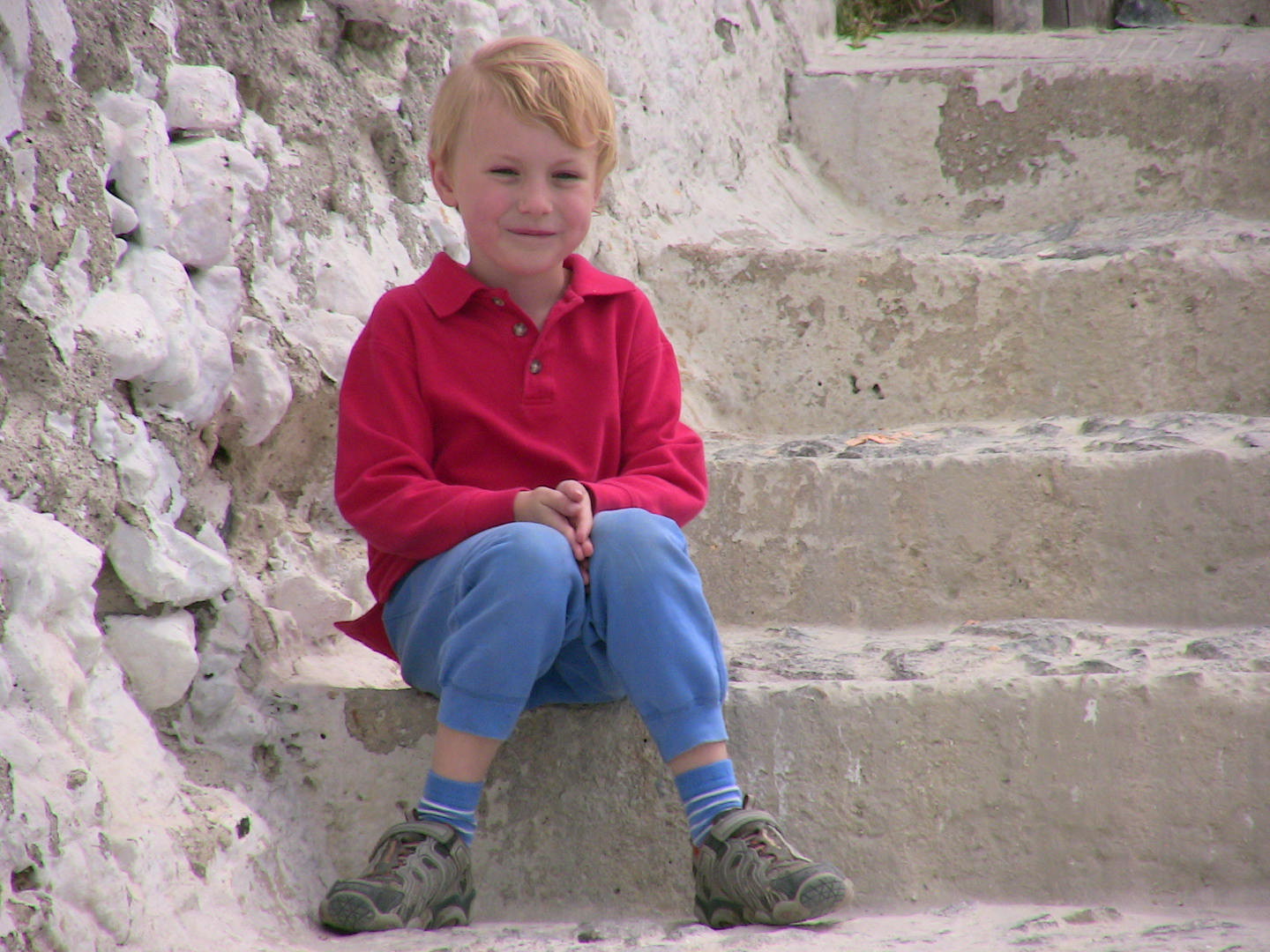
 Sitting our hotel room in Nafplio; it’s 2:20 p.m., and we’re tired and wet after a great day of rainy sightseeing. “I love you,” says Will, sitting next to me drawing. Outside the window, the bay is a pale jade green; across the bay, the mountains are this amazing purple gray, blurred by a mist.
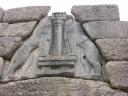
We started the day with another strike scare. The International Herald Tribune reported that national museum and archeological site officials were debating yesterday whether to strike today; there was no way to know, so we decided to proceed as planned. Fortunately, the sites were open. (Again Rick somehow manages to avoid disaster by his clairvoyant travel planning.) We drove (Rick will fill in the details of that escapade) up to the ancient Mycaenean palace, circa 1600 to 1300 BC, thought to be the home of Agamemnon, best known for leading the Greeks in the Trojan War (his brother’s wife was Helen, stolen away by Trojan Paris). The Mycaeneans dominated much of this part of Greece and the Mediterranean; it’s the classic Bronze Age civilization.
The setting was gorgeous: rolling hills of olive groves lead up to the archeological site, perched on a rock between two deep ravines. The palace had a sweeping view of a strategic pass to the north (think foreign invaders) and down the Argolid plain to the sea, where Agamemnon likely launched his ships (and where our hotel is.) It was very quiet, with no other tourists when Will, Rick and I entered the so-called Treasury of Atreus (Atreus being the cursed family of Agamemnon). It is a huge “beehive” tomb, built into the hillside, entered under a door-lintel weighing 50 tons. Inside, the acoustics were eerie; when you spoke from one side of the tomb, your voice sounded like it was coming from the opposite side. Bees buzzed at the entrance.
Up on the ruins, which are apparently brutally hot and crowded in the summer, it was green, with wildflowers, especially poppies, blooming everywhere. It smelled like thyme and fresh rain in dust. We saw the famous grave circles where ancient kings were buried with gold death masks and jewelry and pottery. We saw the bases of what were once colonnades, and tried to imagine what the palace must have looked like. We descended into an ancient cistern, but it was dark dark dark, and Mommy freaked out and had to ascend.
Finally, we drove over to the ancient ruins of the temple of Asclepius (considered the father of modern medicine) and the adjacent theater of Epidaurus, with its reputed amazing acoustics. We weren’t that impressed with the acoustics, but there was a gorgeous view from the amphitheaters’ seats. Musical performances are still held here in the summer; I’m sure that gives the acoustics a better test than listening to Eastern European tourists wearing plastic bags over their hair warble. It was pouring by then, so we headed home. Another amazing day.
A few scattered memories
 We had grilled octopus, something of a Greek speciality, as an appetizer last night. They also took me into the kitchen after I ordered fish to actually pick out the one fish I wanted them to grill. They showed me a half dozen sea bream, which looks kind of like a perch, and I picked one out. …. We’re driving a Range Rover rental now, but the car on Santorini was a tiny Renault, with virtually no trunk or rear end, just a second seat that ended at the back wall. I snapped awake at 4 a.m. on the day we were supposed to leave Santorini worried that we’d never get our luggage, and Will, in that car. I woke Courtenay, and she politely told me that it would work out, and to go back to sleep. She was right … We found an owl on the sidewalk last night, stunned, I think from flying into a window. …There’s a little rain this morning, Friday in Greece, and it smells like home…. We’re kind of hungry for news of home. It’s easy to talk back to us on this blog. Just put your cursor over the small comment button (usually they say “No comments”) after the headline on each blog entry, and hit enter. You’ll see a box to write in, and then hit submit when you’re done. We love and miss you.
Welcome to Nafplion, here’s your flashlight
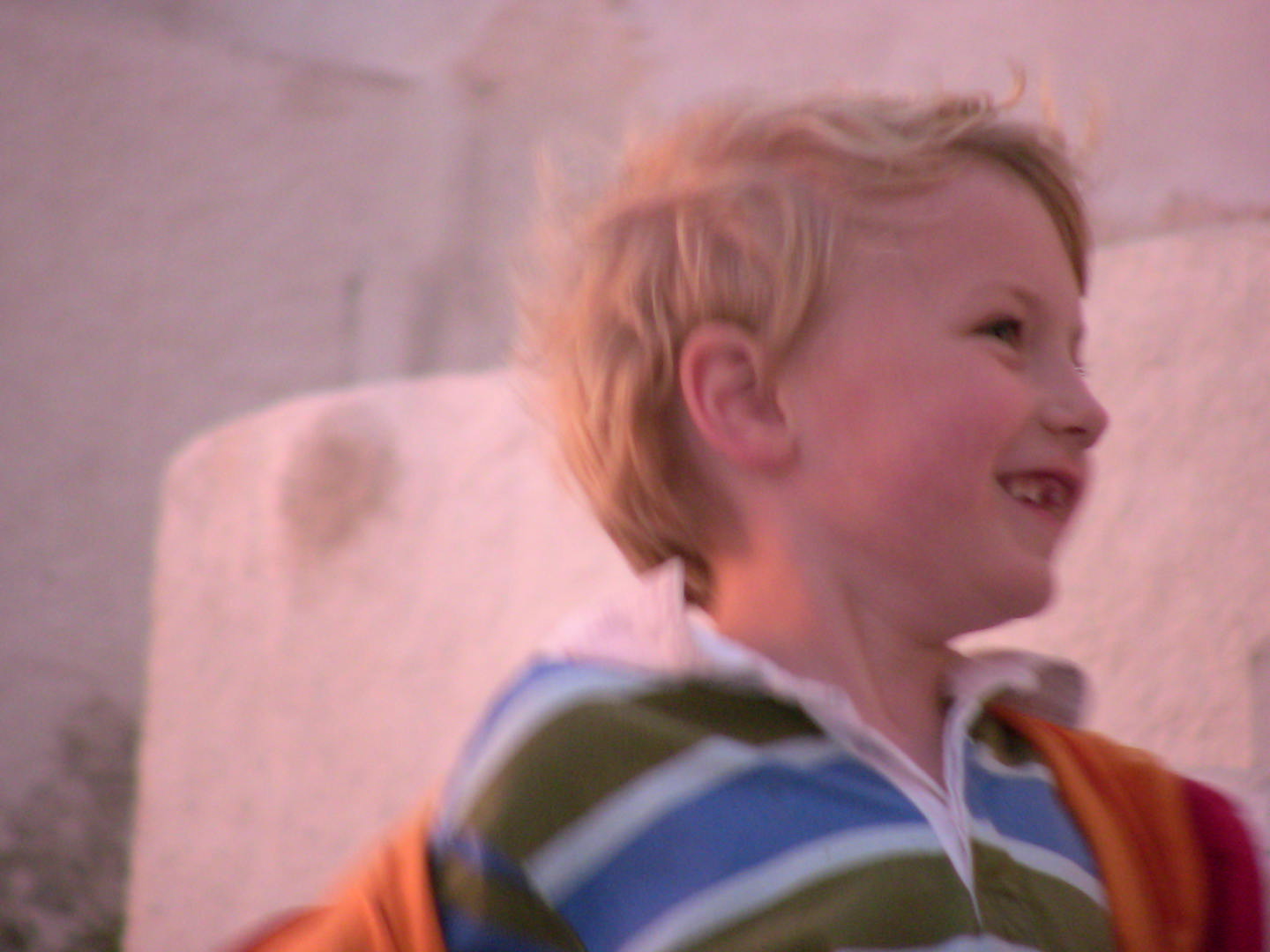
After a fairly long day of traveling — starting with a crowded rush for the plane at Santorini because the previous day’s flight had been canceled, and ending with a several-hour, sometimes white-knuckled drive from Athens — we rolled up into pretty Nafplion to discover that the power was out throughout the whole town, courtesy of the striking unions and their supporters. We carried our bags up four flights of stairs. The water was out, too, of course, but that didn’t stop Will from making a beeline for the bathroom, and, um, going, leaving us with nothing to do but to throw open the sliding glass door, and pray that the power and water would be back on, as promised, in about an hour.
We spent the time wandering the town, and looking, with some eagerness, for potpourri. Thankfully, the power, and water, was back on by 7 p.m. Nafplion is a cool little town, the former capital city of Greece. It hugs a small harbor filled with tiny white fishing boats, and an ancient castle looms over back of the town. There’s a main town square surrounded by restaurants and tavernas, with kids playing soccer and tag well into the night. It’s filled with narrow little streets and pedestrian walks, lined with shops.
We had a seafood dinner by the harbor, and Will finished off with gelato before bed. I’m down in the lobby, late now, writing and downloading pictures from our stay in Santorini. Tomorrow we’re going to explore the ancient ruins at Mycenae, and the Theatre of Epidaurus, and I’ll get some pictures of Nafplion to post here. We’re promised electricity and water through our stay here the next two nights. This strike is something. I think that forever more I will associate piles of garbage, and now power and water outages, with Greece. Hope everyone is well back home.
Riots in Athens, serenity in Santorini
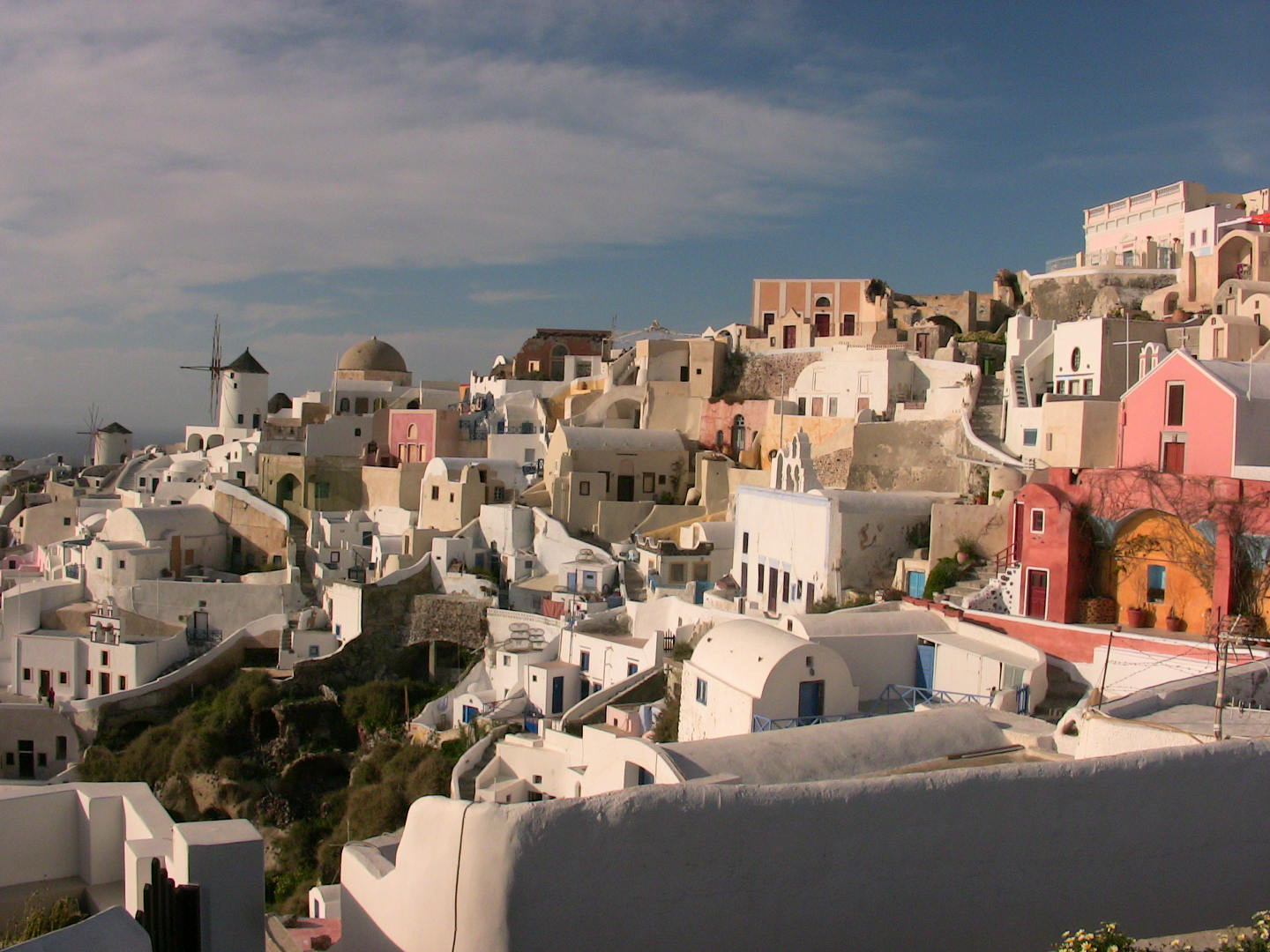
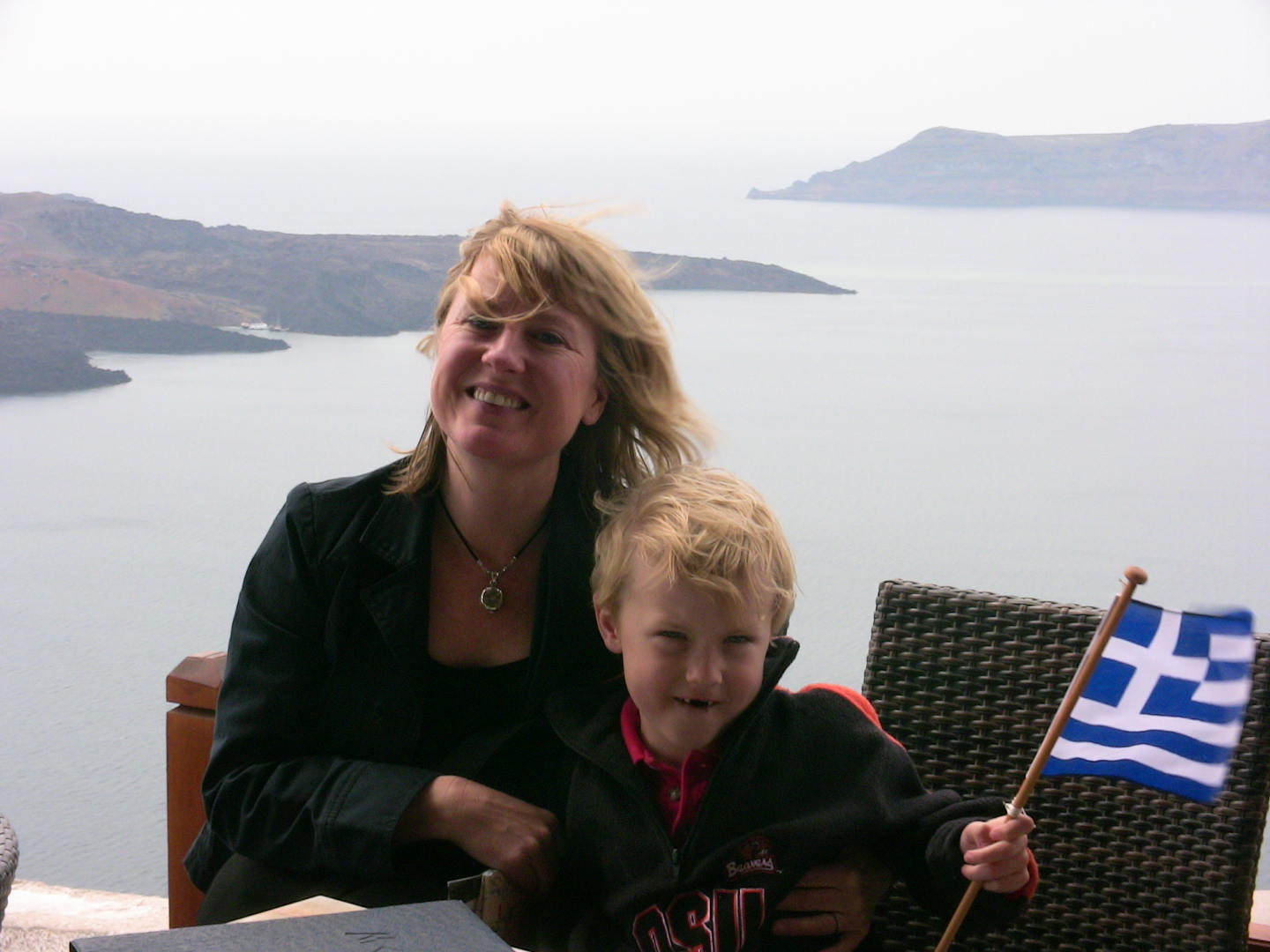
While millions of Greeks joined a strike Wednesday, and an estimated 100,000 protesters, including some with firebombs, marched outside our former hotel room, we rented a car this morning on Santorini, sort of a car, a tiny bright red Renault, squeezed in and took off on a daylong adventure around the island. By the time we reached Fira, 15 minutes of twisty turns later, everybody was carsick. But we recovered our legs in Fira, an incredibly beautiful tourist trap hanging over the steep cliffs of the caldera. You could see from all the cliffside bars that this would be quite the party place in midsummer.
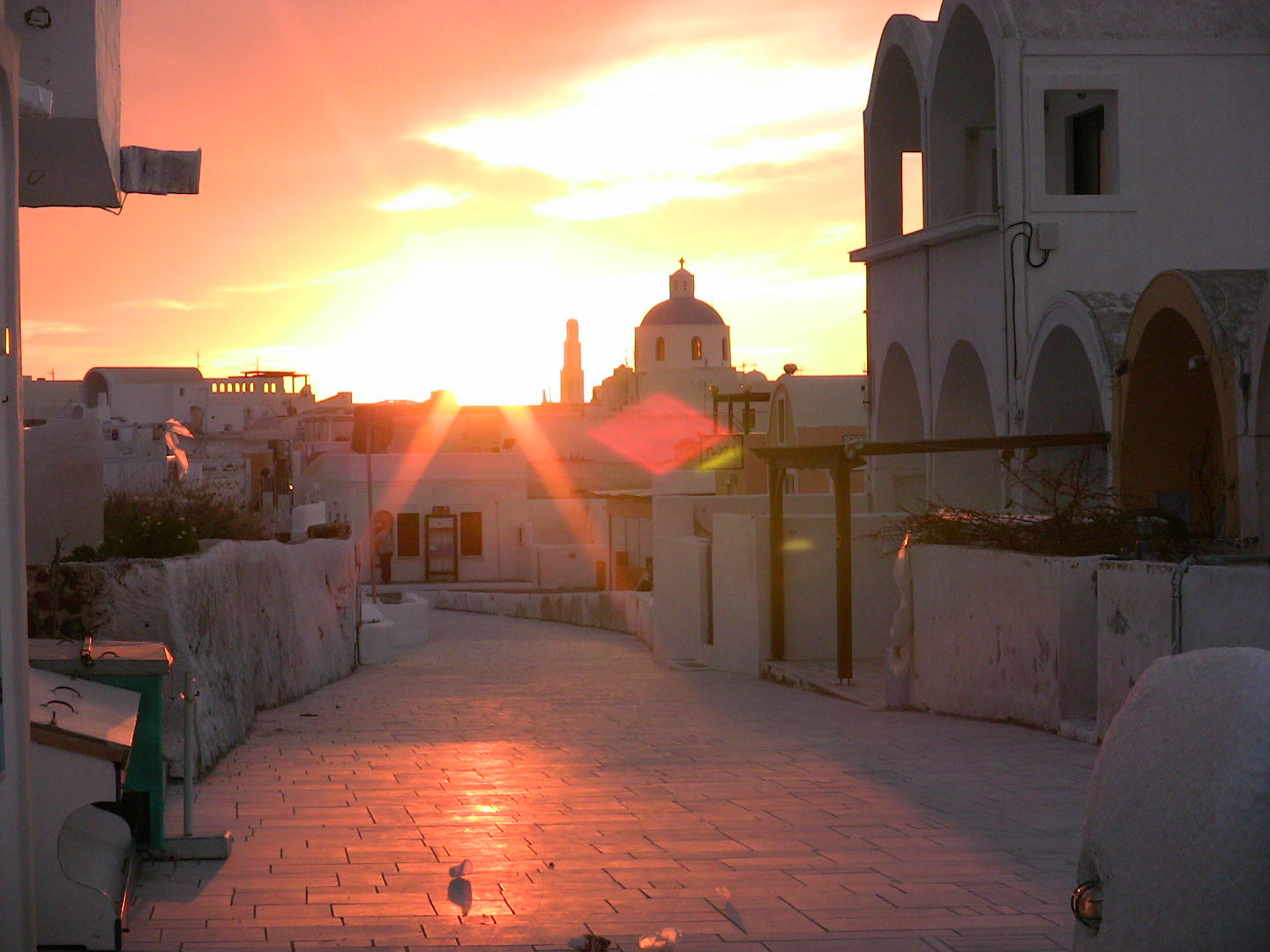
Many of the tavernas, bars and hotels were still closed during our visit, but we passed one stunning view after another (photos will come later when we can get on the Internet on our computer). The general strike had closed the museums, but other than that, it was another day in paradise. Almost everywhere we walked around town, workers were remodeling houses and buildings, and most of them were using donkeys and burros to haul their concrete and other materials. This place is just a dream for a burro-buff like Charlotte.We had a traditional Greek lunch in a classy modern taverna called Zafora on the edge of the cliff. The food was good; we knew it was fresh because theyhad just opened for the season the day before. Will was fascinated by a bright yellow parakeet, so the waiter moved the cage over next to our table. The bird’s name was Donald, and Will dubbed his new friend “Donald the Love Bird.”

We left Fira and drove up the island to a black sand beach at Perissa. The black sand was dotted with pumice, it and the sand was from past volcanic eruptions. The litter, presumably, came from somewhere else, more recent. Will and I threw rocks and waded into the Mediterrean, which this time of year felt about the same temperature as the North Pacific. The sun was out, the winds had died down and it was a great afternoon on the beach.On our way back to Oia, we stopped at the Santos winery, the largest windery on the island, and sampled three of its white wines. (Santorini is famous throughout Greece for its wines; they grow the grapes in low basketlike circles of vines, tucking the grapes inside to protect them from the wind — the vineyards look like huge expanses of bird nests.)
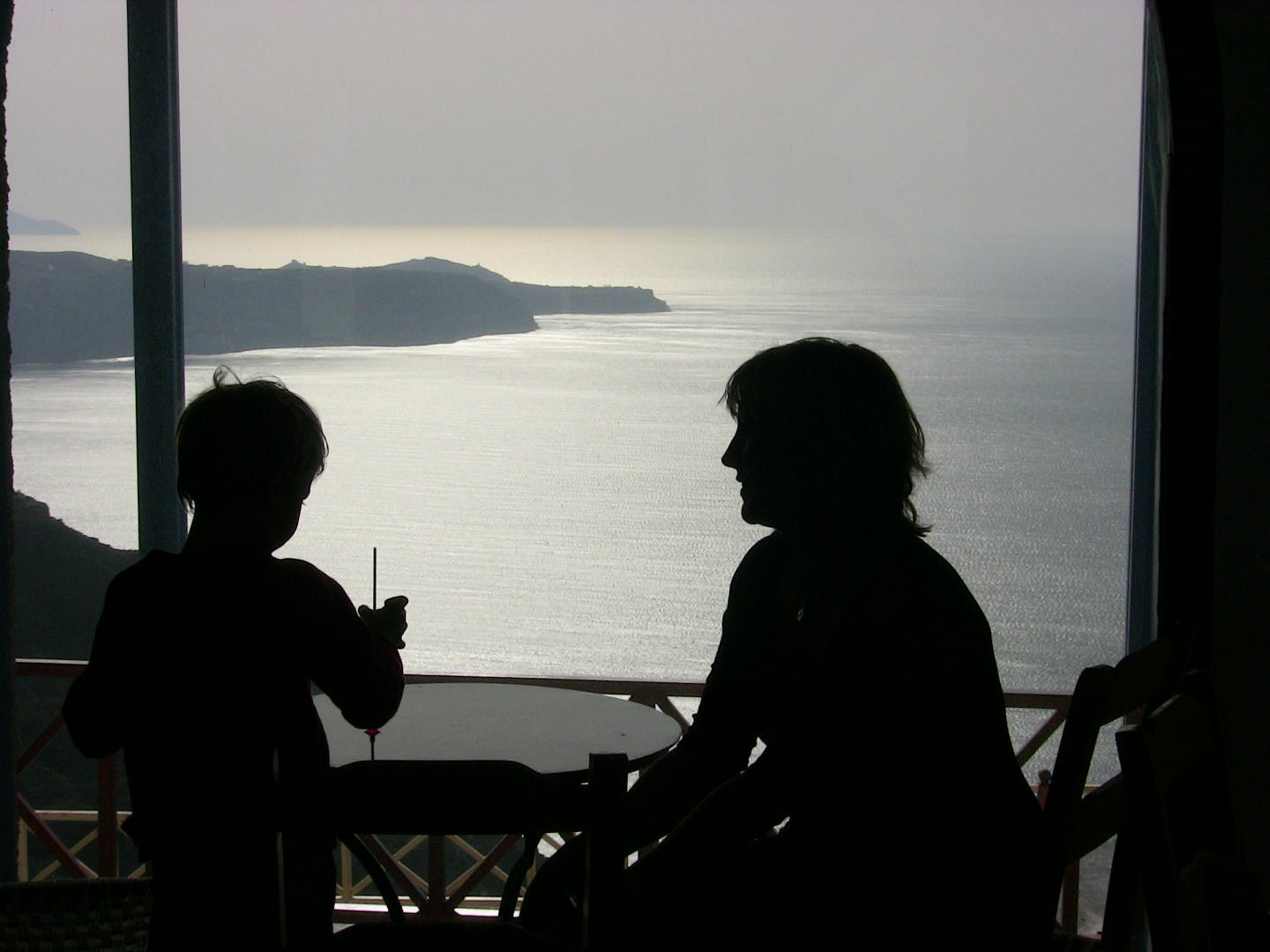
The wines were all very good, even a dessert wine made from raisins that we weren’t sure about, and the tasting room had an incredible view (did we mention the views before?) across the caldera and towards Fira and Oia. We bought a bottle of white to share tonight, our last moments on this trip to Santorini, and a little bottle of the dessert wine to slip into our suitcase to take home to refresh our memories down the road. We kept thinking how everyone we knew would love this place.
 The Thompson Attigs