Category Archives: London
Goodnight, London
LONDON — It’s a few minutes after 10 o’clock on Sunday night and we’ve all just finished packing to come home. It will be a little sad to leave our lovely London flat behind, but we’re all eager to fly home and hug Pippy.
Paint it Black, or Raphael Red, or Turner Grey
LONDON — Will slept until after 10 a.m., and we still managed to make it through the National Gallery and the National Portrait Gallery by 1:15 p.m. With a stop for breakfast of Cream Tea. Not that I am proud of this. But when you have a 12-year-old in tow, even a relatively patient one, it’s sometimes all you can do to make sure he has seen several dozen important works that will hopefully seep deep into his brain, like rainwater through gravel.
So he saw the skull in The Ambassadors, the evil pig stare of Thomas Cromwell, the forever battling troops in Ucello’s Battle of San Romano, Van Gogh’s electric yellow Sunflowers. Will particularly liked several small Raphael’s; I loved the Tudor portraits, especially of Cranmer and Wriosthesley; Rick loved a painting with a chubby cupid being bitten by bees, the Raphael, the Van Gogh. The boys lucked out that there was a strike of museum staff, so several large galleries were closed.
After a bit of shopping, Will scored a new jacket from the very British Topman, near Oxford Circle, which was insanely crowded. The sidewalks were packed a la Harajuku in Tokyo; we could hardly get back down into the Tube station. The only real benefit was we could join the mass of jaywalkers and defy the homicidal bus and cab drivers. Covent Garden, too, was a crazy mass of humanity and street performers, which creep Rick out. Kind of like clowns. Or mimes. We fled.
After shopping, we split up — Rick and Will to the Natural History Museum, and I to the Tate Britain. They loved the dinosaurs; I loved the Turners and the Pre-Raphaelites, especially the Ophelia of Millais. I had seen the painting many times in books on Shakespeare, but seeing it in person brought unexpected tears to my eyes. Something about the flowers, the bird, the faraway look in her eye, echoes of Hamlet, and also of Midsummer Night’s Dream.
We managed to meet back up for dinner at the hotel. Good to be back together again!
Of Snipe Hunts and Paintings
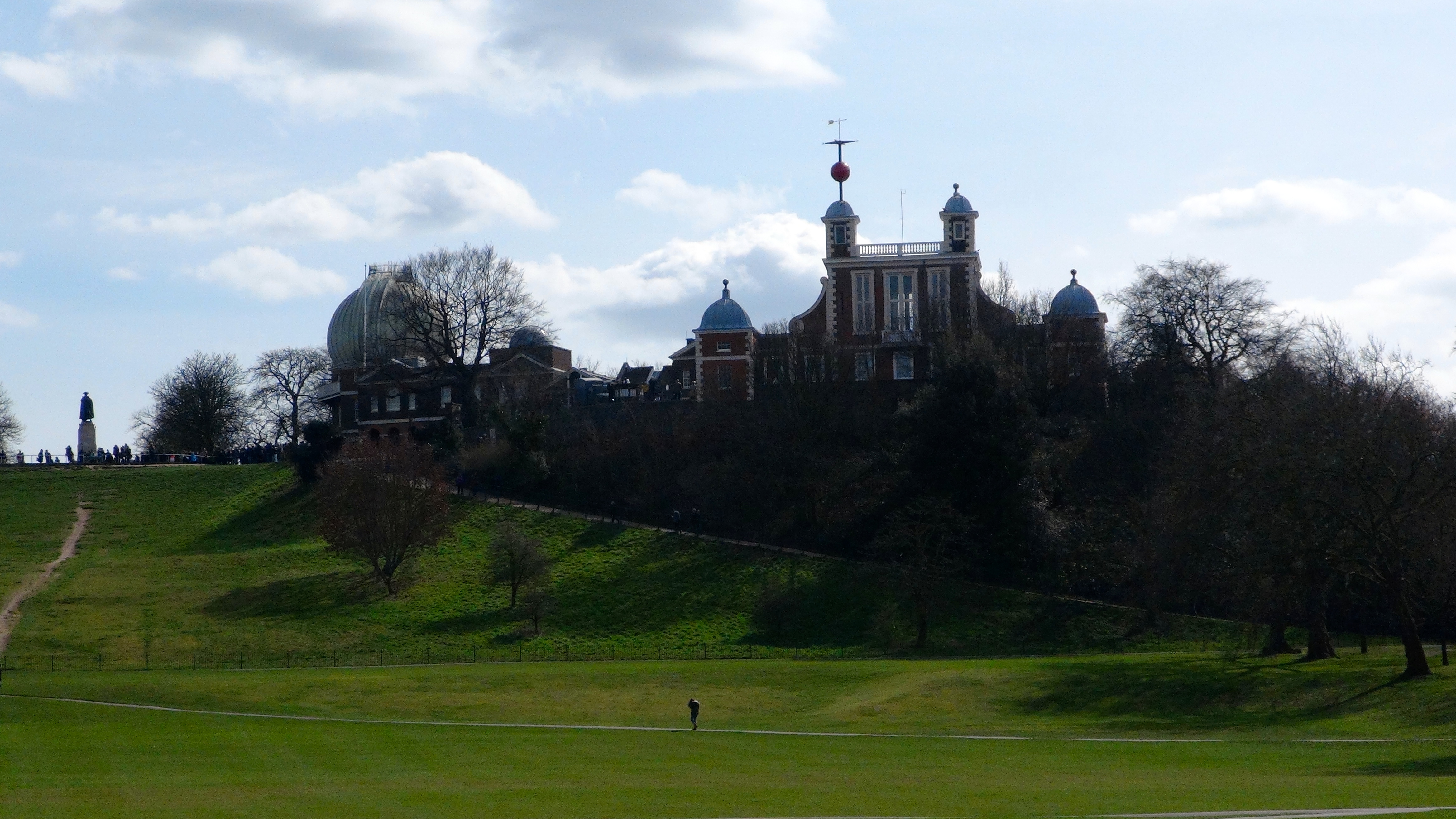
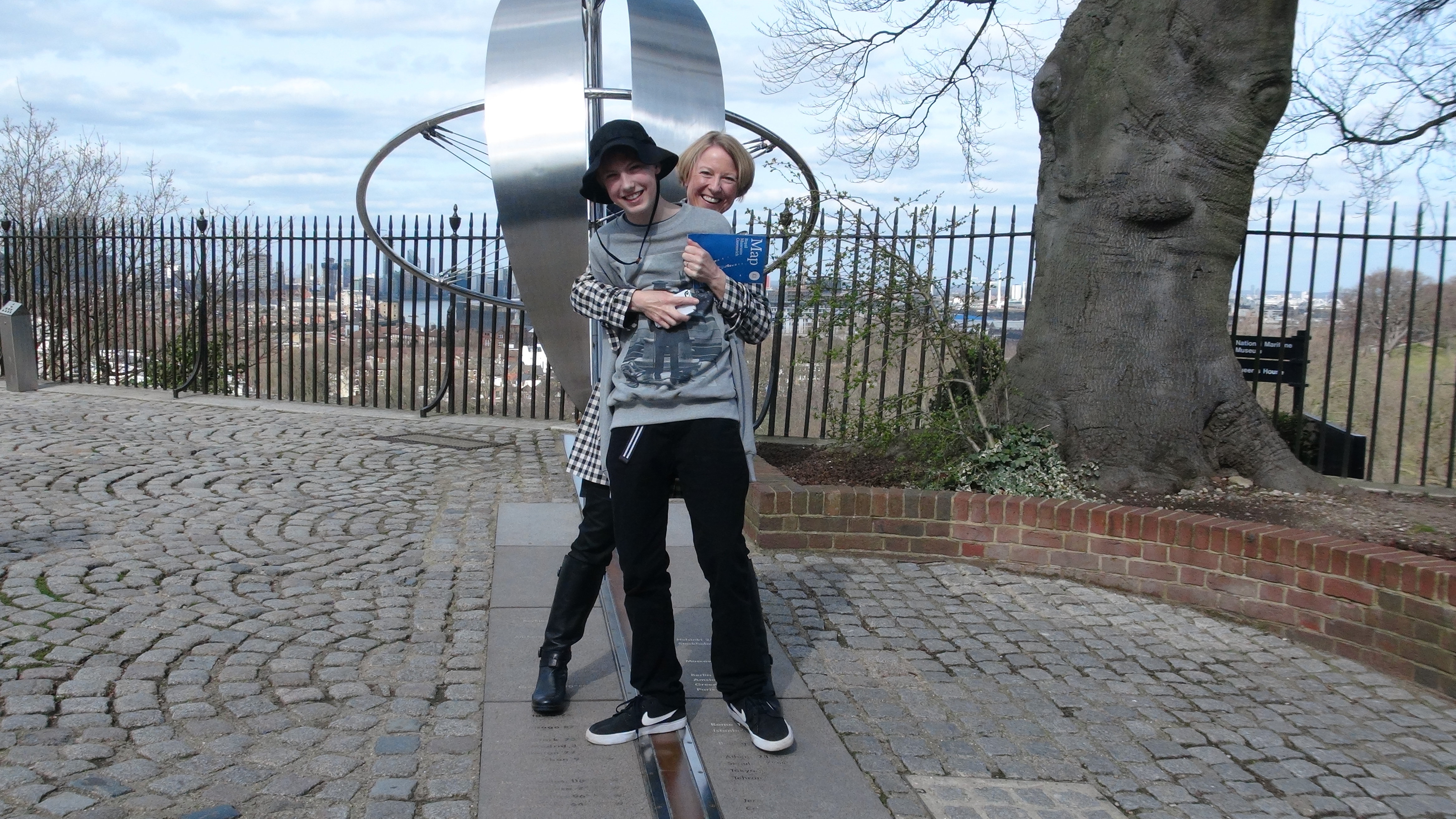
LONDON — Today, the London Eye and a Thames Clipper jaunt to Greenwich, of Greenwich Mean Time and the Prime Meridian. The weather was mostly clear today, so we rode the Eye to see the view. It was OK, but Will and Rick had already climbed St. Paul’s and the Monument, so they were used to the view and weren’t overly impressed. We then jumped on a commuter boat to Greenwich, a few miles downriver, where King Henry VIII and his daughter Elizabeth were born. After a meal in the riverside Trafalgar Tavern — where Dickens used to eat — that darn Dickens keeps showing up at our mealtimes — we headed up to the 17th century Royal Observatory, where Will and I straddled the Meridian, one leg in each hemisphere. We watched the ball drop above the hill observatory — as it has every day at 1 p.m. since the early 19th century so that seafarers could set their clocks for navigation.
We saw the development of the first time piece that made navigating longitude accurate and sailing much more safe. Carpenter and amateur clockmaker John Harrison took on the challenge in the 1700s and developed a series of four clocks — the first three large as a birdcage, the final one — and the successful design — a small and beautiful watch known as H4. It reminded me of Steve Jobs and the quest for the perfect design. Anyhow, I want an H4.
Rick then wanted us to go to the “Deer Park” at the far end of Greenwich Park, a former royal hunting ground on a high place overlooking London and the Thames and the skyscrapers of Canary Wharf. A kind of Pearl District with Major Banks. We teased Rick as we walked, and he asserted that the deer park — which he claimed Rick Steves had called a “must-do” — would sure beat those boring paintings I wanted to see in the Queen’s House back down by the Thames. We walked and walked and walked and walked. Rick was hoping for a Nara-style friendly deer petting zoo experience, I think, but it was more like a bunch of mangy fallow deer behind barbed wire. A little English girl was squealing — “I saw a mouse! Or a rat! I’m not sure which!” when we arrived so that made it a little more exciting. We laughed all the way back through the sunshine to the Queen’s House, which turned out to have some AMAZING paintings, even Rick agreed. The 17th century house had been built for the wives of the Stuarts, and there were some iconic portraits of the Tudors and the Stuarts, as well as a famous Spanish Armada painting and many many others. The house itself, now a popular wedding venue, is famous for being the first perfect home designed by Inigo Jones in the Palladian Italian style.
We cruised through the Maritime Museum, which was designed for an age group we didn’t understand — toddlers? pensioners? both? — so we took the light rail and Tube back home to recuperate for dinner. A stroll down King’s Road to Rabbit, which had the cool woodsy vibe of Ned Ludd without the amazing food. The smoked trout with clotted cream was delicious, as was the mushroom ravioli, but all the “small bites” left Will hungry for a bagel with lox and creme brulé back at the hotel.
We rode home on our first London bus. We had the familiar Tube-vs-Taxi “discussion,” decided to walk, and then a bus pulled up alongside us — it was just like the Grateful Dead song — a bus came by and I got on, that’s where it all began — and we leaped on. It would have delivered us to our door had we not gotten off a stop too soon in an overabundance of caution. Better than a taxi. Better than the Tube. Figured it out two days before we leave. Sigh.
A day of beauty
LONDON – So there is a cure for museum fatigue: Aphrodite’s bottom.
There she was, crouching at her bath just inside the entrance to the British Museum’s special exhibit, “Defining Beauty,” which opened in London today. It was the first glimpse of what would become the best experience I have ever had in all the years of trailing Courtenay through museums around the world.
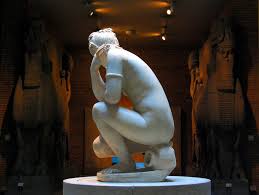 There was room after room of amazing and sometimes colossal objects not only from the British Museum’s huge collection of Greek art but also from the Pergamon Museum in Berlin, the Metropolitan Museum in New York and the Glyptothek in Copenhagen.
Nothing on loan from the new Acropolis Museum in Greece, though, and more on that later.
There was vase after amazing vase with images of myth, war, love and sex created hundreds of years before Christ. There was a bronze youth with a lithe, powerful body recently found in the sea off Croatia. The youth even had copper highlights on his lips and nipples There was the Discus Thrower of Myron in his throwing pose. There was a touching, life-sized bronze baby holding his arms out for love.
And there were some of the Elgin Marbles, the spectacular sculptures that once ringed the top of the Parthenon on the Acropolis that sits high above Athens. They are perhaps the most beautiful and controversial sculptures on Earth, and ones that Courtenay and I have argued about many times.
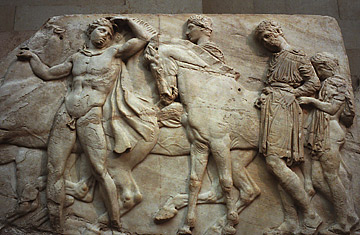 They were removed from the Parthenon for “safekeeping” by Lord Elgin in the early 1800s, and have been held, preserved and displayed in the British Museum ever since. Greece wants them back, and it is so insistent that it refused to contribute any objects to the British Museum’s major Greek exhibition. I understand the arguments for keeping the Elgin Marbles here: They are integral to the British Museum, and returning them to Greece would set a precedent that would send shudders through the great museums of the world.
And yet, I believe they should one day be displayed in the beautiful new museum that Greece has built at the foot of the Acropolis. The panels are amazing, including heroes grappling with centaurs and horses so lifelike, with veins bulging in their legs, that you can almost imagine the thunder of their hooves.
We went on to spend several more hours in the British Museum, which has millions of pieces displayed in miles and miles of hallways and exhibit spaces. We saw incredible things, including Eyptian mummies and the remnants of a man whose body was preserved in a bog for more than two thousand years. Eventually our legs tired and the huge groups of roving schoolkids took over the museum, and we made our way outside.
The rest of the day is largely a blur — the English fish and chips for lunch, the special exhibit in the nearby British Library of the actual copies of the Magna Carta and other documents of what would become democracy, the tattered sheets of paper with the Beatles lyrics, the 300-step climb with Will up the monument to the Great Fire, the bustle and smells of meat pies, cheese and breads of the Borough Market.
All I can see clearly tonight is that frightening Centaur, those stampeding horses, those muscular boys with the impossibly tight stomachs, that baby reaching out with chubby arms, that crouching Aphrodite.
Beauty does last.
But this is now Courtenay, and I get the final word on this post: does anyone remember the esteemed art critic, E. Buzz Miller? That’s all I have to add…






Pies and Adventuring with the Pennystinker
LONDON — It was supposed to be our easy day.
A play, a tour of the reconstructed Globe Theater, and a take-home meat pie for dinner.
Instead, we ended up in what Will termed a “passive-aggressive” argument at dinner in the shadow of the Tower about whether the take the Tube home at 7:30 p.m. or a cab. Obviously, we again tried to do too much. But that is the joy of travel, n’est-ce pas?
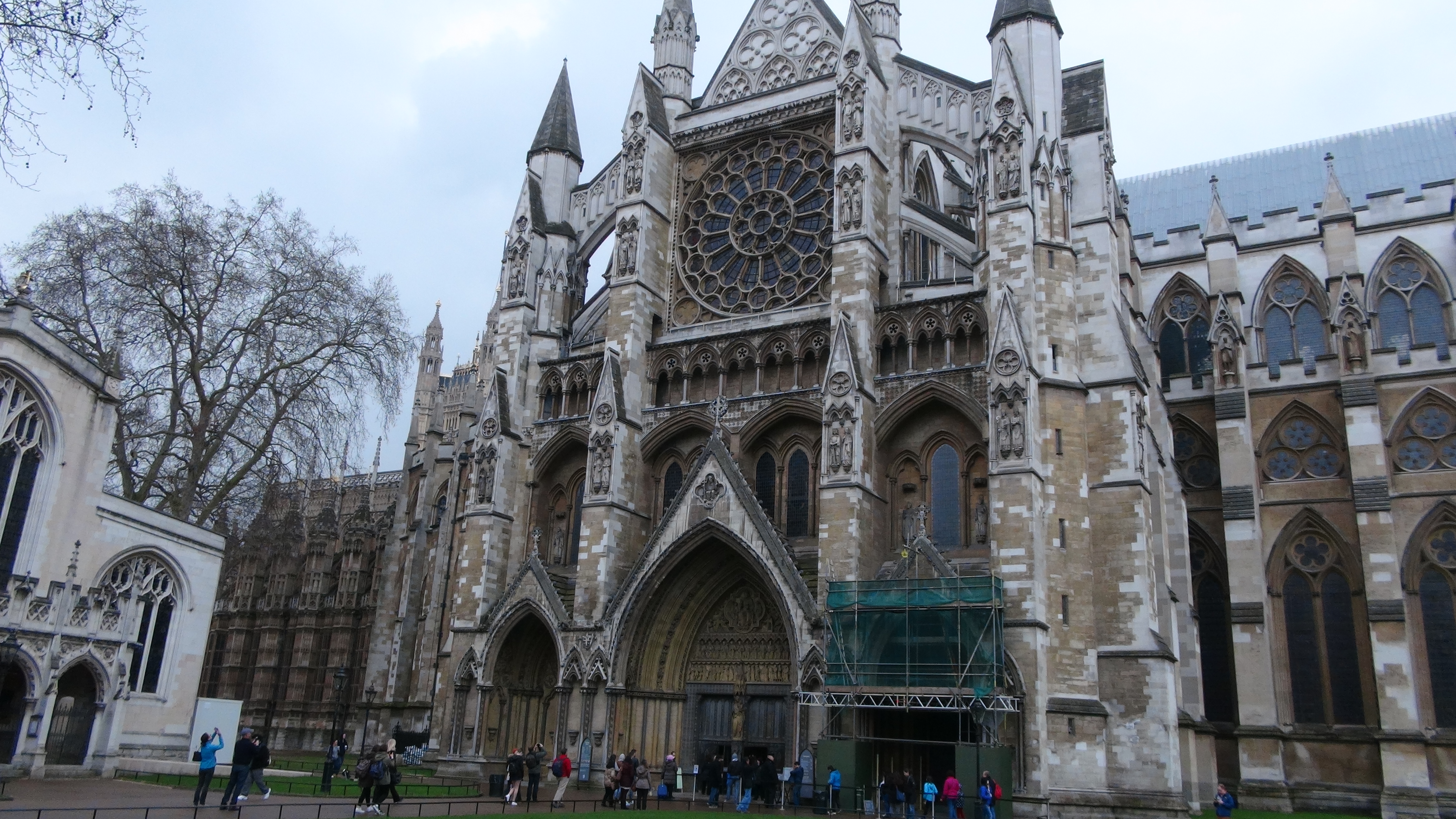
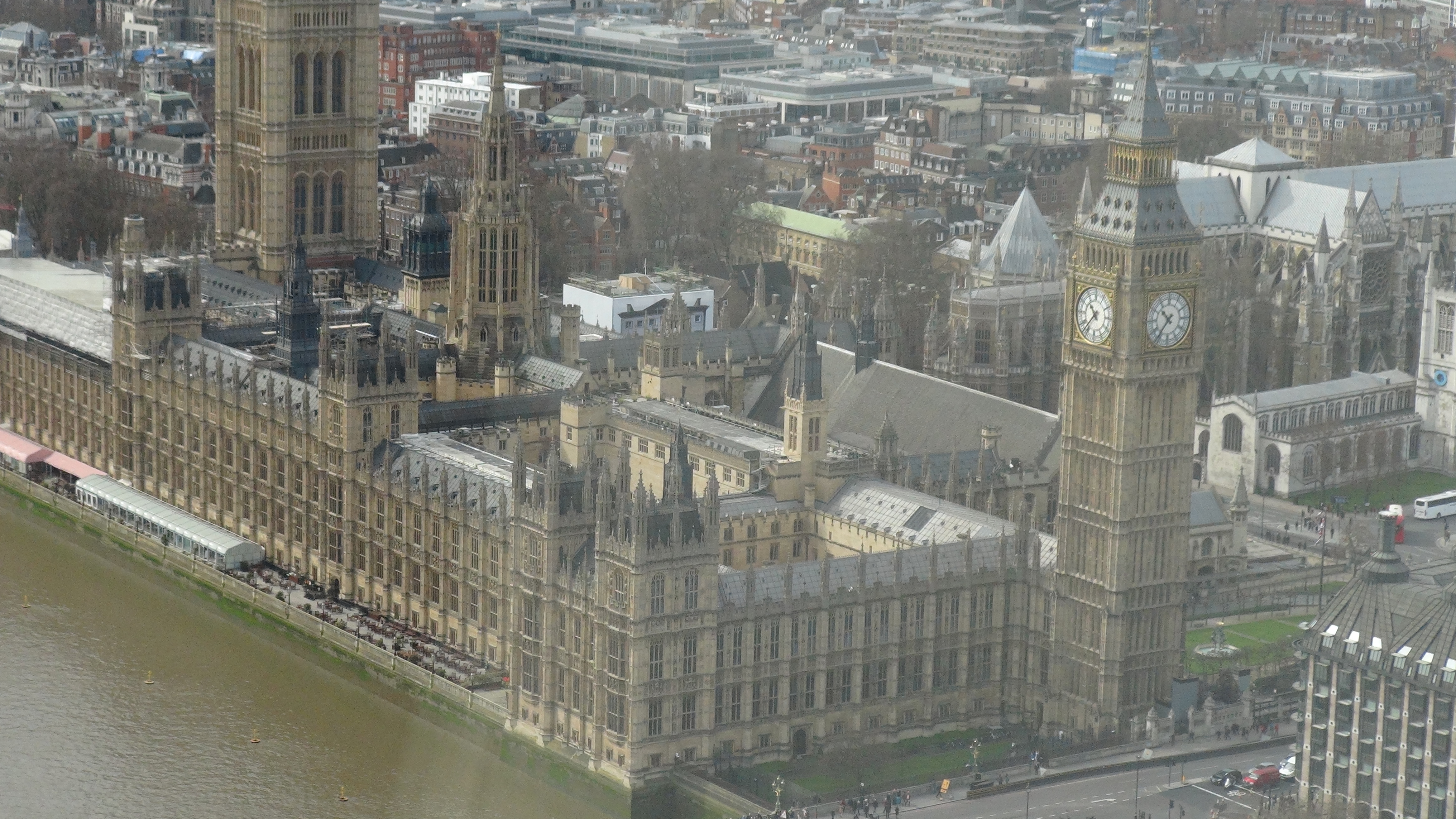
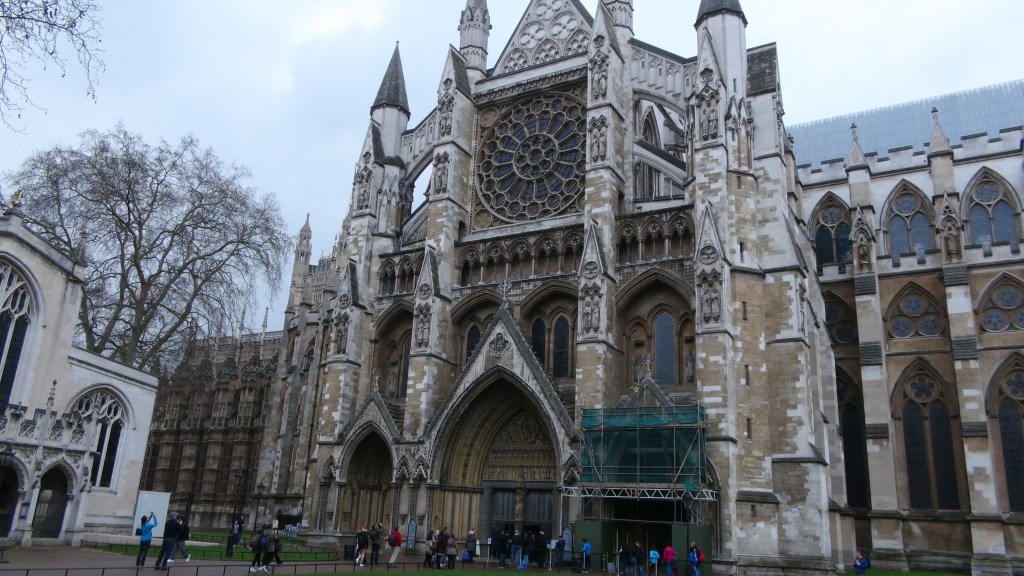
We started the day at Westminster Abbey, the 11th century former monastery that is the old English heart and soul. Here is where the kings and queens are buried, where poets are honored, where the Royal Air Force is commemorated and the Tomb of the Unknown Soldier lies. Its sense of history is overwhelming.
But the highlight of our visit was to the very heart of the abbey itself — the sanctuary of St. Edward the Confessor — the holiest spot in the abbey, a place not on the guided tour, the place the Pope himself came to pray on his visit to London. A sweet old volunteer told me, when we entered the abbey, that we could visit the shrine of the only English saint still intact and still buried in his original spot if we joined the 11 a.m. prayer. We thought it would be crowded, but only about eight of us showed up, to be ushered into the sanctuary, where lay the Confessor, the 11th century king who built the first abbey here. His tomb had been desecrated and stripped of ornament during the Reformation, but the chaplain told us King Henry VIII didn’t dare disturb the saint. Other saints were not so lucky, and their remains “scattered to the wind.” Richard II and Edward III, as well as Edward I Longshanks and Henry III were also entombed in striking bronze tombs in this elevated area.
We joined the chaplain in the Paternoster, and prayed for, among other things, peace among nations, end to strife, the health of the Queen and the realm, and asked Edward to hear us. It was quite lovely.
We then saw the tombs of Queen Elizabeth I, who shares her tomb with her Catholic half-sister Mary, who had once imprisoned her in the Tower. On the opposite side of the chapel lay Mary, Queen of Scots, who had been executed on the orders of her second cousin Elizabeth. They are all laid to rest together. As I said, it’s all a little overwhelming.
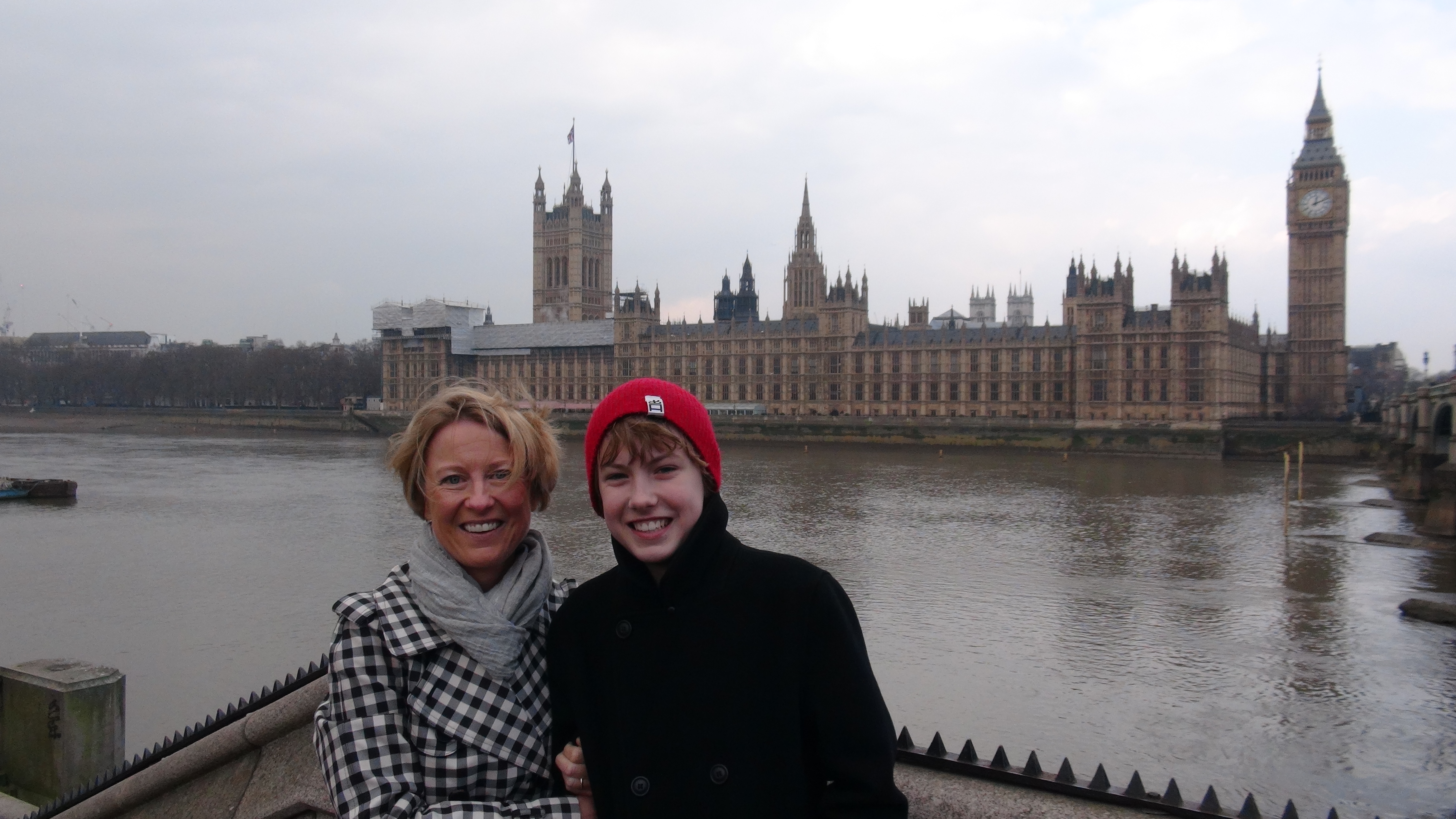
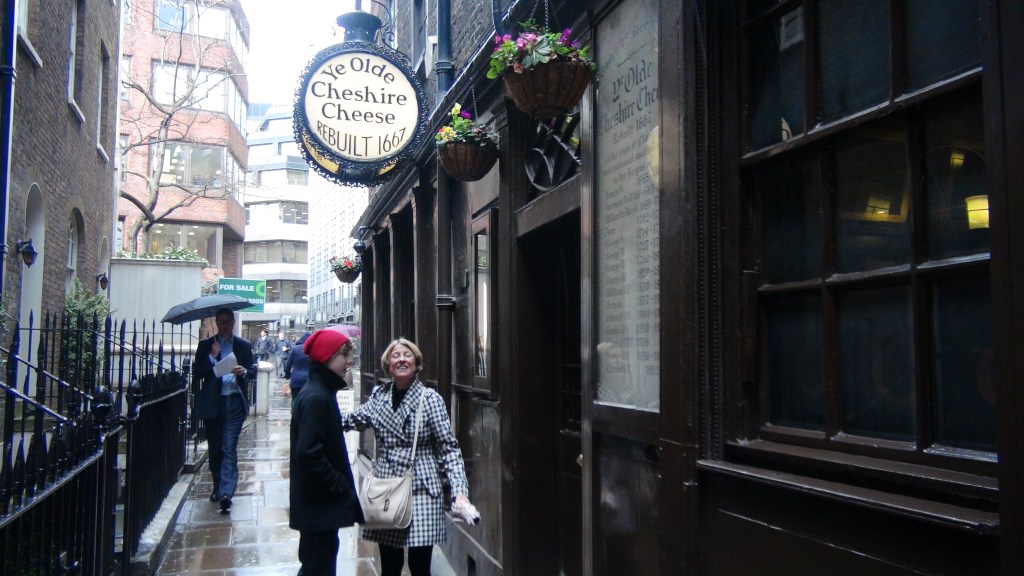
Will stood on tombs as diverse as Charles Darwin, whose seat he had taken yesterday at Ye Olde Cheshire Cheese, to Clementi, whose music he has played on the piano. We admired the lovely ceilings of the Henry VII chapel, as well as the Chapter House, where parliaments met from the 14th to the 16th centuries.
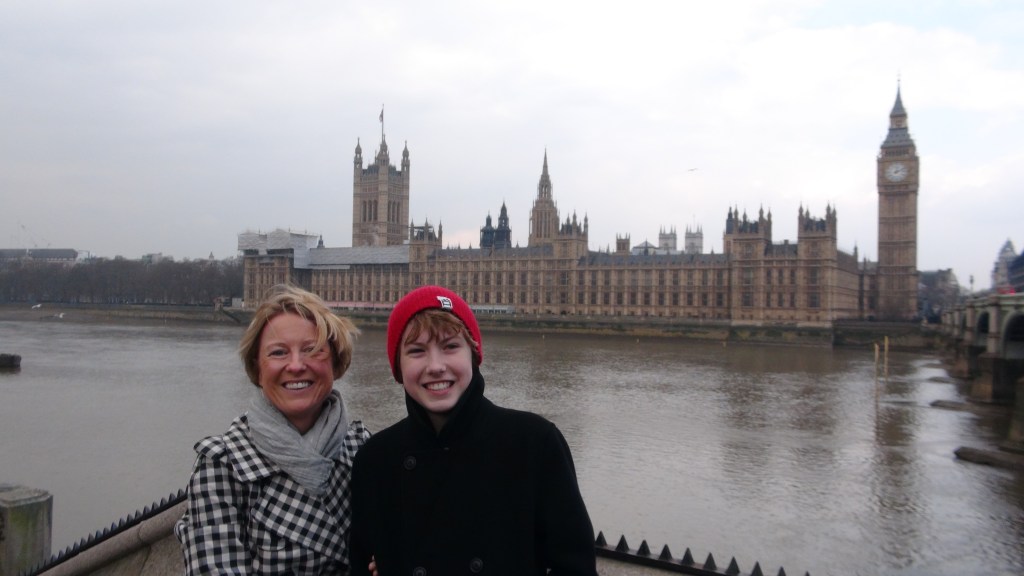
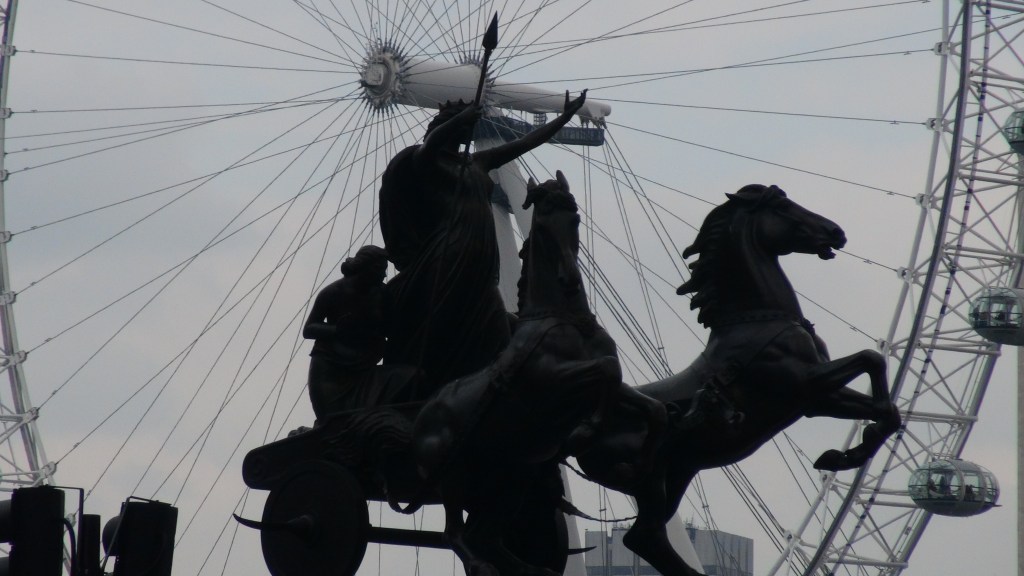
Lunch was in the old County Hall building across Westminster Bridge, a lovely lunch of crab cakes with a view across the Thames at the north bank. We then walked along the south bank, dodging the State Fair atmosphere at the base of the London Eye, and made our way to the Olivier Theater at the National Theater — we had just seen Olivier’s tomb, so it seemed fitting to be seeing a play in his theater. Treasure Island had some terrific sword-play, as well as the most incredible set that rose and fell into the stage, rotating, sprouting pirate ships and islands. Someone told us it’s one of only two such stages in the world — I think the other may be in Ashland. Remind me to check on that. Anyhow, the acting was good, but the second half got a little bloody, which was hard to square with the comedy. Also fittingly, Will’s favorite character was a ship crew member named Grey, whose name no one could ever remember. Grey, Will’s favorite painting at the Tate Modern, now Grey, the nondescript comedy relief.
Our favorite line in the play was just before one of the ships’ mates, a hefty woman very fond of pies, declared just before she died, “Thanks for the pies and adventuring.” Exactly our thoughts.
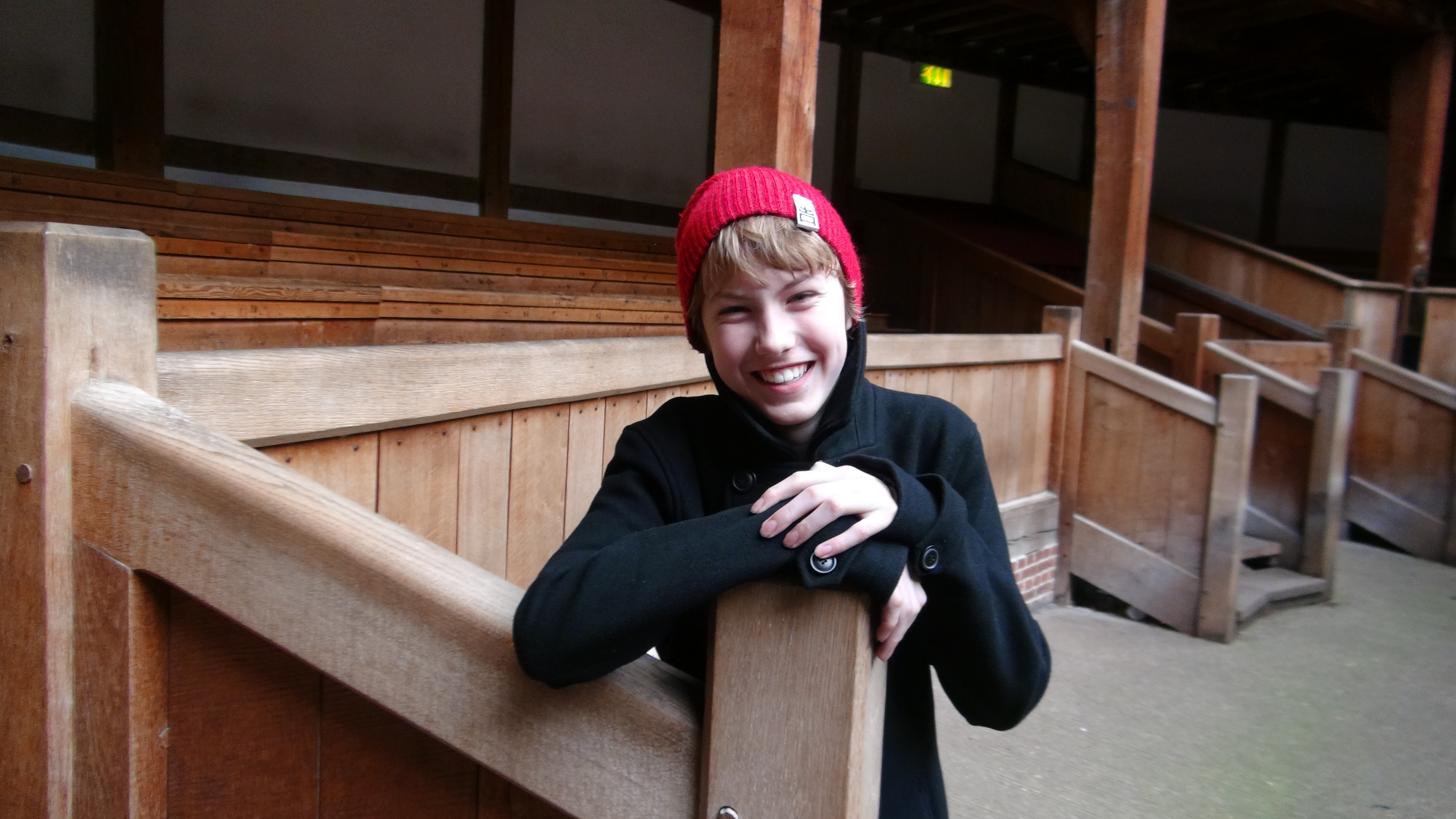
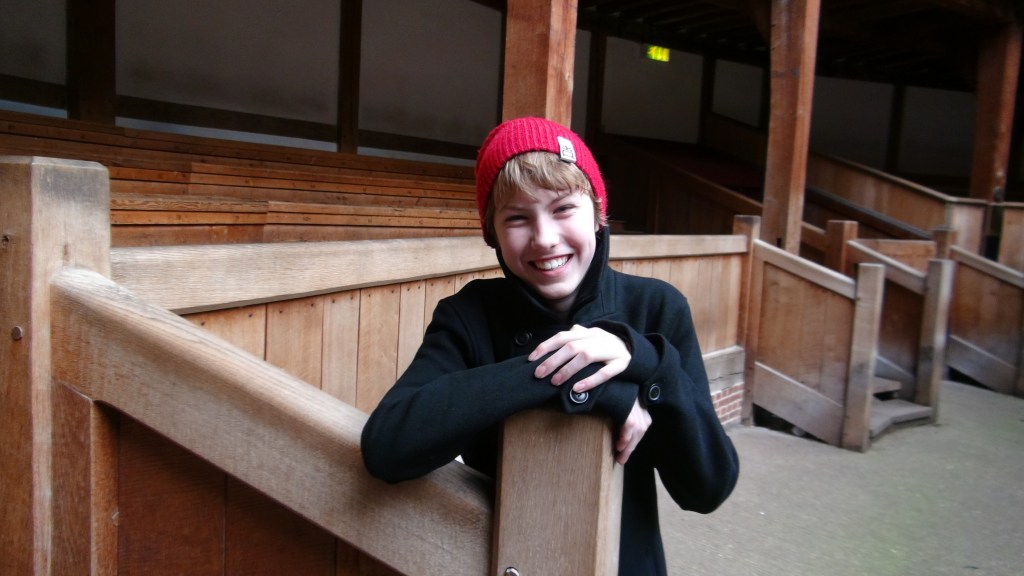
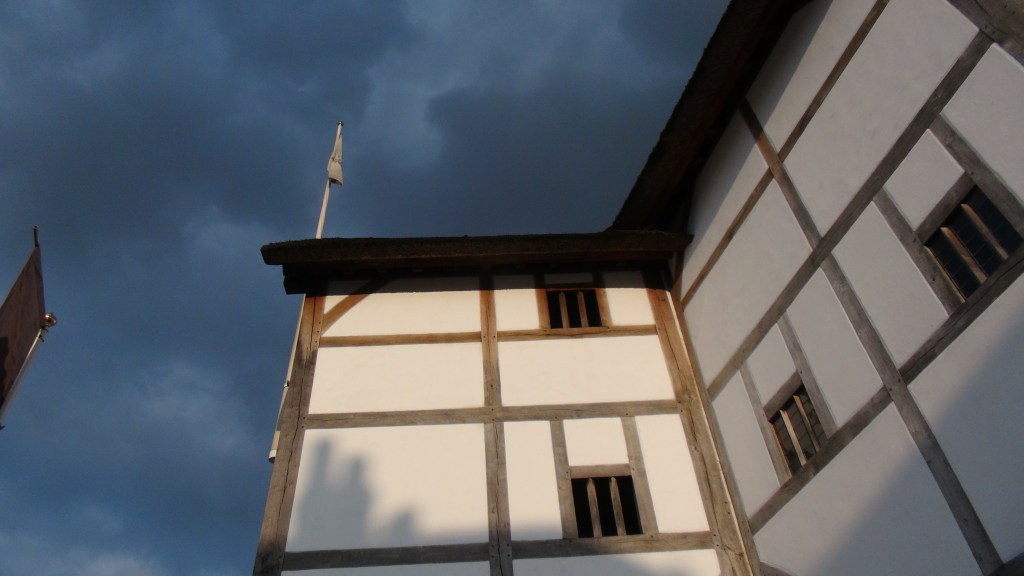
We then raced down the Thames to catch the last tour of the Globe, the vision of American director and actor Sam Wanamaker, built in the 1990s to recreate the theater that Shakespeare wrote for, down to the animal hair in the plaster walls. Rick was disappointed with the tour, since he wanted to hear how it was constructed, but it was interesting and wonderful to see. The guide talked more about the experience of the theater for a 16th century audience, who would pay one penny to stand in the pit at the base of the open air theater. More pennies got you a seat and better comforts, such as a pillow. The groundlings, or the 1,000 who crammed into the pit, apparently smelled quite atrocious, what with the lack of bathing and the penchant for eating raw garlic to ward off the plague. When they roared at the action on stage, apparently they let off a big stink, thus they were called the Pennystinkers. Rick thought the same name suited a certain boy we know and love, as well as a certain black Labrador. Our little Pennystinkers….
Looking back over the day, it seemed incredible we saw the tombs of the kings who appear in the plays by the playwright whose 400-year-old theater we just saw reconstructed. The Oregon Shakespeare Festival just announced they will put on Richard II next season, and here Will saw his tomb and his famous portrait at Westminster, as well as the memorial bust to Shakespeare. It all weaves together…
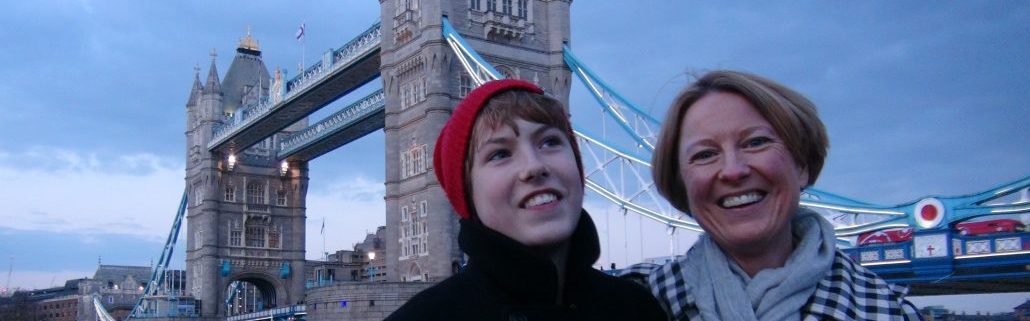
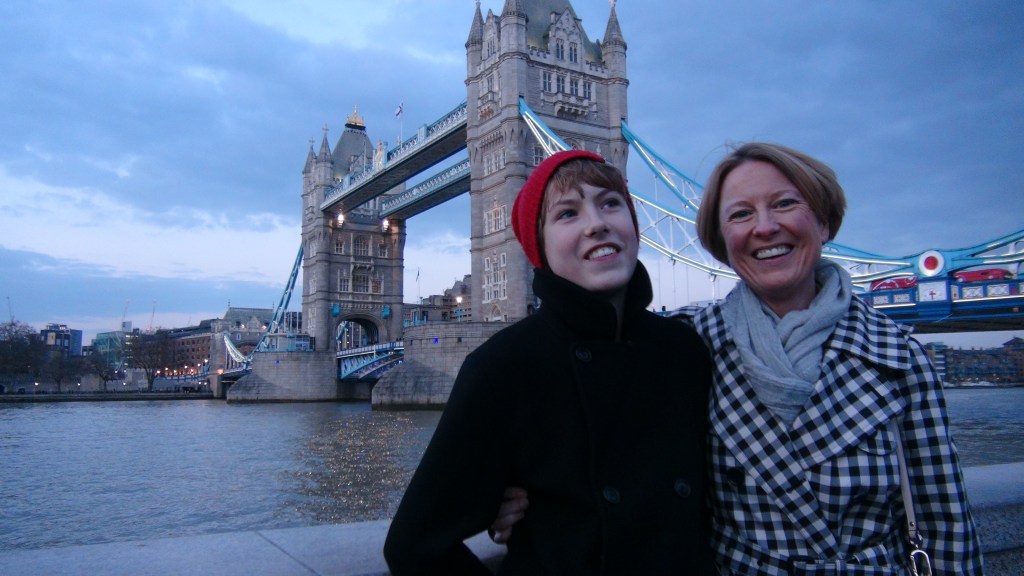
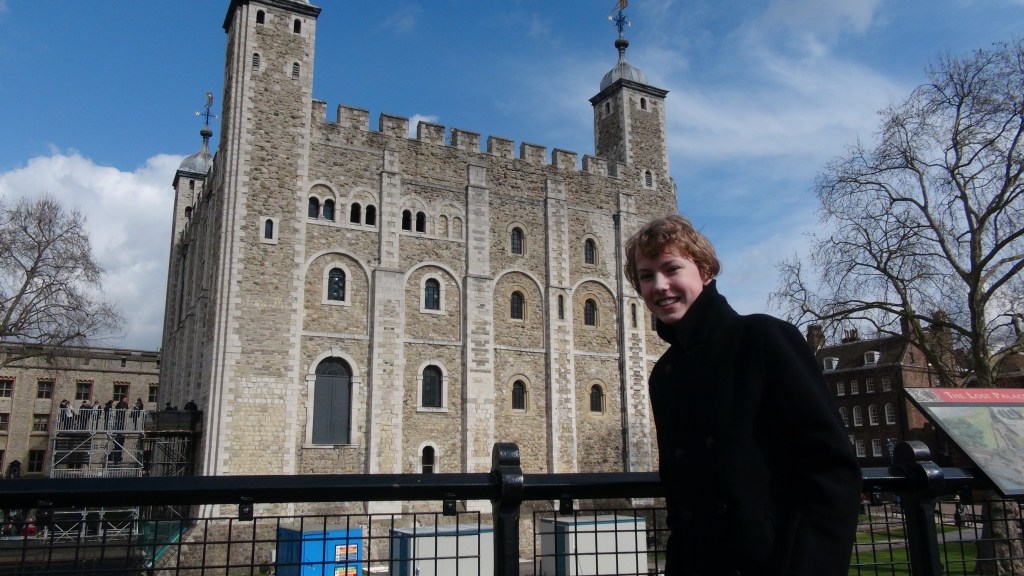
We were then off to dinner at the Perkin Reveller on the recommendation of our friends’ the Riches, and we had a wonderful dinner (yes, meat pies again, with Will eating half of mine, again) with evening views of Tower Bridge, the creamy stones of the Tower itself, and the Thames.
We ended with the fateful passive-aggressive argument — resolved when we took both the Tube and a cab. Good night all and cheers from London!

 The Thompson Attigs