Category Archives: South Korea

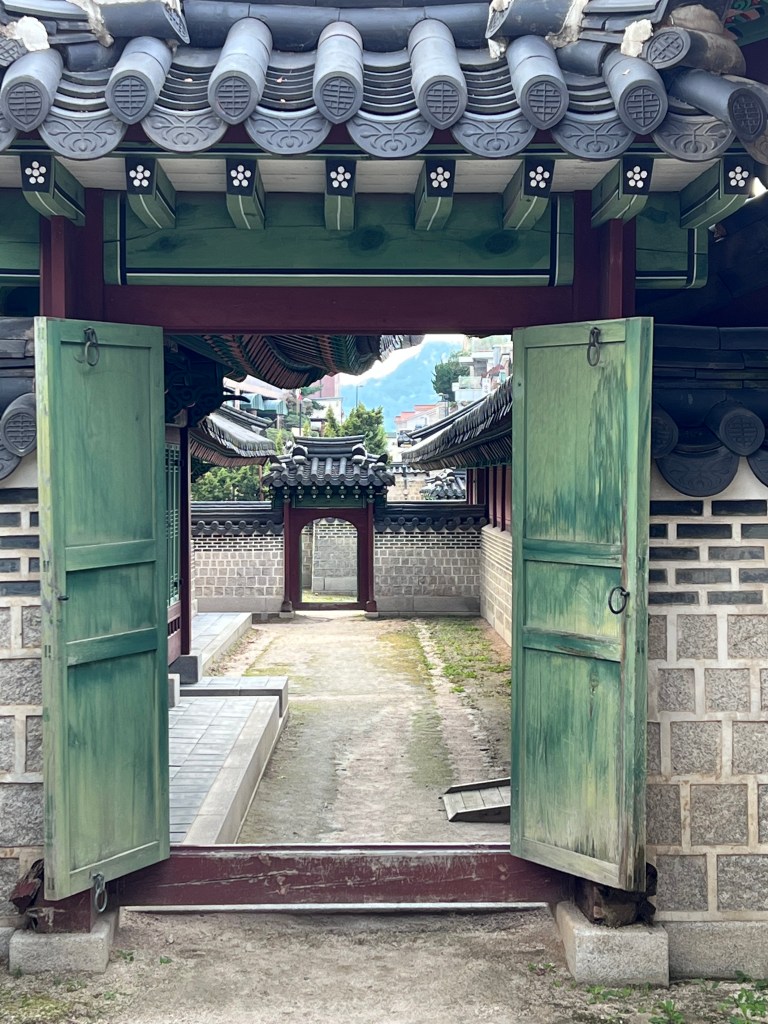
Yeoseot?! Yeodul?! San-Jyu-Pun!!
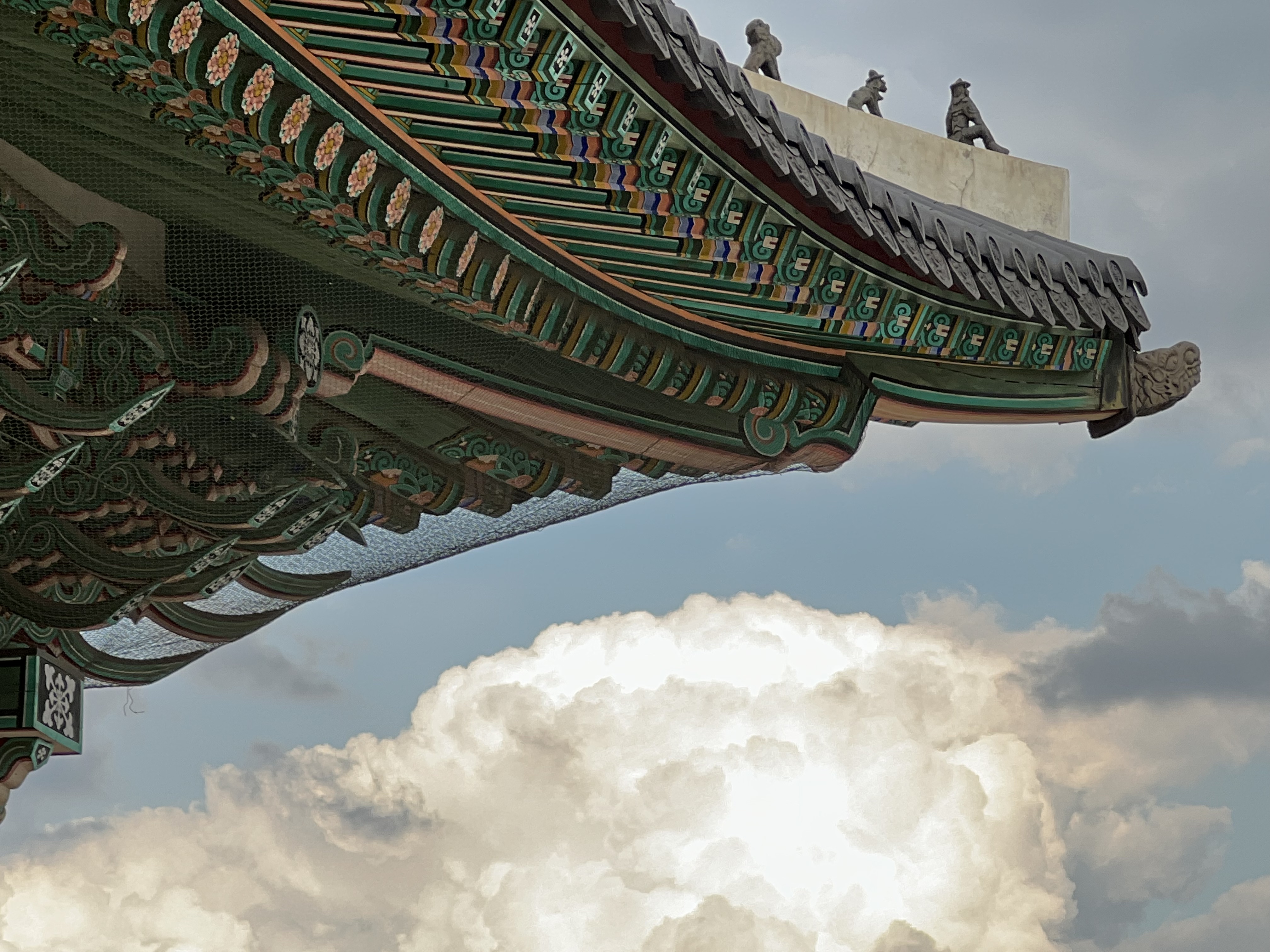
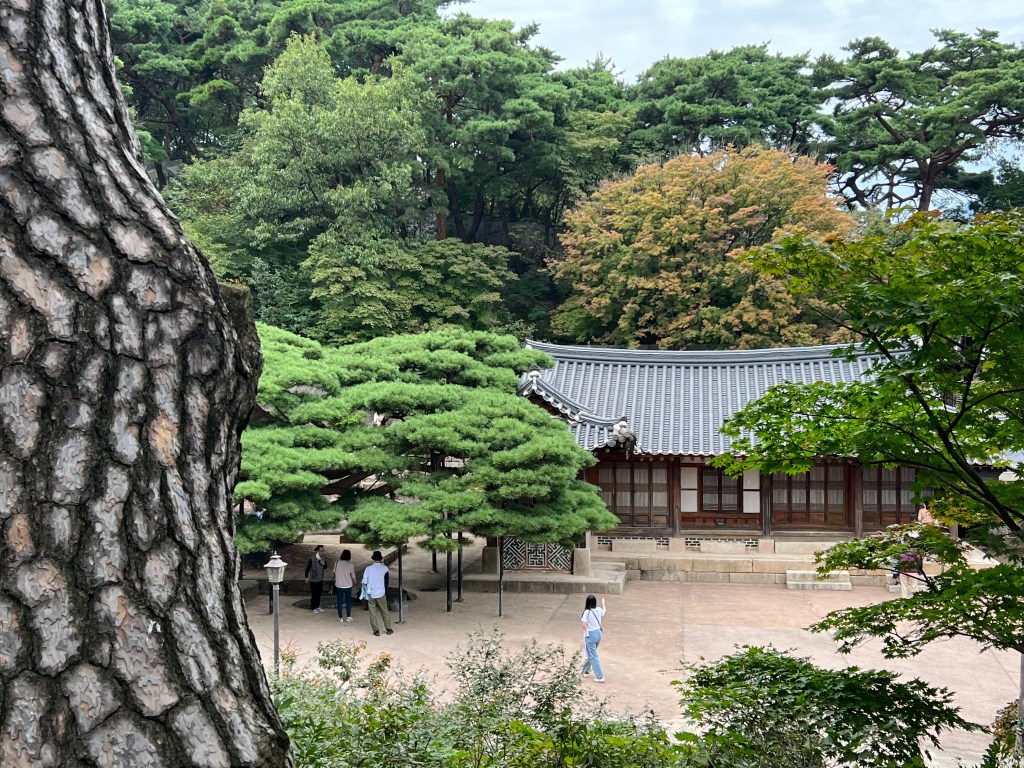
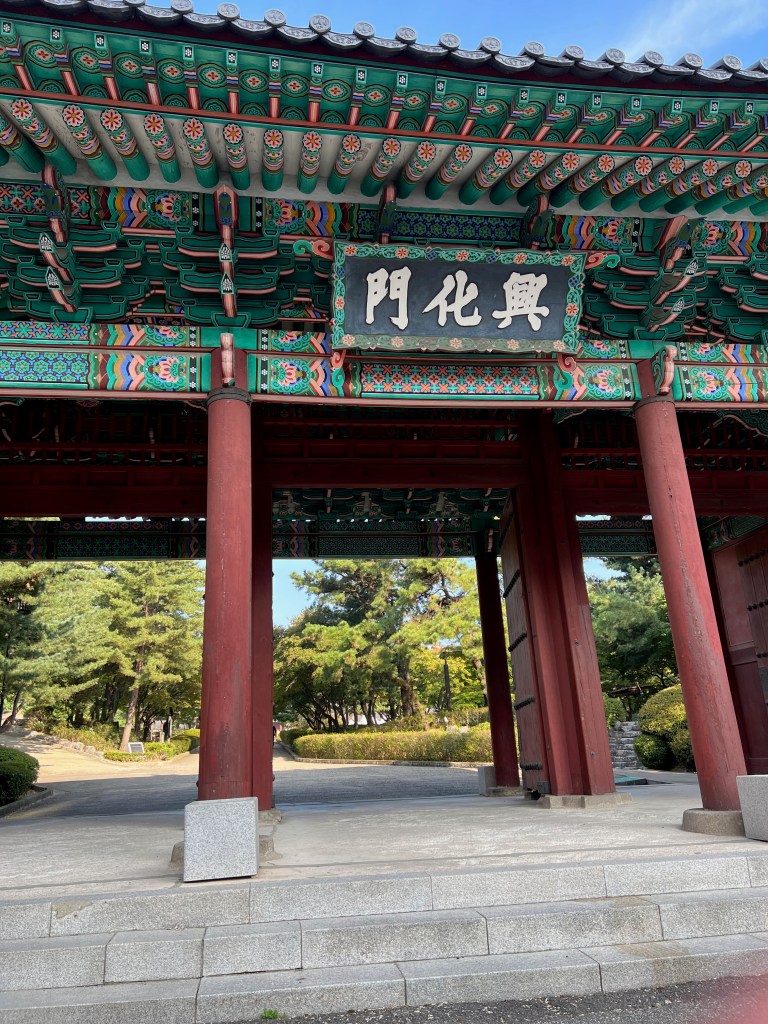
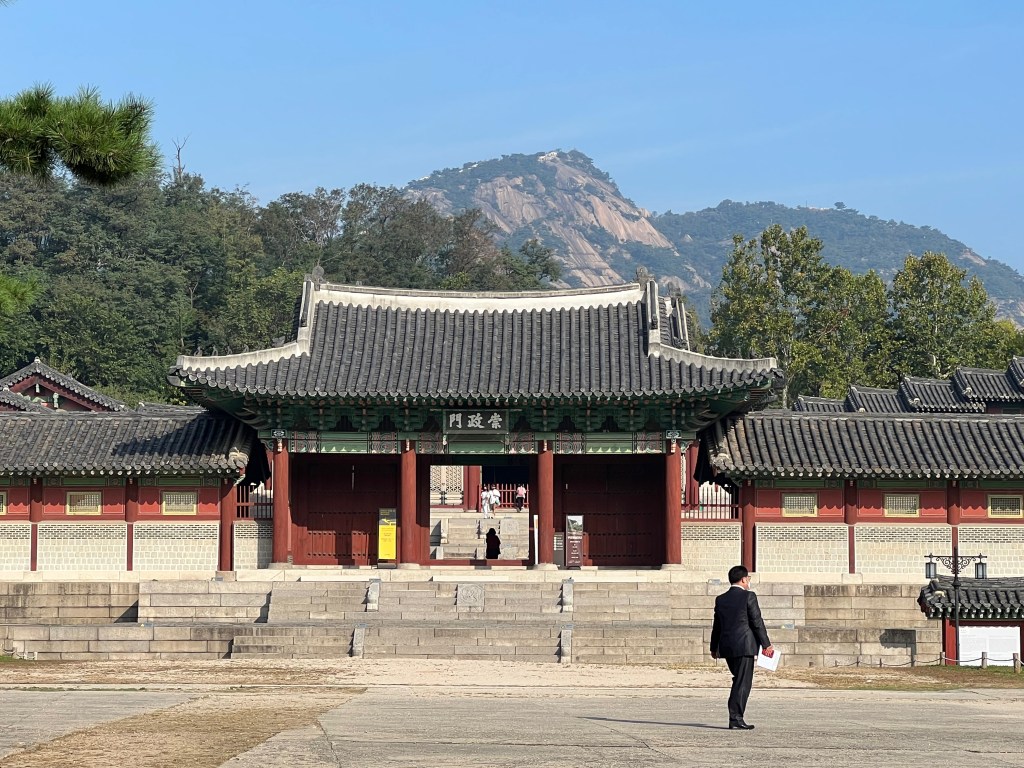
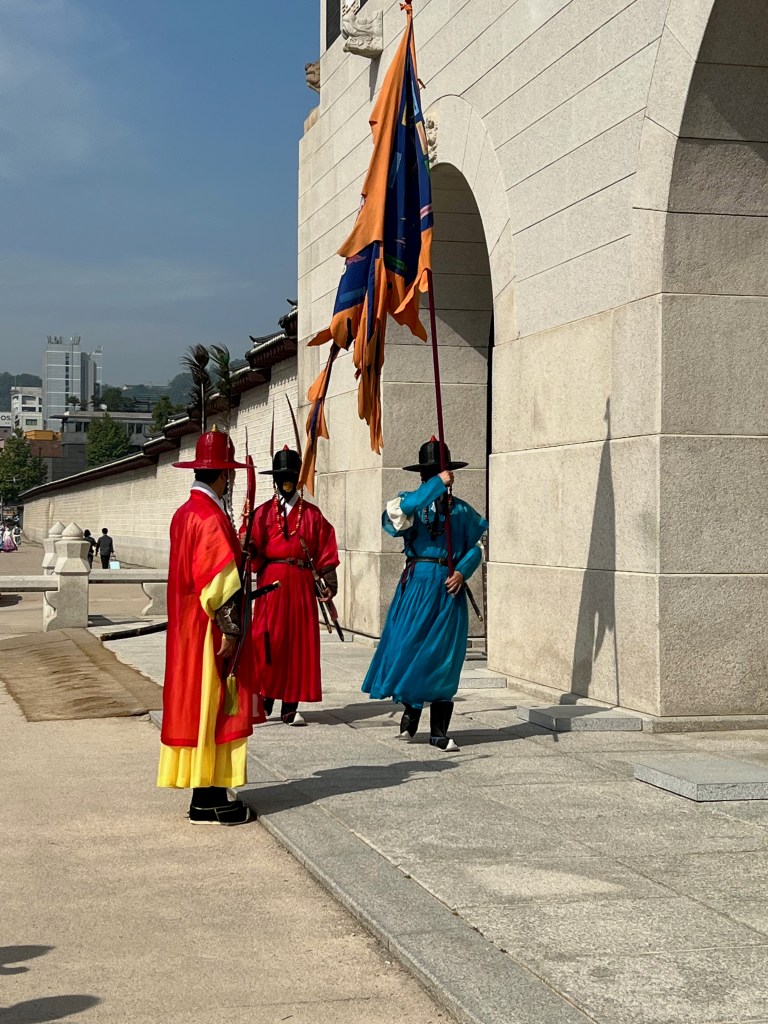
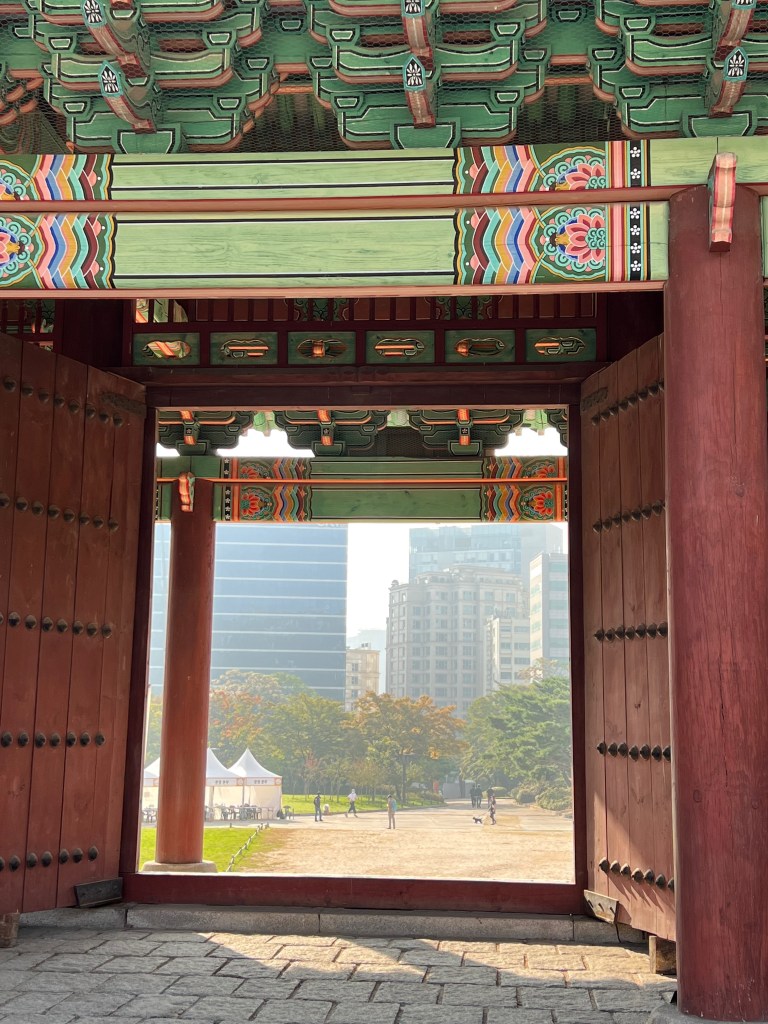
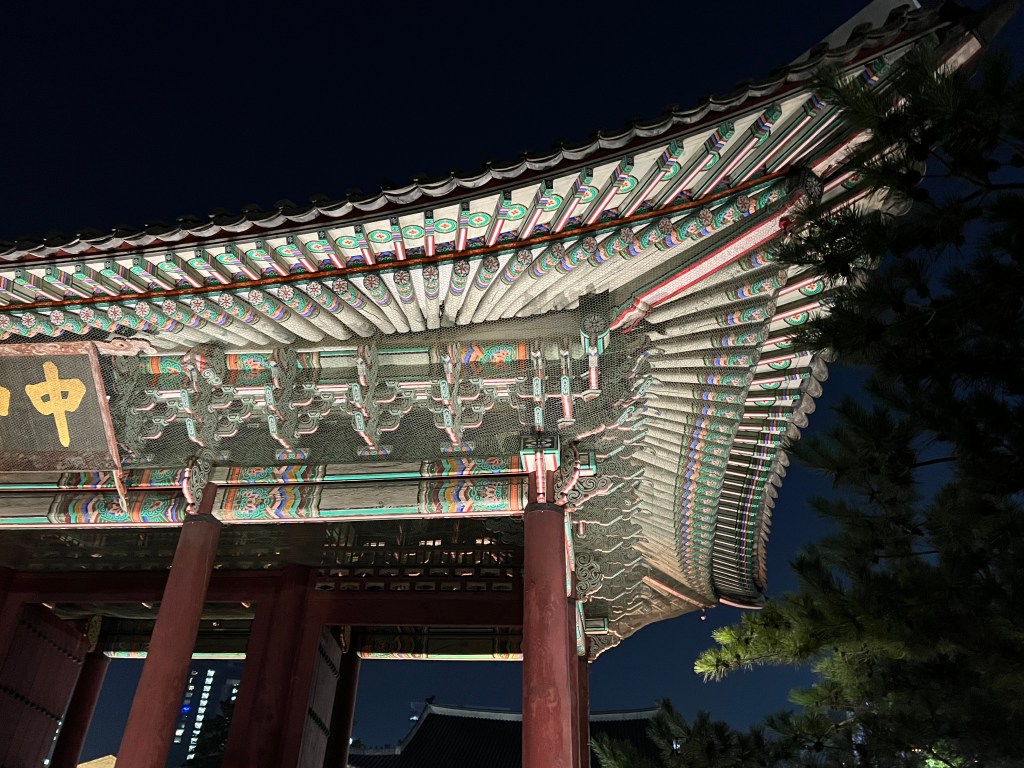
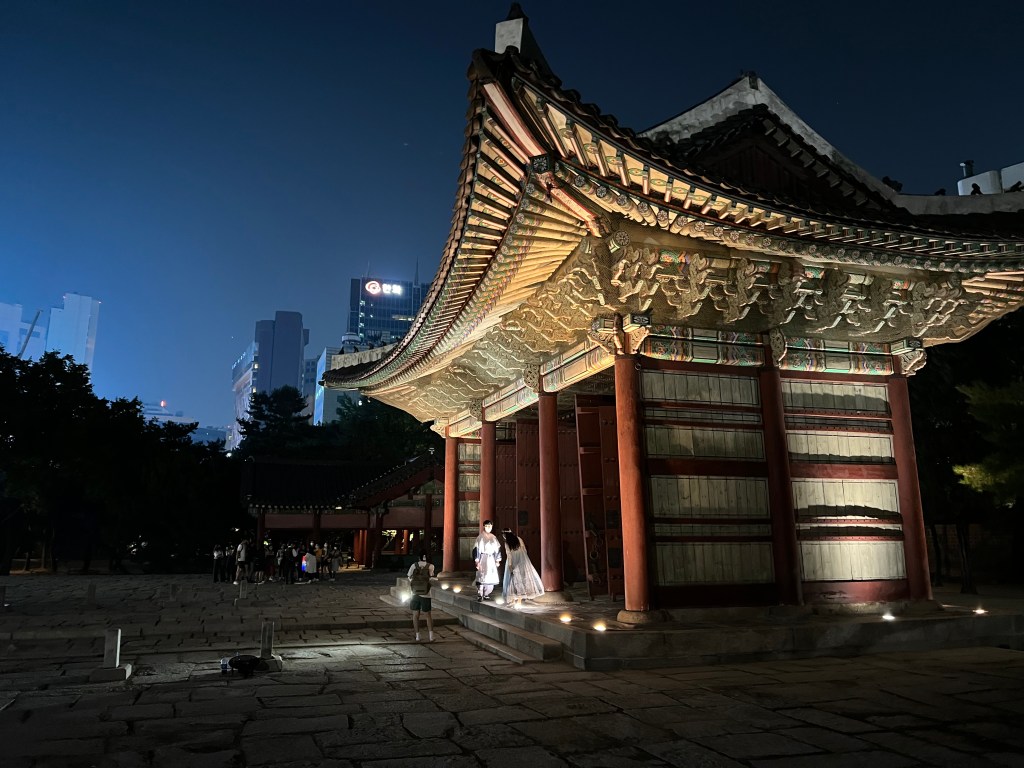
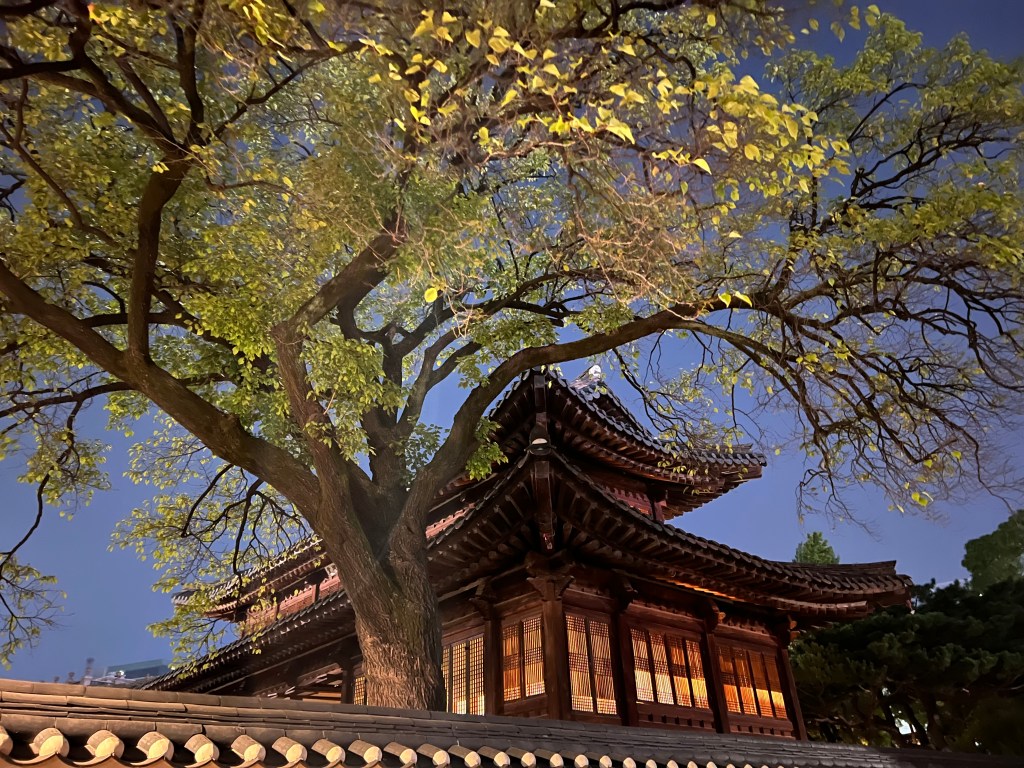
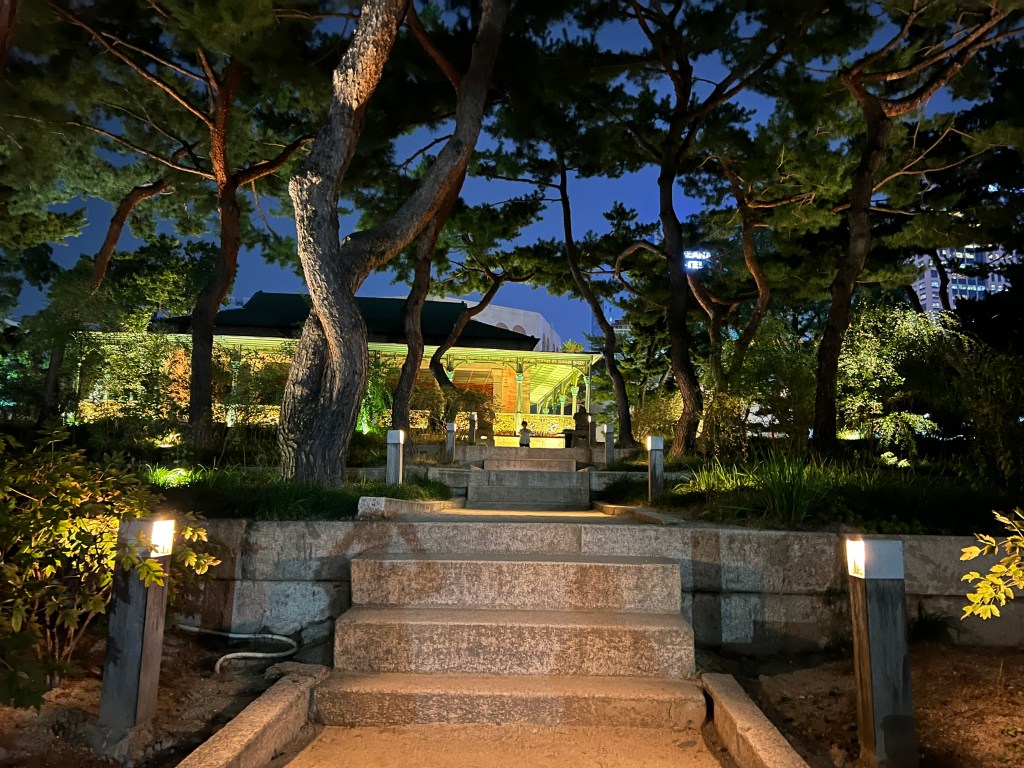
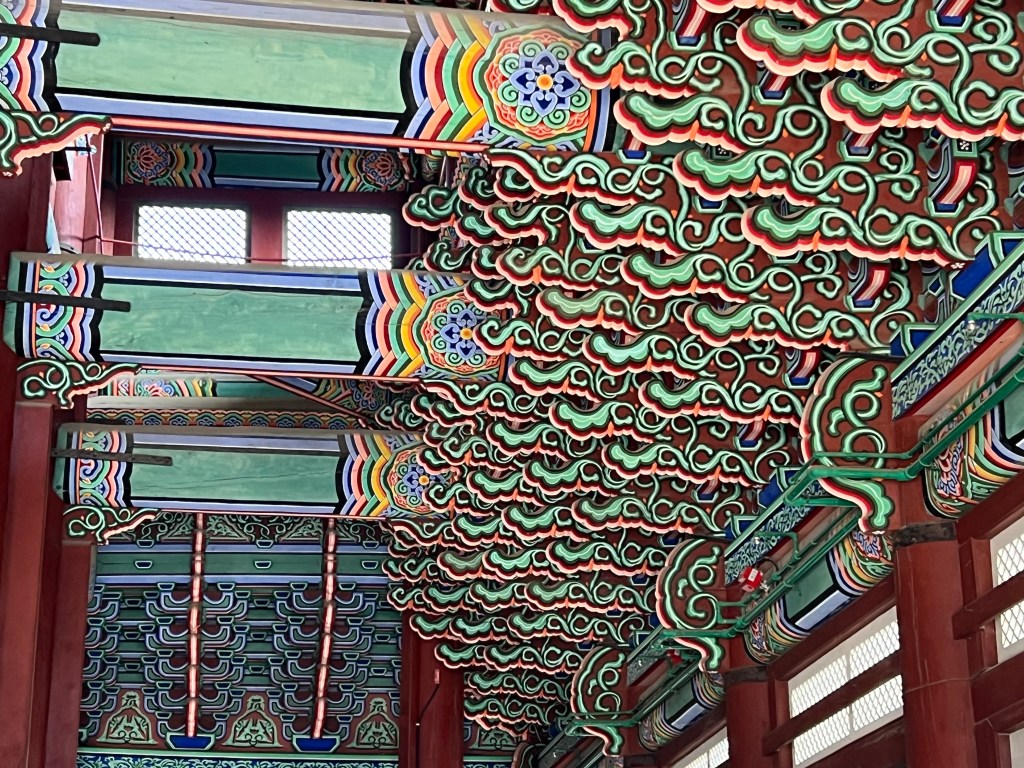
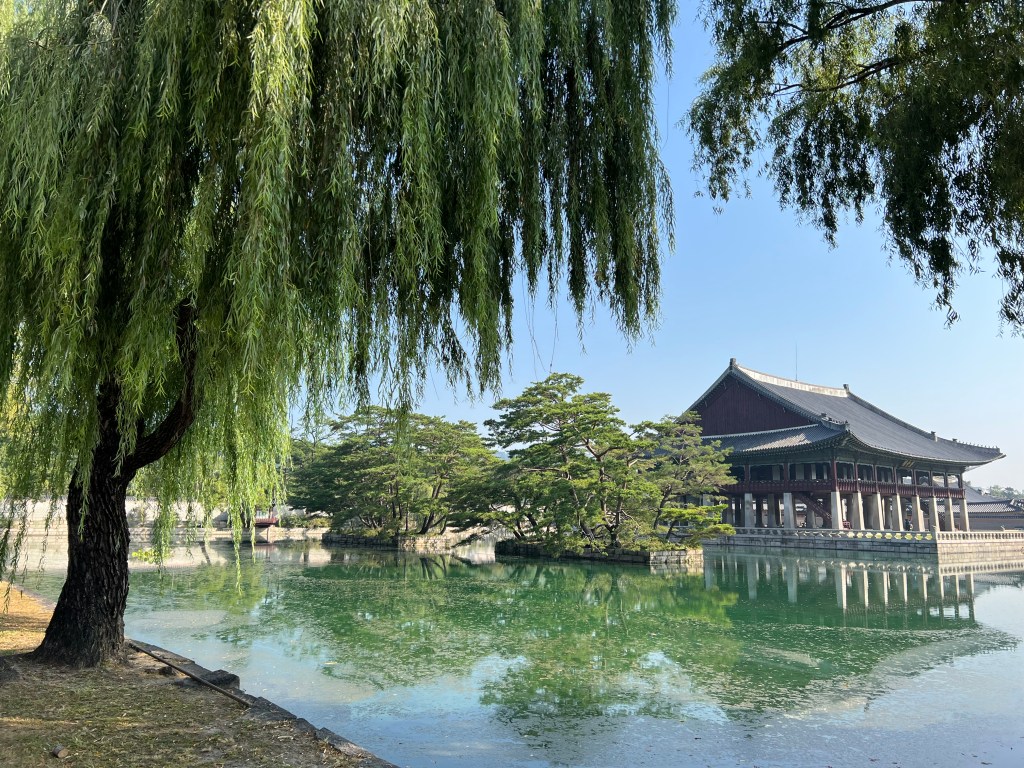
Wednesday, Oct. 5, 2022 – Today, we took a deep dive into Korean culture and history, starting with another sprint to make the only afternoon English language tour of the Secret Garden at the beautiful Changdeokgung Palace, a 15th century Joseon-era palace where members of the royal family had lived as recently as 1989. We had been told the Secret Garden was a must-see, so we booked the tour, thinking it was 50 minutes but was in fact a full hour and half and included 97 other Westerners, including a group of Germans dressed up in traditional Korean clothing, their phones pinging and constant narration making it hard to hear the soft-spoken guide. But the gardens were beautiful and expansive. Tigers once roamed there, eating an occasional guard, and providing leisure space – theaters and study areas and ponds and pavilions – for emperors and their retinues. We learned that noblemen wore many layers of white clothing and were known for an almost Monty-Python funny walk, with their hands clasped behind their back, walking in a sort of zigzag pattern as they perambulated and cogitated. (Turns out that is how I like to walk, minus the white clothing, which I would have spilled something on immediately.) We learned the women wore up to 25 layers of clothing, and saw where fires were stoked under buildings to provide the famous ondul heated floors. Like the other palaces and grounds in Seoul, the original 15th century wooden structures were burned by samurai invaders in the late 16th century. Only 35 percent of the post-1610 buildings remain, but they are being painstakingly reconstructed. (The modern world intruded too: Just feet from the emperor’s most important pavilion, zombies were filmed coming from a shallow pond in the recent K-drama, “Kingdom.”) The forests seemed to have survived intact, and though we were in the heart of Seoul, it was quiet, the sound of frogs and crickets occasionally chiming in.
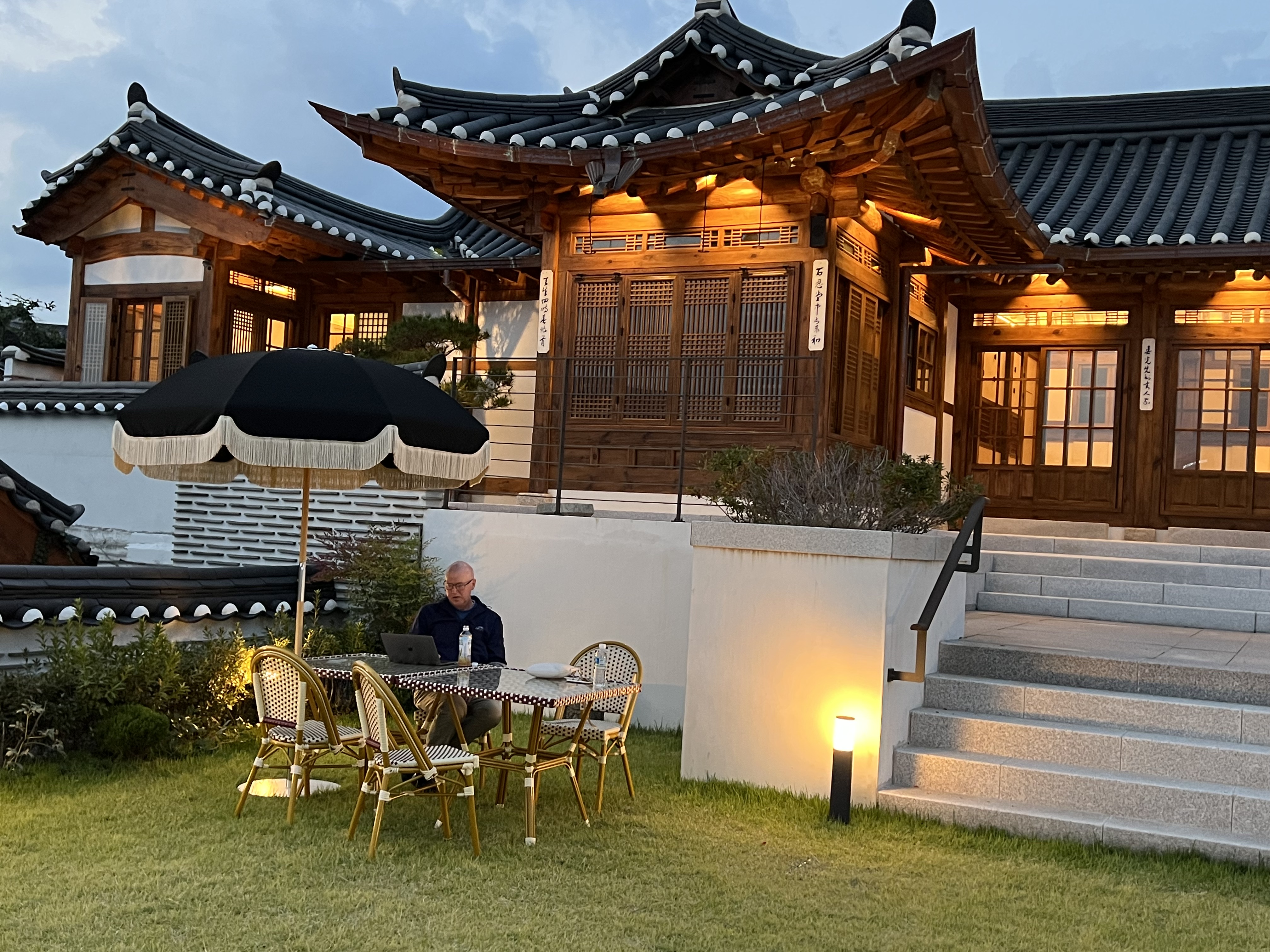
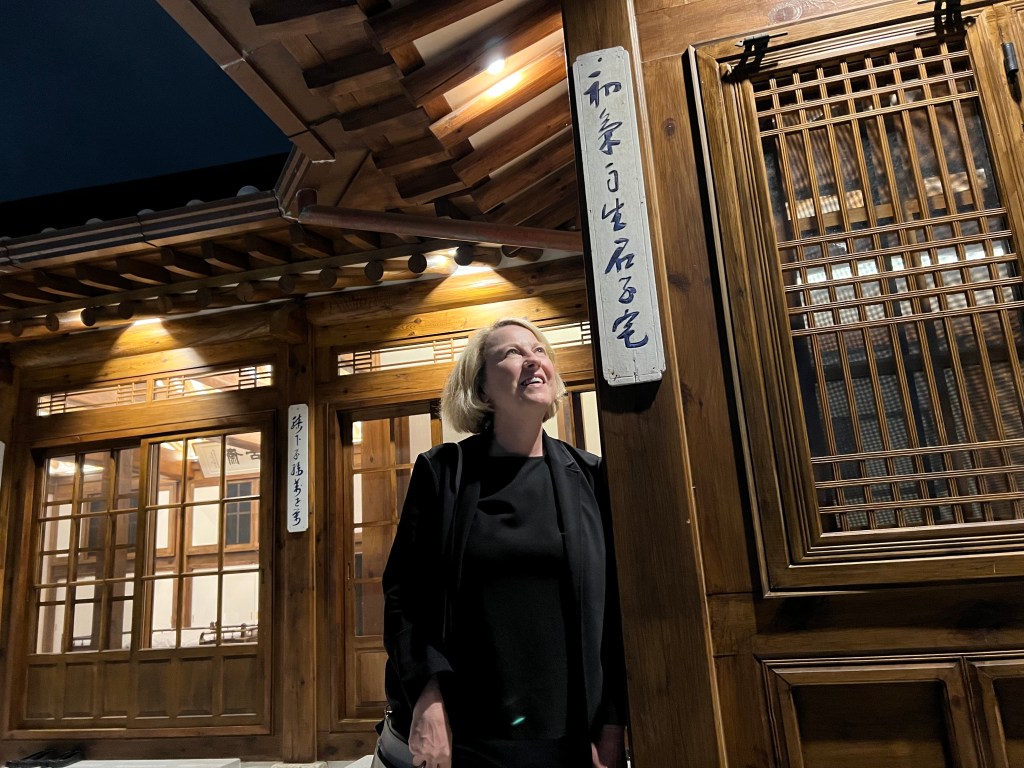
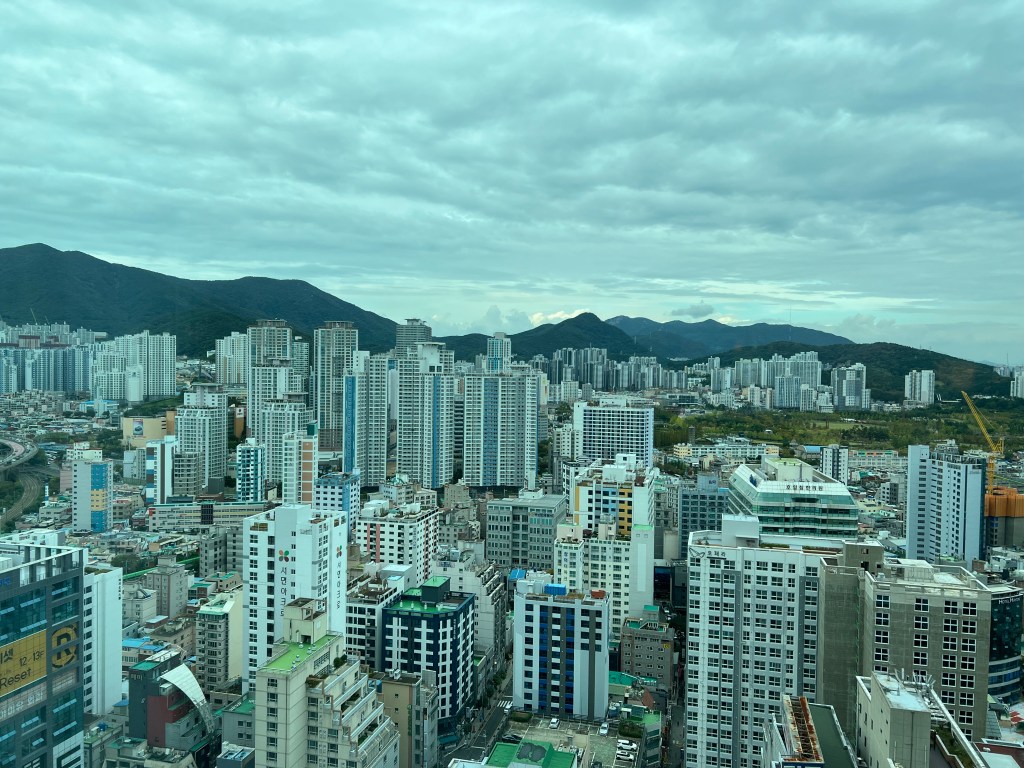
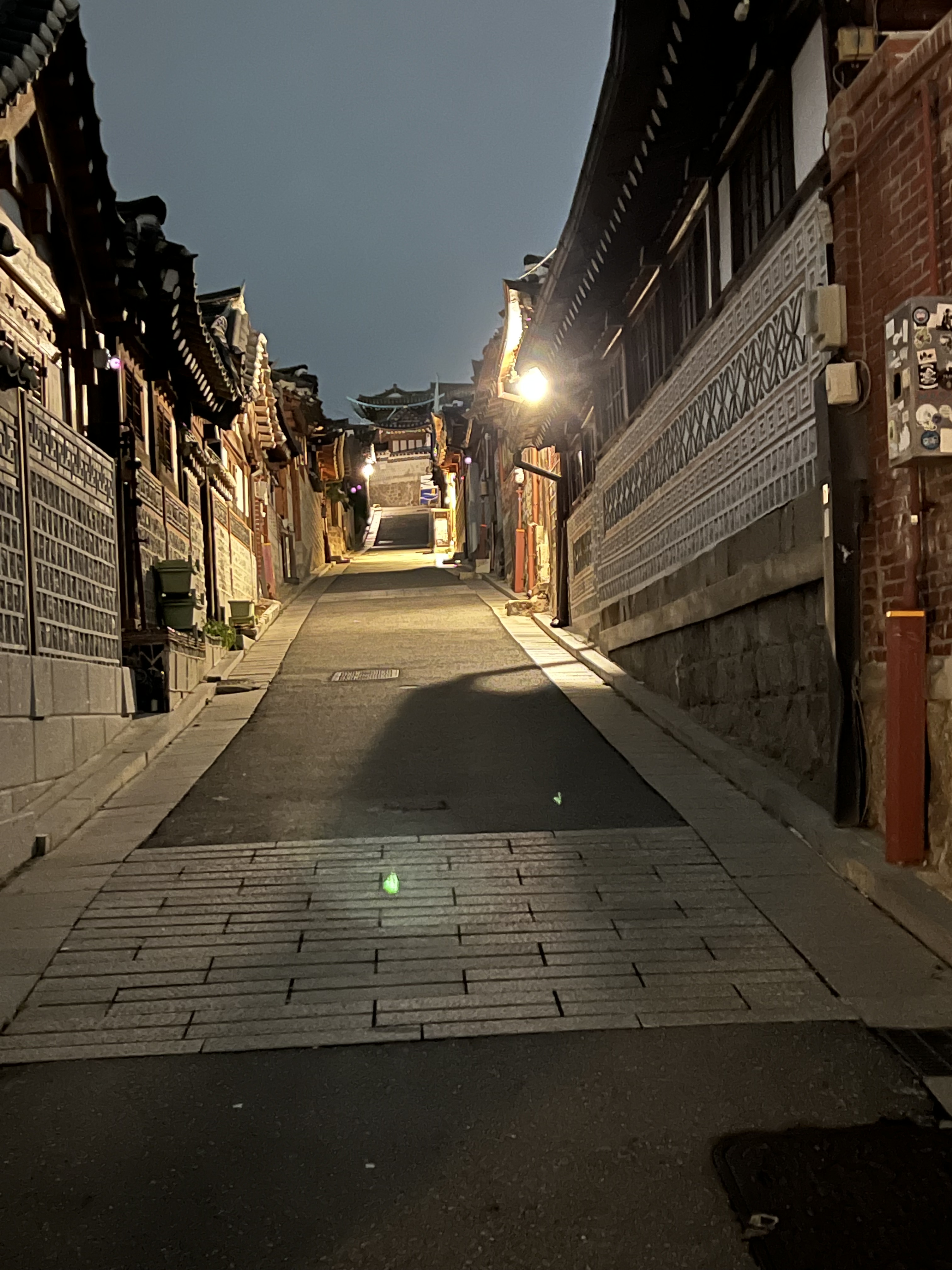
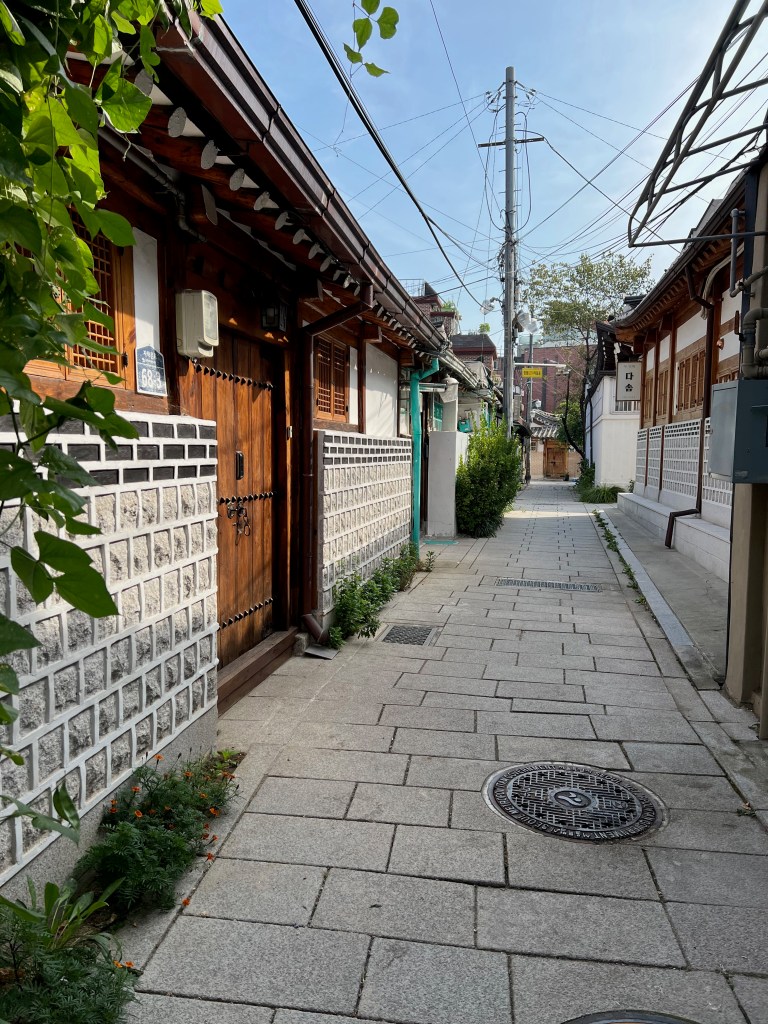
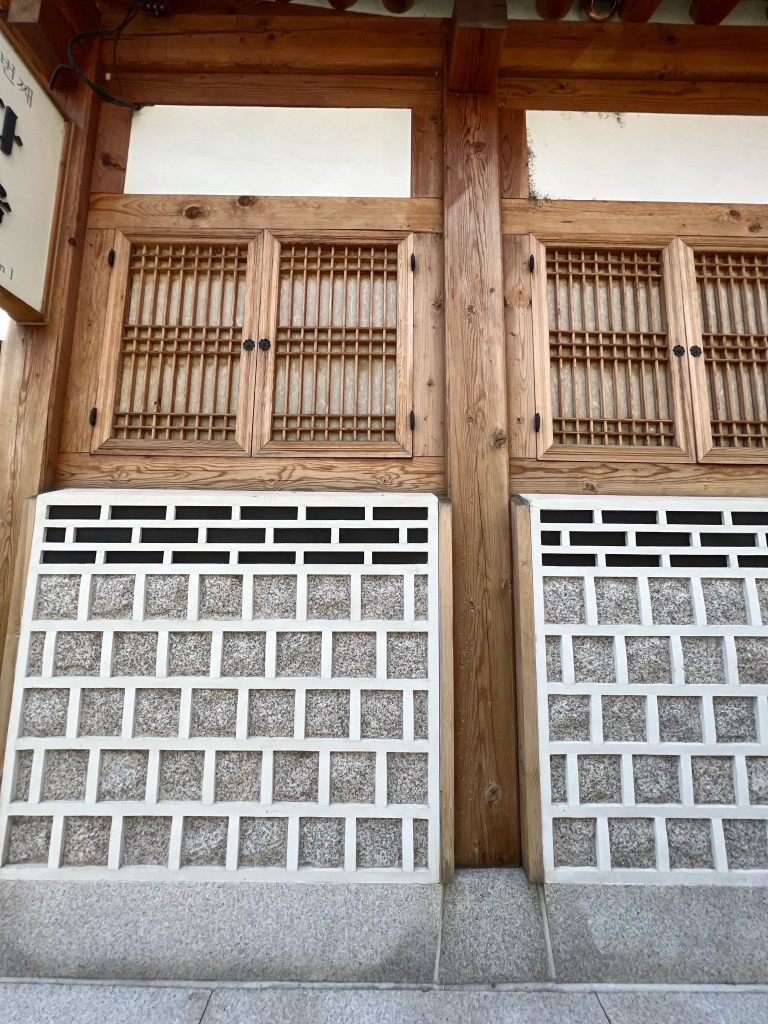
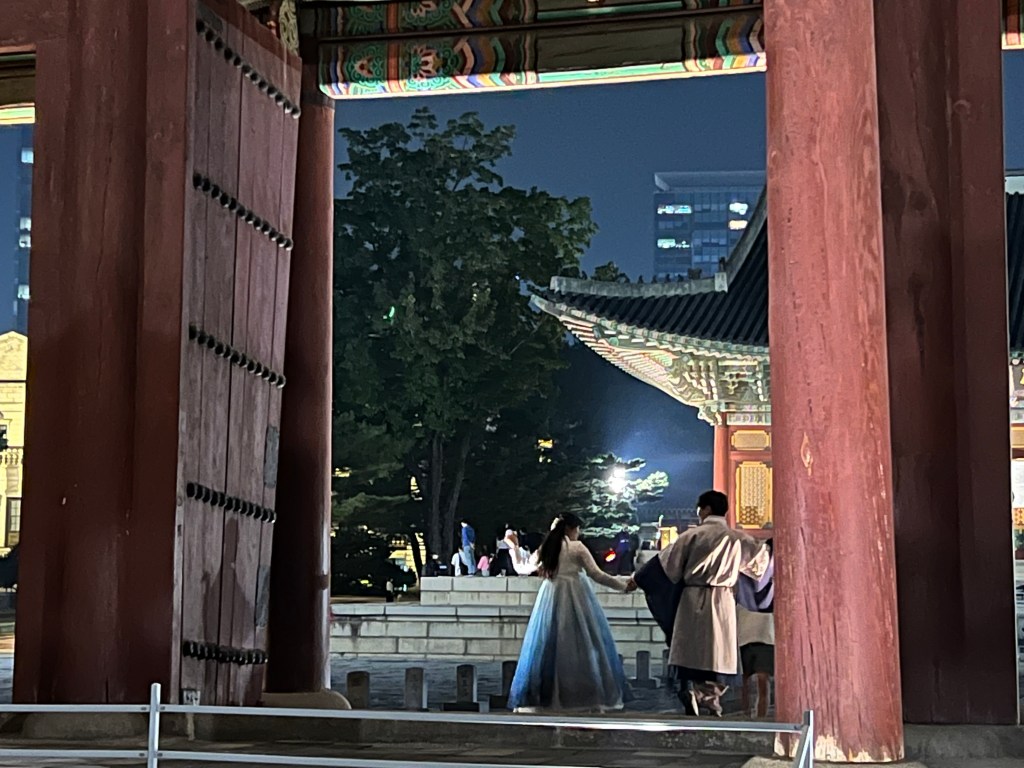
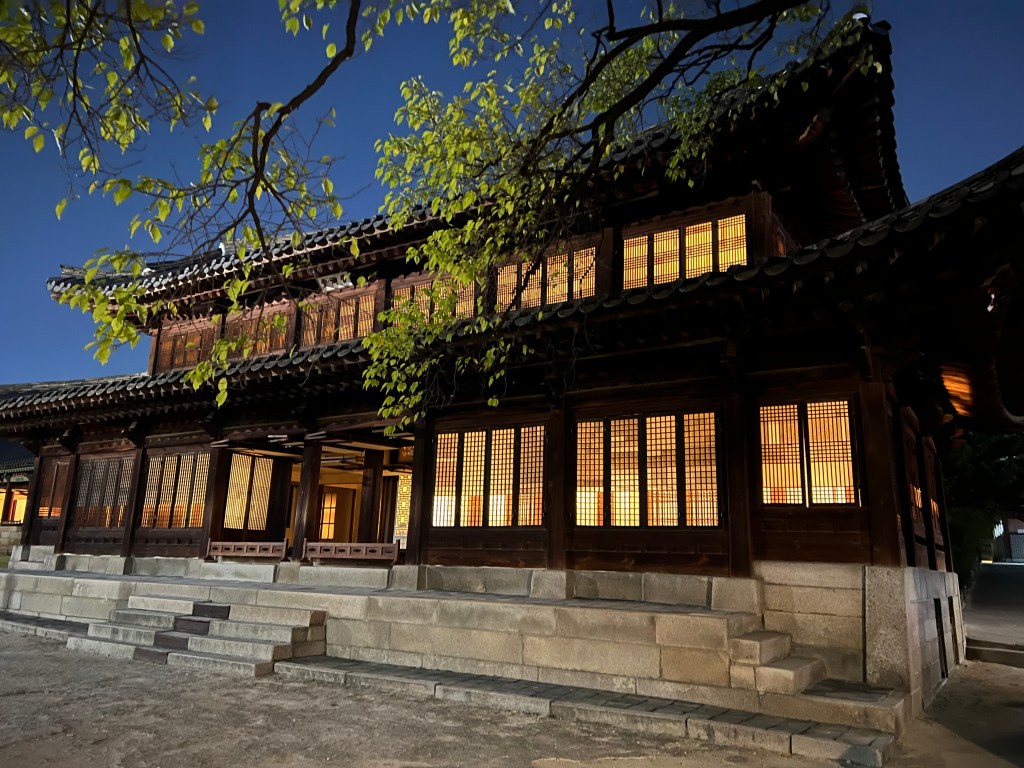
After touring the palace proper, we checked into a hanok, or traditional Korean dwelling, for a special one-night stay in the Bukchon Hanok Village, a hilly neighborhood between two palaces where the Korean government has tried preserve some of the older homes. Twisting streets are lined with homes with upward sweeping tile roofs and slatted wooden windows. Some hanok host guests, while others have small shops, such as a chic perfumerie where we found a scent called “Lumberjack” and hanbok-rental outfits. (Hanbok are the beautiful traditional Korean dresses that anyone can rent – and get into palaces for free!) Our hanok, the Rakkojae Binkwon, had a gorgeous setting, with the main building overlooking a grassy terrace and a spectacular view of downtown Seoul, its tower gleaming blue in the background, the blue signaling clean air.
Our rooms had a front seating area, with floor cushions and low table, and rich mahagony-colored wood walls and beamed ceilings. Rick had a hard time with his long legs sitting at the table, but there was a public room at the center of the building (with an all-important washing machine) where he could stretch out and see the view off Seoul from the open sliding doors. We slept on thick futon-like mats, but it was too warm to test out the ondul heating. The staff, who were wonderful, served us dinner on the terrace. There was an English-speaking staff member who greeted us, but manager spoke little English, but much more than my Korean. As she showed us around, as I started to panic when I realized there was no washing machine in our room (as advertised), Rick seized the controls and began to pantomime washing his jacket. The manager laughed with delight at his communication skills and led us to the common room. I, however, was tasked with the job of determining what time we would eat. After some confusion, I managed to blurt out “chonyeok,” which means dinner, and she nodded with delight. (Any communication was greeted with such joy between us! It’s amazing what a few words can do. ) Korean numbers are notoriously hard (for me!) and I requested yeo-seot-shi – 6 o’clock – and she held up one hand and her thumb, I held up one hand and my forefinger, as we Americans do) and she added “Sam-ji-pun.” And I nodded with delight – since it sounds just like Japanese – 30 minutes past the hour! Nee nee, totally san-jyu-pun, I said, totally mispronouncing the Korean. So it seemed like we were set on dinner. But now breakfast – achim. I was pretty sure I had us down for yeo-dul, but then another staffer got involved and said they want dinner at 8??? And we had to start all over again with our numbers – I must have seemed like what Asma’s family calls “tube lighting.” In India, the old tube lights first flicker and then take a while to illuminate – my brain is definitely on “tube lighting” mode with Korean. I will try to ask when something closes – and I KNOW I learned to say it – and all I can come up with is… blank. And as soon as I leave the store, I remember tada!!! Or tada heiyo! Too late. Tube lighting.
Final note – as I left the convenience store a one minute walk from our hanok, I looked to my right and saw a logo with an N and a D entwined. I thought, What??? And sure enough, to my right were the entrance gates to the Notre Dame Educational Center. I poked my head through the gate but could see no one around, except a statue of Mother Mary in the garden beyond. A city of 25 million, 13 time zones from South Bend, and we chose a hanok right next to Will’s home. Another cosmic moment for the cosmic travelers.
The view from Namsan
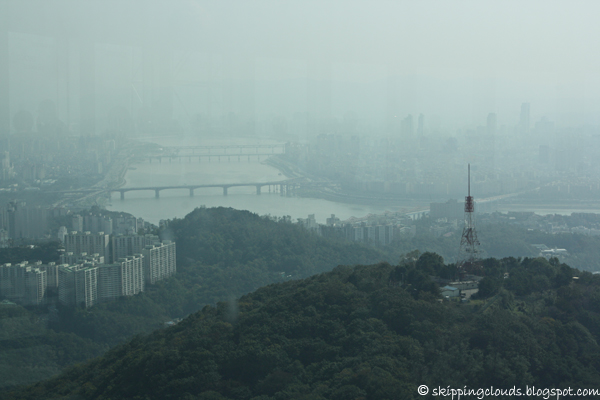
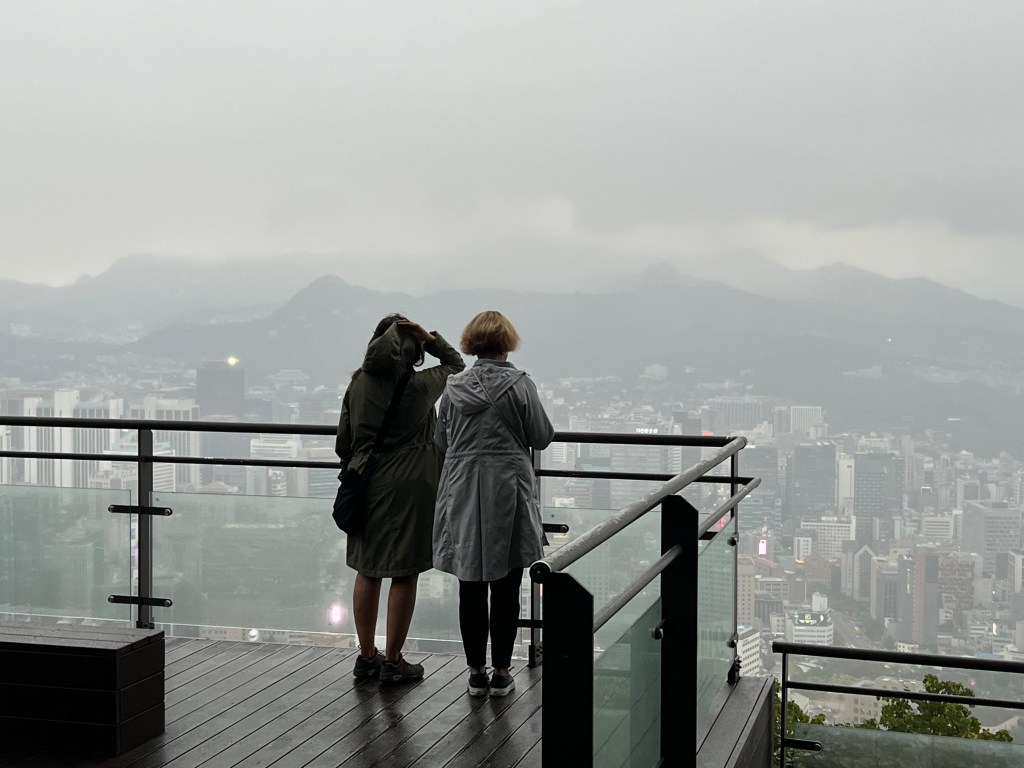
Oct. 4, 2022 – A half hour before sunset, the cab dropped us at the cable car station at the foot of Namsan, a mountain on the southern side of downtown Seoul. Low clouds and fog were settling over the wooded mountain, and a light rain was just beginning to fall. It looked like our long-awaited trip up Namsan, the best, most romantic place to view the city lights of Seoul, might be a bust.
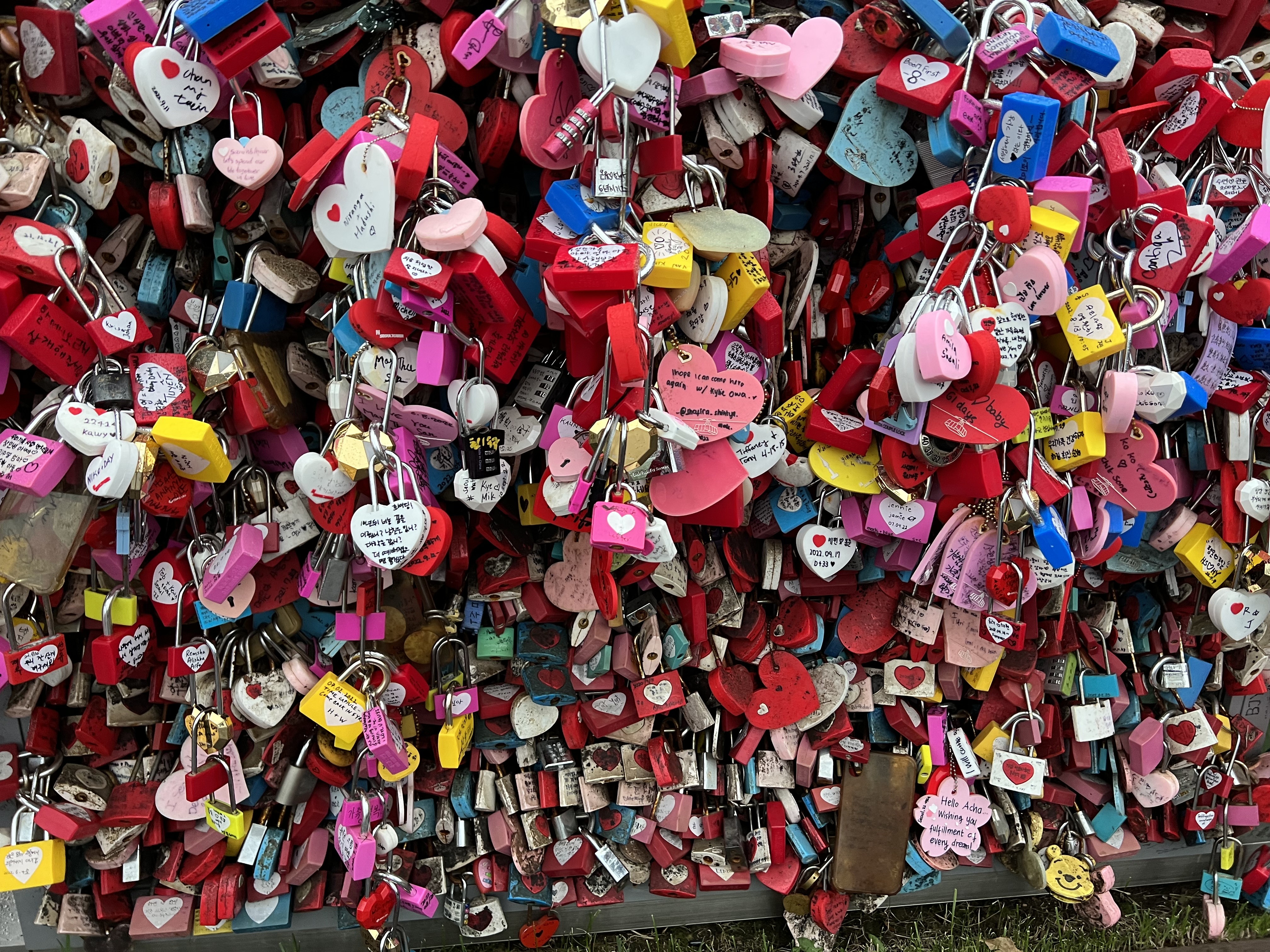
There was no line at the cable car, another warning sign. Our car was only half full as we made the smooth ten-minute glide up the mountain. Outside, the stairs that climbed the rest of the way to the summit were slick with rain. The rails along the walkways were covered with thousands and thousands of “love locks,” padlocks that couples had attached to the railings symbolizing their enduring love. Most were coated with rust, the messages scrawled on them faded from weather and time, but still they held tight. At least the locks did.
The light rain was still falling, the clouds still gathering, when we went inside the tower and joined a short line for the elevator that would zip us up fifteen floors to the observatory, and the restaurant two floors below. We had only a few minutes to enjoy the 360-degree views of Seoul, looking down on the Han River, the sprawling U.S. and Korean military bases, the ghostly shape and bright red warning lights of the massive Lotte Signiel Tower, one of the world’s tallest buildings, before we went downstairs for dinner. Our table against the windows looked out over miles and miles of southern Seoul, including the bright lights of Gangnam and the steady streams of traffic going over the bridges of the Han River.
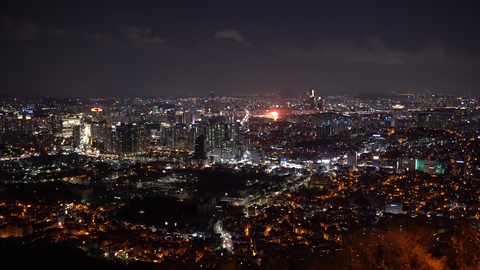
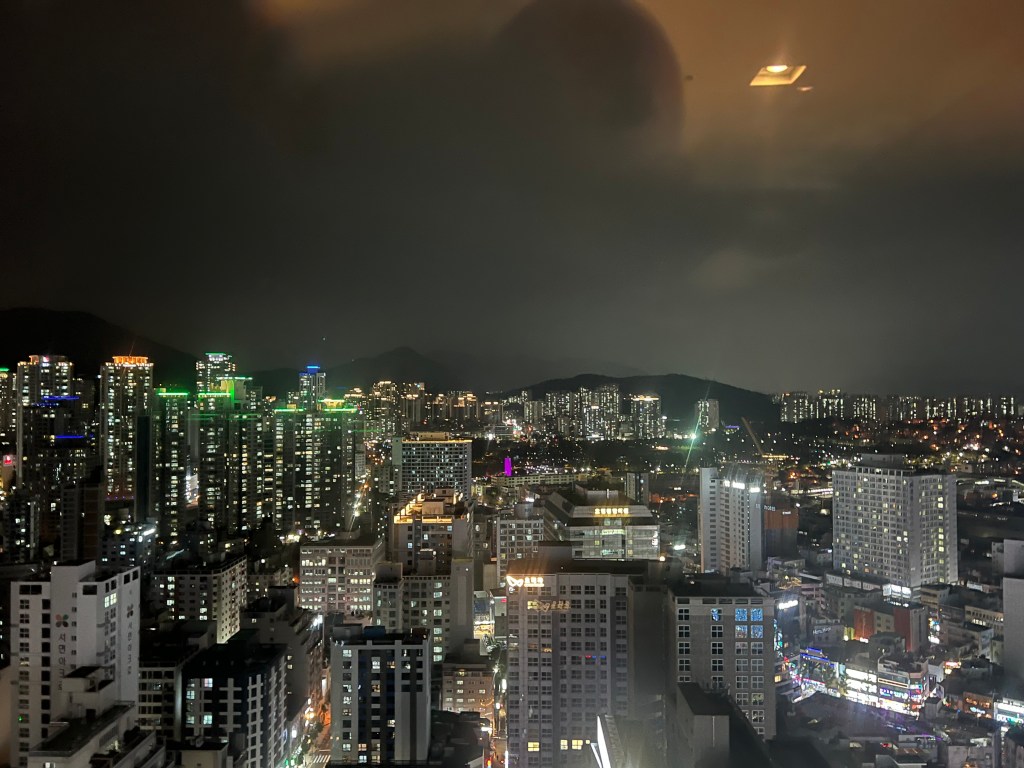
As the darkness fell, and our waitress grilled steaks at our table, the clouds and mist steadily moved off the mountain, and away from Seoul, and we saw what we came for, what we had hoped, the lights of this beautiful city coming on, one after another after another. It was a special time, one of the best, most memorable moments of our vacation so far. Long after dinner, it was still hard to leave that table, that view.
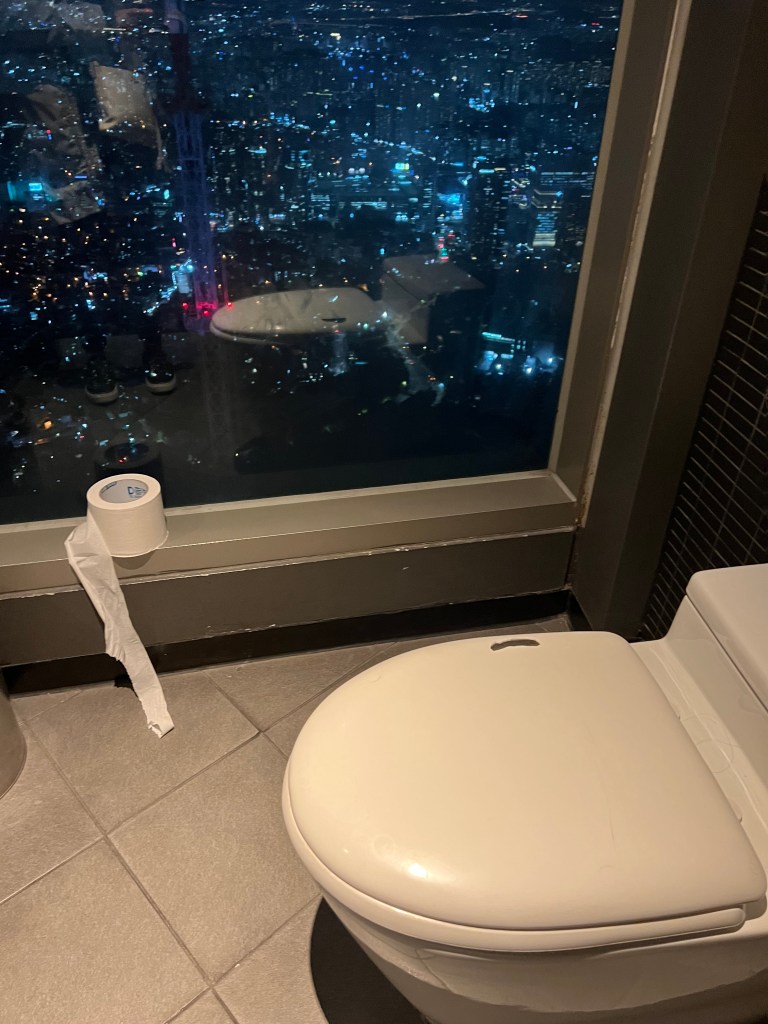
And, well, the bathrooms: The men’s urinals stood in a line against a wall of windows, hundreds of feet high, overlooking all of Seoul. I’m told the women’s stalls provided equally epic views.

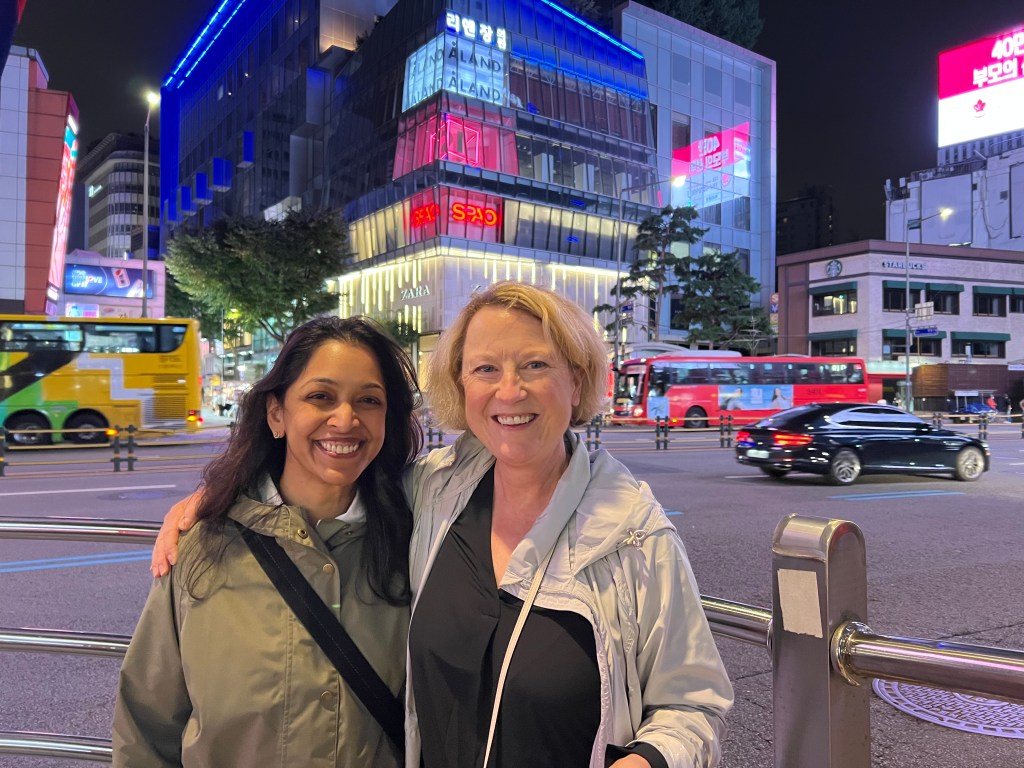
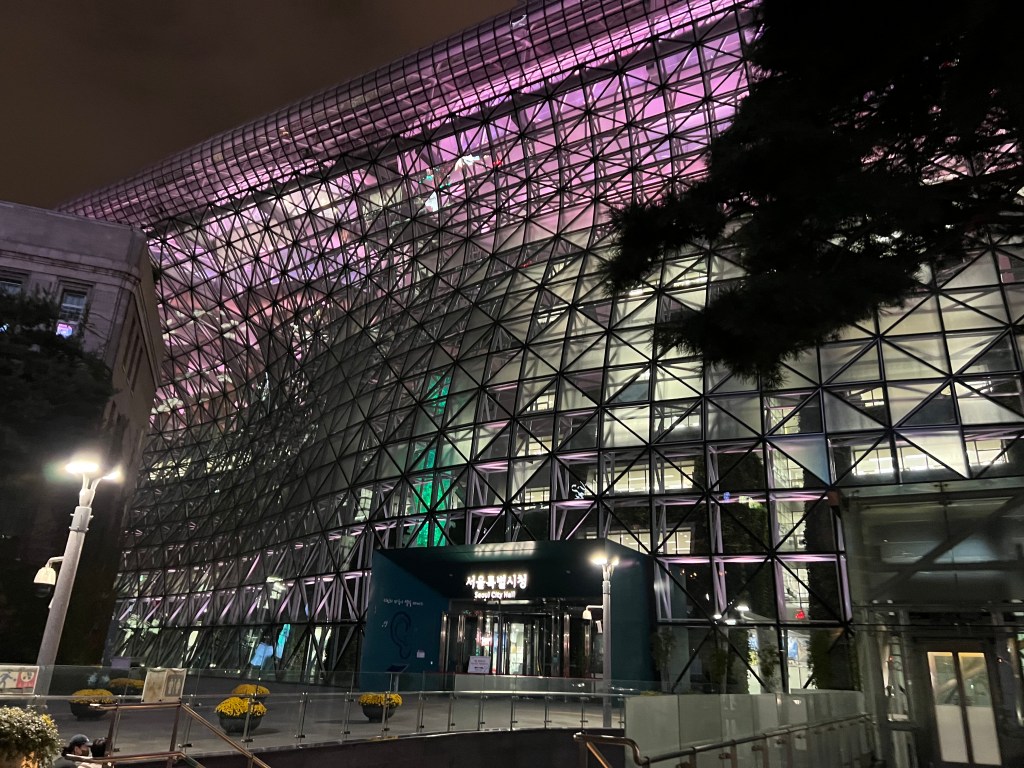
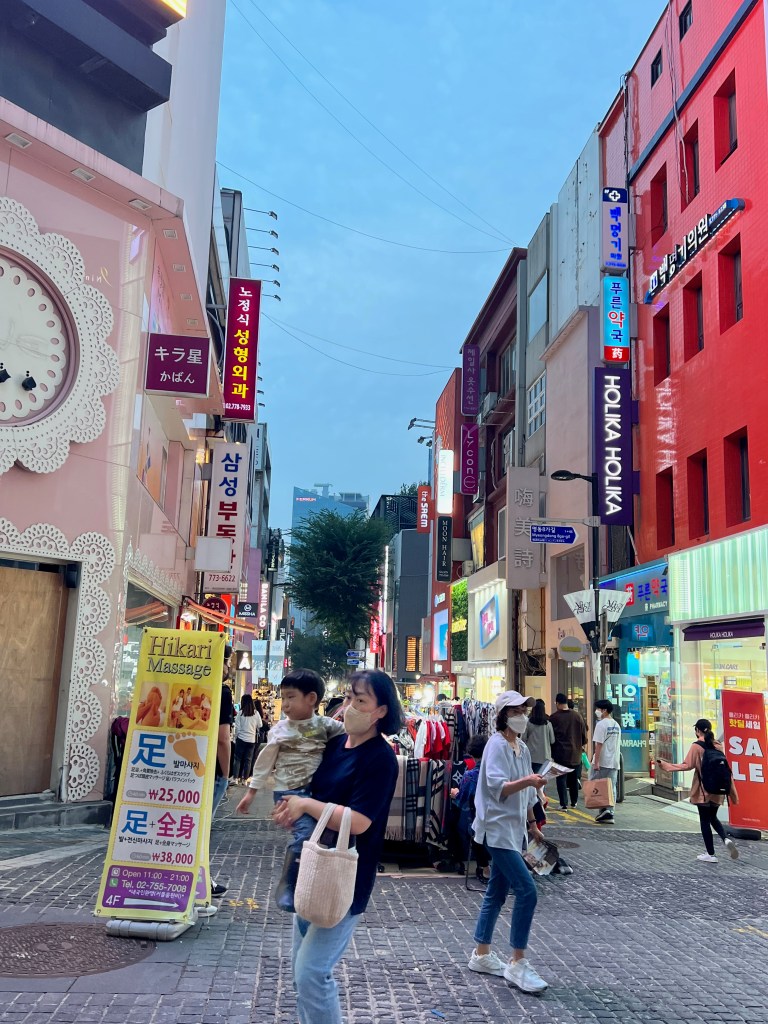
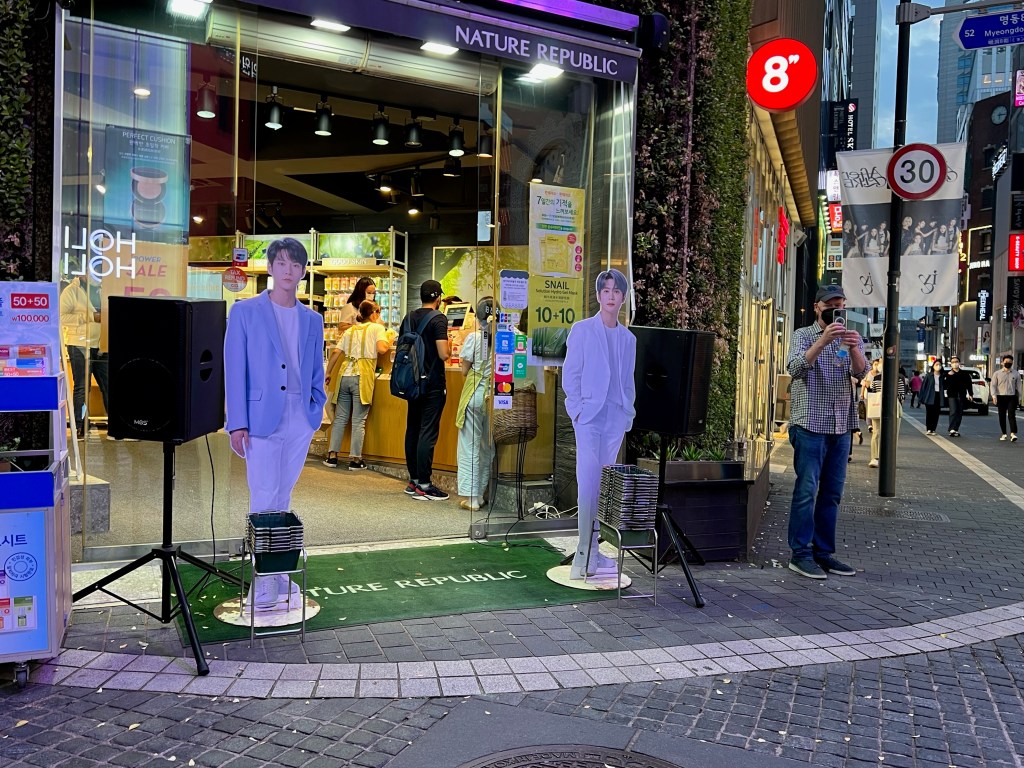
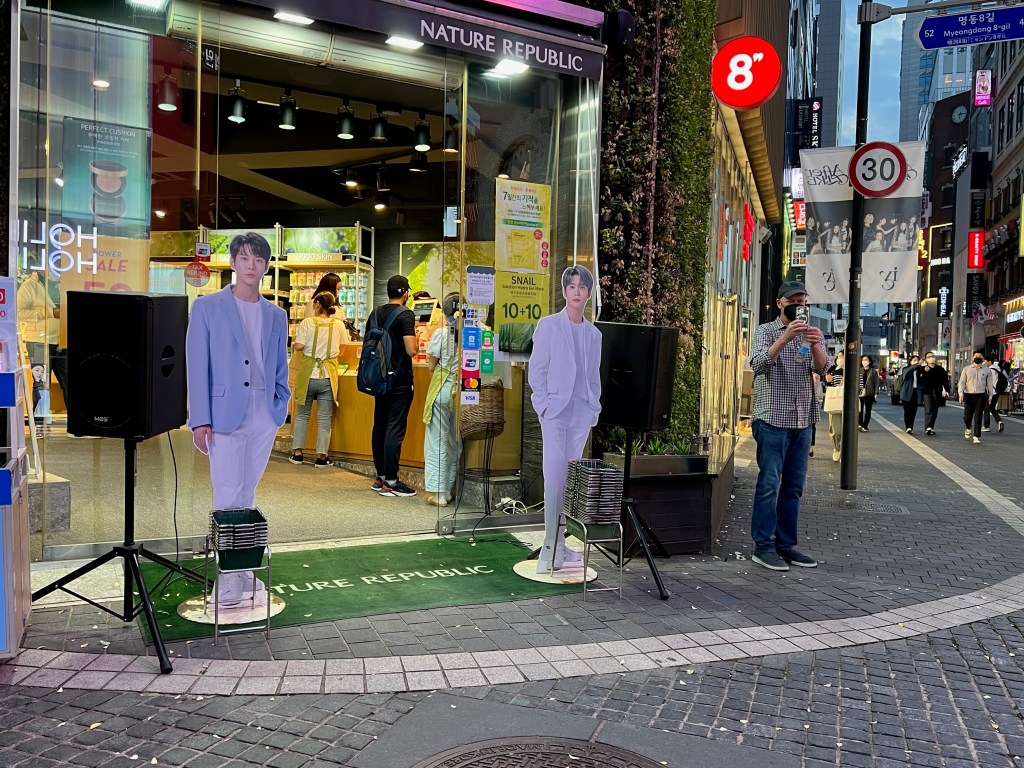
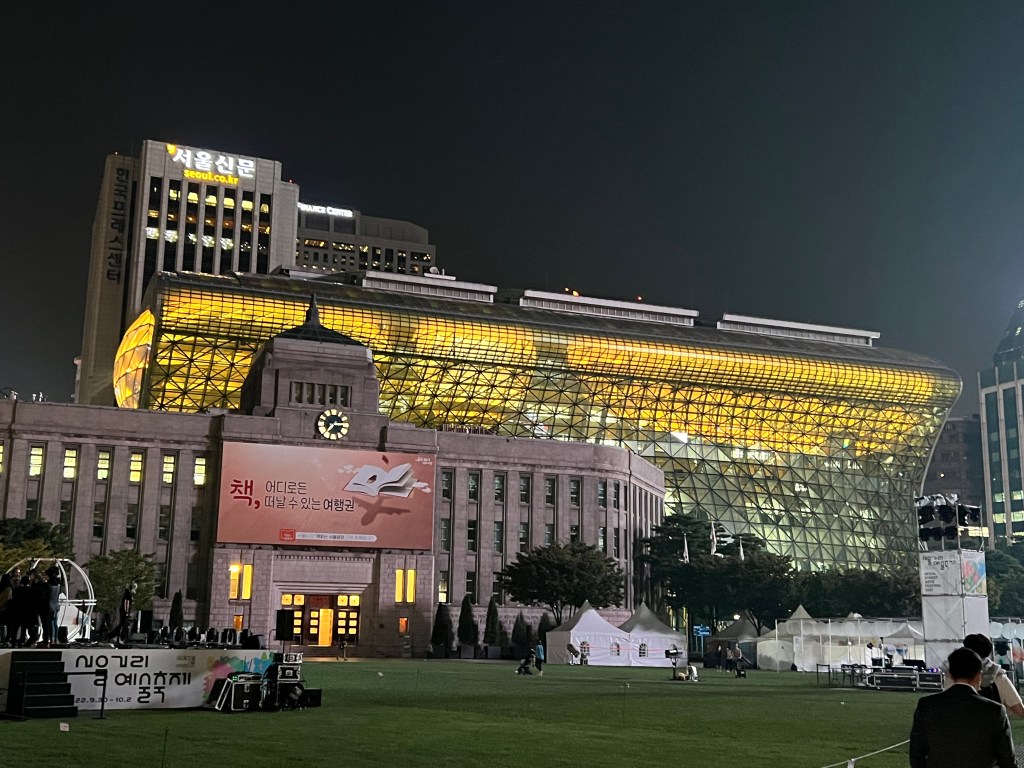
We waited for the elevator behind groups of laughing teenagers, mostly groups of girls. We followed the long trail of love locks back to the cable car station and rode down from Namsan. From there, we strolled beneath some of the brightest lights in Seoul, in Myeongdong, a loud, glitzy, pulsating neighborhood crowded with shops, restaurants, food alleys and video billboards. We shopped our way home, walked past Seoul’s stunning City Hall, its transparent curves changing color every few seconds from blue to purple to gold.
It was one of those vacation nights that you always remember, everything you imagined during the months of planning, just what you dreamed: the darkness falling, the clouds lifting, a very nice meal with people you love, and all those lights, as far as you can see.


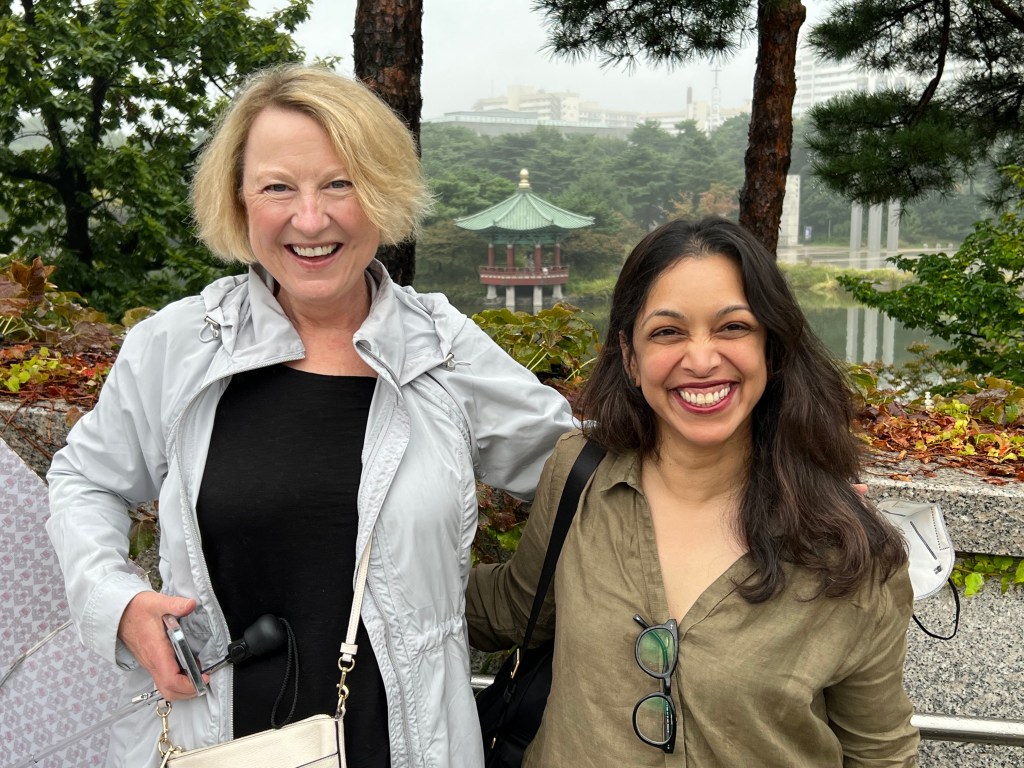

Cosmic walkers
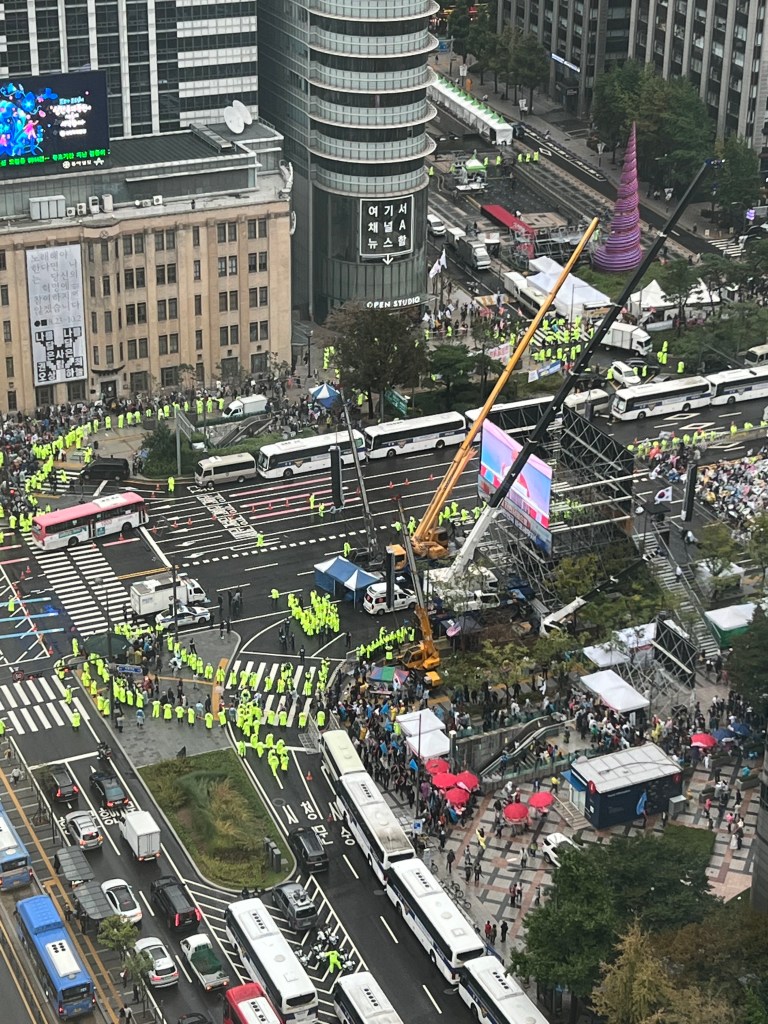
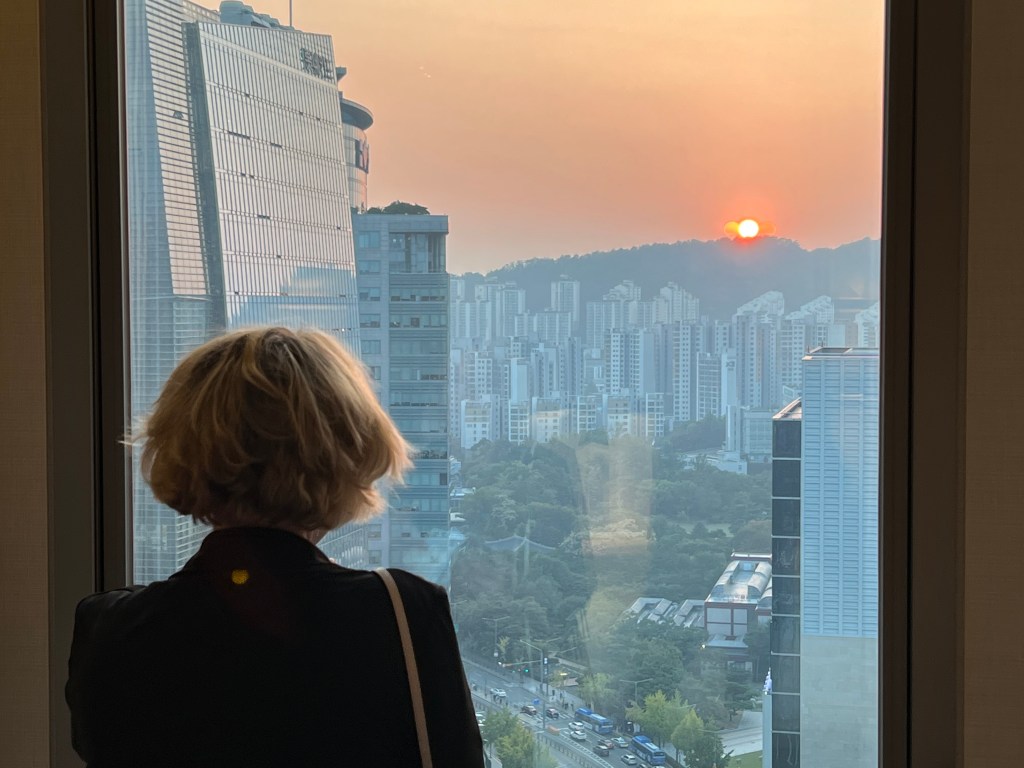
Monday, Oct. 3, 2022 –We spent a few afternoon hours today holed up in our hotel while tens of thousands of conservative political supporters, corralled by thousands of cops in fluorescent green rain jackets carrying batons and riot shields, held a loud, though peaceful, demonstration in the streets just below us, the rain pounding down most of the day.
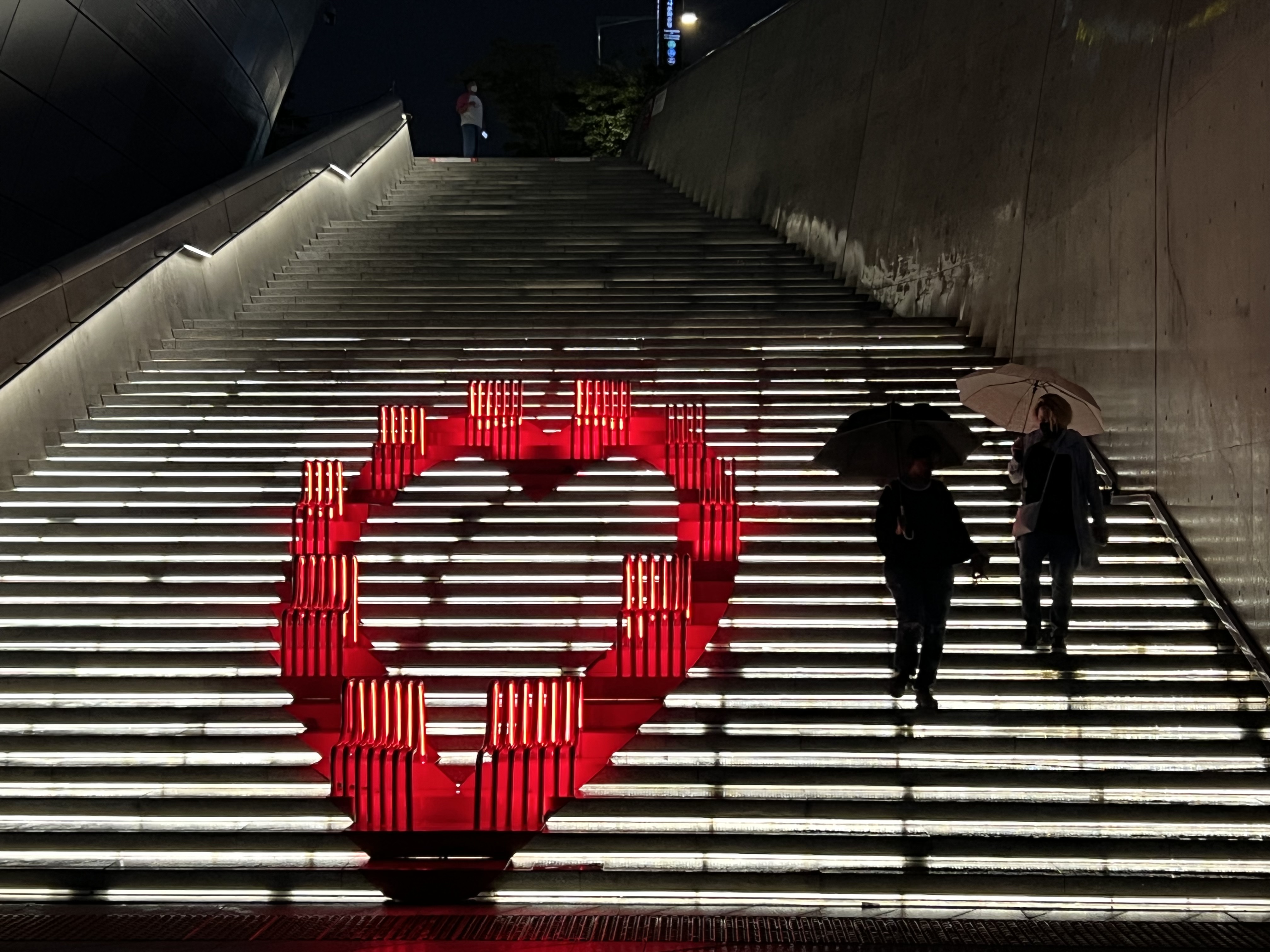
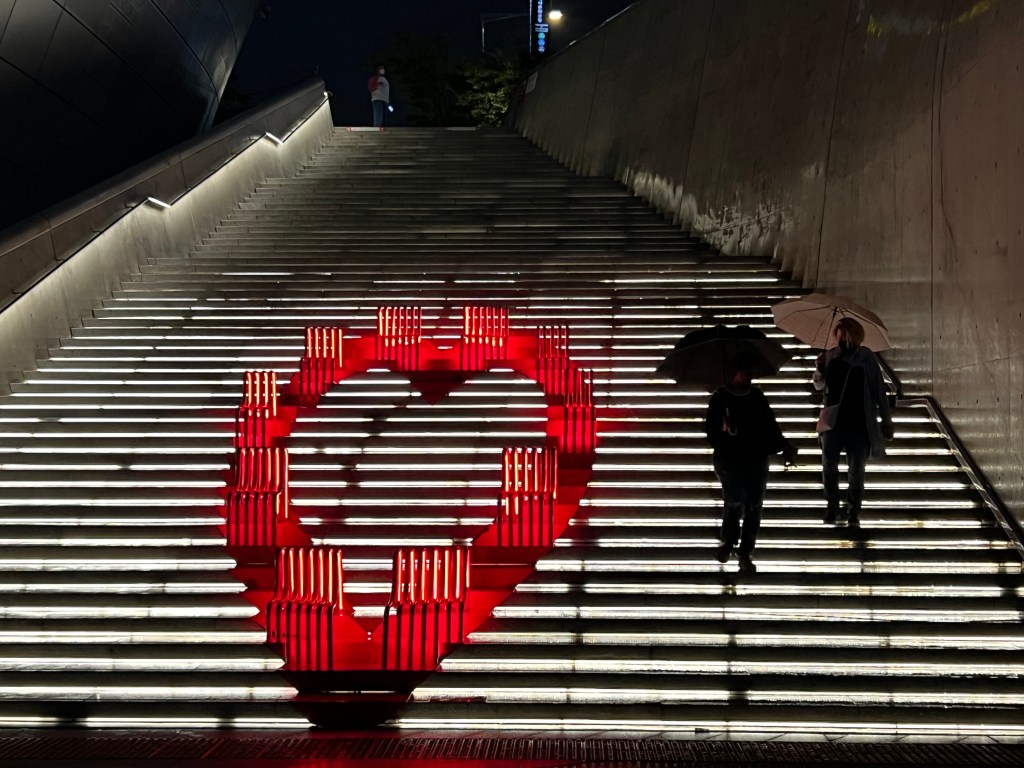
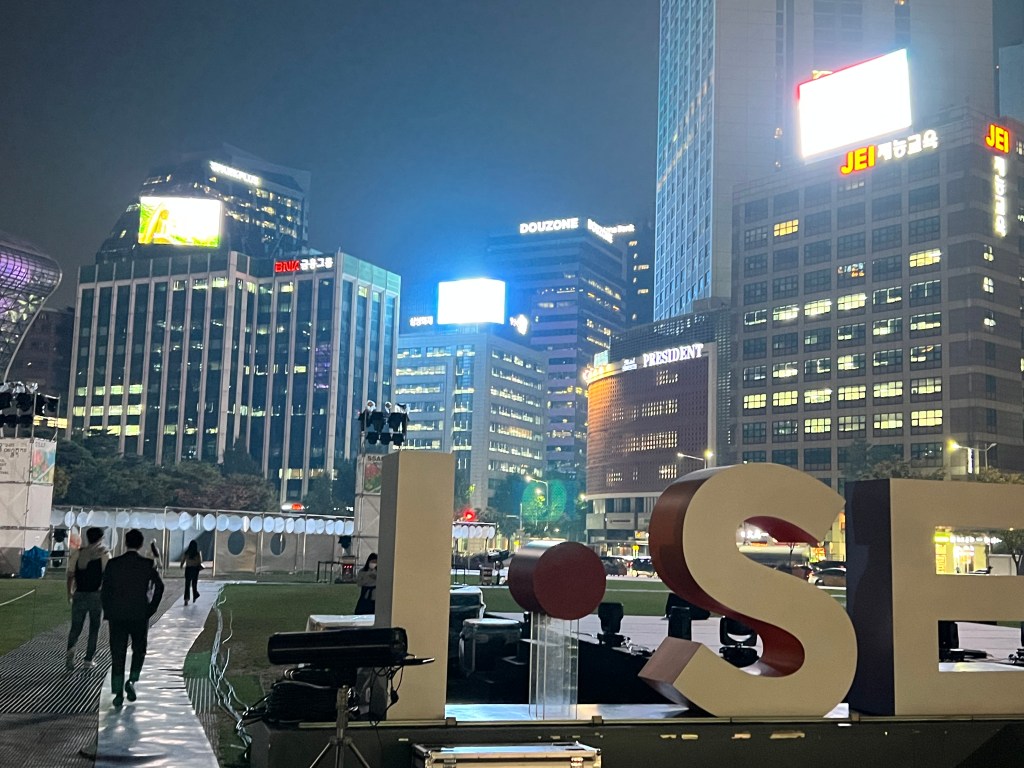
As the demonstration was breaking up, we caught a cab and headed for Dongdaemun Design Plaza (DDP), the famous neofuturist building designed by Zaha Hadid. Along the way our cabbie kept up a steady one-way conversation in Korean, which only our friend, Asma, could partially interpret, and after about fifteen minutes, at times sternly correcting our broken Korean, finally got around to what he wanted to know, asking about the relationship between me, the man the in the front seat next to him, and the two women in the back.
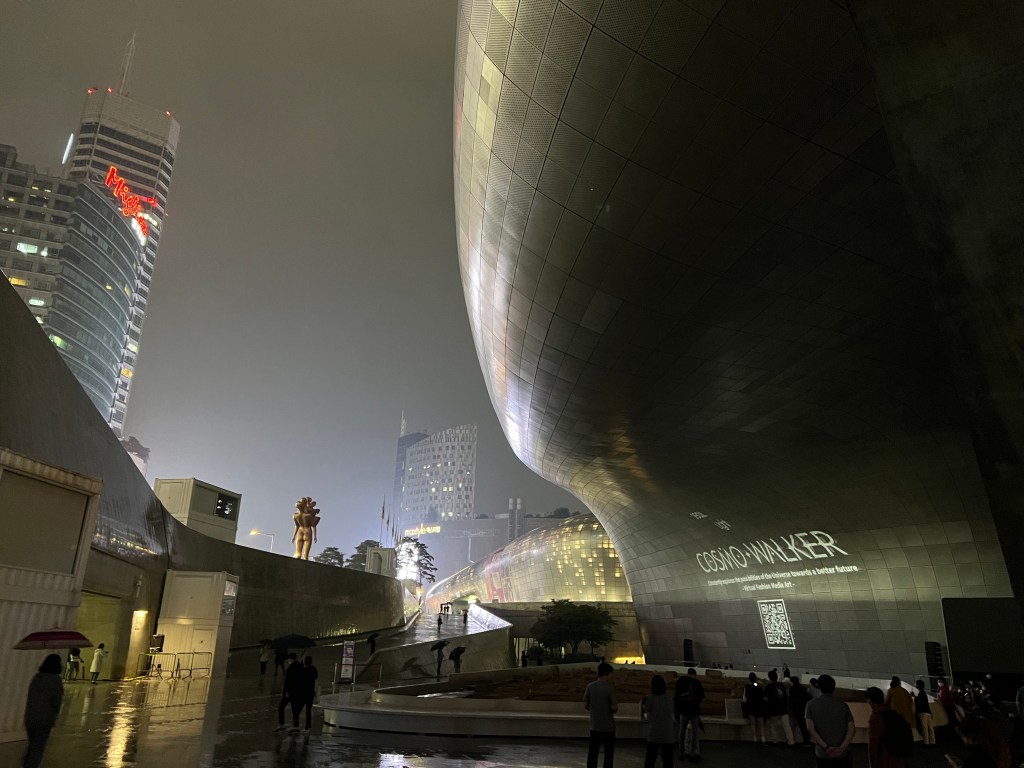
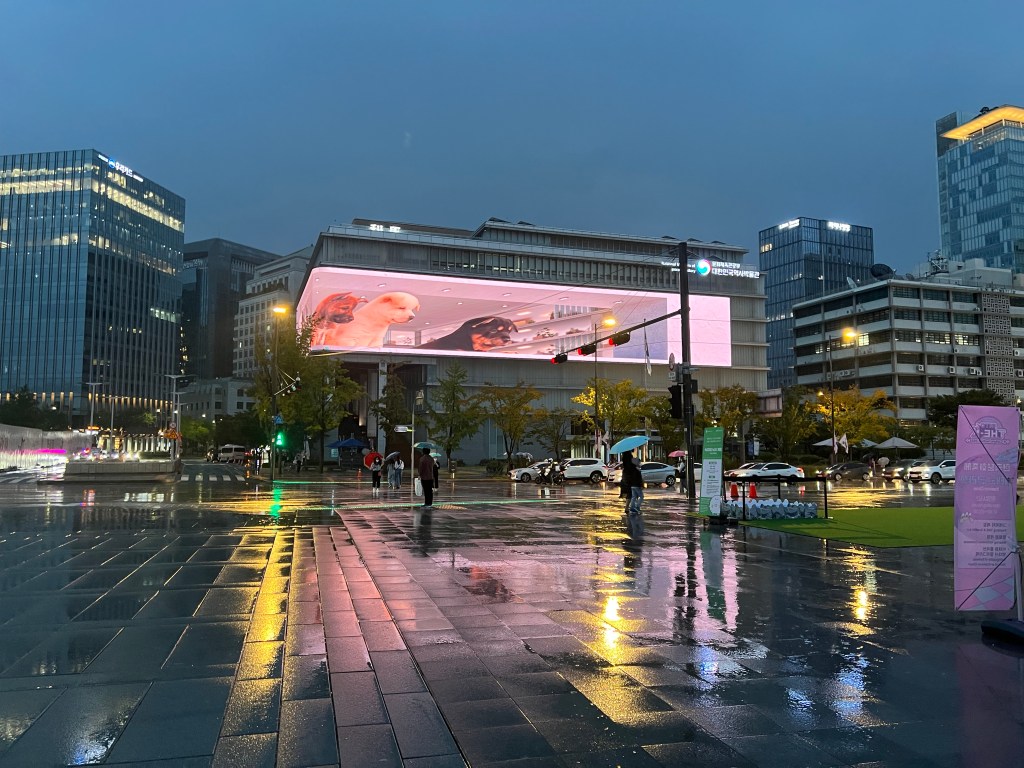
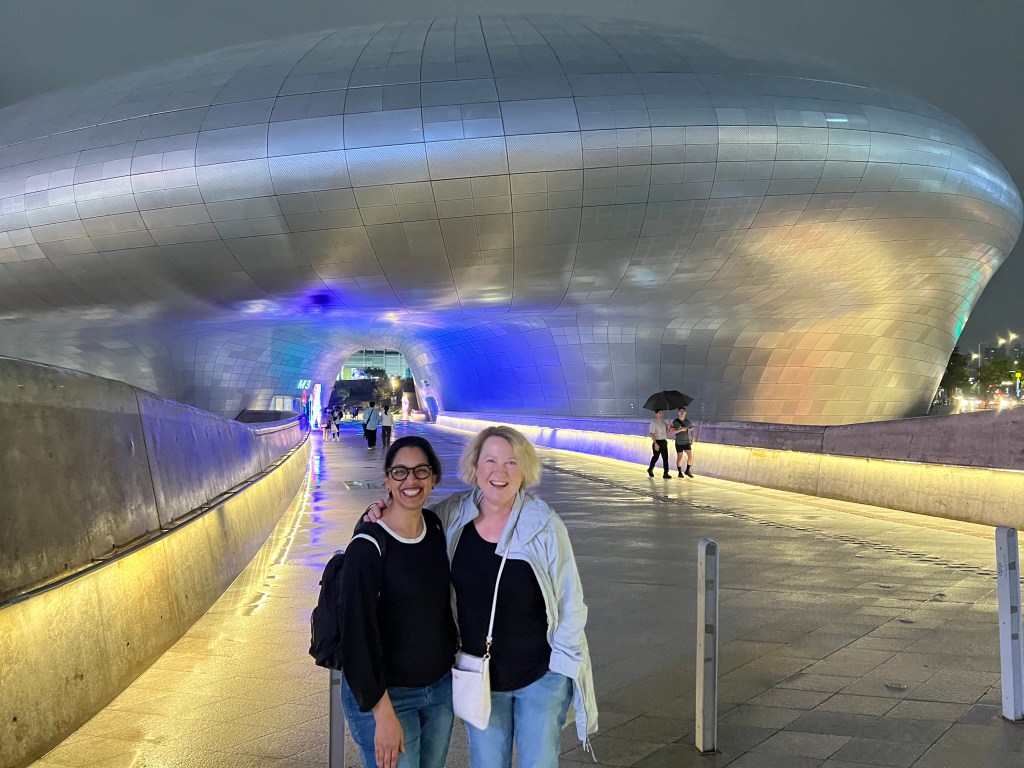
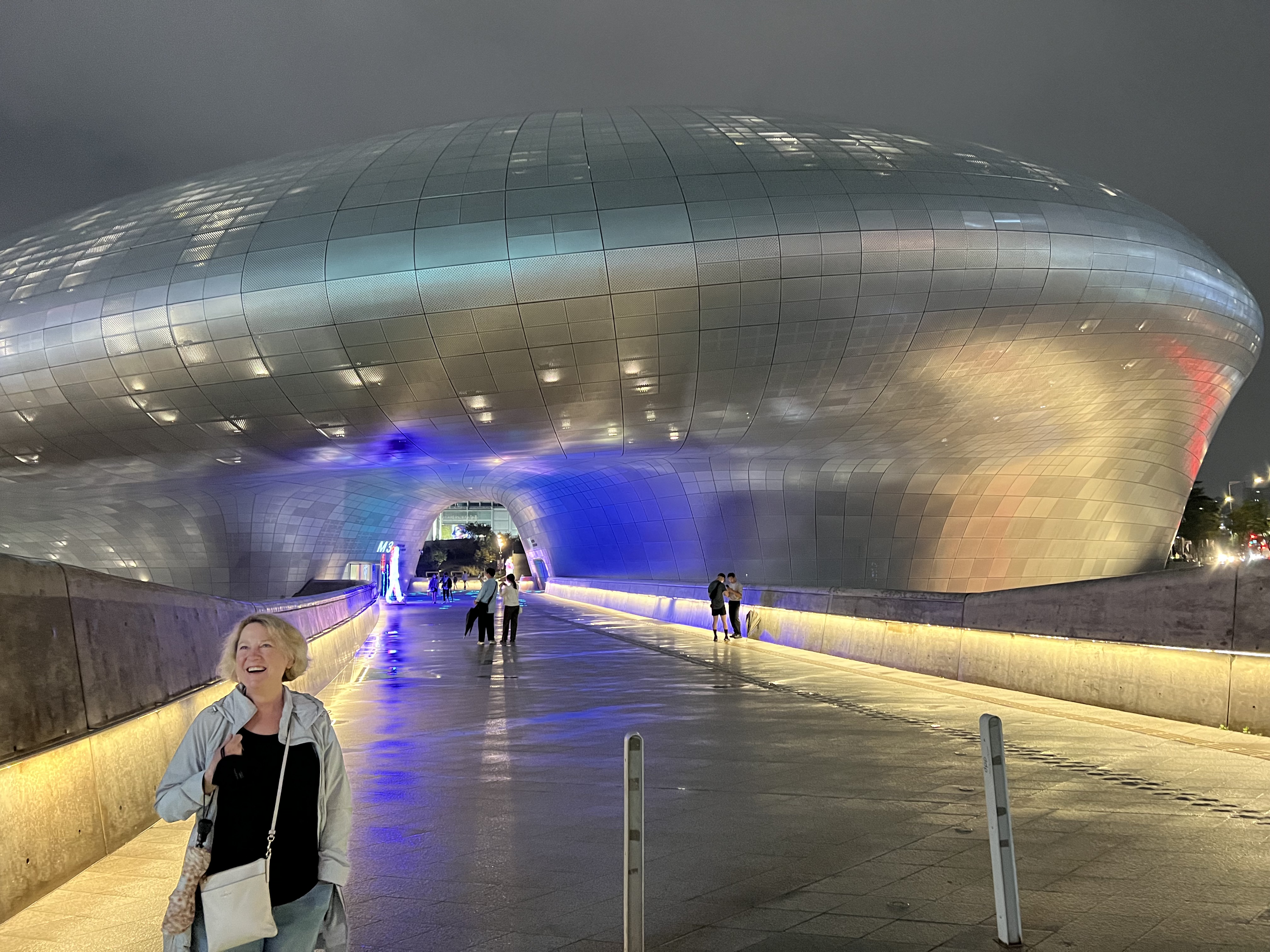
After this long, short drive, we finally made it to the DDP. The building is difficult to describe, but from the outside it looks something like a massive shimmery silver mushroom made of aluminum panels, steel and concrete. We arrived shortly after dark, and the swooping, soaring building glowed with low white lighting. There’s no “front” or “back” to the building, just different levels of ramps that lead inside from all directions. We walked inside on an upper ramp and found ourselves in an entirely white, totally empty, eeriely silent, corridor that circled around the highest levels of the building, climbing higher all the time. We walked alone for about ten minutes, feeling like we were in either an absurdist French film or a perhaps an alien horror film, before finally reaching an entry for some kind of design exhibit called Inside Outside or Indoor Outdoor, which we couldn’t see into, and some young women – the first humans we had seen in a while – seemed to be expecting us and tried to herd us into a short line to see it, but we smiled and backed away slowly and managed to escape on up the winding the corridor.
We’d read that there would be a special light show, “Seoul Lights,” at the DDP at 7:30, and so we spent another half hour or so peeking into a few of the cool design shops – the display floors of one was covered with white stones and clothing was hung next to fake trees – trying to stay out of the rain. Finally, they flashed a message on one outside wall of the building that said only, “COSMO WALKER.” We and a few dozen other damp people waited with growing anticipation. Ten minutes later, the show was on.
Up on the swelling silver side of the building appeared a large disjointed figure, maybe 60 feet tall, “walking,” gyrating, dancing or something, his feet disconnected, to the throb of pounding music. We watched for a few minutes, and the Cosmo Walker changed clothes a few times, and shoes, but appeared to be ready to walk endlessly for the show’s next 2.5 hour run. We didn’t stay for the end, or maybe we did, to be honest I’m just not sure. We later read that the work “depicts the image of humanity walking in search of the possibilities of cosmic life.” Aren’t we all?
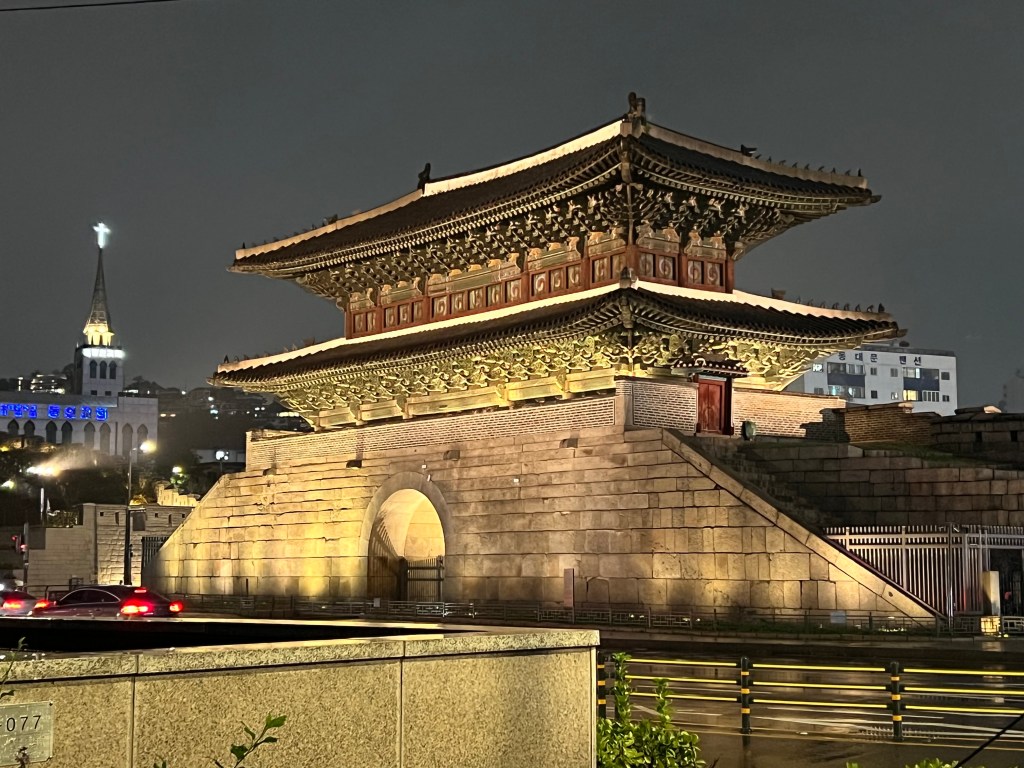
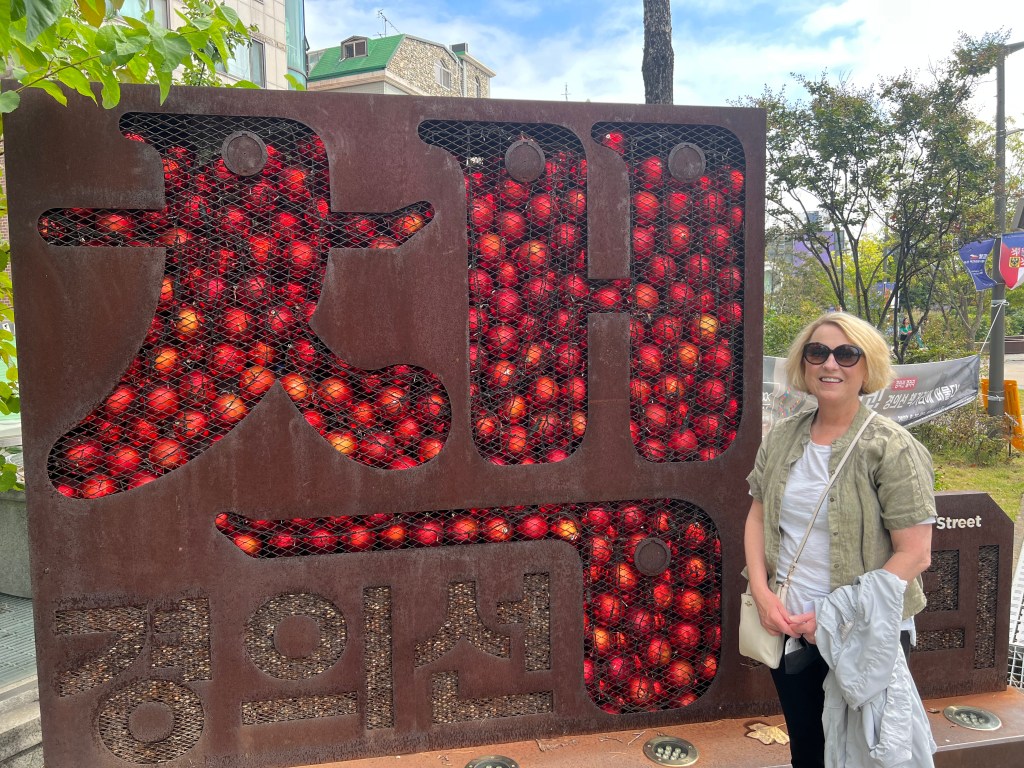
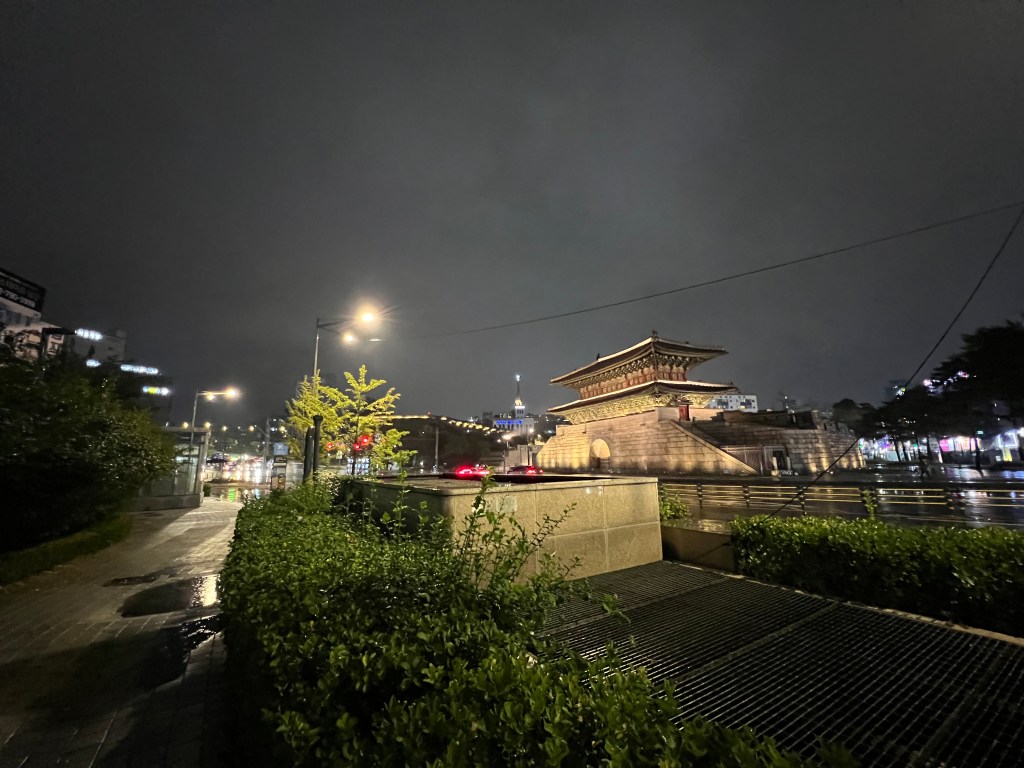
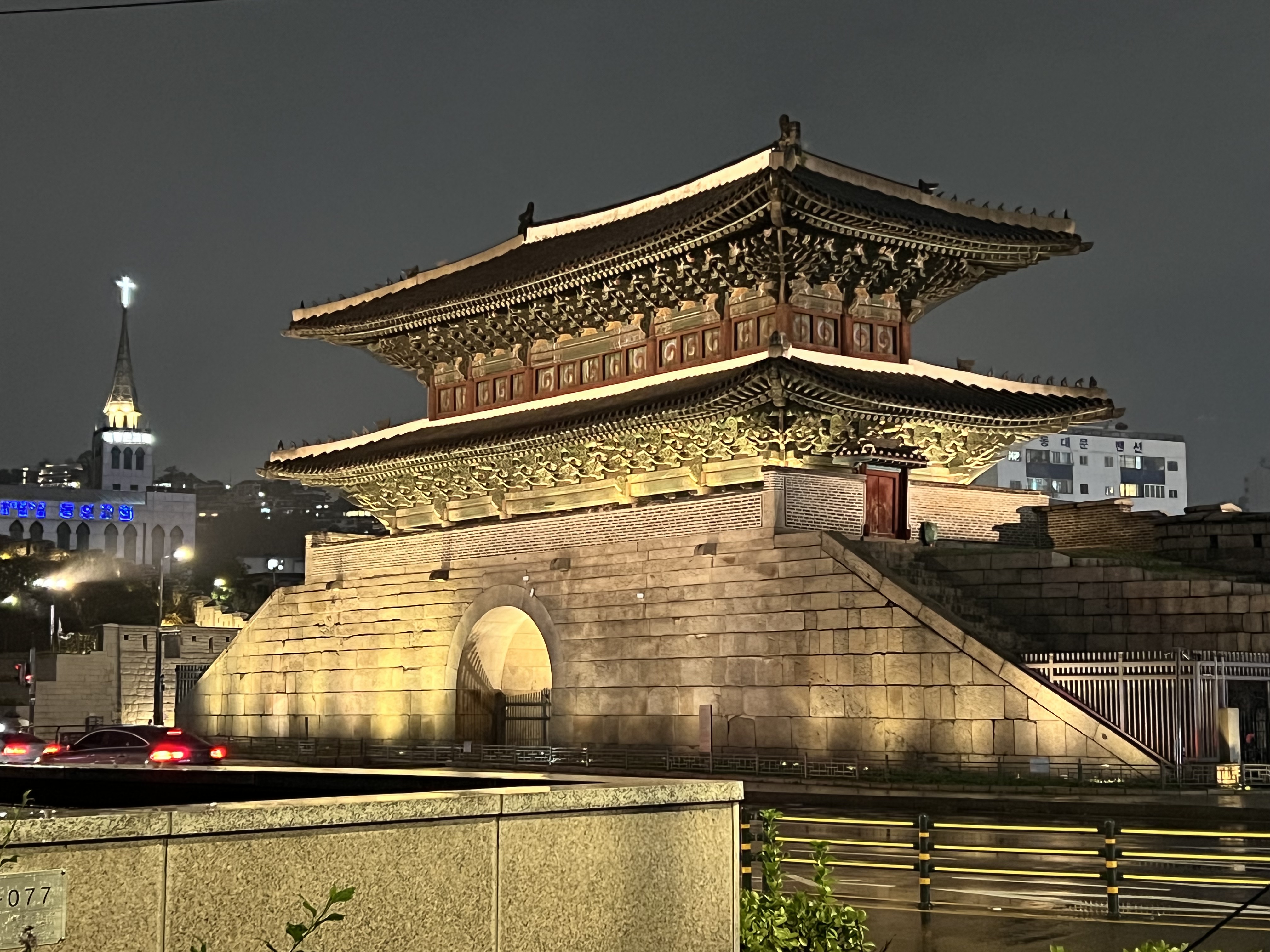
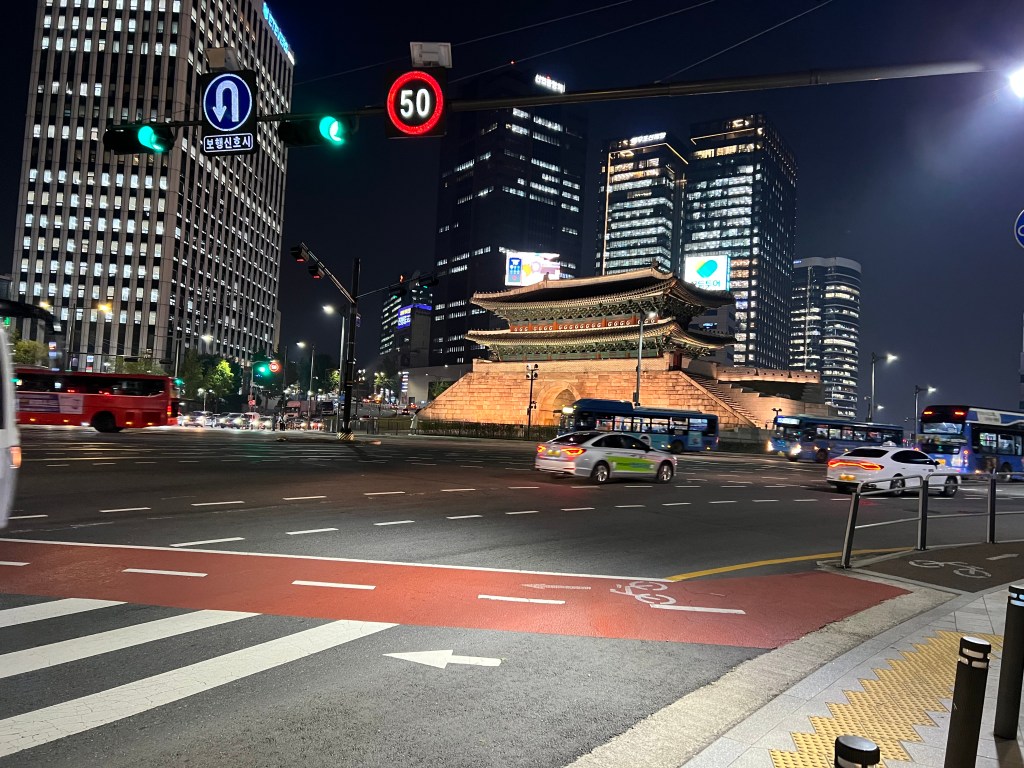
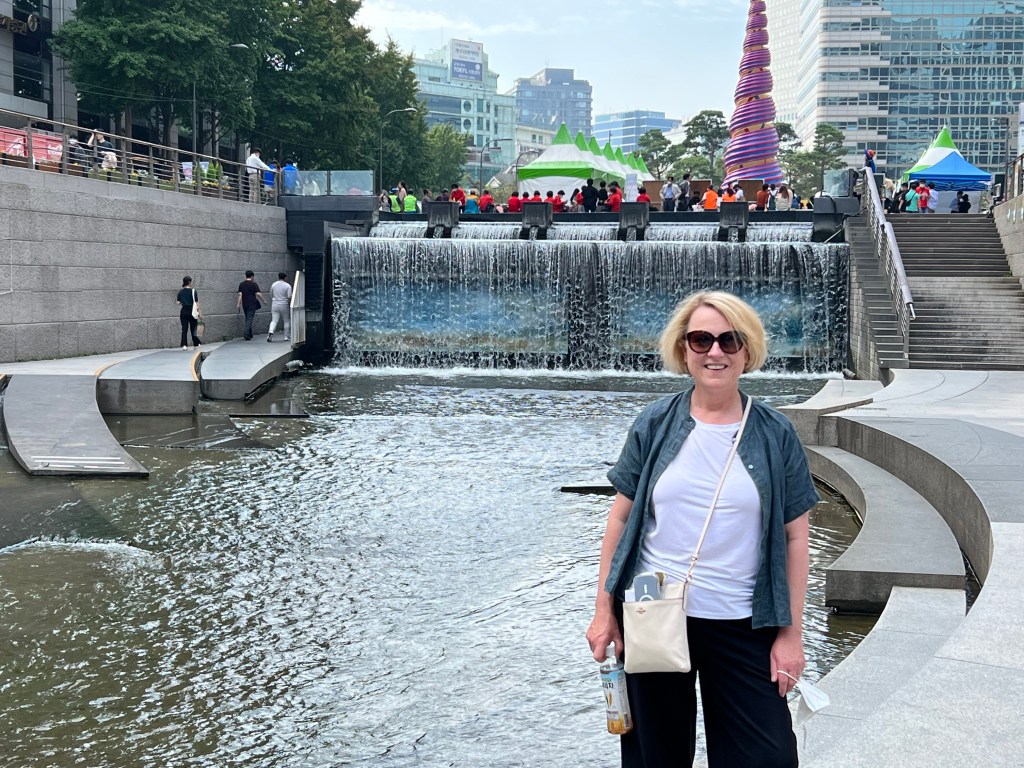
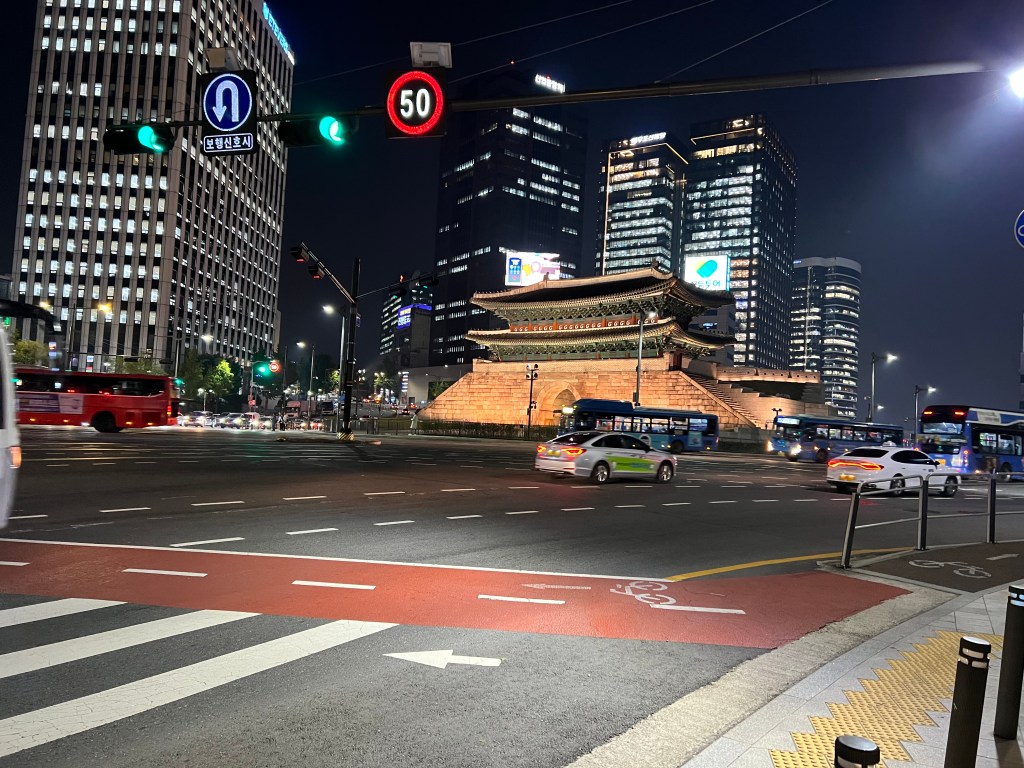
Then we walked out into the rain. Our destination was the famous Gwangjang Market, a food alley that is said to have some of the best street food in Korea, if not all of Asia. Maybe it was the rain, the enormous lunch that we’d had, or the fact that we badly underestimated the distance between the DDP and the market, which turned out to be a half hour trudge in a steady downpour, past the beautiful Dongdaemun Gate, and block after block of a massive wholesale clothing market (it was closed, but we could peek inside and see spaces filled with hats, thousands of hats). We had planned to walk along the beautiful urban stream, Cheonggycheon, but the rain – and potentially rising waters – meant the streamside walk was closed. There is a famous scene in the Korean movie Parasite when heavy rains lead to heavy and disastrous flooding, and Asma commented that we were having our Parasite moment. We finally arrived at the street alley, soaked and mildly disoriented, and were faced with aisle after aisle, booth after booth, filled with endless mounds of mungbean pancakes, tteboekki and kimbap. Not knowing which might be best, we rolled the dice at a stall that had free bench seating, yet still had a few Korean couples eating at it, hoping this might be the ticket. Unfortunately, we made a poor guess – looks are deceiving, since we had had some pretty amazing mung bean pancakes back at Namdaemun market, which had looked much less promising.
We ate, and took the subway back to the hotel, only a few stops, but it gave us one last challenge – a lengthy labyrinthine transfer ending with a sprint down the final stairs to catch a departing train just as the doors were closing. It was a nice rush of adrenaline to at the end of a long, long day, and then the Cosmic Walkers, sweaty, soaked with rain, with sore feet after a long, unforgettable day, finally limped to their rooms.










Barbed wire in the gift shop
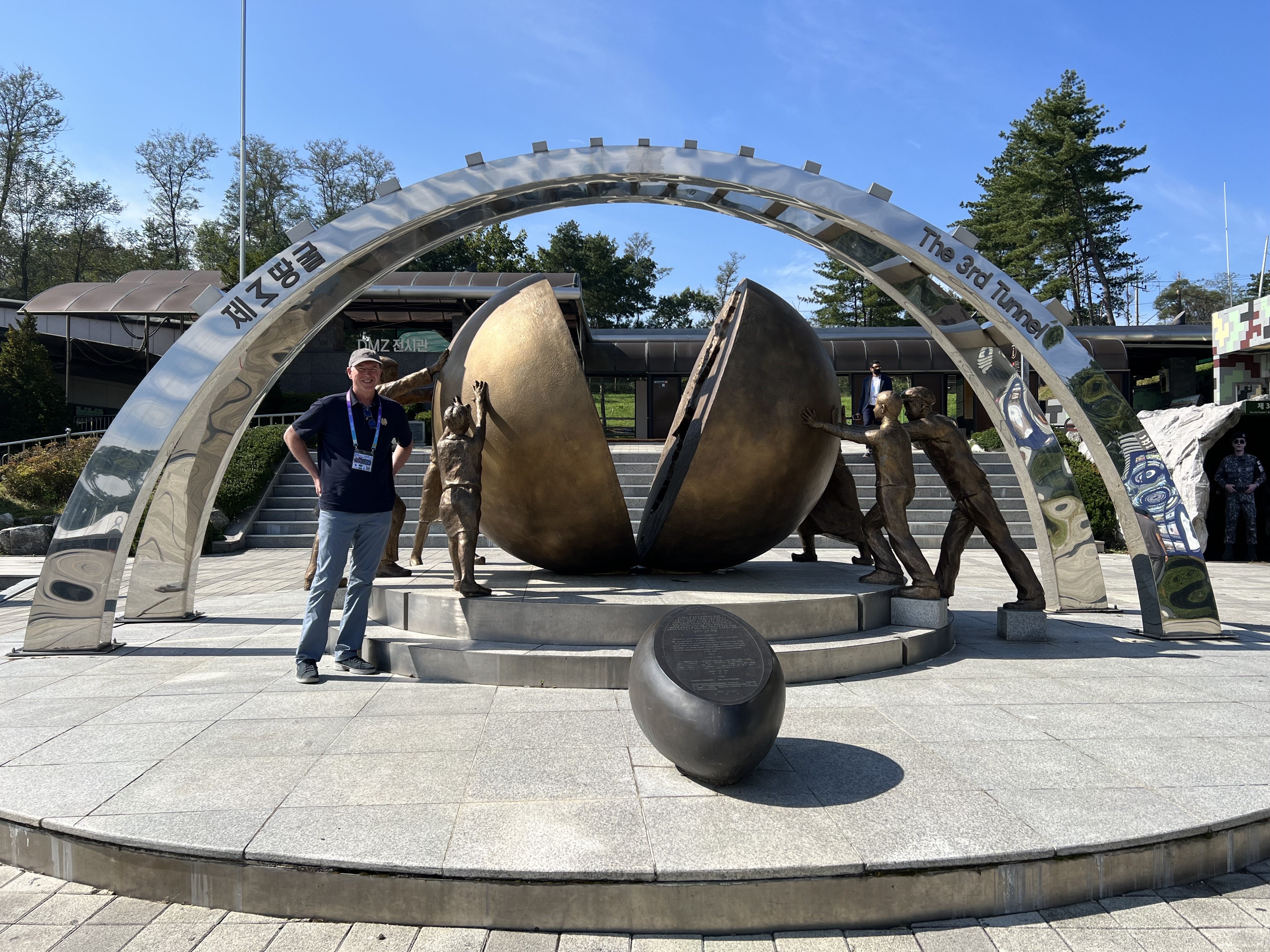
Oct. 1, 2022 – Courtenay roamed more Seoul neighborhoods and palaces today while I went to the Korean Demilitarized Zone, the tense, jagged line separating South and North Korea. Courtenay would have come along but she was rightly concerned about COVID and spending the day in close quarters with a group, a worry that was born out when my seat mate in a small van introduced himself and said he’d just come out of quarantine after testing positive upon arrival to Korea. We didn’t shake hands.
The truth is there is not that much to see at the DMZ, but there is a lot to think about.
It is one of the world’s saddest, strangest tourist attractions, the only place I’ve ever visited where they sell pieces of barbed wire in the gift shop. Former President Bill Clinton called the DMZ “the most dangerous place on Earth,” and perhaps, outside of Ukraine, it still is, with major armies stationed only a few kilometers apart, signs lining the roadsides warning about unexploded mines, and North Korea sending menacing messages by firing long-range missiles almost every day this week.
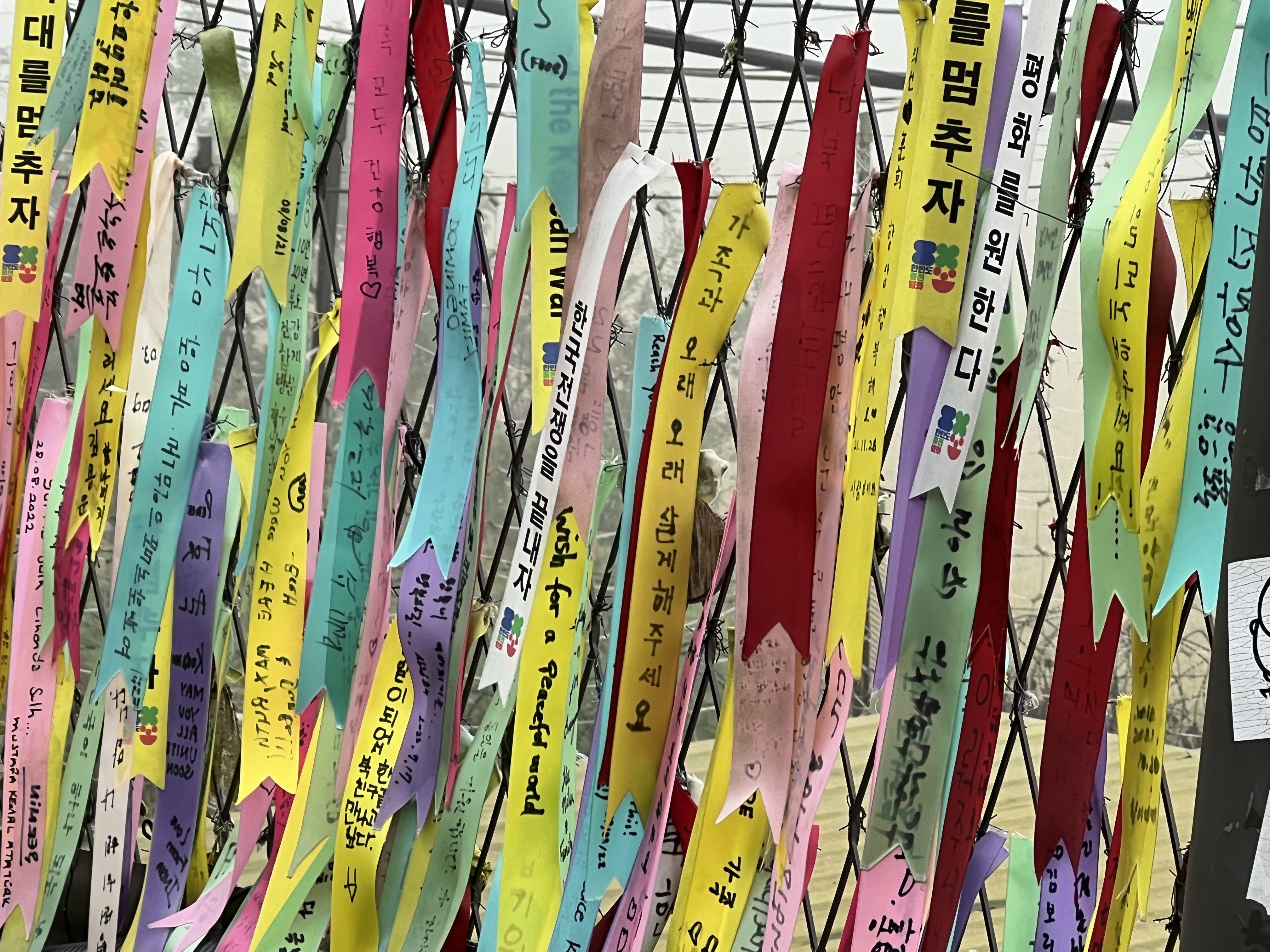
But on this warm autumn day, the fields of rice in the farms around the Korean military checkpoints ripening to a yellow-gold, the DMZ was quiet, almost serene. Fluttering in the light breeze at our first stop, Imjingak Park, the last village on the South Korea side, were thousands of ribbons attached to a fence. Our Korean guide, Nancy Kim, explained that the ribbons carried messages—news of births and deaths, messages of love and lost and longing, from South Koreans to their long-lost relatives in the North. No contact—no phone calls, no letters, nothing—is allowed between North and South, where millions of families were separated when the war ended. The South Koreans place the ribbons in Imjingak hoping that the wind will carry their messages of love into the North. There is also a concrete platform, the Mangbaedan altar, where families come to leave offerings, pray for their lost loved ones, and, Nancy said, cry and cry and cry.
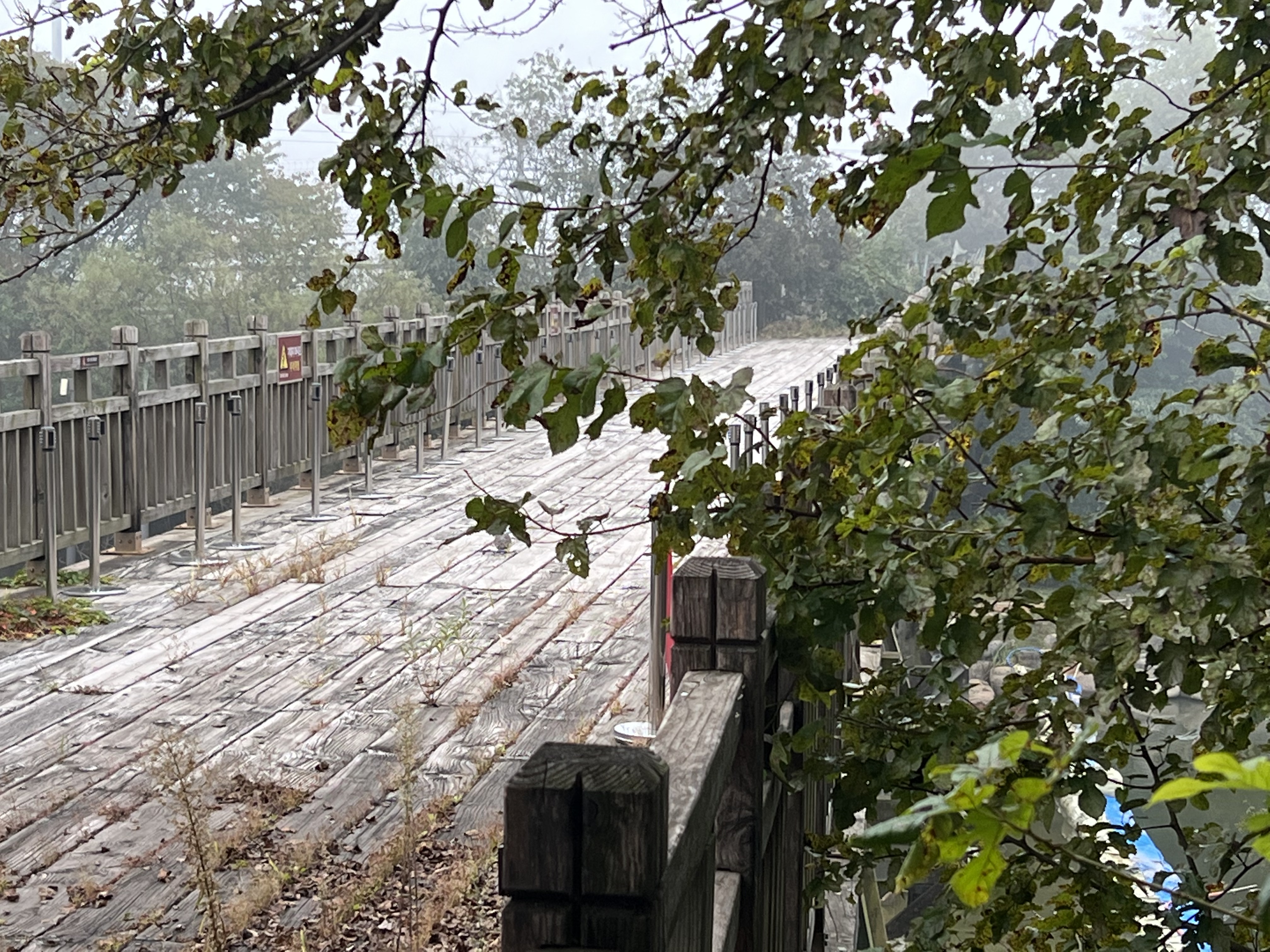
So, no, this isn’t your ordinary tourist destination. We saw the remains of the Freedom Bridge, a now abandoned wooden bridge where more than 10,000 prisoners were exchanged at the end of the Korean War. We then walked down deep into one of the “infiltration” tunnels that North Korea dug beneath the DMZ, apparently as a prelude for an invasion. The South has discovered four of these tunnels; it’s believed there are another dozen or more undiscovered. It’s a long, cramped thirty-minute round trip down deep below the DMZ, where the tunnel is now blocked with three concrete walls, just a few feet south of the military line of demarcation. We went to an observatory on a high bluff overlooking the DMZ, where we looked across the line and see North Korea. It was mostly forested, not farmed like the South side, and through the binoculars atop the observatory, you could see the buildings of Kaesong, the closest North Korea city. From that distance, it looked just like any other small city shimmering in the mid-day light.
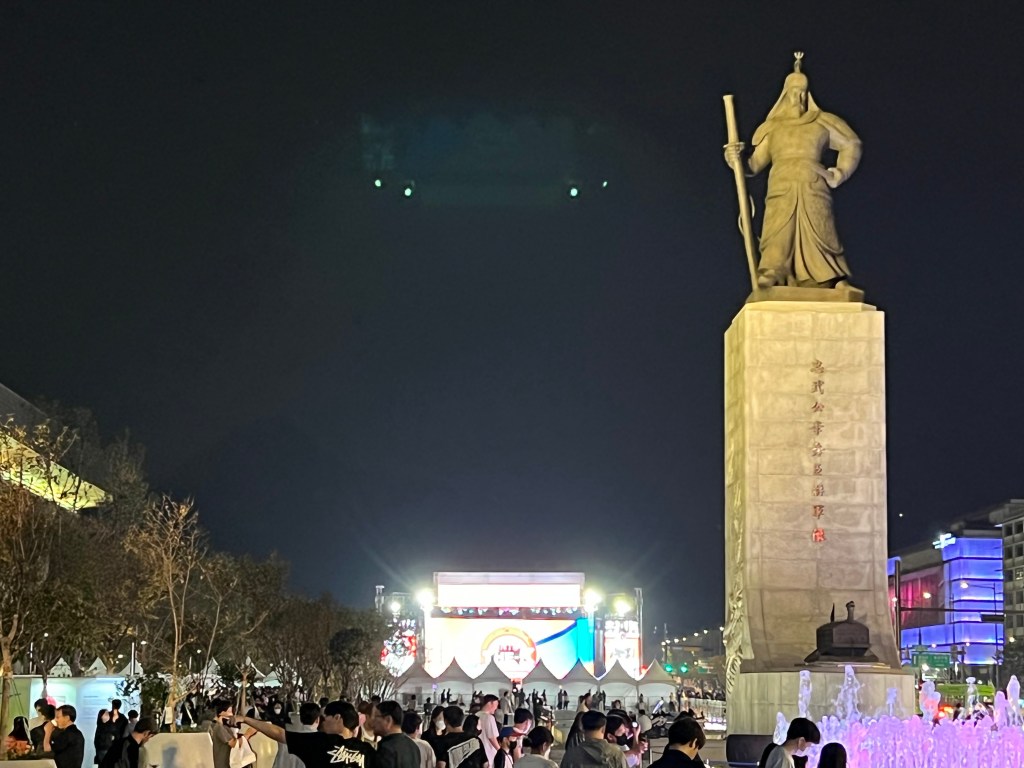
It was a mind-bending day. I came back in the mid-afternoon, met up with Courtenay, and later we went out into the Saturday night maelstrom of Seoul, which was, in such a dramatic contrast, incredibly vibrant and alive, with thousands and thousands of people on the streets, dancing to K-pop music, shopping, eating, a huge group marching around City Hall loudly protesting something.
Meanwhile, the quiet stillness of the DMZ was less than an hour away.
 The Thompson Attigs