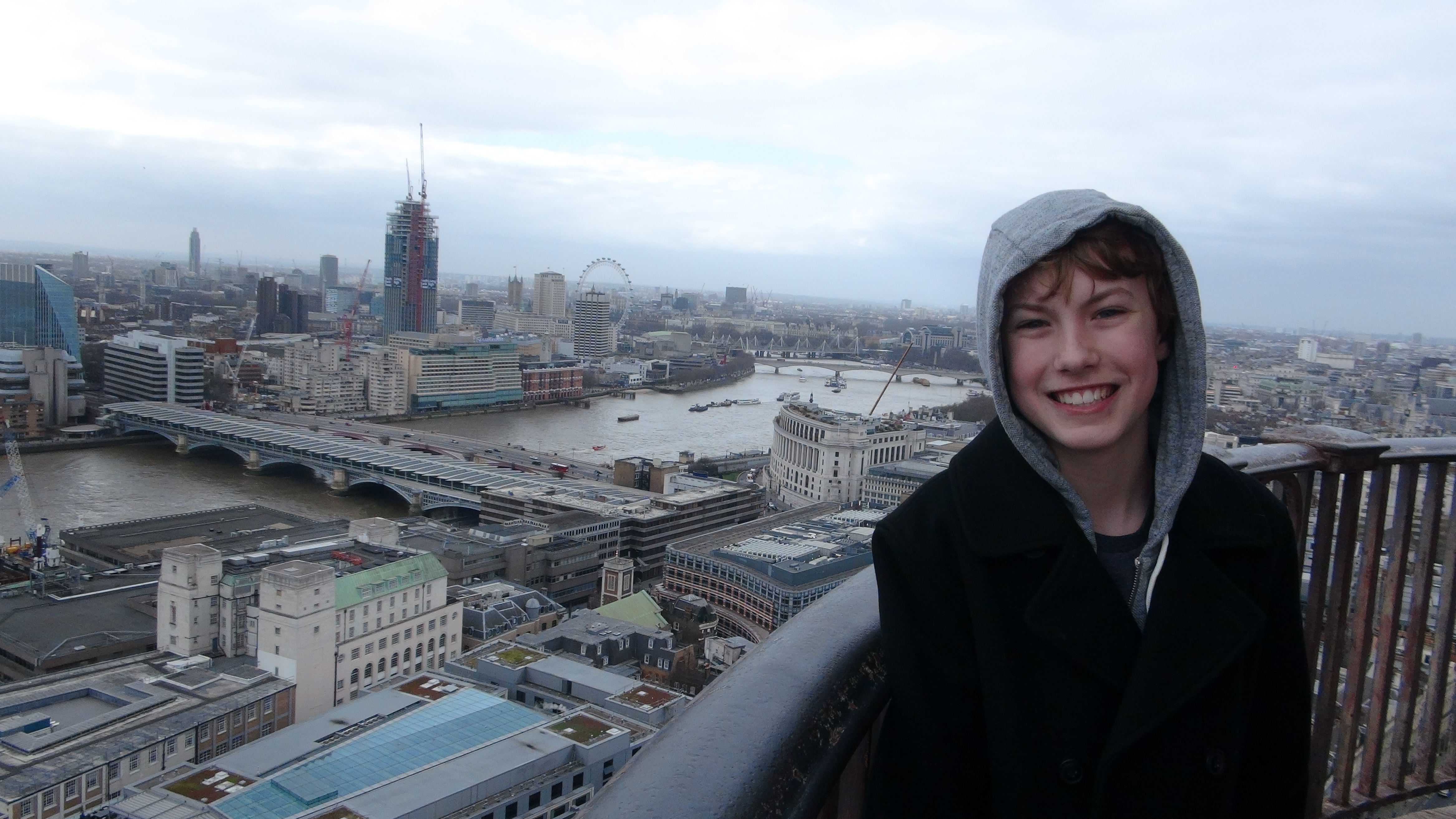
View from atop St. Paul’s Cathedral
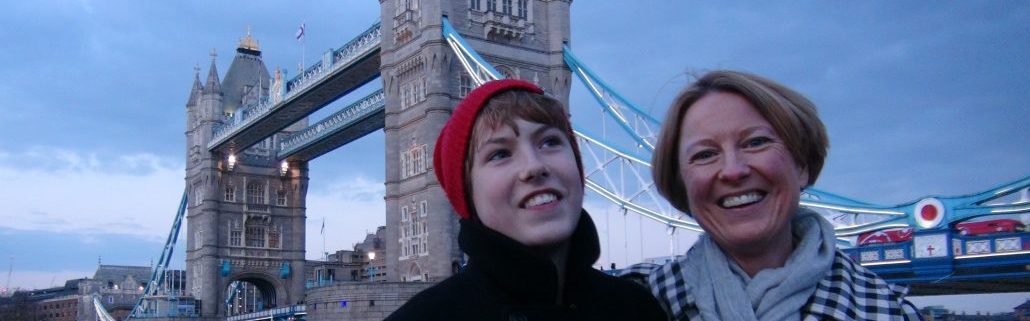
LONDON — Okay, let’s try this again: We arrived in London about noon local time after a nine-hour flight from Seattle. The flight was as good as a long, transcontinental trip can be, smooth and on time, with no drama on board. We had three seats in a row in the middle of the plane and somewhere over the ice cap Will chose to fall asleep across our laps, just as he did as a toddler. Here’s the difference: He’s now 5 foot 8, and Courtenay got his head while I handled size 11 feet for upwards of five hours.
A very friendly Italian driver picked up us at Heathrow and drove us the forty-five minutes or so into the city. It was a beautiful afternoon in London, sunny and all blue sky, and people were out in force picnicking, playing and running in Hyde, St. James and Green parks.
Bit of a snafu at our hotel, The Athenaenum, where the staff told us that are room wasn’t quite ready and suggested we take a walk and come back in twenty minutes. We did that, the room still wasn’t ready, and we took up their offer of free tea or other drinks while we waited. Ten or fifteen more minutes, they said. An hour later, we were still waiting, and waiting. Will and I took another short walk. Still no room. Finally, Courtenay approached the hotel staff yet again and yes, the room was now ready. It’s a beautiful apartment, worth the wait, I guess, with a pullout bed in the living room for Will. They, too, underestimated the length and shoe size of our 12-year-old: The robe they left for him hit him about mid-thigh, and the tiny slippers were hopeless.
We had to hustle out of the room because we had a 4:15 p.m. reservation for afternoon tea at Fortnum and Mason, a department store with a restaurant on its top floor. It was our first tea experience, which featured an amazing tier of sandwiches, scones with clotted cream and jams, and cookies and other treats. It was fabulous. We ate until we all pretty much faded into our seats.
After that, we walked through Piccadilly Circus, which is London’s neon-lit cousin in sleaze to New York’s Time Square, then strolled Regent Street, one of London’s major shopping thoroughfares, passed a half dozen popular pubs with scores of people standing and drinking outside and wound up cutting through Shepherd’s Market, a narrow alleyway of hip restaurants and bars, on our way back to our room.
We’re running on cakes and scones and no sleep right now, and fading fast.
More tomorrow. Hope all’s well back home.
LONDON — We have arrived. Rick is too grumpy to blog. Courtenay keeps insisting that we say everything in her words. Rick keeps editing my post. Will keeps hitting the CAPS button on me.
That is all.
UPDATE — DUBLIN, Ireland, late Monday, Aug. 12: Our flight home through Philadelphia ultimately was canceled and Courtenay scrambled to book new flights, with our group of seven forced to fractured into three different routes. We had a long, frustrating day that ended in disappointment. We all hope to be home by the end of Tuesday, but we face uncertainty and tight connections. Wish us luck.
DUBLIN, Ireland, Aug. 12, 2013–It’s a mess at Dublin International Airport today, with all of US Airways flights to Philadelphia backed up. Hundreds of people are waiting on two delayed flights, including ours, and many people have been here since yesterday, when their flight was canceled. It’s a tense scene, with lots of anger, and a trio of cops here to keep the peace. Since we can’t make our Philly connection to Portland (a four-hour window wasn’t enough, for US Lateways), we’ve been rebooked through Phoenix. At last word, we hope to get into Portland about 1:30 Tuesday morning–five or six hours later than scheduled–but that’s not assured right now. If we don’t get out of Dublin at 4 p.m., we’ll miss our new connection to Phoenix, and then we’re not sure where we’ll go.
It’s been a great trip, but we’re all tired and anxious and eager to get home.
HILTON PARK, Ireland, Aug. 9, 2013 – Sitting in a remarkable manor home that has been in the same family for almost three hundred years, a day after standing breathless in the pitch darkness of a five-thousand-year-old passage tomb, and coming inside from helping a five-year-old boy catch his first pike, I marvel at how Ireland compresses time and the long reach of history.
Everywhere we have gone we have seen things that are startling, and unbelievably old. The passage tombs of Newgrange and Knowth, buried deep beneath mounds with hundreds of tons of earth and stone that ancient peoples somehow dragged dozens miles, are more than five hundred years older than the great Egyptian pyramids, and were built one thousand years before Stonehenge. We all were moved by the complexity and mystery of the passage tombs, which give lie to the idea that the people of prehistoric times were simple, ignorant people. The passage tombs are amazing feats of architecture, engineering and astronomy—made as much with brilliance as with brute strength—somehow oriented precisely with the rising sun on the winter solstice in case of Newgrange and fall and spring equinoxes at other tombs.
At Newgrange, the sun rising on the shortest day of the year enters a narrow box between giant boulders, shoots through a slim, 20-meter column deep into the center of a mound, shimmers as it moves slowly across the stone floor until it reaches the back of the passage and illuminates a series of suns and other symbols carved into stone. No one knows how or why these passage tombs were built all over western Europe, but it seems they were meant at least partially to celebrate the passing of the seasons—of time, again. The light flashing into Newgrange meant that another year had passed, that the days would again grow longer, not shorter, and that the darkness would slowly, steadily, begin to lift again. The ashes of the dead were also discovered inside these tombs, suggesting that perhaps these mounds were places where the spirits of the dead were carefully placed so they would be lifted, in the shimmering sunlight, into the next world.
Newgrange and Knowth, the two passage tombs we explored at the ancient site more broadly known as Bru Na Boinne, were among the most moving historic sites we have ever visited. Another nearby hill dotted with passage tombs, Loughcrew, was similarly powerful. We made the long, slow climb up the hillside to Loughcrew where an Irish guide led our family alone inside a passage tomb, and she shined her flashlight on a descending row of sun symbols, precisely oriented to catch the moving sun once, and only once, each year.
At a moment when my life, and those lives of the people I love, seems to be hurtling past, it is reassuring to experience Irish time, where history just seems to go backwards forever and forever, and around the next corner, or the next stop, I will see something that is unfathomably old. One moment I am drinking ale in the second oldest pub in Ireland, with its two-foot-thick stone walls, the next I am sitting in the drawing room of an estate house that was built more than a century before Oregon, my home, was even settled by pioneers.
On the way to Loughcrew we pulled in to visit the ruins of the church and gardens where St. Oliver Plunkett was believed to be born and first raised. St. Oliver was falsely accused of treason and drawn and quartered by the English, and the roofless church ruins had a tragic feeling. It was an exceptionally dark and evocative place, with English ivy climbing the shattered stone walls and weathered headstones leaning this way and that in knee-high grass. Will discovered what looked like an open tomb in the thick grass. The place seemed so very Irish, a country that is, by turns, beautiful and sad, stunning and spiritual.
But then there was that little boy, representing the tenth generation of the Maddens, the family that built Hilton Park in 1734, taking the rod after showing me where to cast, the silver lure arcing through the gray Irish sky, and setting the hook on the hungry pike, reeling wildly, shouting with excitement, then dropping the rod on the little dock and running to tell his parents about his catch. I was left holding the rod while the pike lazed on the surface, worried that this boy’s first fish was going to get away before he returned, and counting the minutes, which seemed to go by so very slowly, in the way they do in Ireland.
Kilkenny, Republic of Ireland, Monday, August 5, 2013 – Heavy rain showers and wind overnight muffled the sounds of pub nightlife as late as 3:30 a.m., as shouting revelers “pub-crawled” the streets of this medieval city. But we slept well in our wonderfully located B&B, a historic manor house used by the local Earls while their nearby castle was being renovated. You can see the castle from our windows, which overlook a large garden and the restored horse stables of the castle. Both the Butler House, where we are staying, and the horse stables – now a wonderful local craft center – were restored with public dollars, and are now run by some sort of trust.
Renovation was the theme of the day, as we toured Kilkenny Castle. The Anglo-Norman stone castle was originally built in the 12th century, and has been remodeled extensively over the 600 years that the Butler family was in residence as the local noble family and landowner. The family finally auctioned off all their furniture and books in 1935, as they left Ireland for England in the wake of Irish independence and Irish hostility to the Anglo-Irish overlords of yore.
The place fell into ruin until the 1970s, when renovations began. Today, the castle is being slowly restored, room by room, and the results are beautiful. Guides explained how the history of the castle reflects the tensions of Irish history – Kilkenny residents today are very proud of their castle, a major tourist draw. But not long ago, it was a painful reminder of the English domination of Ireland. It is a painful to think about the juxtaposition of opulent Chinese and Moorish decorations added in the 19th century – the same time as the Great Irish Famine of the 1840s. Apparently, the ruling noble Butler at the time, who kept a meticulous diary, never once mentioned the famine, though dying people would have been visible everywhere had he left the castle, noted one guide.
We then ventured through the streets of Kilkenny, down narrow medieval alleyways and shopping streets. We ate in Kyteler’s Tavern, famous as the home of a noble woman named Alice Kyteler, accused of being a witch. She escaped to England, but her poor maid was burned at the stake on the site of the town hall. Today, the pub is famous for its music, and marginal bar food – Dad stuck to a strict whiskey-and-apple-pie diet, just to play it safe.
We then wandered past the Black Friary, named for the black robes of the Dominican friars, and ended up at the Cathedral Church of Saint Canice, for which Kilkenny was named. Will and Rick climbed up the 100-foot-tall tower built in 849 AD. They said it was the scariest tower they have ever climbed – the wooden steps were narrow and crooked and very cramped. It’s amazing it is still standing. The cathedral itself was built between 1202 and 1285. It has an evocative graveyard, and the cathedral itself is filled with sarcophagi. We found one particularly interesting one, containing a Butler nobleman and his wife, one Margaret Fitzgerald. It turns out she is a daughter of the Earl of Kildare, which means she is probably related to Will’s friend Kazu Fitz-Gerald, who is also related to the earls of Kildare. Cool Kazu! We said hi! And her husband carried a huge sword! Perhaps he fenced sabre, we are not sure.
Rick and the kids are now headed to the beautiful green lawn of Kilkenny Castle, a wonderful park, to play “hurling” with Will’s new hurling stick and ball. I don’t know much about it, but it appears to resemble cricket somewhat.
We were supposed to take a short drive this afternoon to see some famous monastery ruins, but slowness was the word of the day and the black Mercedes remained firmly parked in the car park. Tomorrow, off to Glendalough, the Wicklow Mountains and Trim, ancestral home of the Plunketts (but perhaps not our Plunketts.) Stay tuned.
KILKENNY, County Kilkenny, Aug. 4, 2013 – We began our day in Dingle, my favorite Irish town so far, remembering the sweet sounds of traditional Irish music and the screams of laughter from two groups of costumed young women out for bachelorette parties that crashed O’Flaherty’s Pub last night. It was another travel first, sipping Irish beer while watching young women dressed in “Where’s Waldo?” red-and-white stripes guzzle Coors Lite over ice and play ring toss with a three-foot-long inflatable BEEEEP! Mitchell declined to take a toss.
Today was a day mostly spent on Irish roads, from the narrow mountain road over spectacular Connor Pass on the Dingle Peninsula to the controversial M8 superhighway that skirts too close to the ancient Rock of Cashel. (Note from Courtenay – it was a super great freeway! Best road in Ireland! J Rick says I’m an un-eco-conscious ugly American, but I guess I’ll have to live with that label.) We left Dingle at 9:30, retraced our route to Tralee, cut past busy Killarney and buzzed through Marrow and Mitchelstown, whereupon we took a brief break. Will, already road-weary, took advantage of this timely roadside stop to puke. That makes two Western European nations—Italy and Ireland—that he has graced in this manner. Not to mention Japan…
We rolled into the town of Cashel about 2 p.m., had a minor tired-couple argument over the choice of parking lots, endured a fairly bad pub lunch and made our way up the hilly town to the Rock of Cashel, an acropolis topped with the ruins of a castle, an ancient cemetery and three different eras of Christian churches dating back to 1100 AD. The sun was shining as we sat together on a rock wall at the edge of the cemetery, an iconic round tower above us, sweeping views of Irish farms below, taking in the place that has been at the center of so much Irish history. (Note from Courtenay: we only got to sit there for about five minutes. Then we got to get back on that super-good super-fast super-convenient M8 freeway and scream off to our next B&B)
With Mitchell navigating, an hour or so later we entered Kilkenny, a mid-sized Irish town that dates back to medieval times, and made our way down busy narrow streets lined by shops, bars and restaurants, to our hotel, the Butler House. (Note to Yosuke: I drove this on Google Maps before we came and it rocked to know where we were going!) The hotel backs up to Kilkenny Castle, one of Ireland’s great restored castles. We huffed our bags inside and up several flights of stairs, the friendly hotel proprietor, Richard, gently steered us away from our planned dinner destination (bad pub grub, he said) and found us two tables at a terrific Italian restaurant, Rinuccini’s. After a big meal including handmade pasta and much liquid refreshment, Gene headed for a self-guided tour of the huge wine cellar beneath the main floor of the restaurant. We were worried that the fire trucks outside had been called to deal with this intruder.
After dinner, we wandered across the street to the beautiful grounds of Kilkenny Castle, which was carpeted with Irish-green grass and stately oaks and maples. We approached a low stone wall that looked down on the river that makes a slow turn in downtown Kilkenny. A lone kayaker made his way downriver. It was all beautiful and serene, and then Mitchell looked across the river and saw something floating on the far bank. It was, naturally, a large foam BEEEP!, one even lengthier than the unit that was in play in Dingle. What is it with this country?
As if in answer, the funny, gregarious guard named Matt O’Neill who ushered us off the grounds of the castle as the park was closing told us the key to understanding Ireland. His country, he said, is like one of those stubborn door locks that is reluctant to open. So here’s the secret, he said, to gaining access to the real and true Ireland. With a big grin, miming shaking a key in a frozen lock, he said, “You just have to give it a jiggle.”
 The Thompson Attigs