Fashion, history, art, donuts and sumo

Saturday/Sunday

It’s now 4:30 p.m. Sunday, and we’re chilling in the hotel room indulging in Will’s newest obsession – sumo. No, the room isn’t big enough for a sumo match between him and Daddy (there’s barely room for our luggage), but there’s a tournament on in Osaka, so from 4 p.m. to 6 p.m. all week, sumo is broadcast on TV. Needless to say, we are planning our days around it, which works quite well because we start our days so early we are exhausted by 4 p.m. Yesterday, we did the Harajuku-Shibuya fashion tour, walking down Takeshita Doori with its crazy young crowed, and hit Omotesando to visit Kiddyland, the 5-story toy store where Will’s favorite stuffed animal, Snowby, was born three and a half years ago when we were last here.
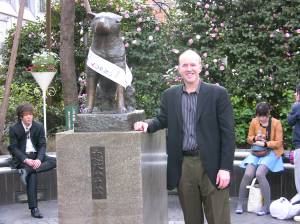
Rick with Hachiko

Things seem so familiar here, yet look on the surface very different from when I lived here more than two decades ago. Yes, many people still wear white masks over their faces to protect themselves and others from germs; yes, people still seem to prefer to keep their distance from gaijin in subways and restaurants; but there is much more English spoken now and foreigners don’t really stand out that much; the variety of clothing and hair color is vastly more varied; things seem more relaxed. But it’s hard to say. I just wish there weren’t so many Starbucks, Tully’s Coffees and Makudonarudo Hambaagaas.

After visiting the statue of Hachiko — the loyal dog to waited for his master to return from work long after the master was dead, and an essential Shibuya meeting place for people in the pre-cell phone era — we were rather beat and headed back across Tokyo on the subway to relax in our room and watch sumo and eat Japanese crackers and some surprisingly good Gouda cheese and California wine that Rick had sweetly bought for our arrival. Evening, we ventured out to a sushi bar recommended by Rick’s interpreter – it was delicious, though by the end Will was totally sagging. He is an unbelievable trooper. Will slept all the way to 5:50 a.m. today, much to my relief, given that I woke at 4 a.m., still not adjusting to the time. Out of our hotel window, we could see workers setting up the Tokyo Marathon route a block from our hotel. We ventured out and watched the start of the marathon, with the wheelchair racers zooming by first, followed by the runners. It was extremely windy, and the neat rows of cardboard garbage cans kept blowing into the race route, along with the matching hats of the hoards of race volunteers. Will thought it was all hilarious.
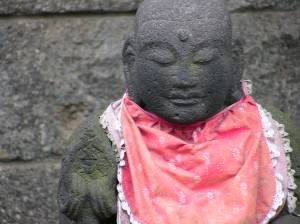
Temple figure

We then took the train to north Tokyo, where we wandered around a very old section of Tokyo, Yanaka, one of the only, if not the only, sections to survive both the 1923 earthquake and subsequent fire, but also the bombings of World War II. It’s a hilly area, with narrow winding streets, old wooden buildings and many temples and shrines, along with tiny shops offering beautiful Japanese paper, bamboo carvings, and “College Potatoes” – a sweet confection of sweet potatoes eaten by students at a nearby university – and by our own Rick Attig, who today accepted an offer to became a graduate student of fine arts at Pacific University. Boy, I buried that lede, didn’t I? We are proud of him.
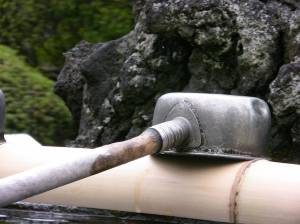
Outside the temple

It started to rain, so we grabbed a taxi to Ueno, where we searched for a tiny soba shop through the seedy, garbage filled alleyways near Ueno station. We had to wait in line for about 20 minutes with a half dozen well-dressed Japanese who laughed at Will’s antics jumping from flagstone to flagstone outside the restaurant, and then ducked inside for delicious buckwheat noodles. Next was the National Museums at Ueno, where Will oohed and aahed over the ancient clay “Haniwa” figures, rusted bronze swords, Buddhist sculptures, and of course, armor. Rick was most excited about the beautiful writing boxes, with their ink stones and beautiful lacquered surfaces. He loved that so much care would go into the ritual of writing. I, of course, loved the Buddhist sculpture, a throwback from my college days at Waseda University, but was disappointed that much of the collection was closed for the month of March. It’s funny: Will has come to really enjoy museums, much to our delight, and for the first time in his life, he was OK with not buying something at the gift shop!!!

We also glimpsed the spring’s first cherry blossoms in the garden outside the museum — and today was declared the first official day of cherry blossom season in Tokyo — a full week early this year. We are looking forward to being here for Ohanami, an important cultural ritual of enjoying the beauty and ephemeral nature of sakura blossoms. 

Finally, the most important stop of the day: we took a subway halfway across Tokyo to find Neyn, a gourmet, semi-cult donut shop Rick had found online in Akasaka. We caught a subway back to the hotel with a dozen donuts in hand; we sat next to a dozing young Japanese woman, who like us, had a big bag of Neyn donuts at her feet. And we made it back to our room in time to catch the sumo tournament. The tournament started with some “nostalgia” clips from long, long ago – much to my delight, because it was the era when I came to love sumo, 20 some years ago. So here we sit, Will drawing cartoons of sumo wrestlers and marathoners, including one about a sumo wrestler who visits a donut shop and knocks a bunch of stuff over, Rick is doing laundry in the bathtub, and I’m typing this. We’ll venture out later for yakitori – Will’s choice tonight.
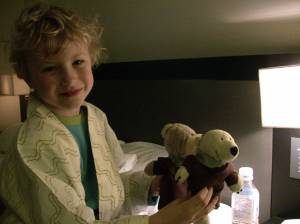
Will’s First Morning in Tokyo

Saturday, March 20, 2009

Will's ready for the day, at 3 a.m.

We woke this morning to the chirping of Will, who declared it was 6:45 and time to get up. I felt a glimmer of hope he was right, but knew it my heart he wasn’t. Indeed, he’d read the glowing lights of the room thermostat, which declared it was 64.5 degrees in the room. Actually, it’s 3:25 a.m., though it feels like 11:30 a.m. Portland time. Ah, the joys of jet lag.

 While Courtenay struggled to make “Drip-On” coffee using an origami-esque folding technique that was WAY too difficult at 4 a.m., especially because it involved boiling hot water, Will wrapped his stuffed animals Snowby and Iceby in mock-kimonos using the sashes that came with our robes. We are now preparing to go to the Tsukiji Fish Market, the largest seafood market in the world. Why? Because it is the only thing in Tokyo open at this hour, except for the hookers around Shimbashi Station.

 It’s now 12:45 p.m. and what feels like three days later. We ventured out to Tsukiji at 5 a.m.; it was unbelievable. It’s a vast seafood market – the largest in the world. We arrived in darkness, unsure of where to go.When I asked a sake seller where the main fish market was, he pointed in the direction and said, in Japanese, “Be careful. It’s dangerous.”  And it was. What a scene – it reminded us of a James Bond movie where the bad guys are zipping around in little carts through a hyperindustrialized warehouse. But the bad guys here were men in rubber boots and rain coats driving little forklifts  and dragging handcarts here and there; you literally had to watch your back, your sides, your front at all time in the tiny corridors of the mazelike market.

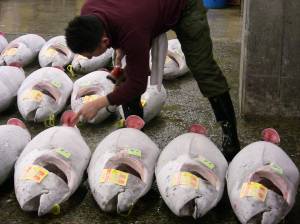
A buyer examines tuna at Tsukiji Fish Market

We finally found the main fish market where upwards of 450 different kinds of seafood from around the world is sold. We saw live eels, fish, clams, scallops, you name it. At the tuna auction, we managed to squeeze into a small viewing area to watch the 5:30 a.m. auction, where wholesalers bid on the whole, frozen tuna that lay like torpedoes on the floor of a warehouse. Each auction starts with a man wildly ringing a bell and then shouting ensues and the fish are sold, ready to be shipped to restaurants around the city.

 We luckily made it out of the market without getting squashed by a forklift. We made our way back to the hotel for breakfast since we figured Will couldn’t handle raw fish for breakfast. We then walked around the Imperial Palace, bought some train tickets at the main Tokyo Station, walked around the expensive shopping area of Ginza, had coffee and croissant, and it still was barely 9 a.m. We were killing time because the highlight of our day – the visit to the Pokemon Center – wasn’t open until 10 a.m.

Pokemon Heaven

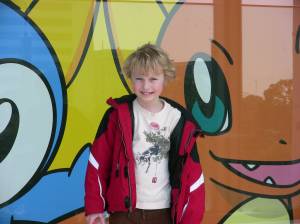
A train stop away, Will knew we were at the rain station because he saw a group of young people wearing Piplup hats waiting to flood the train station to direct visitors to the center.  When we arrived at 10 minutes to 10, Pokemon Center had a line snaking outside the door with anxious Japanese families waiting to get in when it opened. We joined the line, and at 10, burst into the world headquarters of the Japanese equivalent of beanie babies. They sold everything from Pokemon cards, to Pokemon stuffed animals, Pokemon seaweed, Pokemon curry rice, Pokemon chopsticks. Will was in nirvana.

We just had lunch at an amazing tempura shop, where Will wowed the kimono-clad wait staff with his appetite and his polite “Gochisoosama deshita” at the end of the meal. We sat at a counter, as at a sushi bar, and watched the chefs prepare the sushi, piece by piece. We ate way too much – we didn’t want to appear rude, of course!

And it’s only 1 p.m. We’re about to head out to Harajuku, where young people dressed in crazy clothes go to blow off steam and be rebellious out of the sight of their parents on the weekend. The weather is gorgeous and warm today, so we want to take advantage. Hope all you are well!!!


Around the Imperial Palace, at a 10-minute pace

I jogged around the Imperial Palace this afternoon, about a four-mile run from the hotel. I’m afraid I didn’t represent my country all that well; I was being passed right and left. Tomorrow is the Tokyo Marathon, one of the world’s biggest marathons, and a section of the course includes what I ran today. If only I were in better shape … 

The ski jump, with Sapporo in the distance

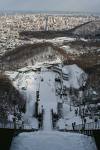
Yesterday was a long but eventful day in Sapporo. I toured a beautiful orchestra hall, and went to the top of the ski jump that was used for the Sapporo Winter Olympics, and is still used for events and training. I rode the chair lift up and down. There’s also a cool Winter Olympics museum there, with interactive games, including a simulator where you do a ski jump. I went 113 feet, far short of the 140-foot record. My hosts were nice about it, but clearly unimpressed. 

I also met Sapporo’s mayor, a very serious but interesting man who talked about what he thinks Portland and Sapporo have in common, including an appreciation of nature, and beauty, and life conducted at a pace to enjoy both. I liked him, and his city, a great deal. I will always have found memories of Sapporo, and the people I met there, and how important it is for them to have a connection to Portland.

I said goodbye to Yoshida-san at the Tokyo airport late last night, bought sushi to go and ate dinner in my room. It was a relief to wake up at a reasonable hour this morning and have nowhere to go. I needed a break. I watched the Blazers lose to Cleveland on my computer, and then wrote a couple blog posts for The Oregonian. I also did some research on MFA programs at Antioch and Pacific, trying to decide what to do, where to go. I’m leaning Antioch, but I’m just not sure. 

Courtenay and Will arrive in a few hours. I am eager to see them, share my stories and spend some time exploring Tokyo with them before I get back to work on Monday.

From Shimbashi to Sapporo

Sapporo during its annual Snow Festival

A long, surreal day that began when I snapped awake at 4:30 a.m., and wound up walking the streets of Shimbashi just after dawn, along with some rather aggressive Tokyo prostitutes, and finished with a great dinner of beer, sashimi and other delicacies with four members of the Sapporo foreign relations department.

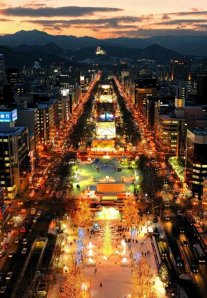
I flew to Sapporo from Tokyo today with a translator, Yoshida-san, and we toured parts of Sapporo before  visiting a school to meet with students who  went to Portland last year. Portland has a sister-city friendship with Sapporo that will mark its 50th year this spring, one of the longest sister friendships between any American and Japanese cities. The city officials, students and others were excited to welcome a Portland journalist, and my interview with the shy students, under the watchful eye of the school principal, also was photographed and recorded by a reporter from the Haikkado daily newspaper. It took me a while to get the students to warm up; they were intimidated, I think, by the setting. But I told them that so far all that I had done in Sapporo was visit a giant trash incinerator (true) and that unless they opened up about their city, I would go back to Portland and write solely about Sapporo and its incinerator, and that got them finally to open up. They were really charming kids, and they followed me outside after the interview, and shook my hand and wanted to pose for pictures. 

The city officials were abuzz about the mayoral sex scandal in Portland, and had lots of questions about what’s going on, and what’s going to happen. There’s some anxiety about the timing of a big delegation of Sapporo citizens scheduled to visit Portland in June, timed not only for the Rose Festival, but also perhaps for the beginning of the effort to recall Sam Adams. 

There is a lot of curiosity and interest here in Portland, and I hope to write a piece encouraging Portlanders to have more interest in and curiosity about their Japanese sister. There is a lot of pride about Sapporo, a city of 1.8 million that is just coming out of another long winter, with old snowdrifts still piled around town. 

Tomorrow I am scheduled to visit the ski jump built for the Sapporo Olympics, a beautiful concert hall that cost more than $150 million to build, interview the city’s climate change and sustainability experts and chat with the mayor of Sapporo before flying back to Tokyo. This has been great fun so far.

Wide-eyed in Tokyo

Ohayo Gozaimas! It’s 4 a.m. Tuesday in Tokyo, and I’ve been awake for a couple hours on my first morning here. My time clock is messed up after the 11-hour flight from Portland and bus and taxi rides. I went out last night into Ginza and bravely ventured into a yakitori/sake restaurant. The staff concluded that I was Australian, but I’m not certain why, or whether that is a good or bad thing. Tokyo is just as we left it when we visited three years ago, over-the-top busy, noisy and compelling, a sensory overload of a city. I have my first meetings today with leaders of the Foreign Press Center and one of Japan’s top experts on fisheries resources, which are in trouble here. Japan is badly overfishing its waters, its seafood consumption is shrinking and the number of Japanese fishermen, who are aging, is falling by 10,000 people a year. At this pace, they say, Japan will have no fishermen in just 12 years.

Last night I met Suzuki-san, the Foreign Press Center officer who arranged my trip. She speaks very good English, having lived and studied in Toronto for four years. I am a good two feet taller than she is — a towering Australian, as it were.

There is some sort of contraption in my room to press slacks and shirts. It’s not an iron, exactly, and I think I will give it a try now. I still have two hours to kill before breakfast.

Jamata, for now

Wedding Day in Oaxaca

It’s Sunday morning, Feb. 7, and members of the wedding party are straggling in slowly to sit around the pool in the sun and recover from the 12-hour wedding extravaganza yesterday. Will is splashing happily in the pool, and Rick is sipping water in the shade.

 The wedding day began yesterday with Will cementing his new friendships with Max and Fred, the 5- and 7-year-old sons of the “best boy,” as they called their father, a university friend of Rob the Groom. Will and the boys ran wildly through a huge empty room in the hotel/nunnery, perhaps once a chapel, now a performance area.  Fred and Max fascinated Will with stories of their school uniforms in London, where they wear a tie everyday to school and a “jumper.” Seemed totally wild to him.

 We then dressed for the wedding, which began at noon in the ornate 16th century Temple of Santo Domingo. The elaborate cathedral was nearly entirely gilded inside, even its fluted columns glinting with gold. Popes, cupids, angels and early church fathers covered the arching ceiling. As it is a major tourist destination, tourists wearing shorts and sporting cameras rather rudely wandered up and down the aisles during the ceremony.

 The ceremony was entirely in Spanish, with Rob even speaking his parts in flawless Spanish. The bride Elizabeth was gorgeous, in a classy, form-fitting silk gown. Since bride and groom are both journalists (Elizabeth a photographer for AP in Beijing, the groom a TV producer for Aljazeera based in London) the place was bristling with top news photographers from around the world – Agence France Presse, AP,  Getty – all scrambling like paparazzi to photograph their friends’ wedding. It was a wonderful scene.

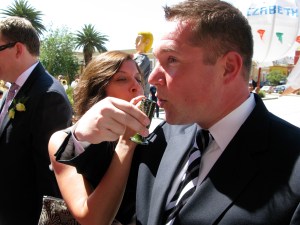
 After the mass, which Will weathered beautifully in his little pinstriped blazer that Rick said made him look like a rock star trying to dress nicely – we left the church to find a Mexican band and huge, 8-foot-tall dancing puppets depicting the bride and groom. Women in colorful Mexican costumes handed out tiny green pottery cups and poured mescal for guests in the blazing sun. The square swarmed with trinket sellers, beggars, tourists, the wedding party and tourists snapping photos – it was quite a scene. Eventually led by the band and the bride and groom, those of us wearing high heels tottered our way down the cobbled streets back to the hotel, where we gathered for the civil ceremony in one of the hotel’s grassy courtyards.

  After that champagne, followed by “mescalitis” or margaritas made with mescal, a multicourse meal featuring Oaxacan specialities such as mole, another live mariachi band, tequila, toasts, dancing to everything from raggaeton “Gasoline” to old Madonna standards. There was even a reporter and photographer from the local press doing a story on the acclaimed Mexican journalist (Elizabeth) getting married in town. Will alternatively danced and chased his friends – all of them wearing Lucha Libre Mexican wrestling masks and swinging small rubber chickens – gifts from the bride and groom. Helen, Mike, Rick and I sipped tequila and took in the scene.


Helen and Mike sampled the mescal.

 Will logged more than 30,000 steps on his pedometer. Finally, about 9:30, he couldn’t take it any more and asked to go to bed. Since our room was right next to the action, he bathed to the sound of the now-returned mariachi band and wrote three pages in his journal before falling asleep with the music still blaring.

 This morning, Will declared it was the best wedding ever.


Exploring Oaxaca and Monte Alban

Today we slept in, for a total of 11 hours! We got up and had a leisurely breakfast in the bouganvilla courtyard, where there is an amazing buffet. Will had French toast and papaya (so good, he says), while the adults tasted the tamales and local cheeses.

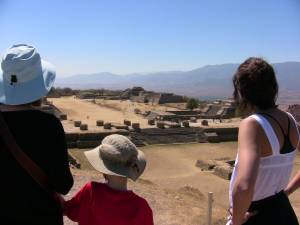
 We then hired Arnold, a local guide, who drove Helen, Mike and us up to Monte Alban, at 6,500 feet in elevation a full 1,500 above the city on a hill the ancient Zapotecs flattened to build a vast ceremonial city. It was amazing. We descended into a tomb, saw the ruins of domestic homes under whose floors the families buried the bones of their family members, and a ceremonial ball court that Arnold said had to do with fertility. We think Arnold had his favorite theories about things, not necessarily based on archaeology, since it didn’t always jive with what we read in our guidebooks or on the explanatory signs along the route, but who knows?

img_1268

 We walked among the remains of huge temple platforms once used for sacrifice and other ceremonies and the vast grounds that had amazing acoustics so the priests could address the assembled masses. The day was clear and the views of the valley were amazing. Arnold, who is 82, also told us about the mathematical and astronomical sophistication of the Zapotec people, who lived in the areas some 3,000 years ago, according to his reckoning, which we are not sure of. The ruins date from 500 B.C, so around the time of classical Greece, the Parthenon and Greek tragedy. We saw the glyphic writing, along with carvings in stone of contorted human figures called “Los Danzantes,” or the Dancers — though modern archeologists speculate they may be sacrifice victims or defeated kings. It was hot, and Will started to droop, but gutted it out for the full proverbial three-hour tour. Will also found a carving on a stair, which was his first major archaeological find!

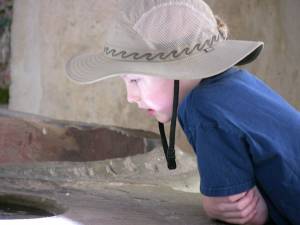
We ended up back in town by 2:30, nearly the local time to have the main meal of the day. We ate at a lovely, relaxing restaurant called, appropriately, “Los Danzantes.”  It was a beautiful indoor courtyard, surrounded by soaring architectural stone walls that echoed the ruins we had just seen. Will insisted we sit near the large pool surrounded by artistically arranged mortars and pestles. We had good food – coconut shrimp for Will, which he snarfed – a few Coronas and wandered back to the hotel to relax before the first official event of the wedding, a cocktail party on a rooftop terrace overlooking the Cathedral of Santo Domingo and the sunset on the distant hills.

We met many of Elizabeth and Rob’s family and friends, and Will made two new buddies, 5- and 7-year-old brothers who are sons of the best man from London. Courtenay freaked that they would catapult off the terrace (there were no rails whatever) or plunge into a cactus or crash into the open fires where chefs were cooking tortillas. Fortunately, no one was hurt. Then home to our hotel, a block away, for baths and cuddles and the sound of guitar music from some evening party we hope ends soon! Good night all!

Greetings from Oaxaca, Mexico!

img_12301

It’s Thursday evening, Feb. 5, and we’ve had our first full day in Oaxaca after flying in Wednesday evening. Our flights from Portland to Houston and from there into Oaxaca were uneventful – Will was a peach, despite a 6-hour layover in Houston. We met our good friends Helen Ubinas and Mike Dunne in the Houston airport, and came into the city with them. Our hotel, the Camino Real, is a really beautiful old hotel that is a major historical site in itself, a former convent built in the 16th century – at the time of Shakespeare, Will likes to relate. It is a stunning place, with exposed brick, crumbling stucco on walls several feet thick, a labyrinth of passageways, arches and hidden courtyards lush with flowering trees and bouganvilla. There is also lovely, chilly pool that Will took a dip in this afternoon. Outside our room is an ancient gazebo-esqe structure called the Lavendera. It’s where the nuns used to do the laundry, and there’s lovely running water into a series of basins.

Last night we cooled off after we arrived with a couple beers and a big Sprite for Will in one of the courtyards (the whole place is open to the sky), and a plate of cheese, meats and deep fried grasshoppers, which were spicy and, actually we decided, not all that tasty. This morning we went exploring on foot with Mike and Helen, starting with the Zocalo, the main square in the center of the city, through the massive gothic central cathedral and on to the central market, which is this enormous, sprawling collection of tiny booths all packed under one roof. Everything was for sale, from huge slabs of meat, whole dangling saffron-colored chicken, and entire mahi mahi and other fish, to toys, jewelry, pots, art, fruit and vegetables, and piles and piles of those grasshoppers. Row upon row of chilies in burlap bags were stacked next to piles of fresh herbs and spices. It reminded Courtenay of the indoor markets she visited years ago in Vietnam. It was a wild, fun place, and Will’s eyes were wide the entire time.

img_12391

We went from there to a chocolate factory. Oaxaca is famous for its chocolates; after all, cacao was first cultivated here by the ancient peoples, where it was made into a drink for royalty. Chocolate is now used in the many and complex moles for which Oaxaca is famous. We bought several kinds after trying some of the tasting-size pieces. Will put a pretty good size dent in the tray of tasting pieces before we pulled him away. We went from there to the big regional museum a block from our hotel at the Cathedral of Santo Domingo. The collection of ancient artifacts dating from the time of Classical Greece are housed in another gorgeous former convent, a huge stone building surrounded by an amazing cactus garden and full of ancient artifacts from the nearby ruins at Monte Alban and other sites.  The artifacts ranged from prehistoric spearpoints to intricate gold and jade jewelry found in a tomb at Monte Alban to relics of the Spanish invasion. Numerous interior courtyards and open external windows gave us a view of the surrounding mountains and the sprawling low-slung city.  It was a great museum, and we had almost the whole place to ourselves.

We went from the museum to lunch at a restaurant sporting modern art, when we sampled the mole sauces for which Oaxaca is famous – verde, Colorado, tradicionel, and three others whose names we’ve forgotten. After that, it was back to the hotel to hang around the pool, and meet more of the friends and family of Elizabeth Dalziel and Rob Hodge, the couple getting married on Saturday.

Tonight we’re all going out to dinner with the wedding party at a traditional restaurant looking out on the zocalo, and tomorrow we’re hiring a driver to take us out to Monte Alban, the ancient ruins. Hope all’s well back in Oregon.