









Barbed wire in the gift shop
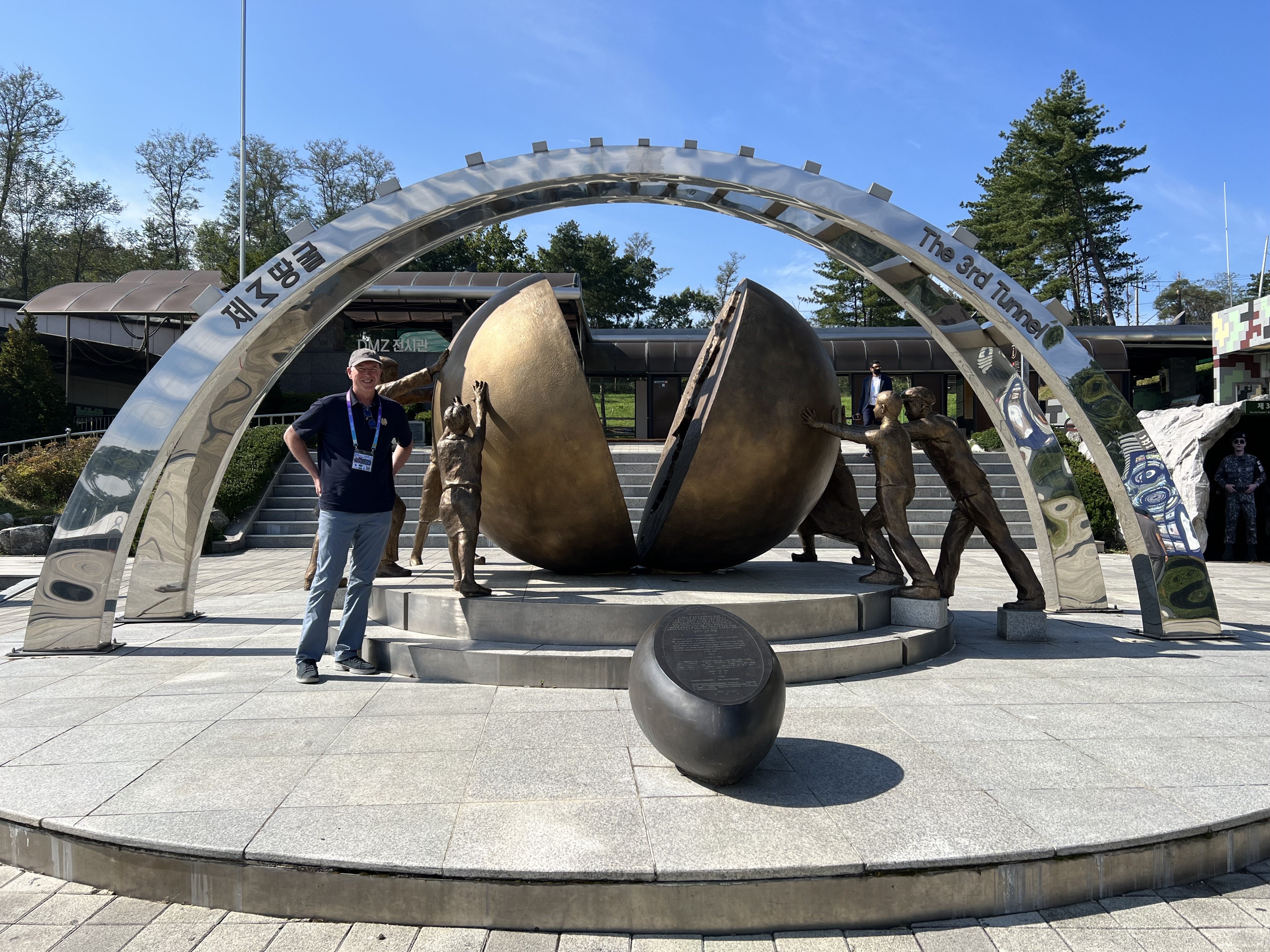
Oct. 1, 2022 – Courtenay roamed more Seoul neighborhoods and palaces today while I went to the Korean Demilitarized Zone, the tense, jagged line separating South and North Korea. Courtenay would have come along but she was rightly concerned about COVID and spending the day in close quarters with a group, a worry that was born out when my seat mate in a small van introduced himself and said he’d just come out of quarantine after testing positive upon arrival to Korea. We didn’t shake hands.
The truth is there is not that much to see at the DMZ, but there is a lot to think about.
It is one of the world’s saddest, strangest tourist attractions, the only place I’ve ever visited where they sell pieces of barbed wire in the gift shop. Former President Bill Clinton called the DMZ “the most dangerous place on Earth,” and perhaps, outside of Ukraine, it still is, with major armies stationed only a few kilometers apart, signs lining the roadsides warning about unexploded mines, and North Korea sending menacing messages by firing long-range missiles almost every day this week.
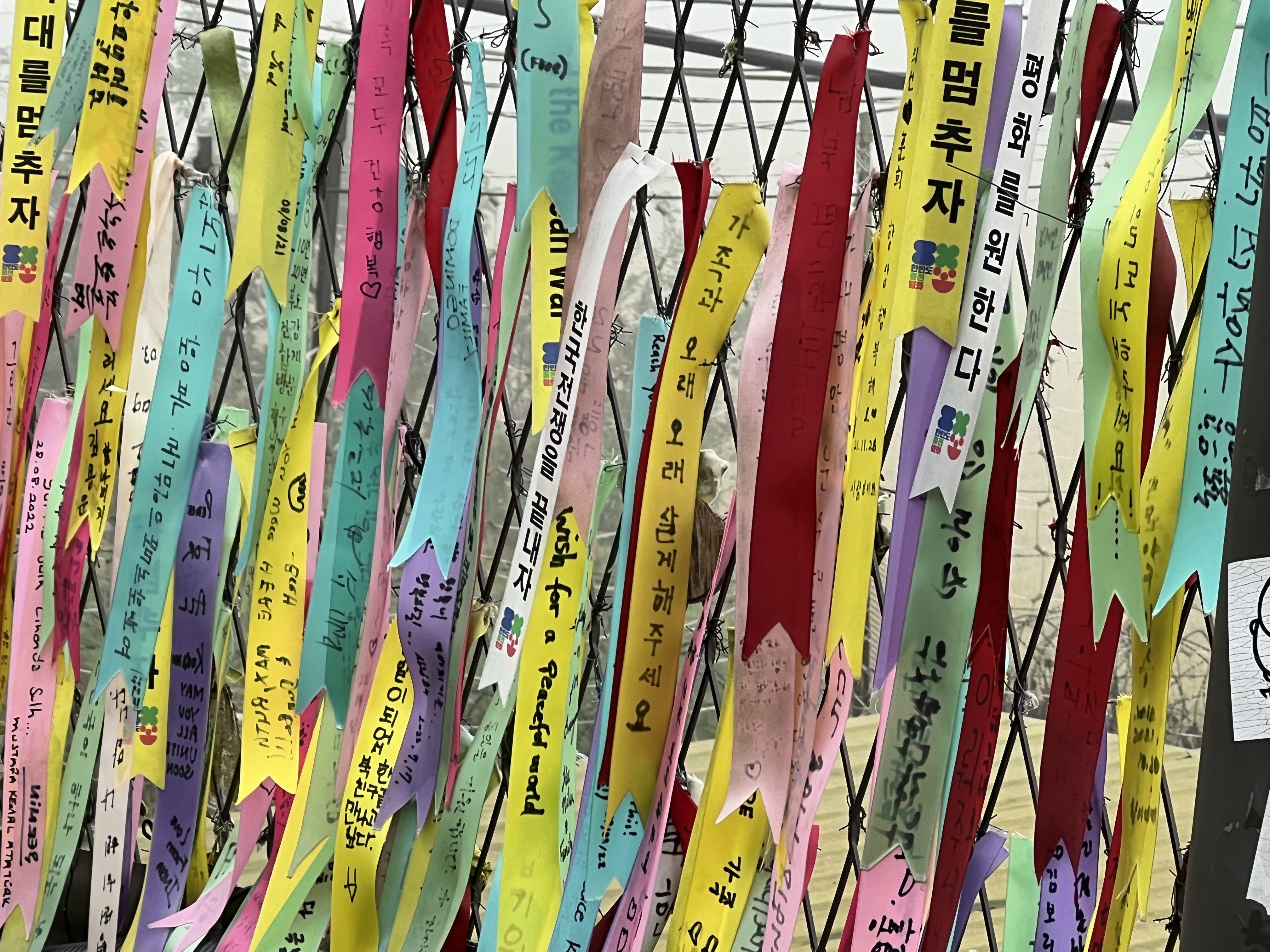
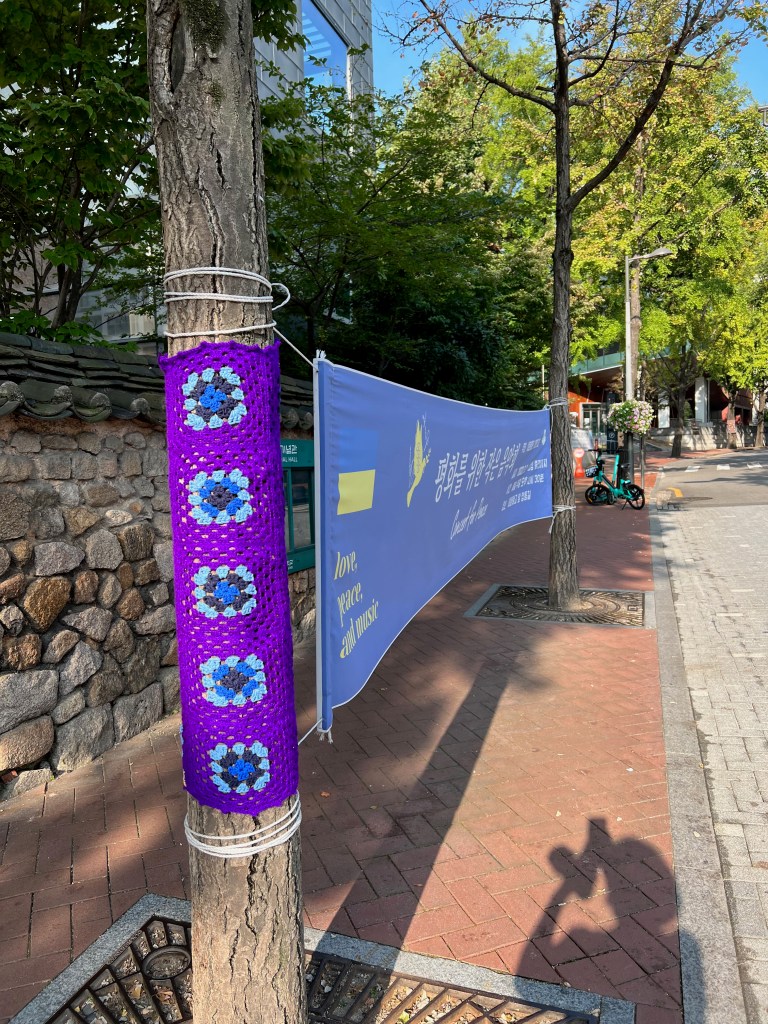
But on this warm autumn day, the fields of rice in the farms around the Korean military checkpoints ripening to a yellow-gold, the DMZ was quiet, almost serene. Fluttering in the light breeze at our first stop, Imjingak Park, the last village on the South Korea side, were thousands of ribbons attached to a fence. Our Korean guide, Nancy Kim, explained that the ribbons carried messages—news of births and deaths, messages of love and lost and longing, from South Koreans to their long-lost relatives in the North. No contact—no phone calls, no letters, nothing—is allowed between North and South, where millions of families were separated when the war ended. The South Koreans place the ribbons in Imjingak hoping that the wind will carry their messages of love into the North. There is also a concrete platform, the Mangbaedan altar, where families come to leave offerings, pray for their lost loved ones, and, Nancy said, cry and cry and cry.
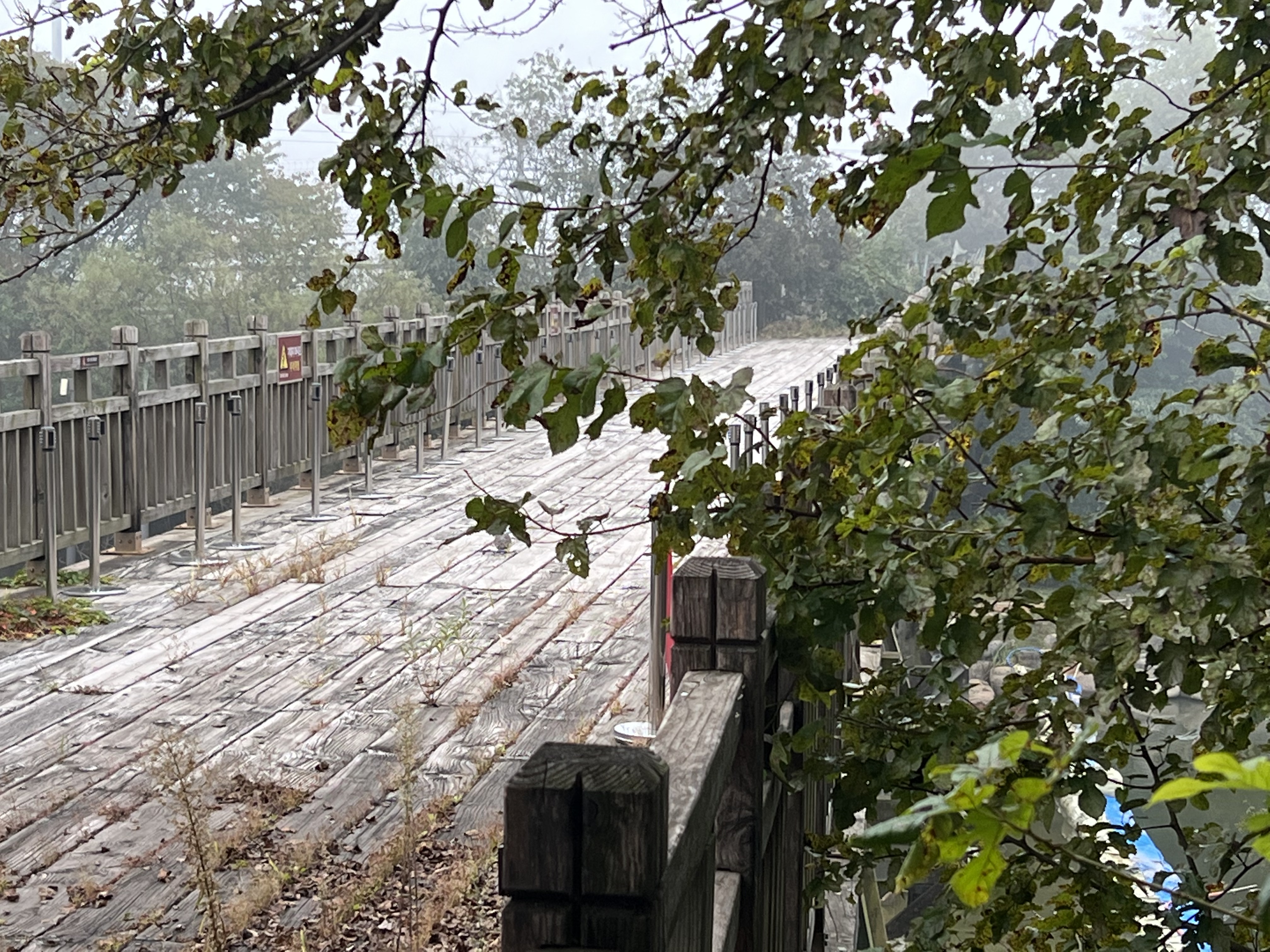
So, no, this isn’t your ordinary tourist destination. We saw the remains of the Freedom Bridge, a now abandoned wooden bridge where more than 10,000 prisoners were exchanged at the end of the Korean War. We then walked down deep into one of the “infiltration” tunnels that North Korea dug beneath the DMZ, apparently as a prelude for an invasion. The South has discovered four of these tunnels; it’s believed there are another dozen or more undiscovered. It’s a long, cramped thirty-minute round trip down deep below the DMZ, where the tunnel is now blocked with three concrete walls, just a few feet south of the military line of demarcation. We went to an observatory on a high bluff overlooking the DMZ, where we looked across the line and see North Korea. It was mostly forested, not farmed like the South side, and through the binoculars atop the observatory, you could see the buildings of Kaesong, the closest North Korea city. From that distance, it looked just like any other small city shimmering in the mid-day light.
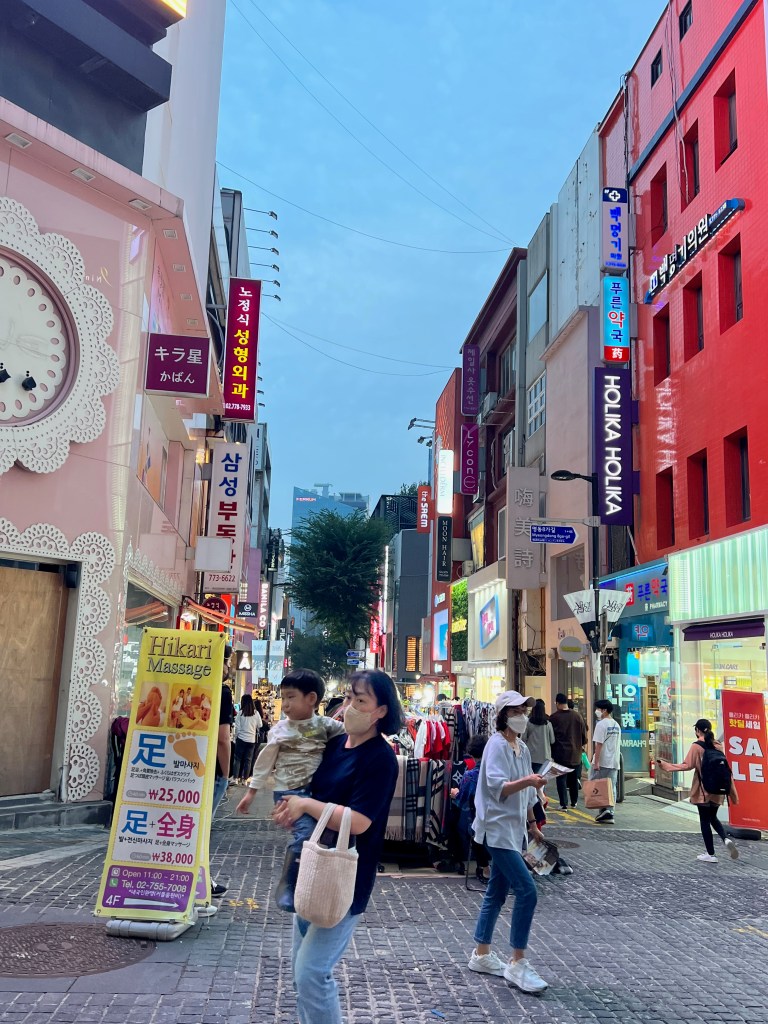
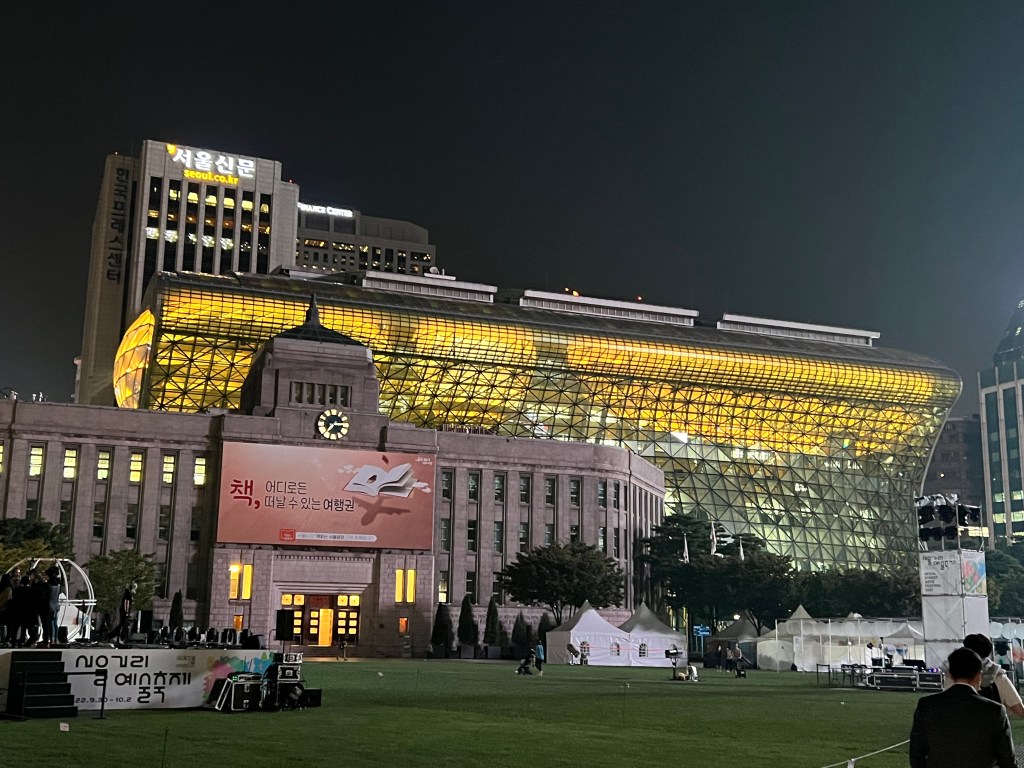
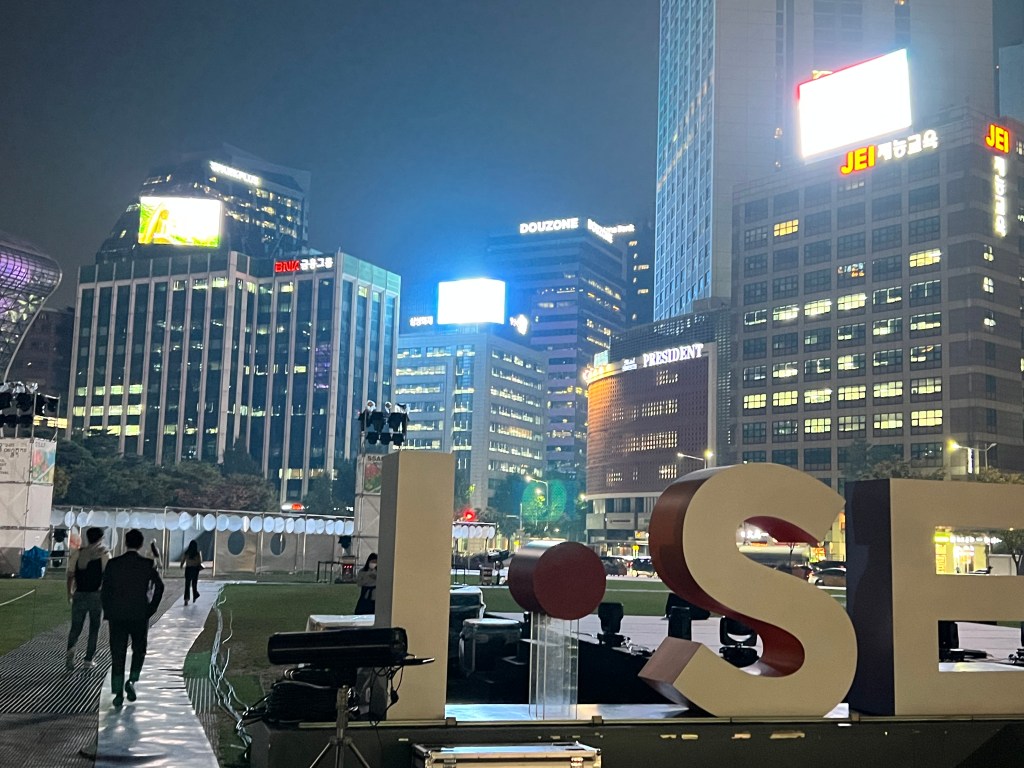
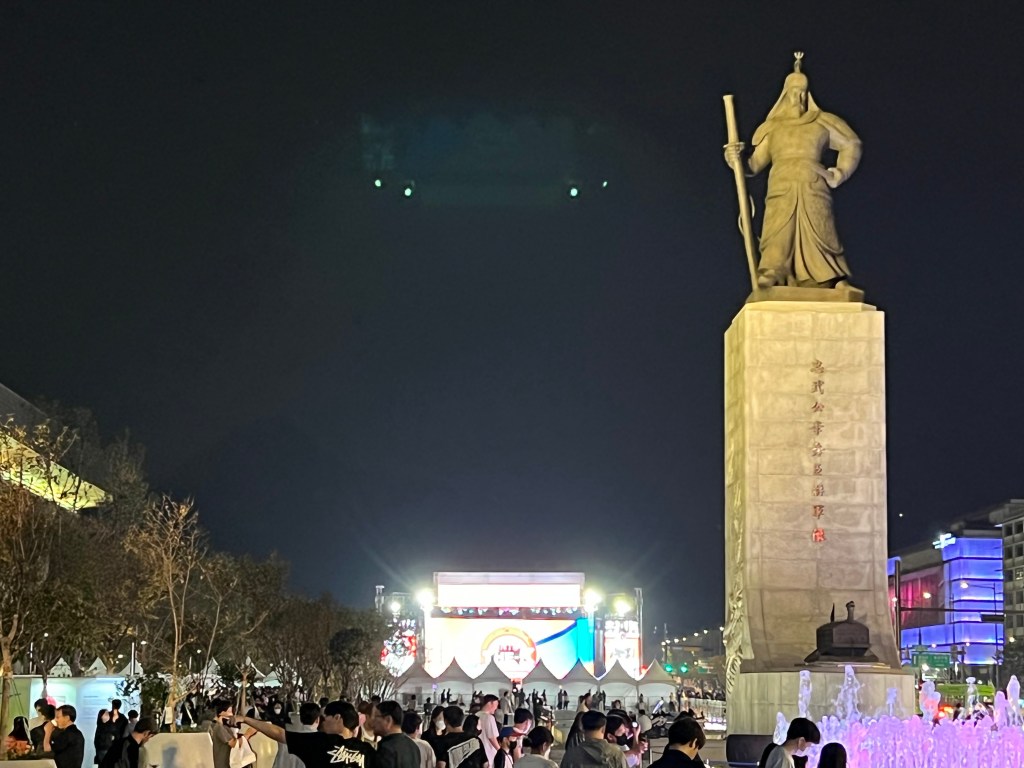
It was a mind-bending day. I came back in the mid-afternoon, met up with Courtenay, and later we went out into the Saturday night maelstrom of Seoul, which was, in such a dramatic contrast, incredibly vibrant and alive, with thousands and thousands of people on the streets, dancing to K-pop music, shopping, eating, a huge group marching around City Hall loudly protesting something.
Meanwhile, the quiet stillness of the DMZ was less than an hour away.
Seoul Survivor
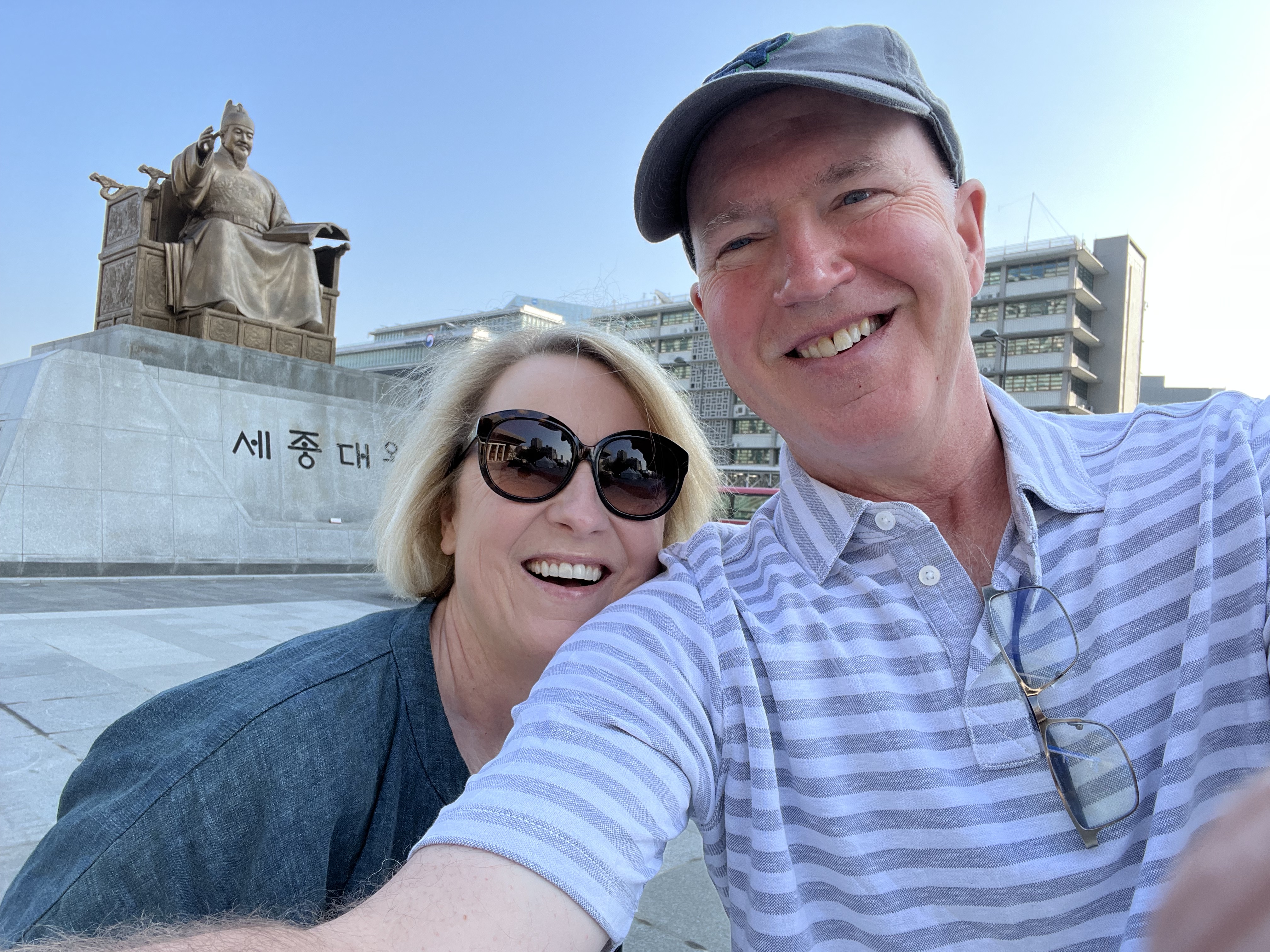
Written by Courtenay
Wednesday Sept. 29 to Friday, Sept. 30, 2022 – Almost exactly five and a half years ago, I was sitting in an exam room at OHSU, trying to understand the incomprehensible news that I had blood cancer. I was in utter shock and despair. All through that terrible morning, my phone kept pinging – “Almost time for your flight to Tokyo,” “Four hours until your flight to Tokyo,” “Your flight to Tokyo is now boarding.” It was a surreal punctuation to a reality that rather than boarding a plane for a long hoped-for trip to Japan and South Korea with my family, I was facing a rather terrifying and uncertain future. We had planned to meet up with fencing friends in Seoul and take Will to watch our first international Grand Prix after a short stay in Tokyo. Instead, we found ourselves in a completely parallel universe, where the only travel that people talk about is your “cancer journey,” a term I despise. That ain’t no journey.
But I digress. One stem cell transplant and a lot of recovery later, in March 2020, we were set to take that same flight, to take Will, Mitchell and Alex on Alex’s first trip to Asia and our first trip to Japan in eight years. March 2020 – remember the lockdown? My timing was impeccable. I started to feel like I should never plan another trip to Asia or the whole world would come crumbling down. Our next attempt to travel to Asia – just South Korea this time and with friends Asma and Rehan – was scuttled last fall when the Delta variant surged. So you can imagine the trepidation – and disbelief – that I have felt over the past few days as we actually flew to South Korea. The feeling as we took off from Seattle was surreal, but a good surreal. It felt amazing to be able to do something I once thought I might never be able to do again, that flying here now, this fall, somehow helps – not erase – but lay down a new track on those traumatic memories. I feel blessed. I feel healthy, strong and excited to explore this totally new country, culture and language. I feel normal. I feel like me. There was a time five years ago when all I wanted was to not be myself, anyone but myself. I am myself again.
Oh, and Seoul is incredible.
Our friend Sungmin had told us so. He is right.
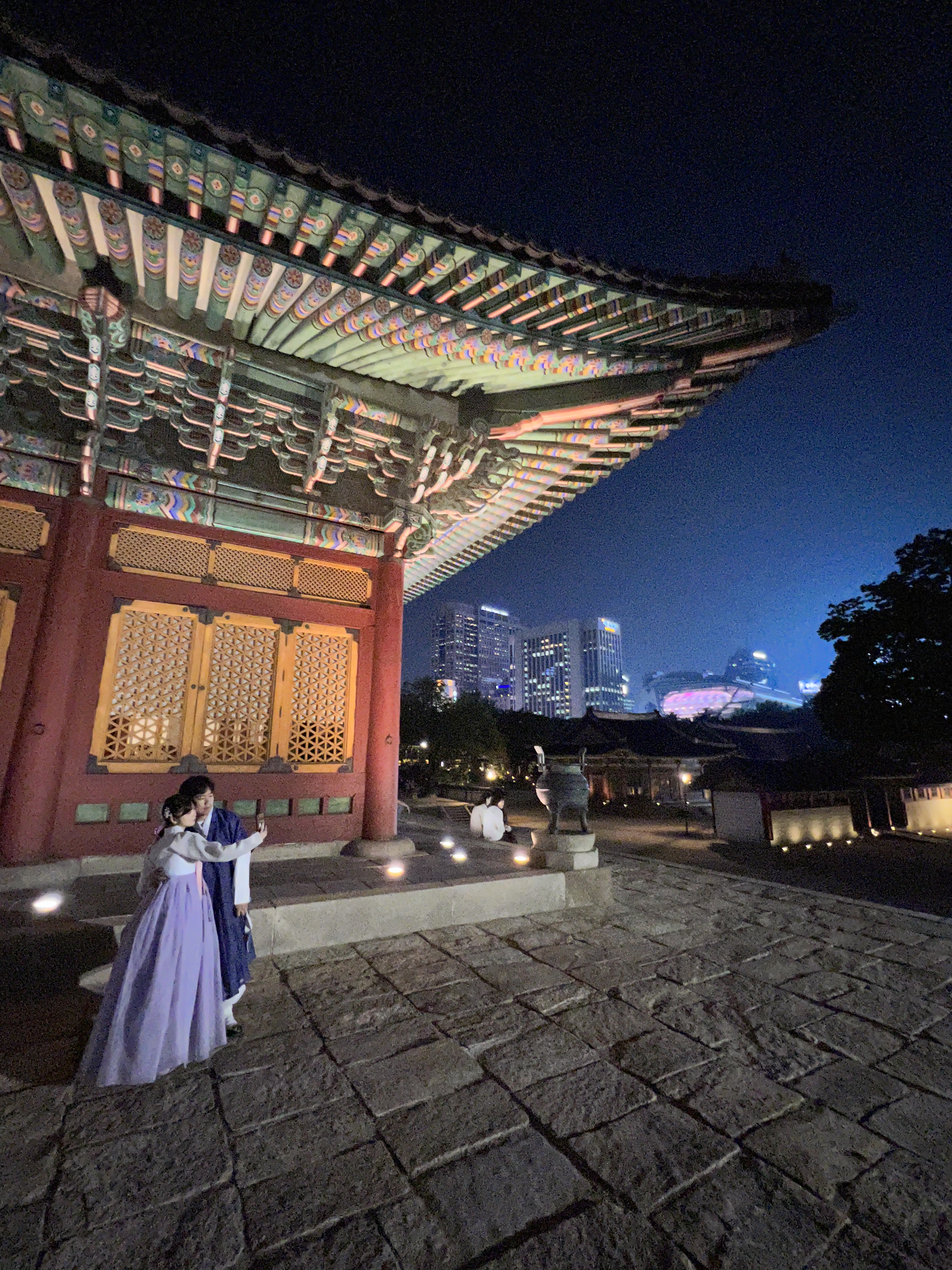
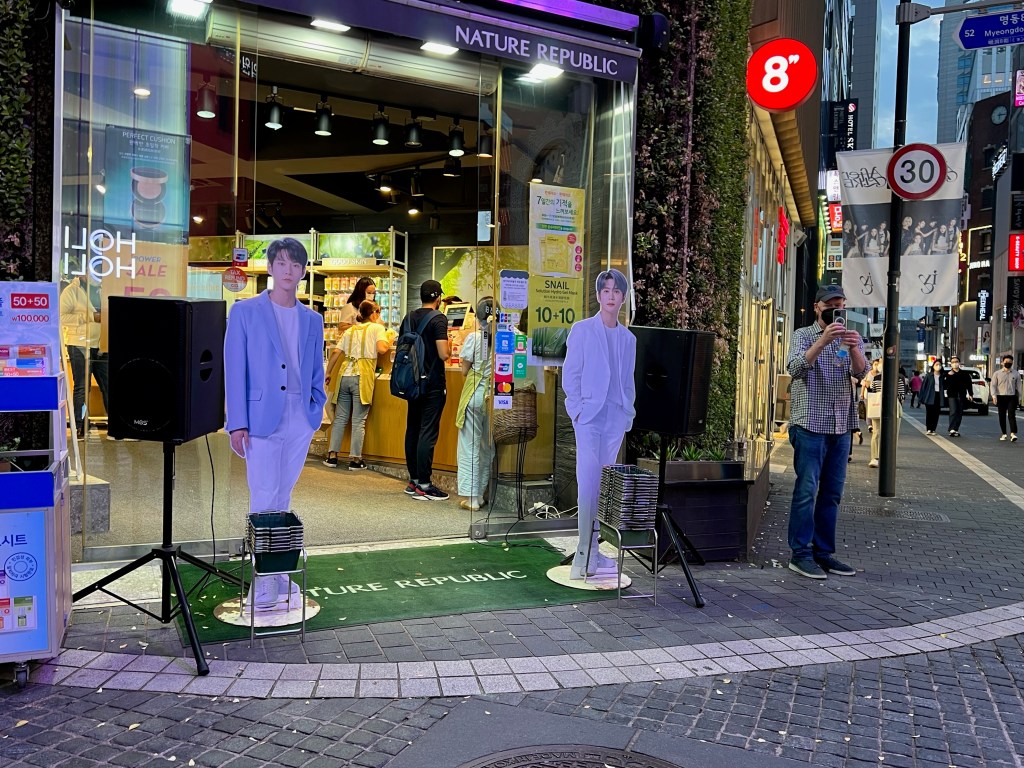
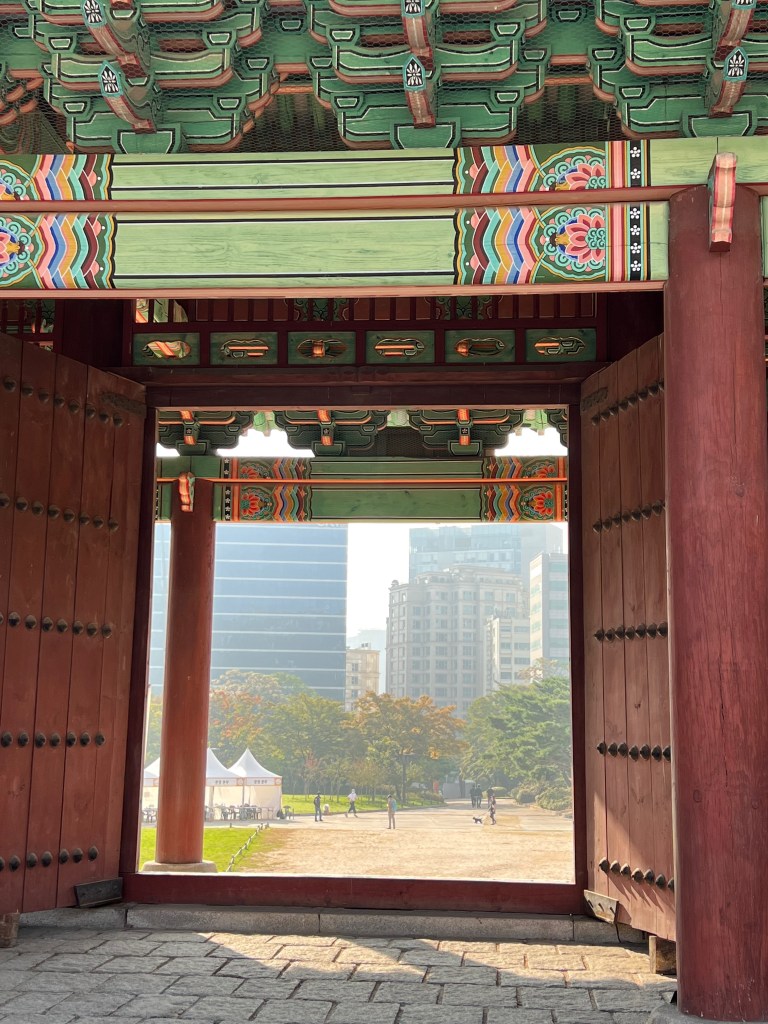
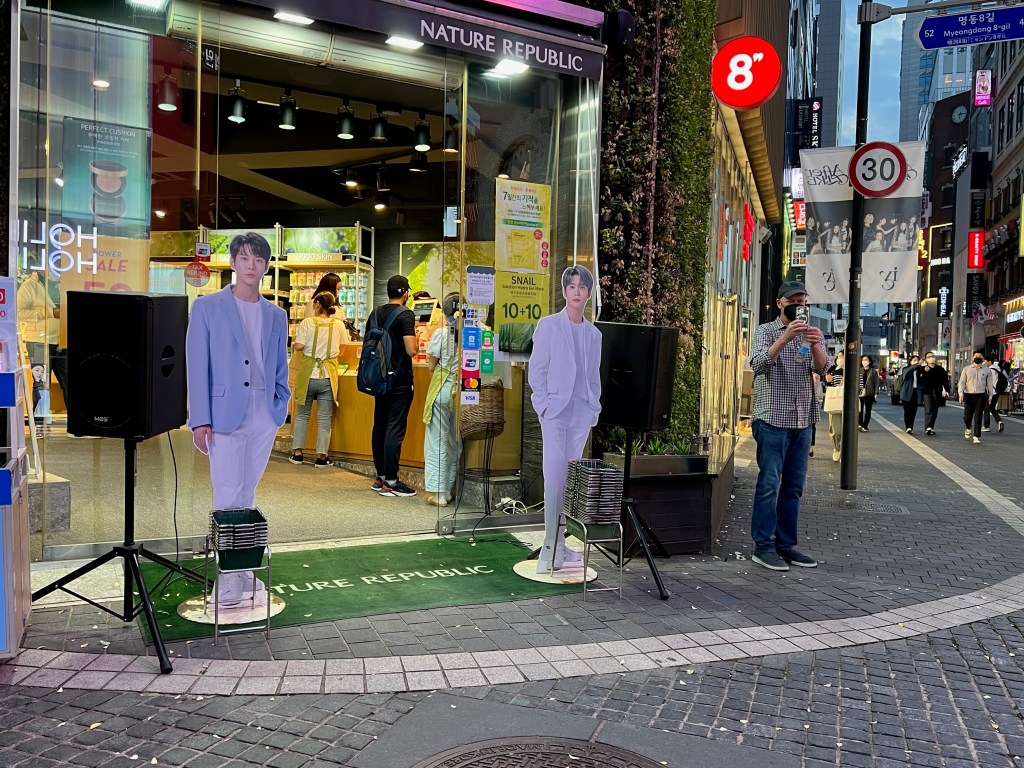
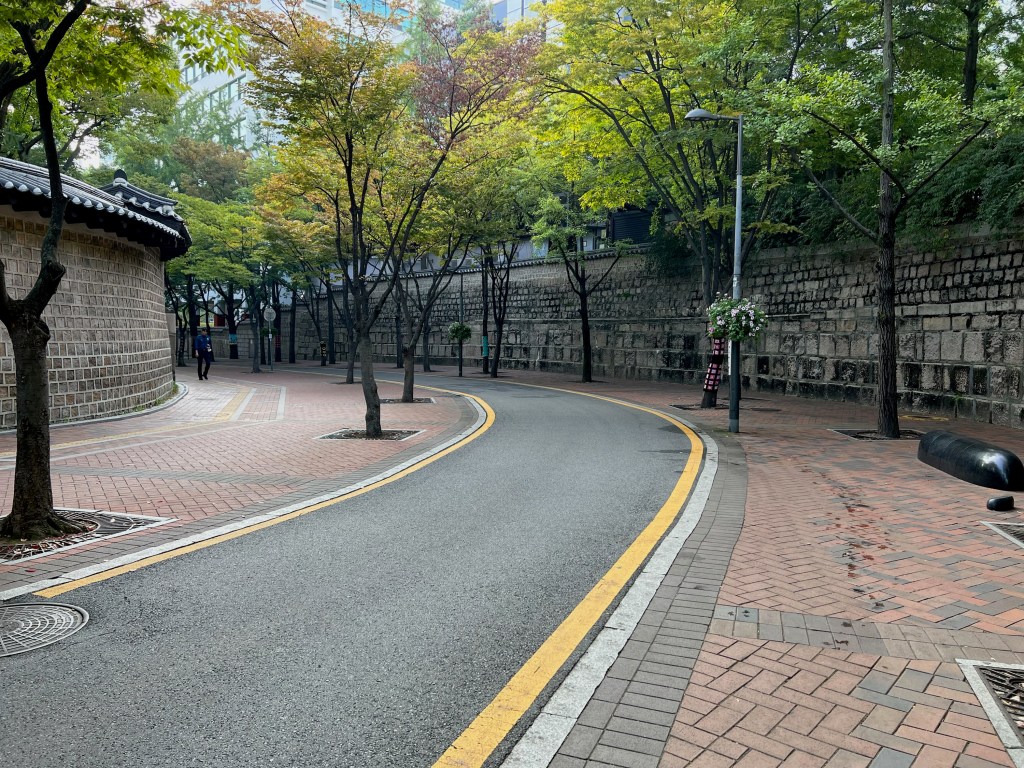
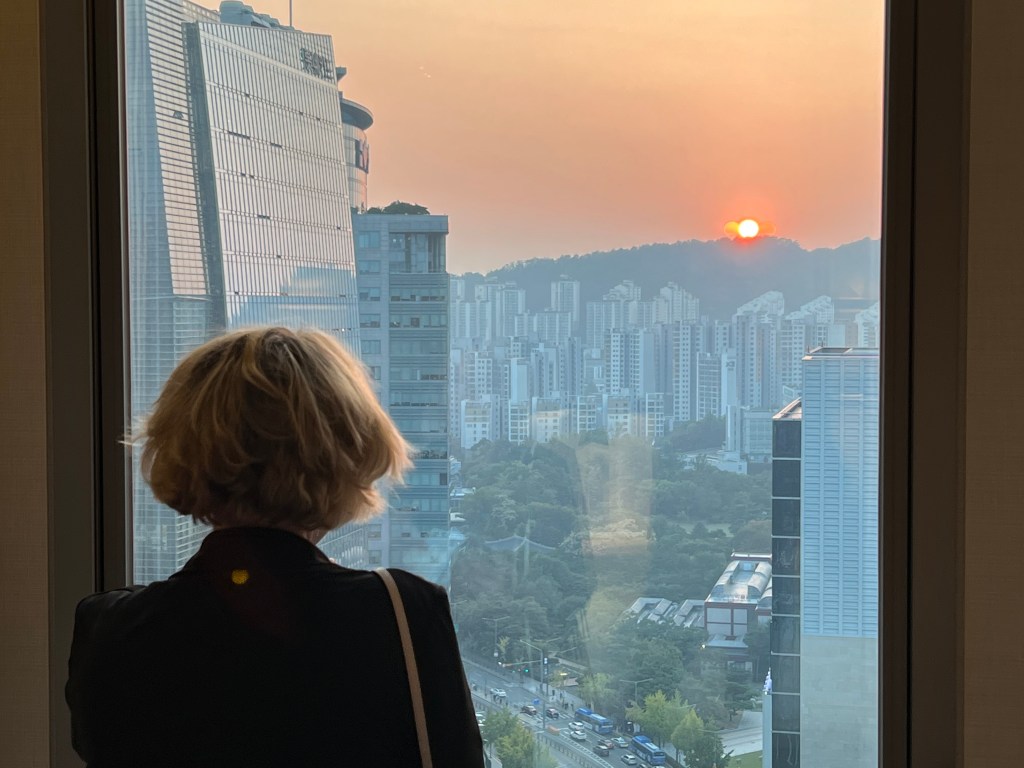
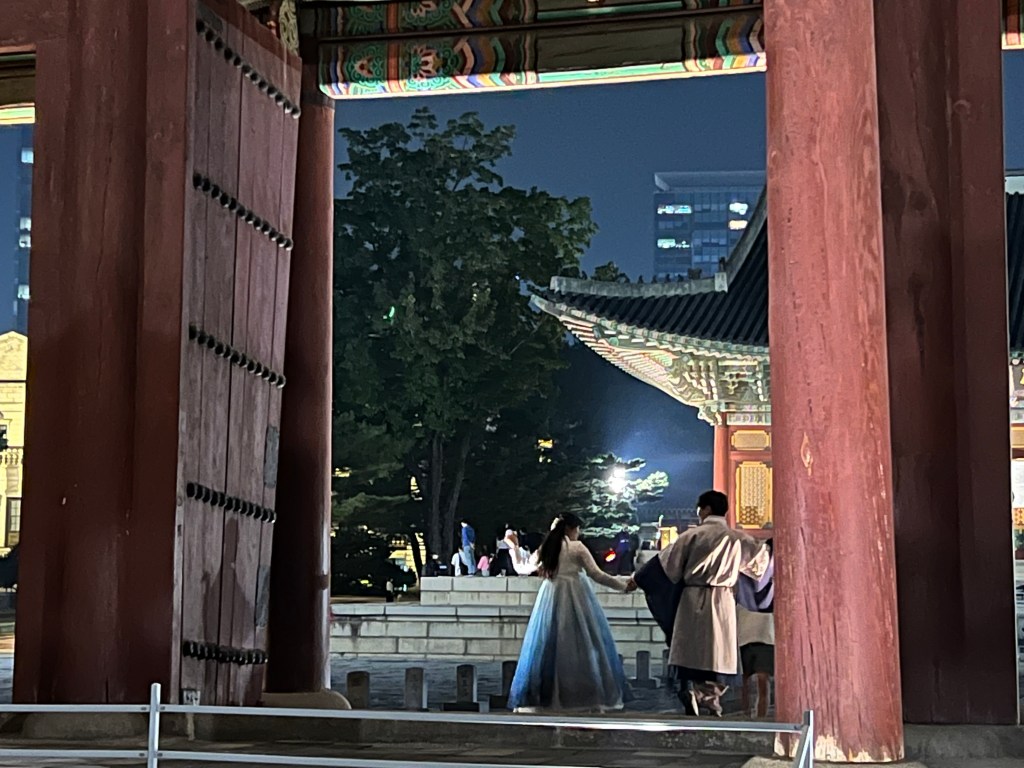
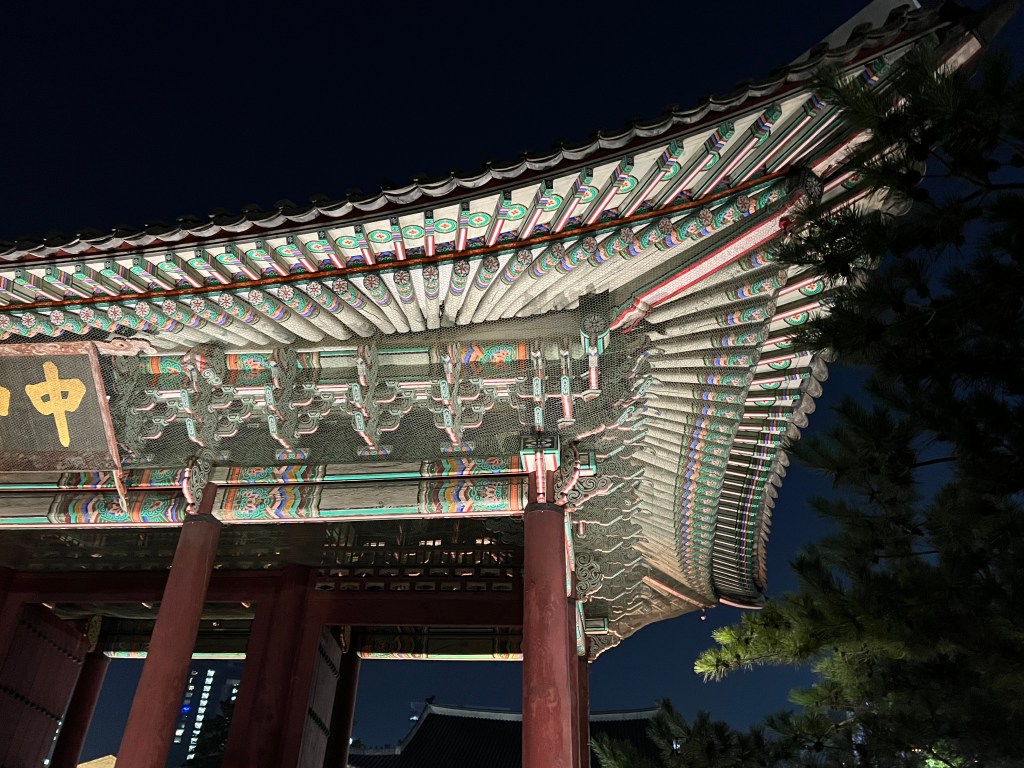
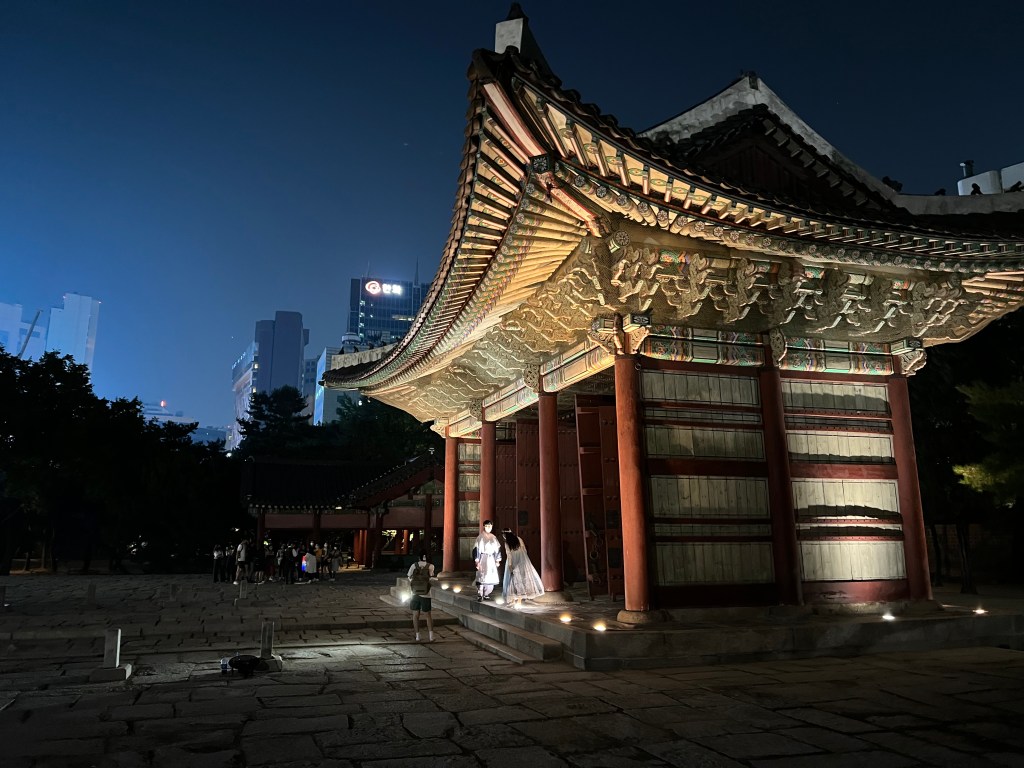
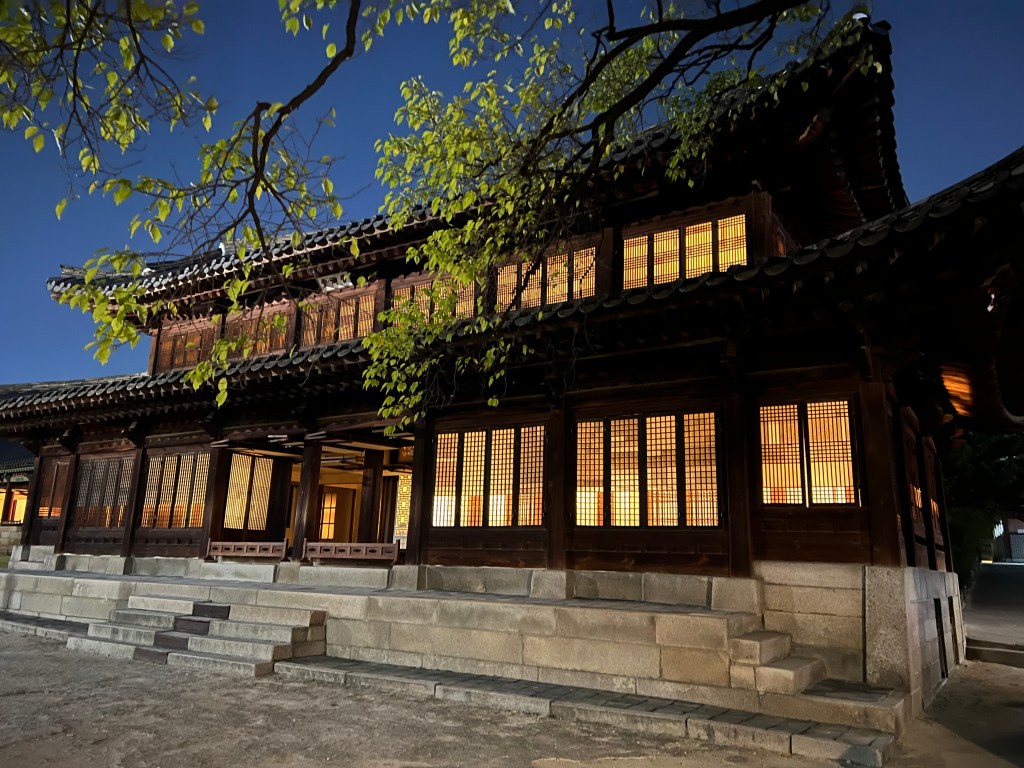
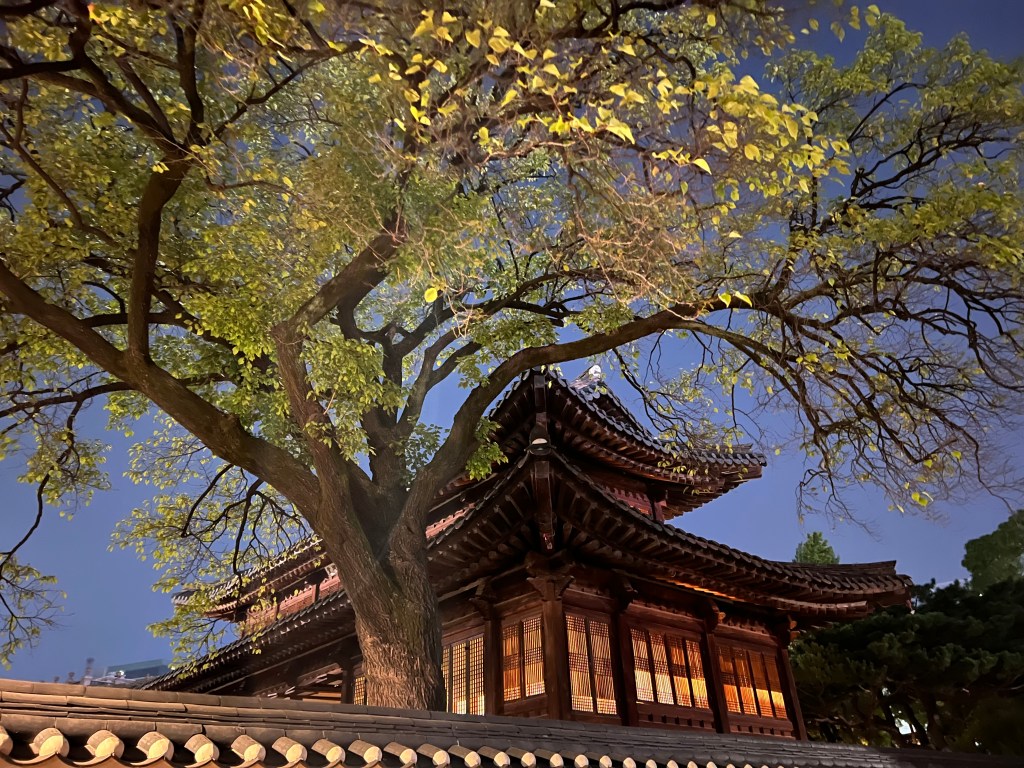
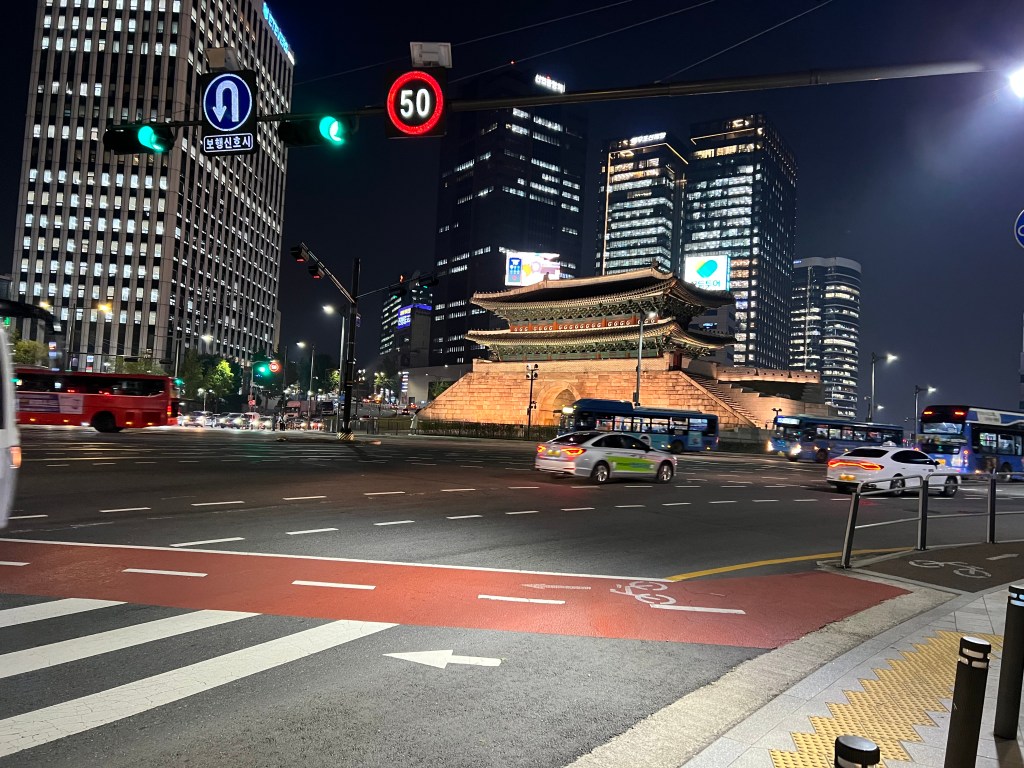
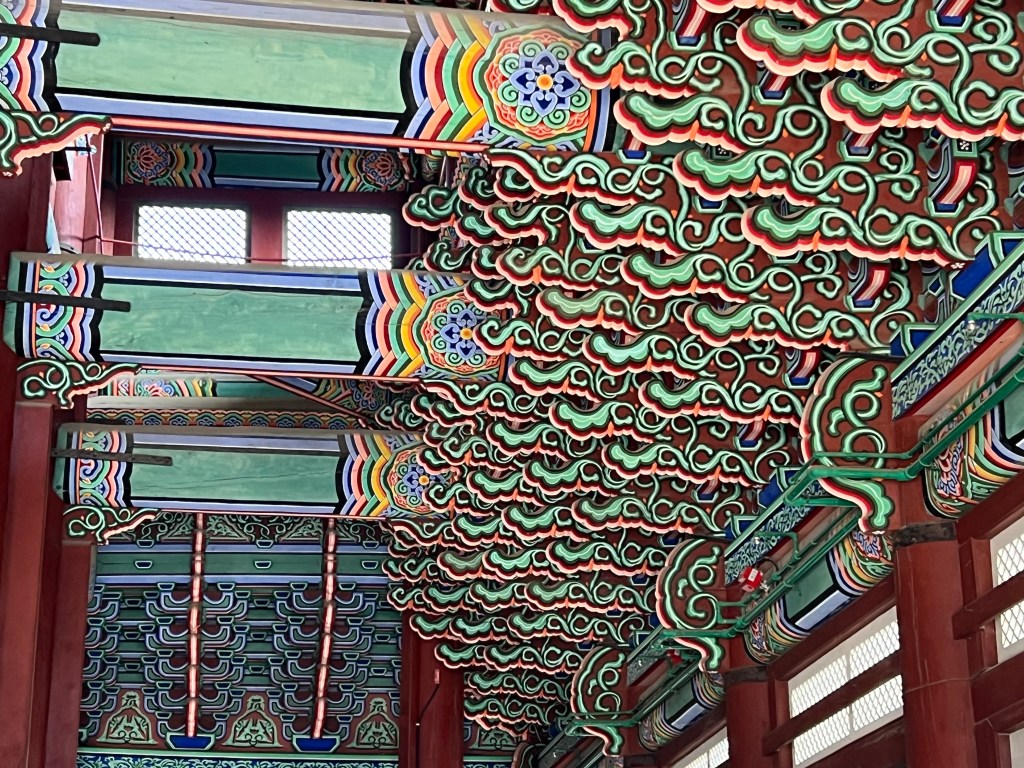
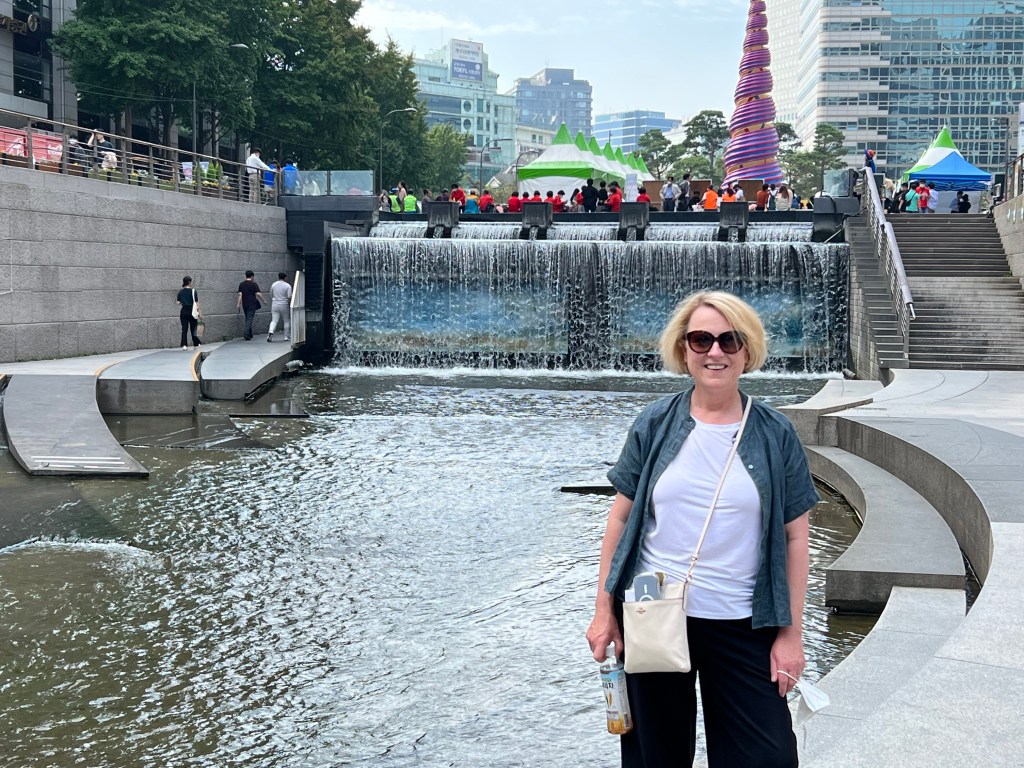
We got to our hotel Thursday just as the sun was setting, and after a quick shower, we headed out into the balmy evening to see the lights of the busy Gyeonghwamun district and the beautiful Deoksugung palace, with its beautiful, brightly painted gates and pavilions lit up in the night. Young people in traditional hanbok posed for photos, and families strolled in the cooling evening air, with the sweeping up-curving tile roofs of the pavilions set against a backdrop of tall modern buildings and neon billboards of the surrounding city. It was magical. The city has a mellow vibe, people on the streets don’t seem too busy, too much in a hurry. They hold hands and walk and laugh, or gather in clusters outside restaurants smoking cigarettes. And laughing. There is a culture of cafe hopping, as well as of bar hopping. We had dinner at a fried chicken and beer joint – a thing here – at the one free outside table – while a group of what looked like work colleagues drank and laughed and caroused just inside. It looked like no work-related party I had ever seen – they were doubled over in laughter.
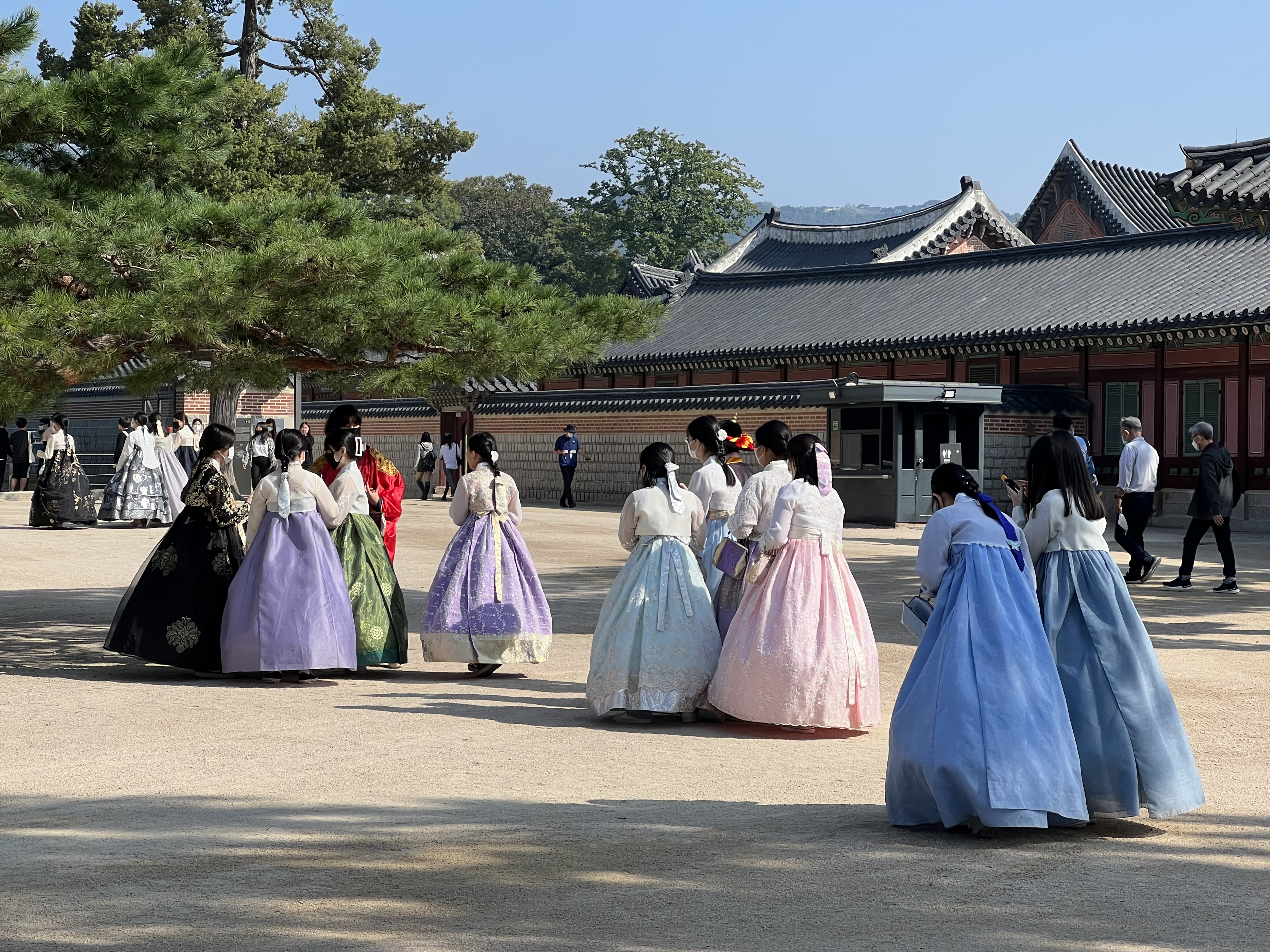
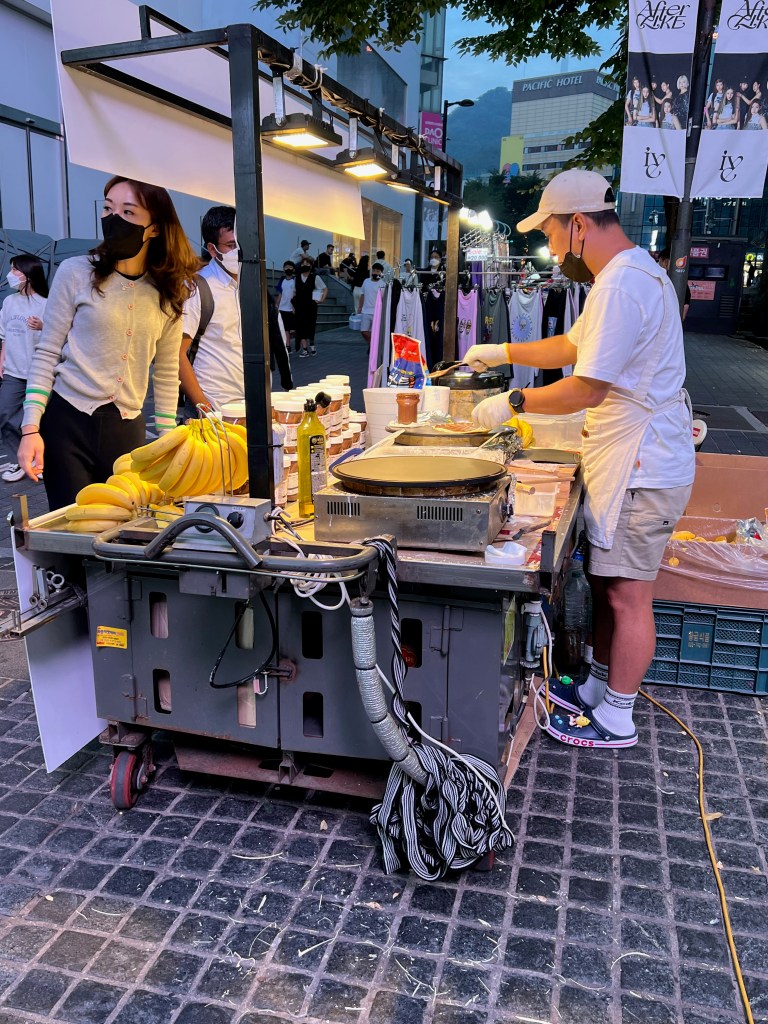
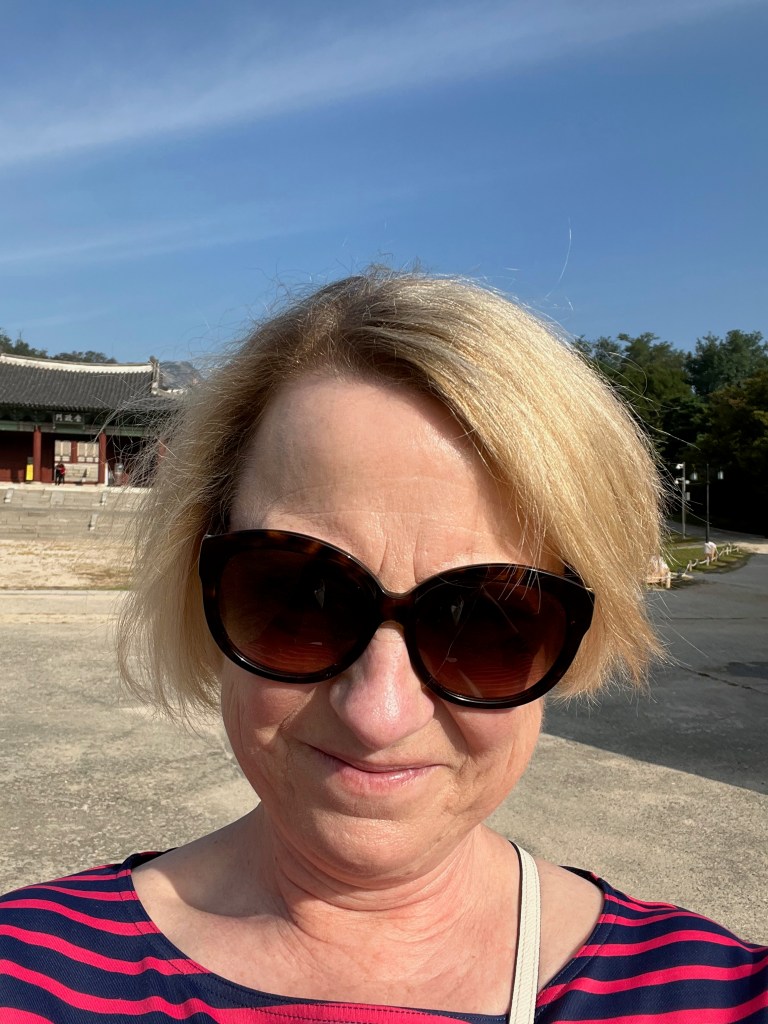
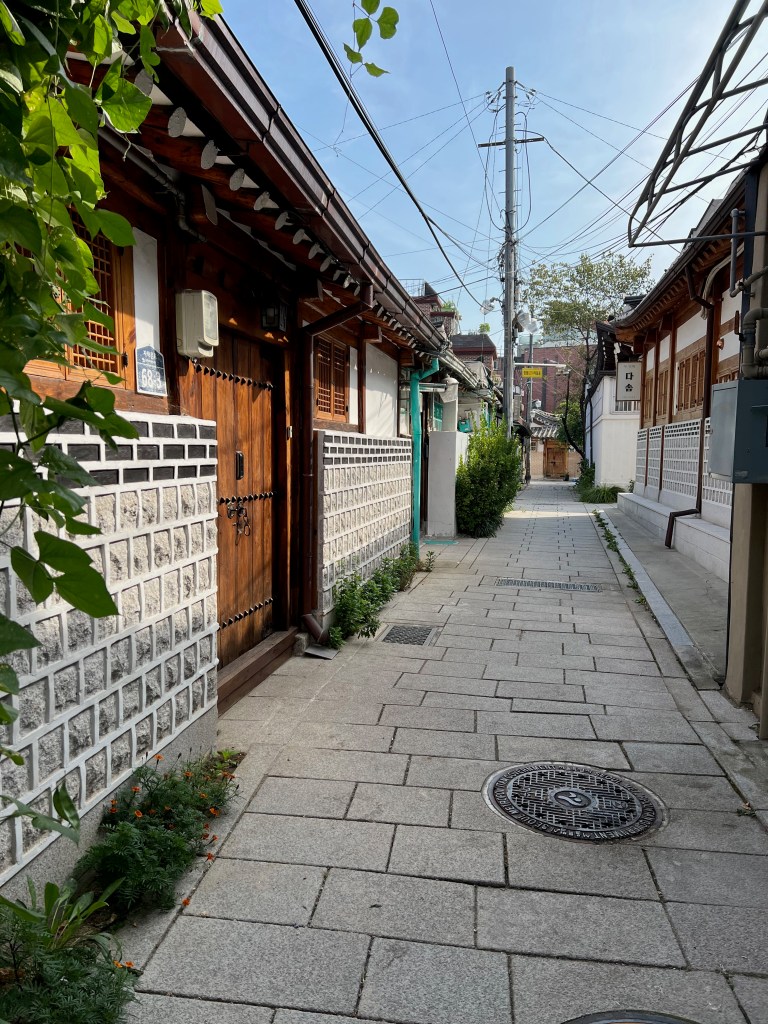
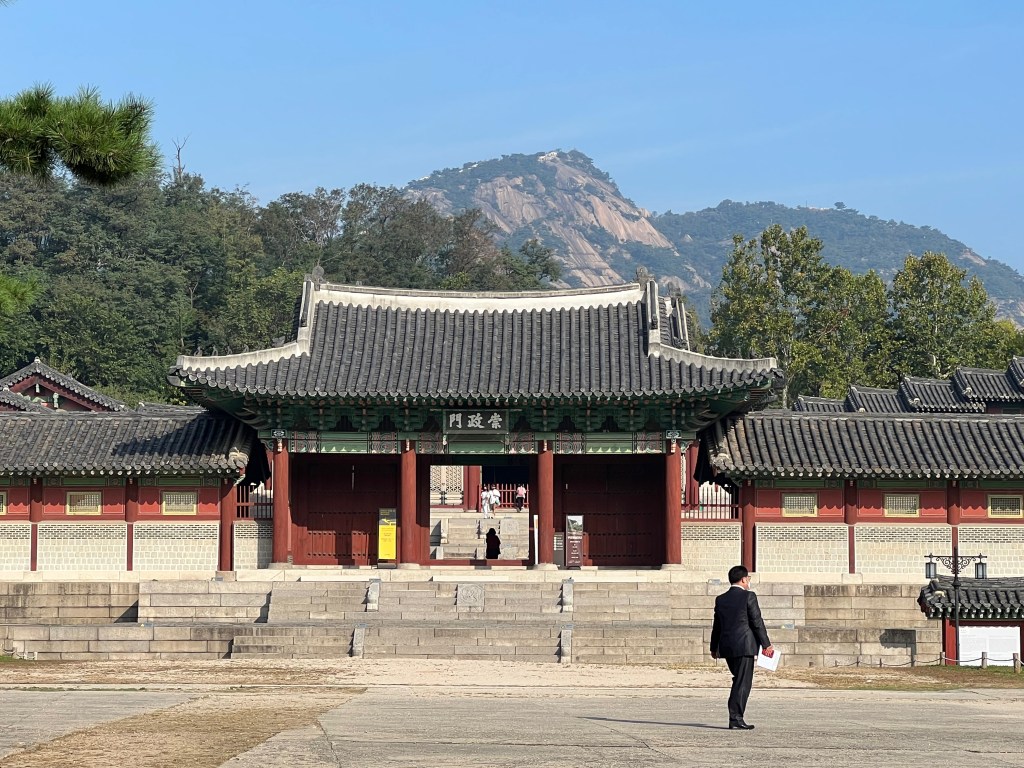
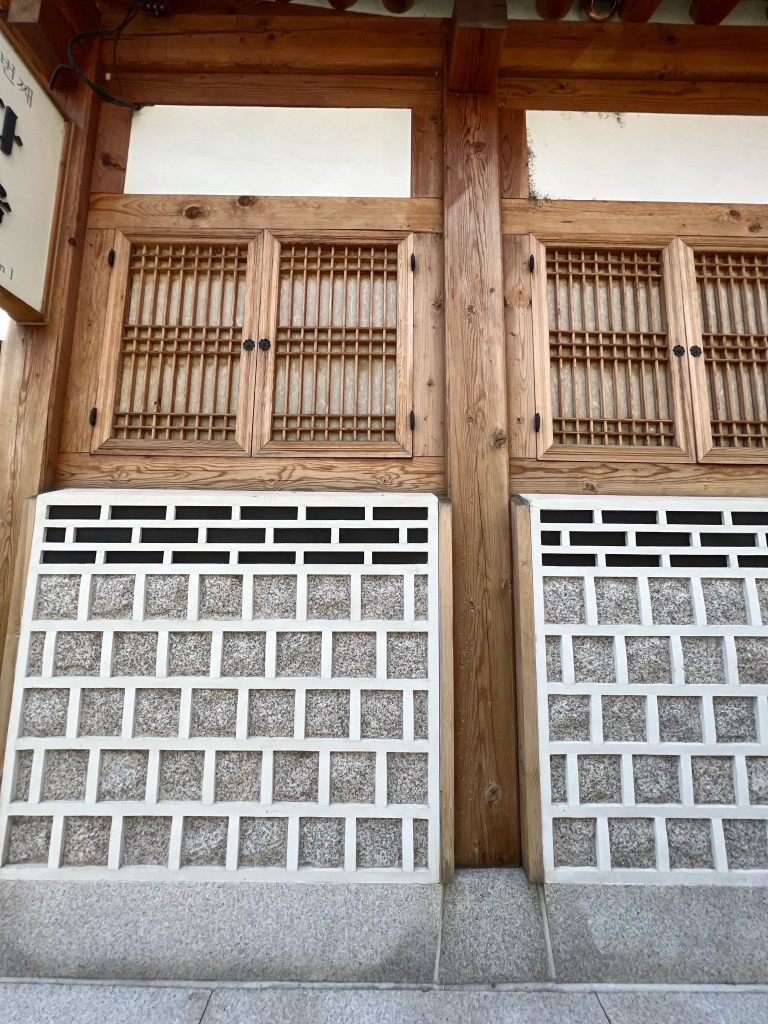
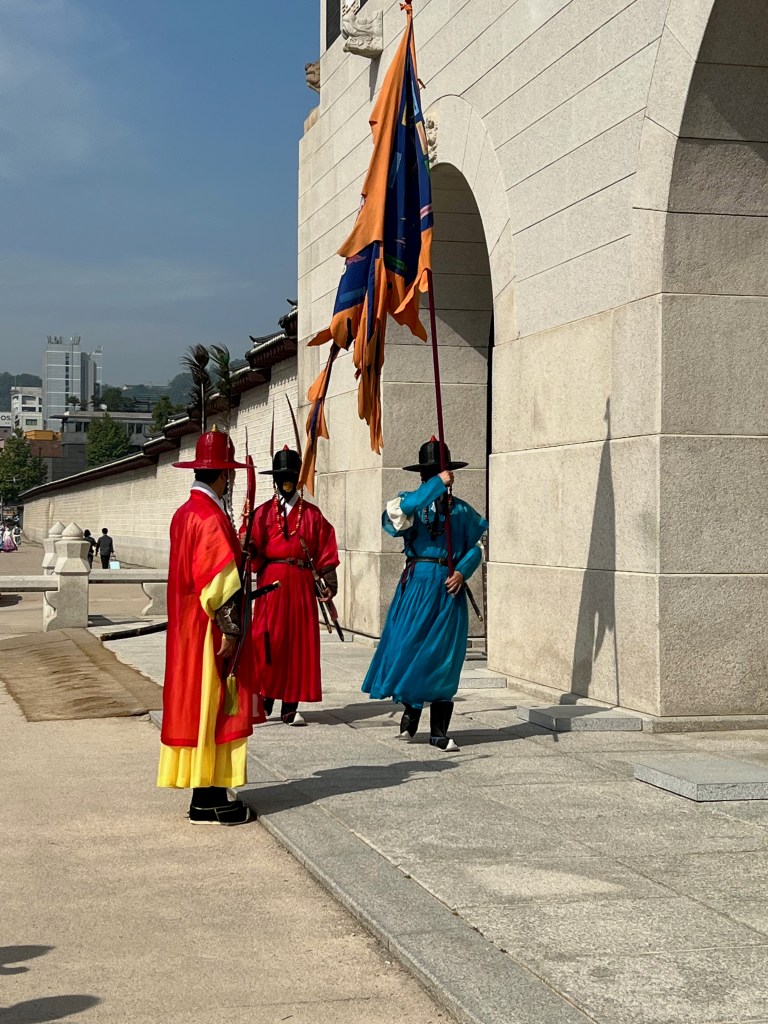
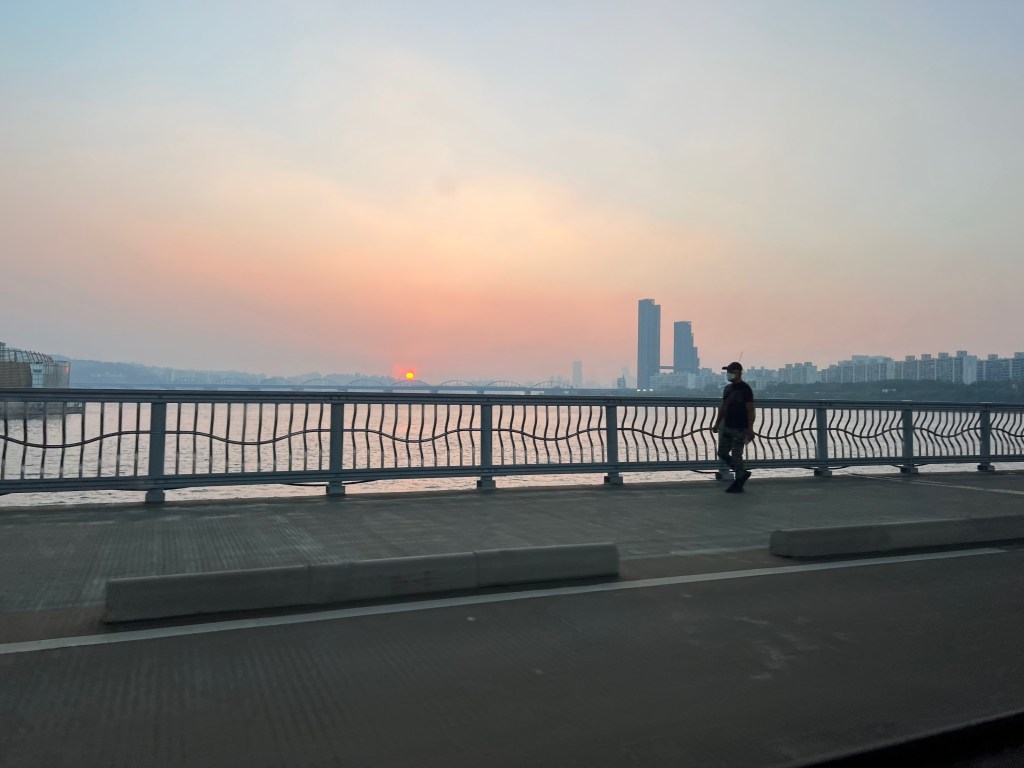
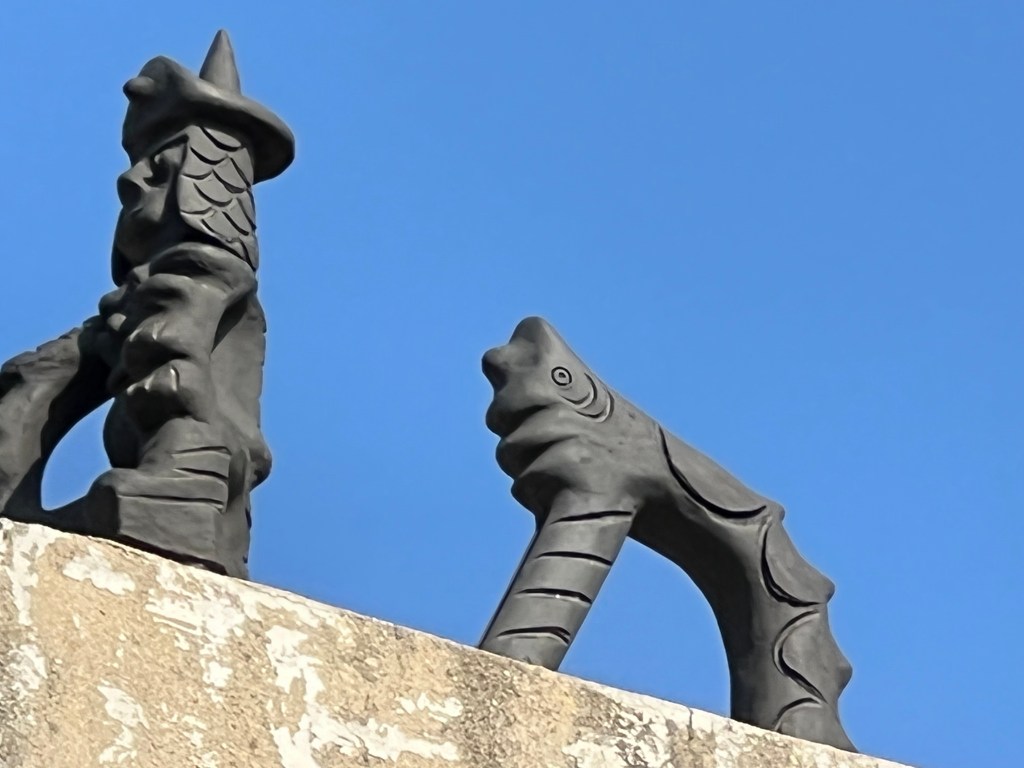
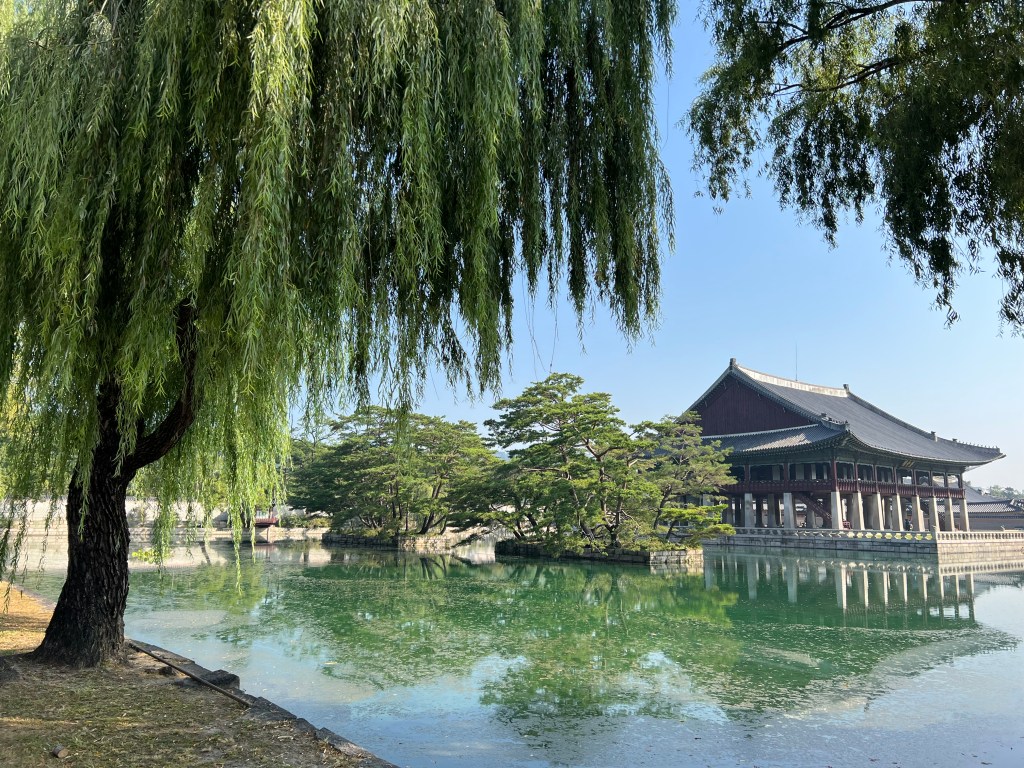
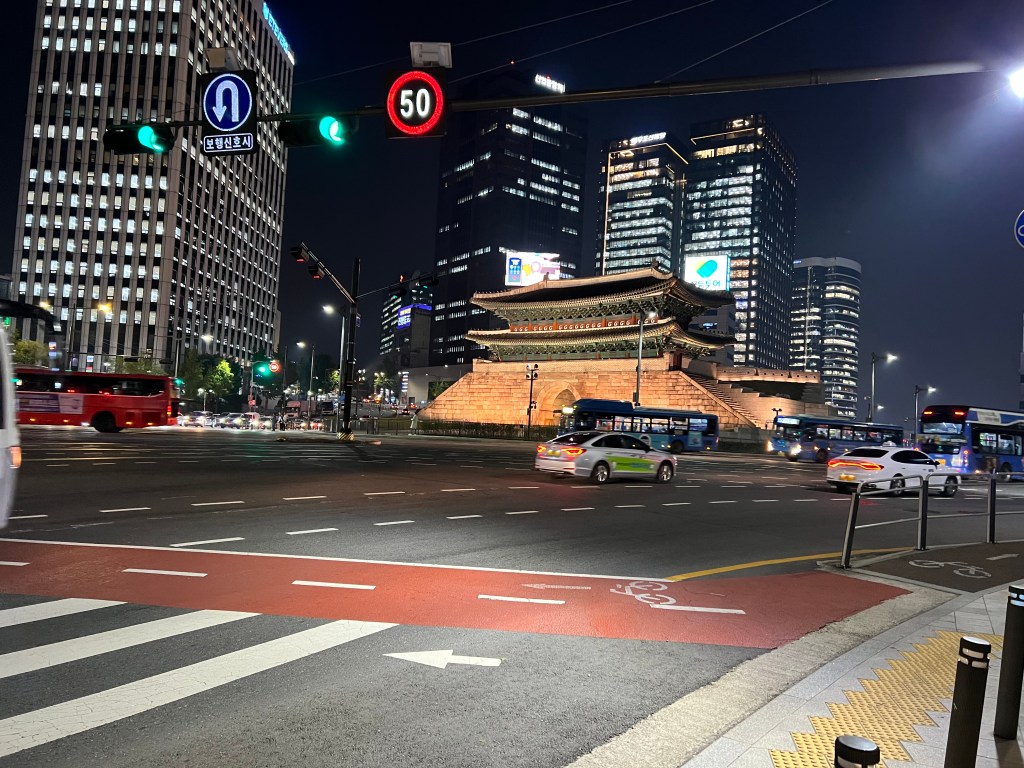
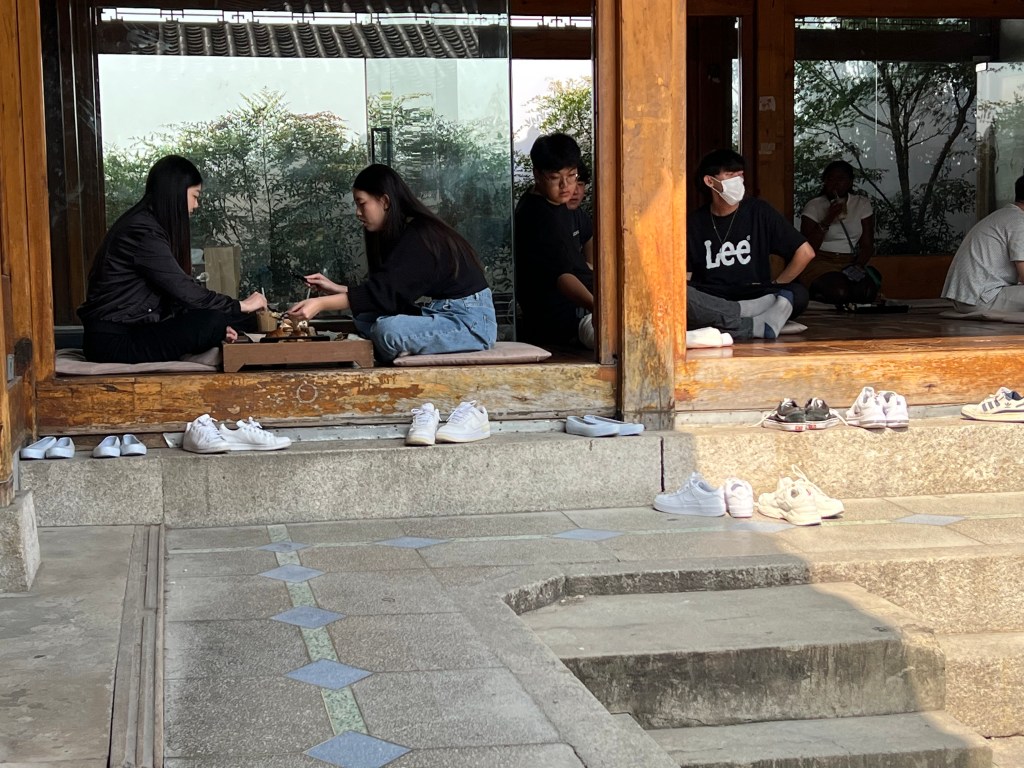
Today, our first full day in Korea, was a perfect day. We started in the cool morning air to explore the nearby palace of Gyeongbokgung, which dates back to the 14th century but was destroyed several times by the Japanese in the late 16th century and again in the 20th century during colonization. The buildings have been restored and the extensive grounds, while modestly landscaped, were beautiful and relaxing, especially with the backdrop of mountains just behind. Will called to talk while we were there, and it was so wonderful to stand in the shade of a gingko tree and talk, while groups of young people wearing traditional Korean clothing, snapping selfies and laughing, wandered past. We then ourselves wandered the galleries and very hilly streets of nearby Samcheong-dong, and found a quiet cafe with outdoor tables I had found online. (It’s such a miracle when your plans actually work out.) We wandered more and then had lunch in the courtyard of an old hanbok that had been turned into a bakery of sorts – another Google search find. My next Google search find didn’t turn out so well – the definition of a snipe hunt. After sitting out the heat of the afternoon in our hotel, we took a cab to a much-hyped night market along the Han river, which divides main Seoul in the north from Gangnam, the wealthy district of Psy’s famous K-pop hit Gangnam Style, south of the river. We consulted multiple websites, and even got the hotel concierge to confirm the super hip and groovy night food market was really happening. Well a 30-minute cab ride and a tromp up and down the river later, we found the folded up tents of the market, all locked up together. We will never know why it wasn’t held when it was supposed to be. But whatever! It was a lovely sunset along the river, and dozens and dozens of people had pitched picnic blankets or little half-tents to stay out of the sun and eat snacks and food and watch the sunset. It was like Central Park on a very busy summer weekend. We managed to snag a cab back to Namdaemun, a famous market area which we knew had a lot of street food. But as it is when you are in a big city, we found street food but are not sure still whether we found the Namdaemun food street. Whatever! We bought some mung-bean pancakes, kimchi dumplings and vegetable kimbap (seaweed wrapped around vegetables) and walked back to the hotel, where we ate our street food in the cool of our room. Rick is snoring now, though he is supposed to edit this post before bed. We have to get up at 5 a.m. for our DMZ tour – apparently the crowds were so bad there today that the tour group is making us meet in the lobby at 6 a.m. Arg! Stay tuned…

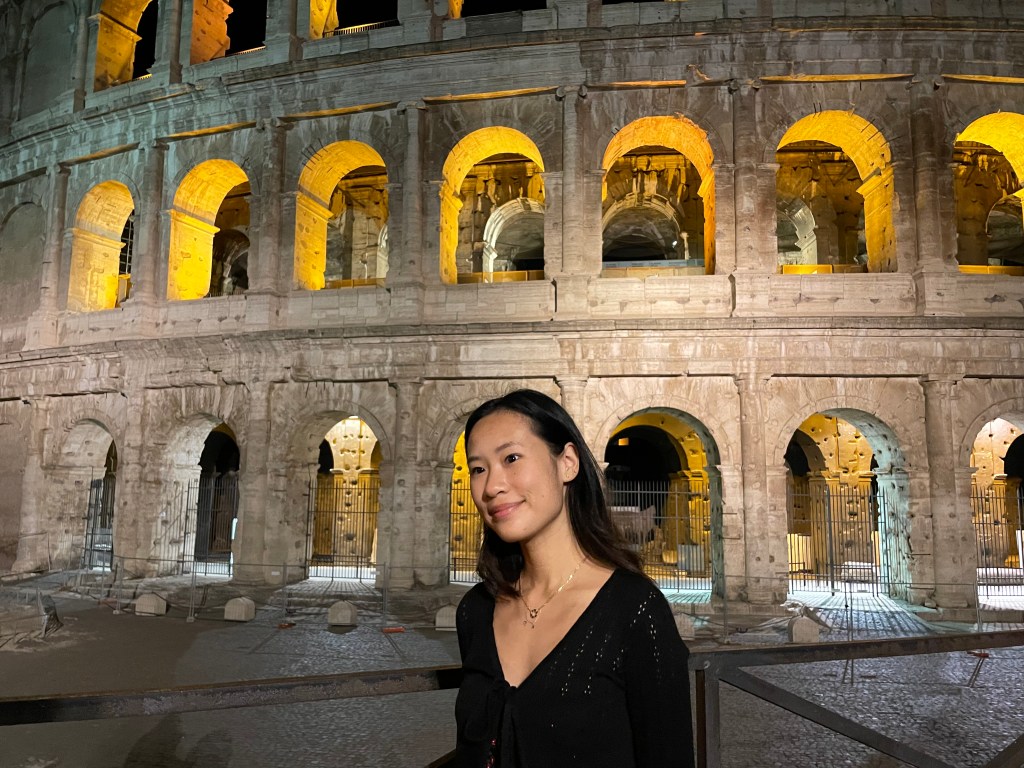

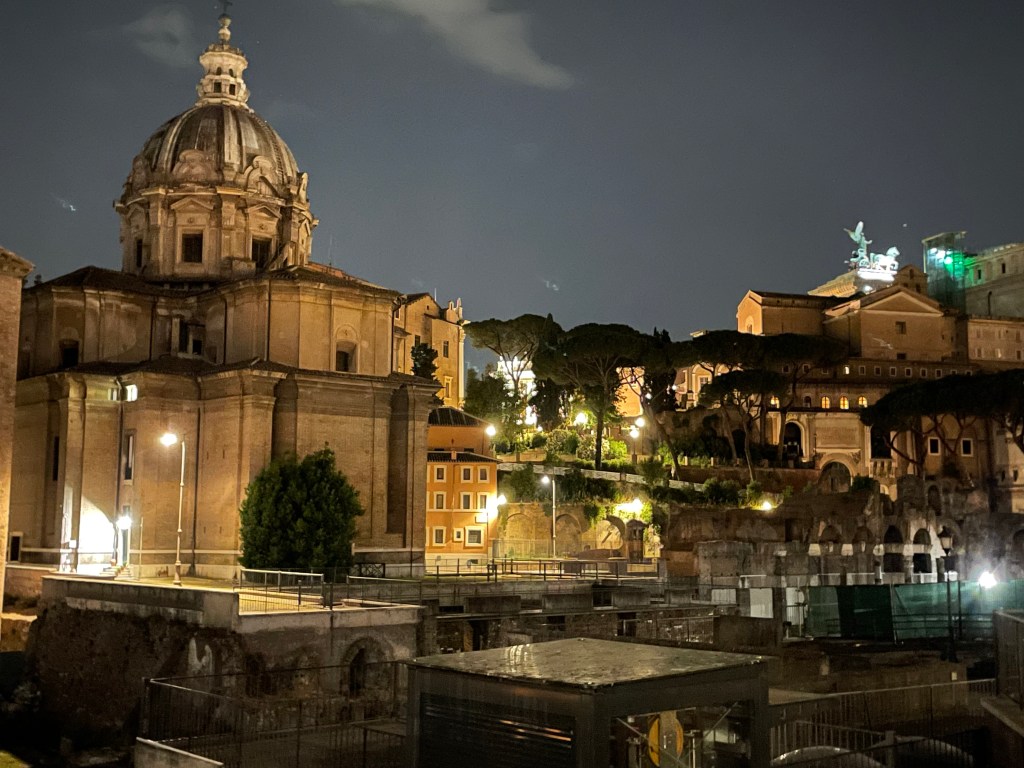


One day, one city, two of the world’s most beautiful buildings: St. Peter’s Basilica and the Pantheon
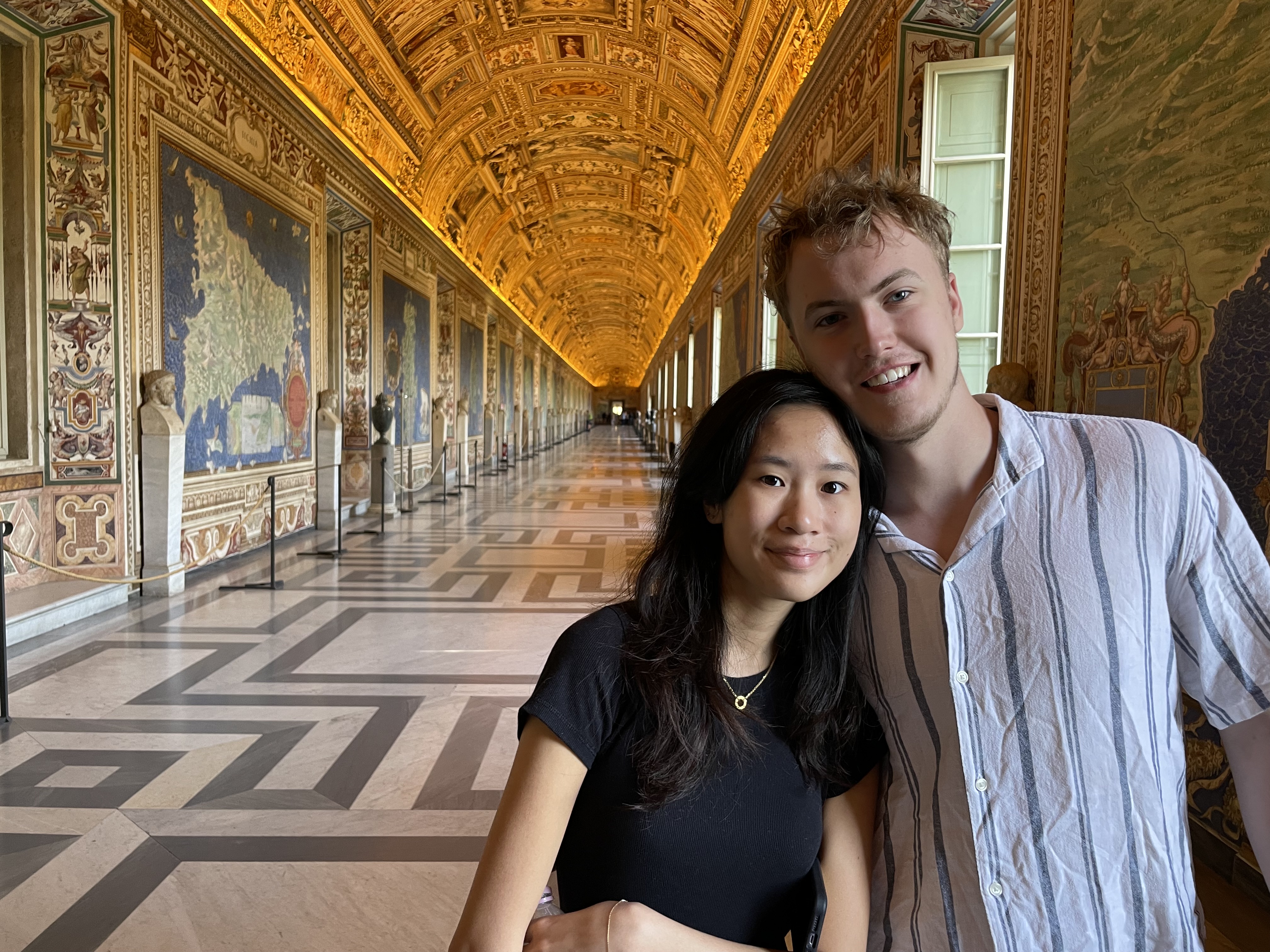
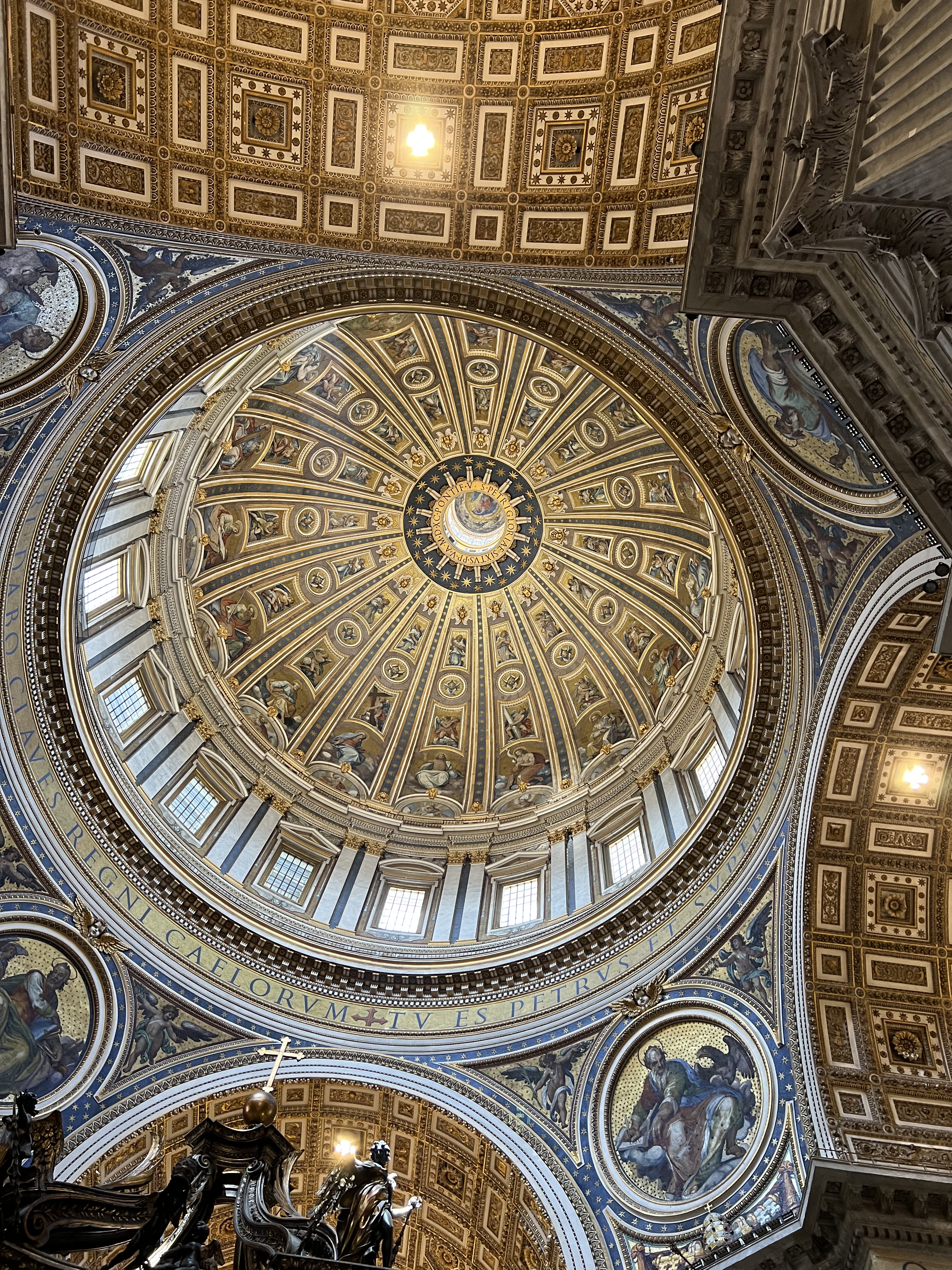
ROME – Tuesday, May 24, 2022 – I was dreading this day – in the best possible way – because I had bought a private tour for the Vatican that started at 7:15 a.m. and I had no idea what to expect, except that Will and Amy would likely be fairly grumpy to get up at 6 a.m. to see yet ANOTHER museum and church. It turned out to be absolutely wonderful – we had a guide for just the four of us, and she took us through parts of the vast collections of the Popes, seeing treasures from the ancient world – statues that changed the way we see – to the Renaissance and beyond. The ornate palaces of the popes, their self-aggrandizing art, their pillaging of ancient monuments, the famous Papal apartments of Pope Julius II with the amazing Raphael paintings, the Sistine Chapel! Rick was able to see his beloved School of Athens, which Will apparently was drawn to as well, with Aristotle holding his book the “Ethics,” a work Will has been wrestling with for the past year at Notre Dame. We also waited a half hour in the hot morning sun to see St. Peter’s Basilica, an awe-inspiring space the length of one and a half football fields and whose side arms are bigger than most churches. Rick commented that most of the churches we have seen on the trip would fit inside this one glorious space. Will perhaps gave it his highest compliment ever, saying it was like a movie.
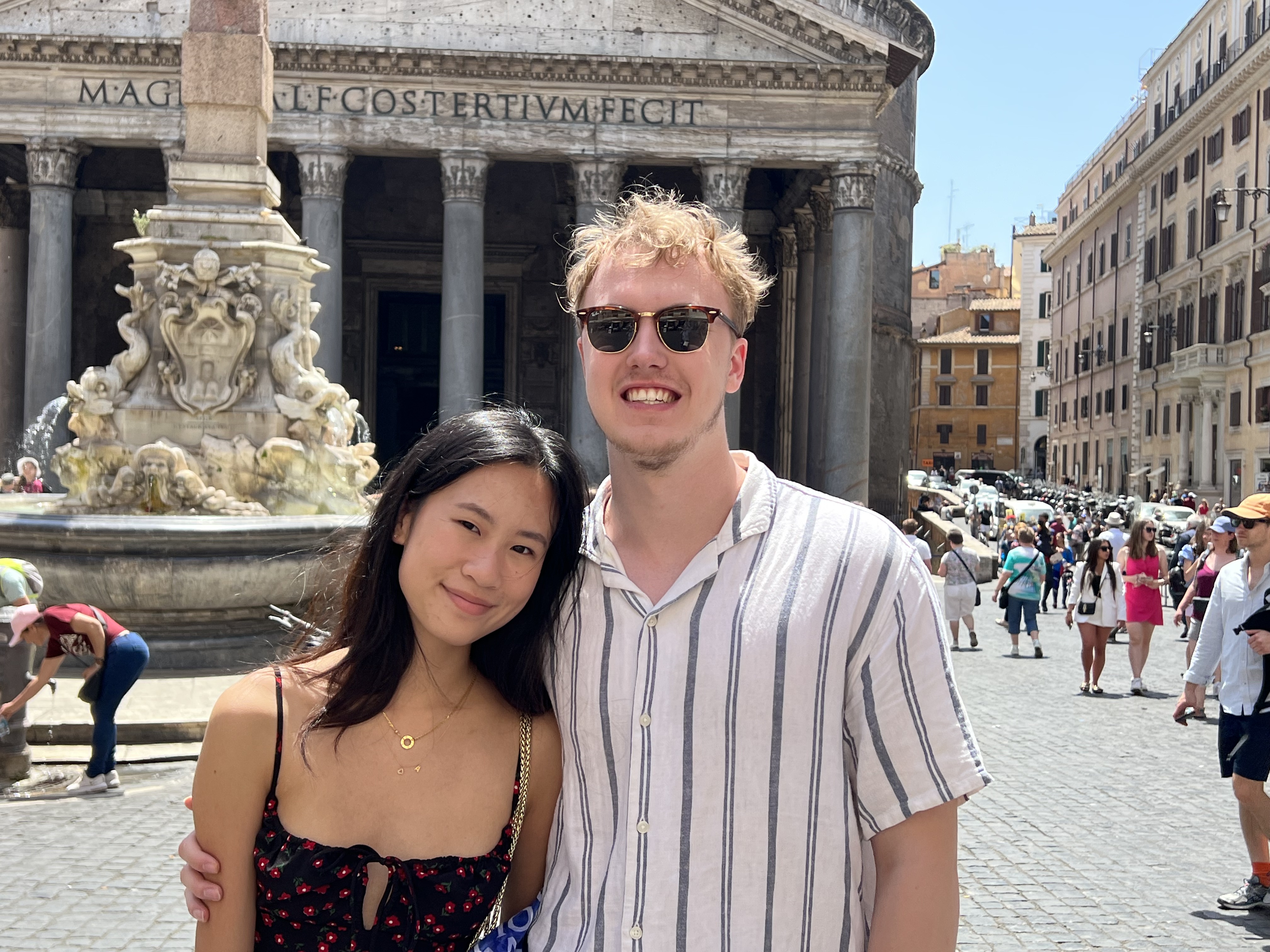
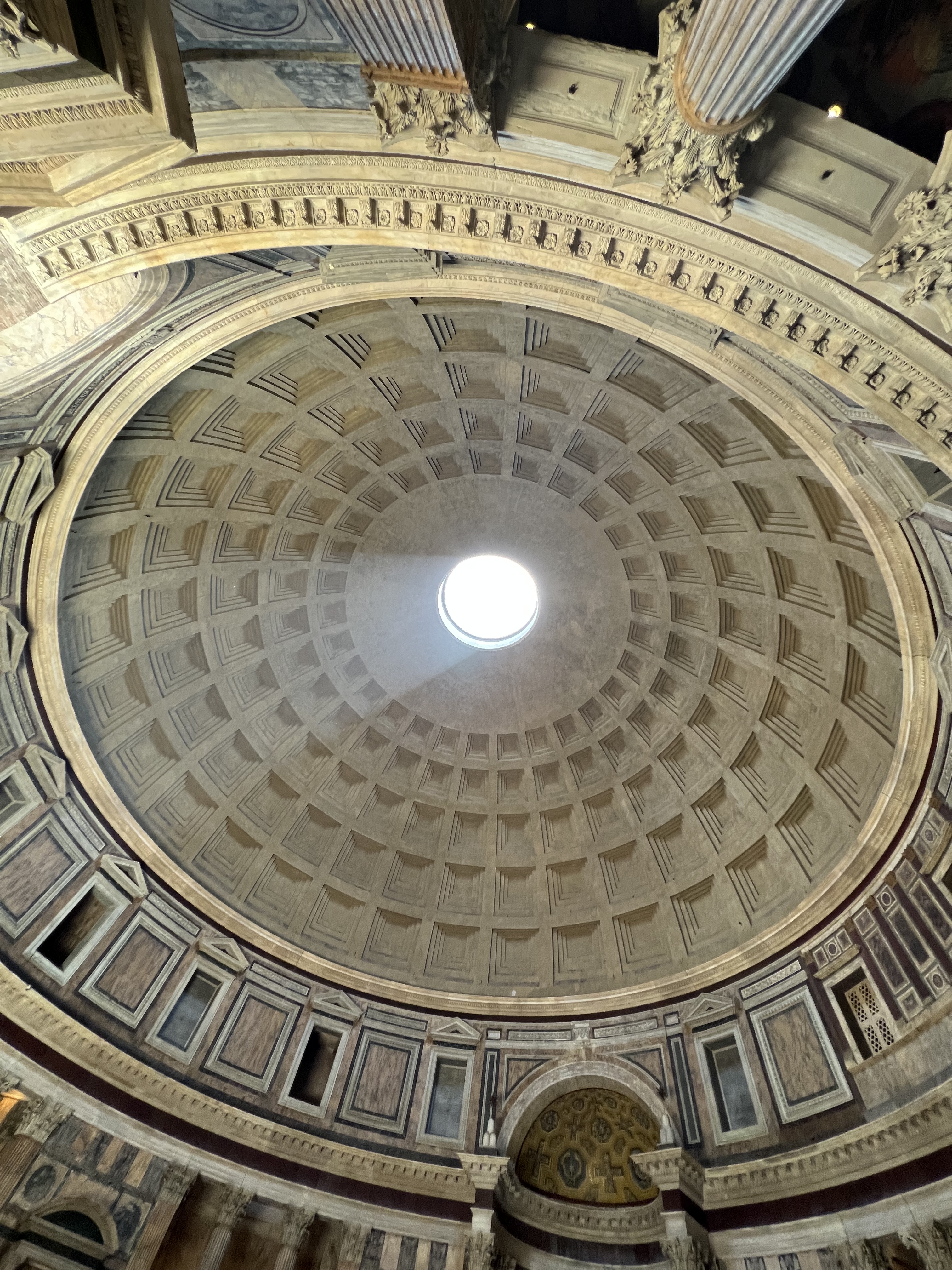
Afterwards, we went to the Pantheon – how could we see two of the world’s greatest structures in one day? Did that really happen? It is a transformative space, with its beautiful oculus and coffered ceiling. We had some wonderful granita afterwards, and you could see the majestic structure peeking around the corner, and it really didn’t feel real. I was once skeptical when Yale University’s Diana Kleiner proclaimed the Pantheon was the most beautiful building in history, but I am now a convert. St. Peter’s may be spectacular, but the Pantheon is almost like one of Plato’s “forms,” the ultimate ideal of what a building should be. We will have to ask Will if I am totally off base on this one.
Tonight, we are off for Dim Sum at a well-known restaurant a 3 minute walk from our hotel. Three minutes is about all we can handle after a very long, hot day. And I didn’t even mention the Caravaggios that Rick and I squeezed in after the Pantheon – the paintings of St. Matthew at the Contarelli Chapel at the Church of the Francesi (near Caravaggio’s haunts) and those at the Santa Maria del Popolo – where we had to wait for 25 minutes to open, so we bided our time with an excellent museum on Leonardo, recapping all we saw in Milan two weeks ago. Rick was exhausted but a good sport. And we learned the trick to lighting up the Caravaggios – both churches required you to put a few euros in a machine to illuminate them – otherwise you can’t see much in the darkness. But the key is to let the lights dim, then the crowds leave, then you put money in and enjoy them in peace for a few minutes. We were transfixed by the Calling of St. Matthew – my new favorite Caravaggio, though Rick confessed his favorite is the still life of fruit we saw back at Milan’s Ambrosiana. It’s a fair choice.
Ok, my 15 minutes are up – actually 20 – so I must go. Tomorrow we will visit the Coliseum, the Palatine Hill with its view over the Circus Maximus and the Forum! Party on, Nero!
The art of a too-brief visit to Florence
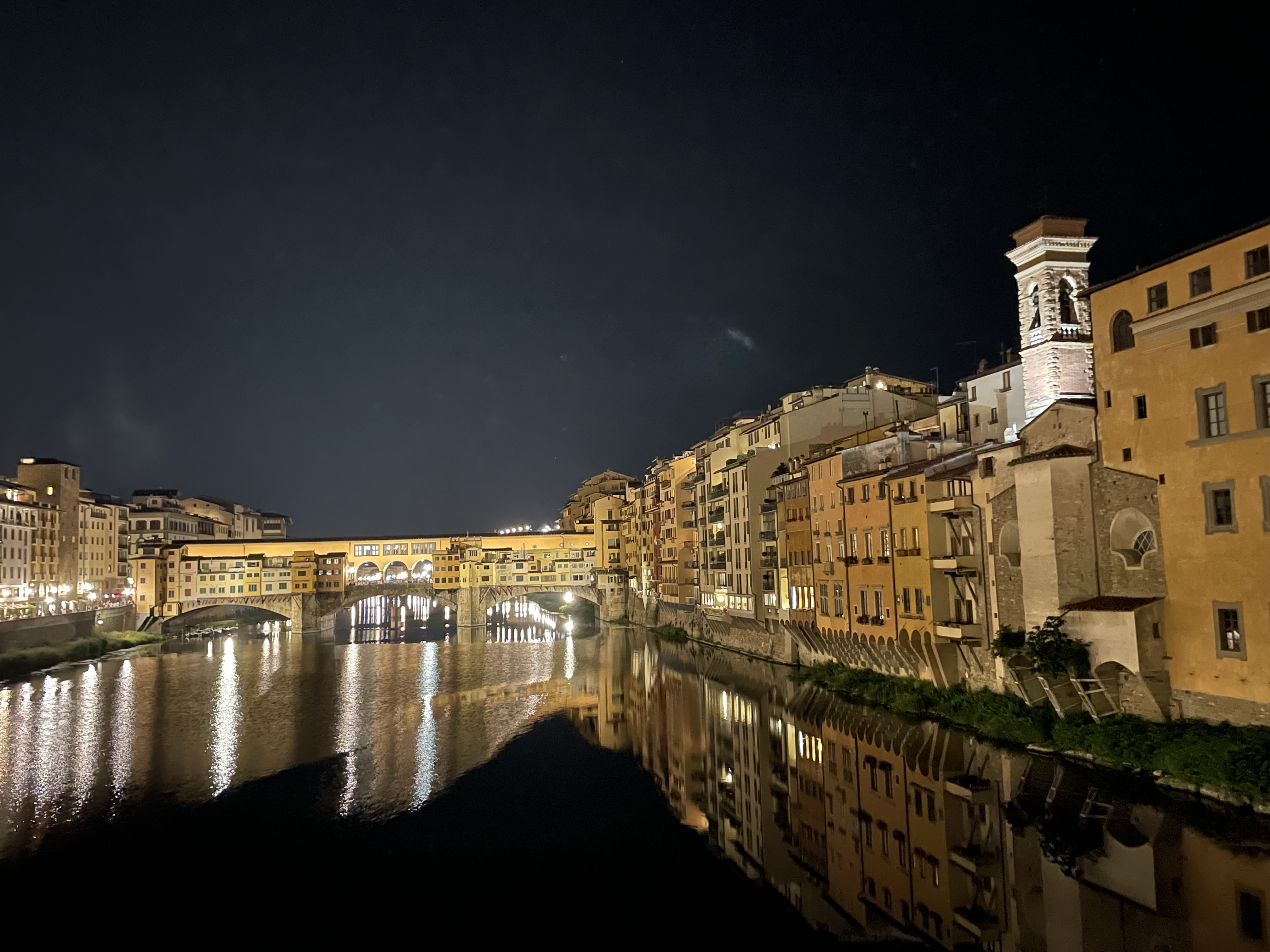
ON A TRAIN FROM FLORENCE TO ROME, Monday, May 23, 2022 – I love super-fast trains. Love them. From my first ride on a Shinkansen in Japan, I was hooked, and the Italian super-fast trains, the Frescciarossa, are just as smooth and fun as their Asian counterparts. Ok, so they don’t really run on time that much, but ours was only 9 minutes late, and now we are speeding along across the Tuscan countryside watching the hills and red-roofed houses flash by our windows.
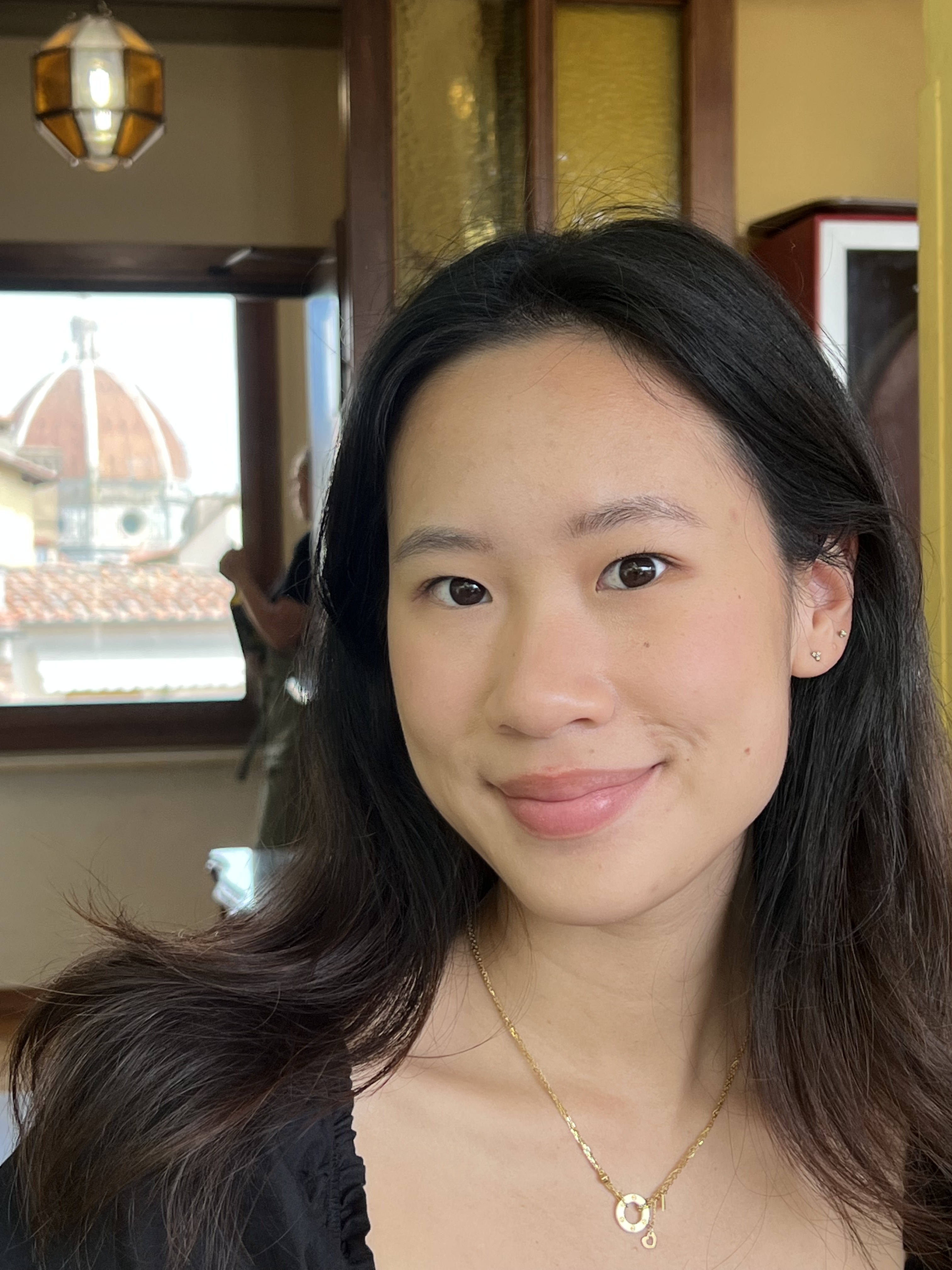
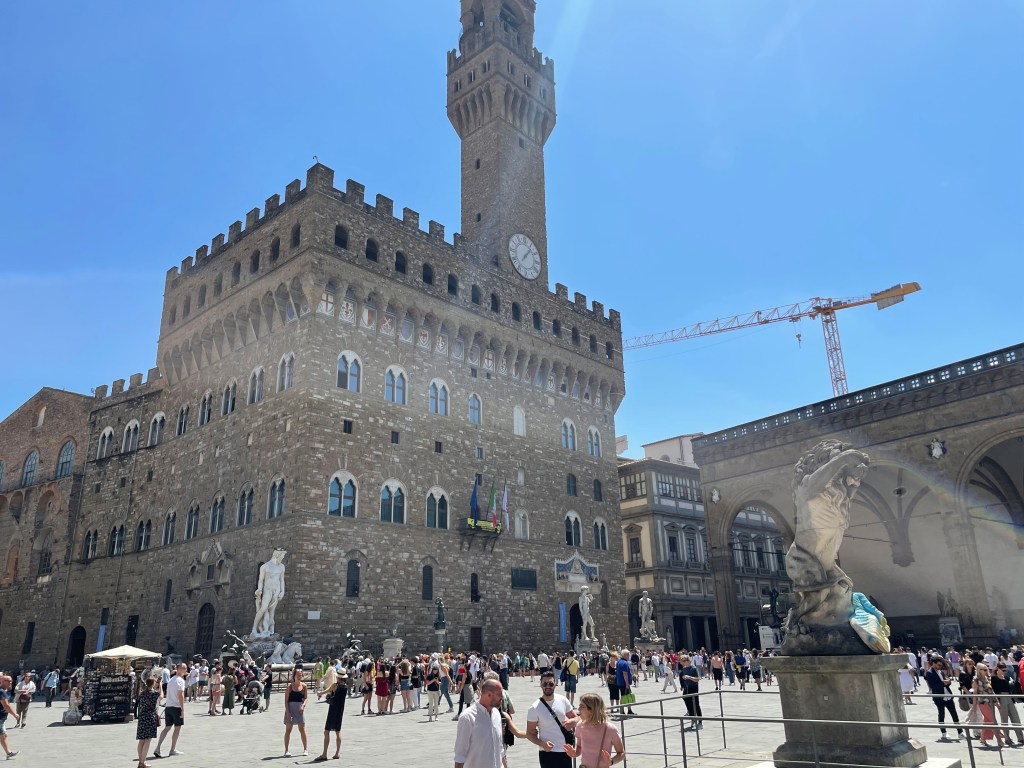
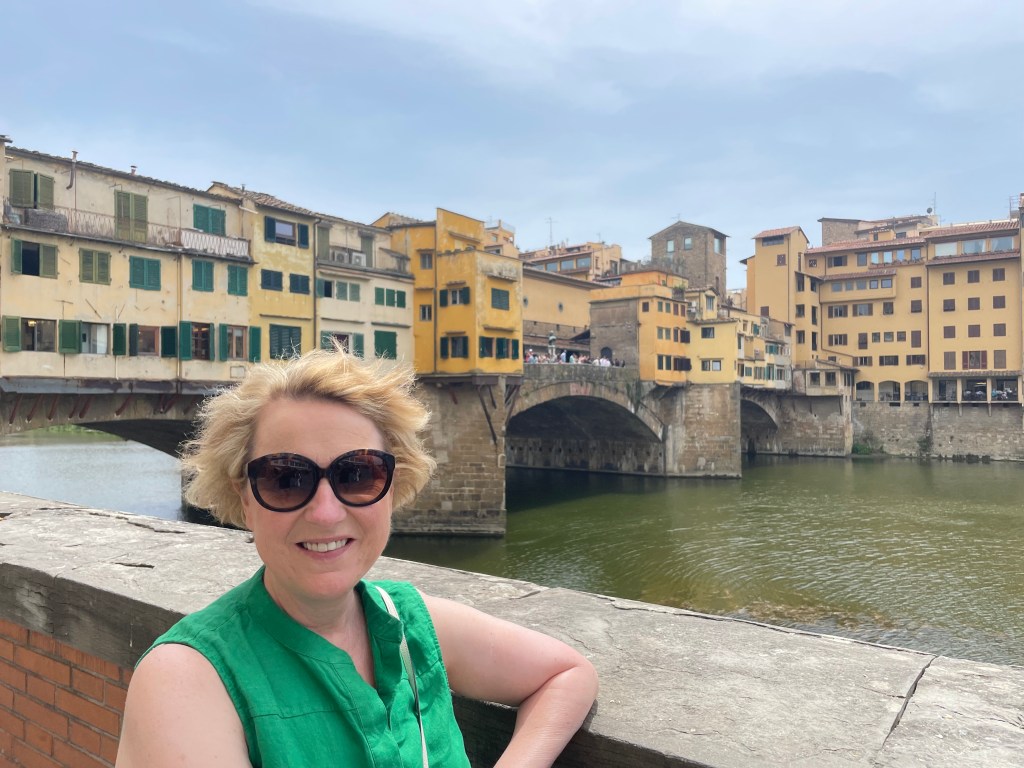
We had a wonderful, if very brief, stay in Florence, where we met up again with Grazia, who drove the 1 ½-hour drive to brave the heat and the crowds of a Florentine weekend with us. Florence is a small medieval city, with narrow, winding streets despite the best attempts of the ancient Romans to set it up as a traditional grid-patterned Roman military camp – the traces of which still remain in the main (wider) streets and the piazzas, one of which was the old Roman Forum. But I digress. The fact is that Florence is small, so when it is filled with masses of tourists – as it was this weekend – it feels extremely crowded. Regardless of what you may read in the news, European travel is full-on this summer. There were many Americans among the throngs, many of them young, but we also heard UK English, German, Russian, Chinese and Italian spoken among the tourists.
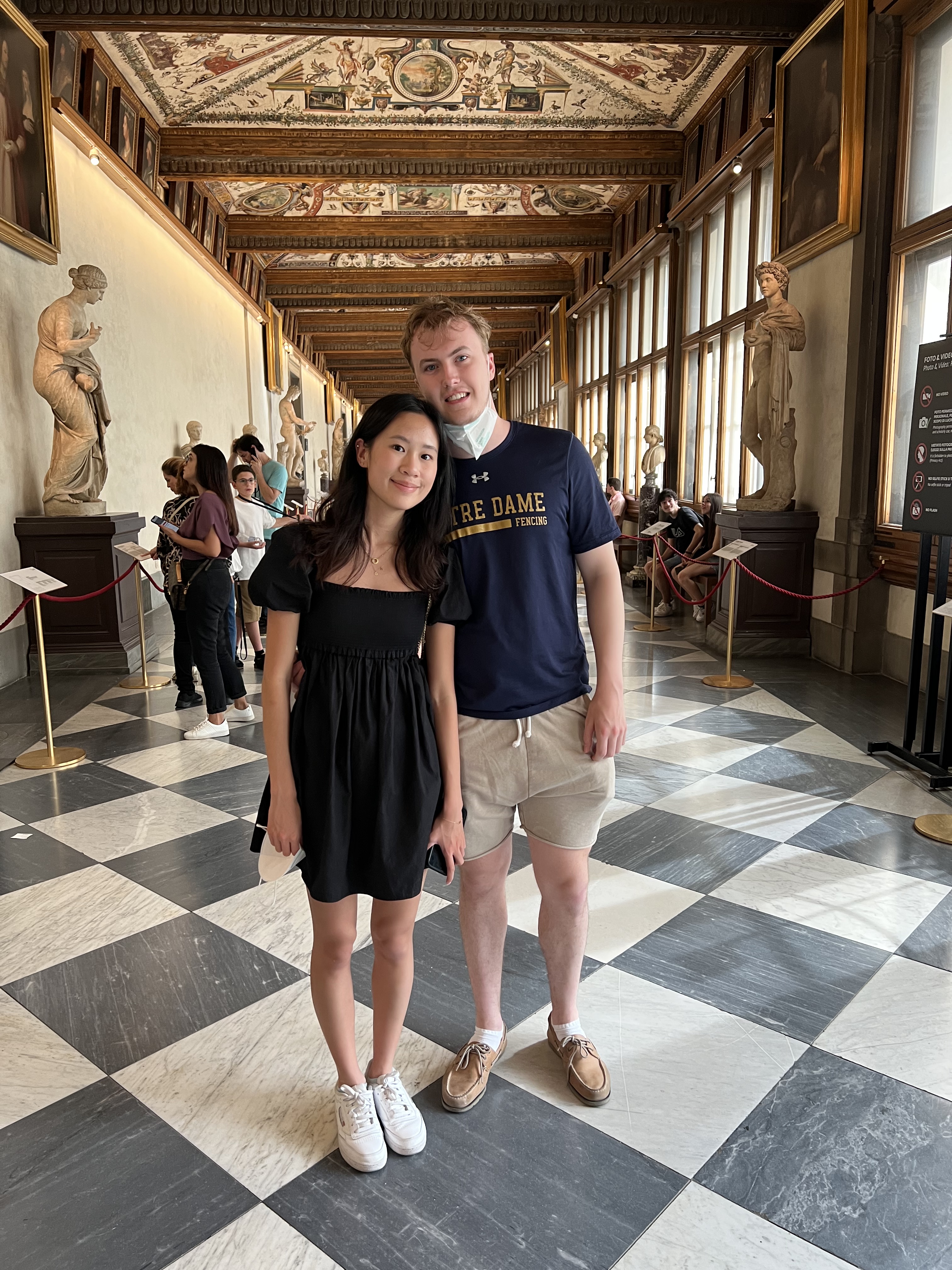
The theme of our weekend with Grazia was art – very old and very new. I have been focused this trip on showing Will and Amy great masterpieces of the past, but Grazia pulled me into the present, taking me to an NFT art show (what???? Yes, my thought exactly) that was running alongside the Donatello exhibition at the Strozzi Palace. It is digital art, sold digitally, sometimes for very large amounts of money, apparently using crypto or something. I am rather skeptical, but perhaps I am just too old. Grazia’s friend, who deals in art, is taking notice of the trend however, so stay tuned when you hear about NFTs. Grazia and I saw a massive digital artwork in the entryway of the storied Renaissance palace – it was a huge white frame filled with swirling, psychedelic shapes that constantly morphed and seemed to spill out of the frame into our space. It actually made us think of the introduction of linear perspective I have been so obsessively telling W&A about – how Donatello in sculpture and then Masaccio in painting continued the revolution in art toward humanism and realism started by Giotto (and Pisano before him) in the early 14th century. Maybe people looking at this new-fangled art perfected by Leonard da Vinci were met with the same skepticism. Unfortunately, my loyal gang of art lovers were worn out and missed the NFT show, as well as the tour of an amazing collection of modern, 20th and 21st century art collected by Grazia’s friend’s father. The collection included Andy Warhol, Keith Haring, Jean Michel Basquiat, as well as many other artists I was not familiar with, but should have been. My friend Twink would have been over the moon.
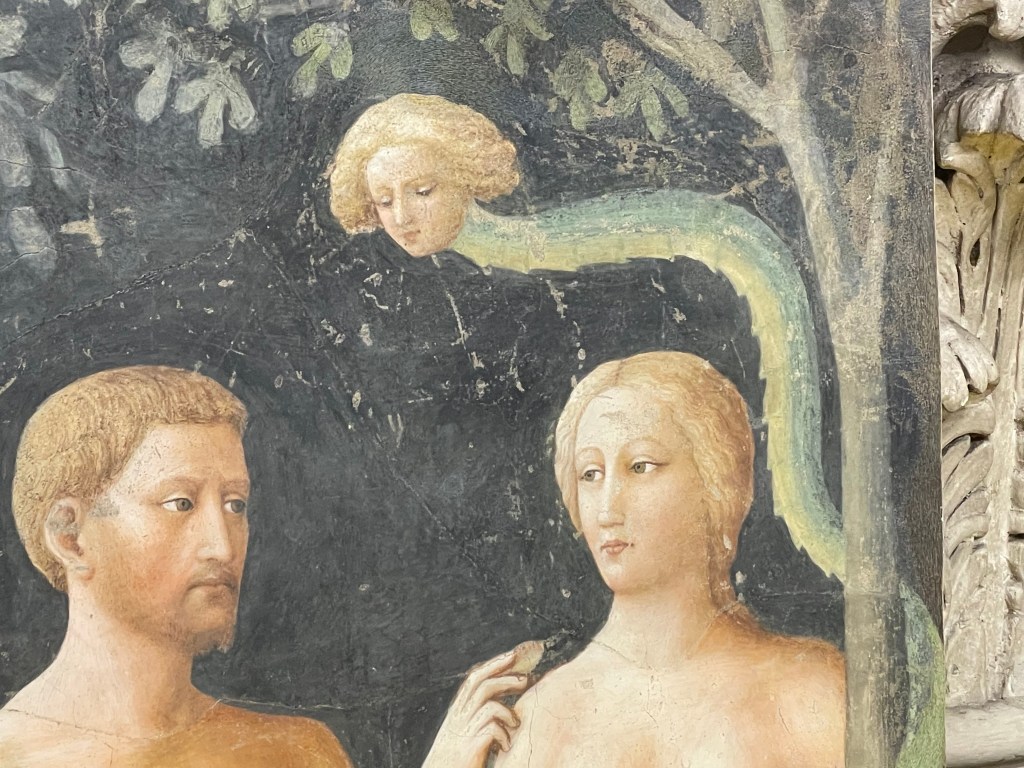
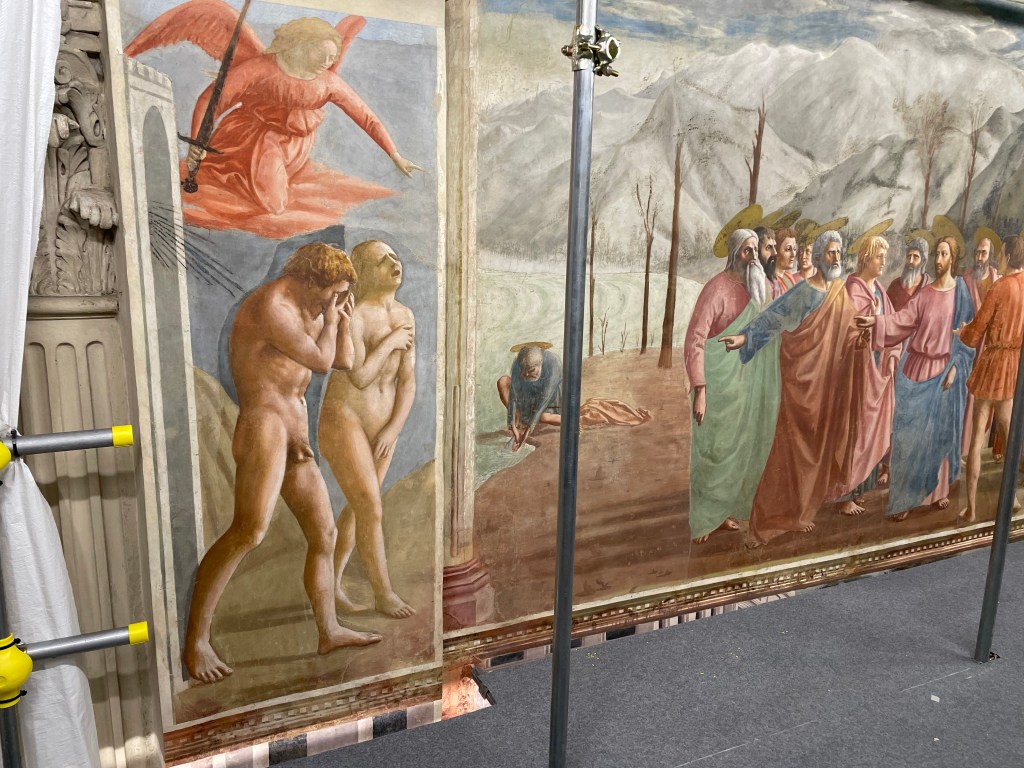
But lest I forget, Rick and I were also able to have an amazing experience examining, up close, the amazing 15th century frescoes by Masolino and Masaccio at the Brancacci Chapel south of the Arno River. They are being restored, and visitors are allowed to climb the scaffolding to see the frescoes in small groups, for a half hour. It was amazing to be able to witness this transition from stylized to more realistic, between abstraction and realism – a tension that we saw play out in the modern art of the Casamonti collection as well. Oh yes, and we took W&A to the Uffizi late yesterday before joining Grazia again for a final Florence farewell dinner. Oh, just a few Duccios, Botticellis, Leonardos and Michelangelos before dinner. And we had some amazing food in Florence – the first night, Will and Amy sought out Chinese noodles while we had dinner with Grazia and a few friends from Florence and Rome at the 4 Leoni. Grazia also set us up for an amazing lunch at a hotel-top restaurant with beautiful views of the city – and the best truffle pastas.
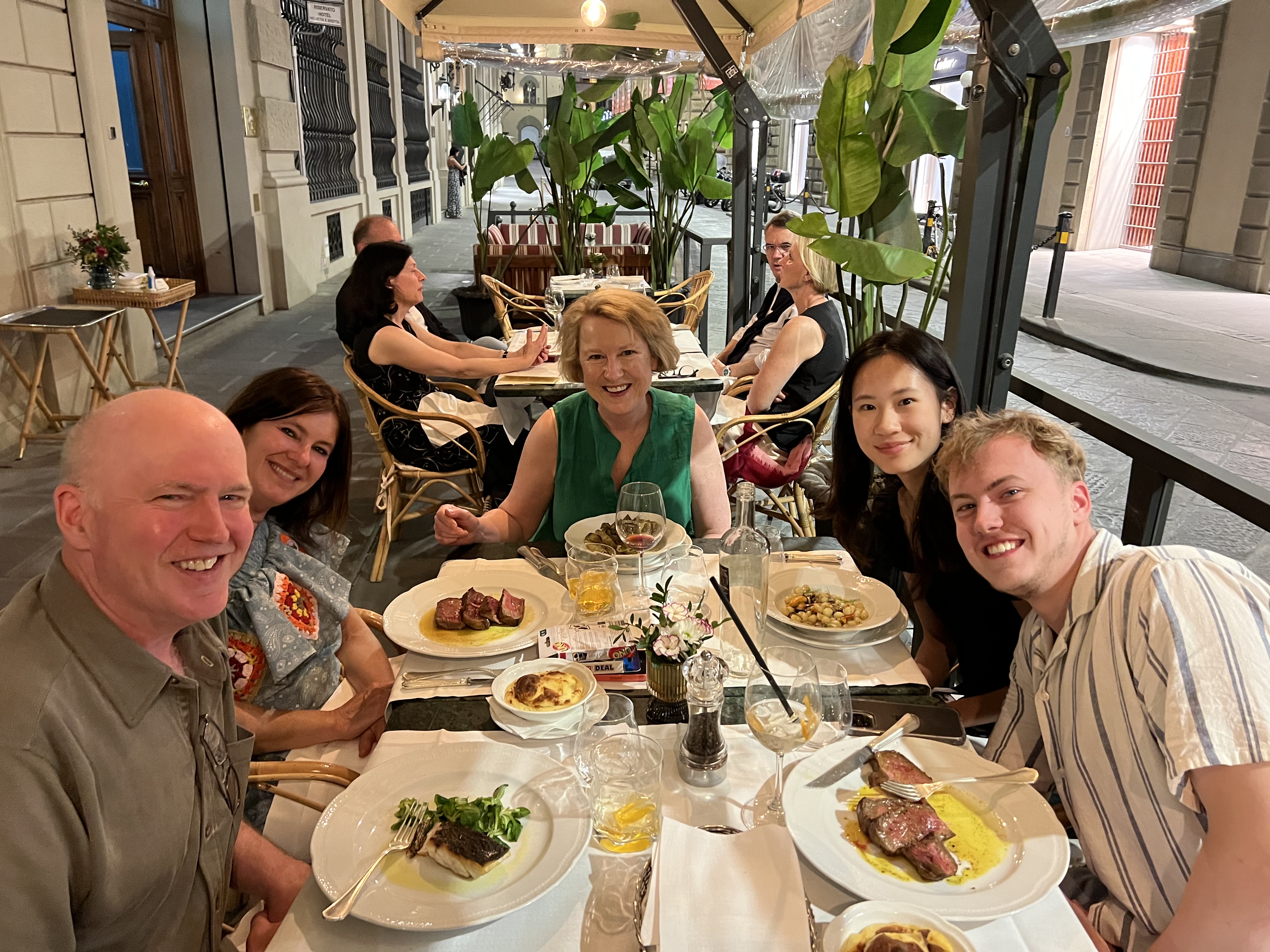
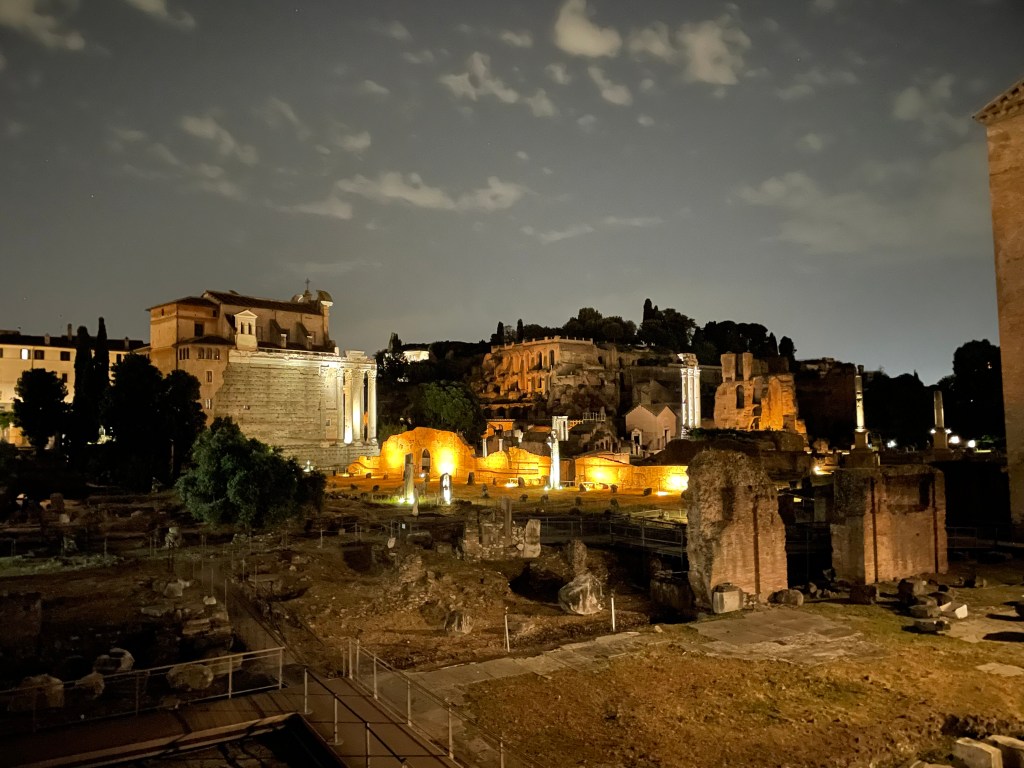
Dinner last night was lovely, too, and it was funny, because we first said goodbye to Grazia Saturday night, because she was headed back home on the coast after spending the night at her friend’s house. But then she decided to stay, so we spent Sunday afternoon together at the modern art museum, and said goodbye again. Then she walked her sweet little King Charles Spaniel around a while and decided to stay for dinner! So we had the pleasure of a wonderful Florentine meal with her before she hit the road for home last night. So every time we said goodbye and see you soon, it was true. So hopefully, it will be true again. So we are off to our final stop – Roma! First on the itinerary is pizza, followed by the Roman Forum at night. Tomorrow morning we will get up at 6 a.m. for our early-morning breakfast tour of the Vatican
From the frescoes of Padua, to the mosaics of Ravenna, and on to the towers of Bologna
BOLOGNA, Italy – Friday, May 20, 2022 – We have been extremely remiss in our blogging, so much so that my mother called me last night to remind us to “keep sending those blogs!” It’s nice to know we have a loyal readership.
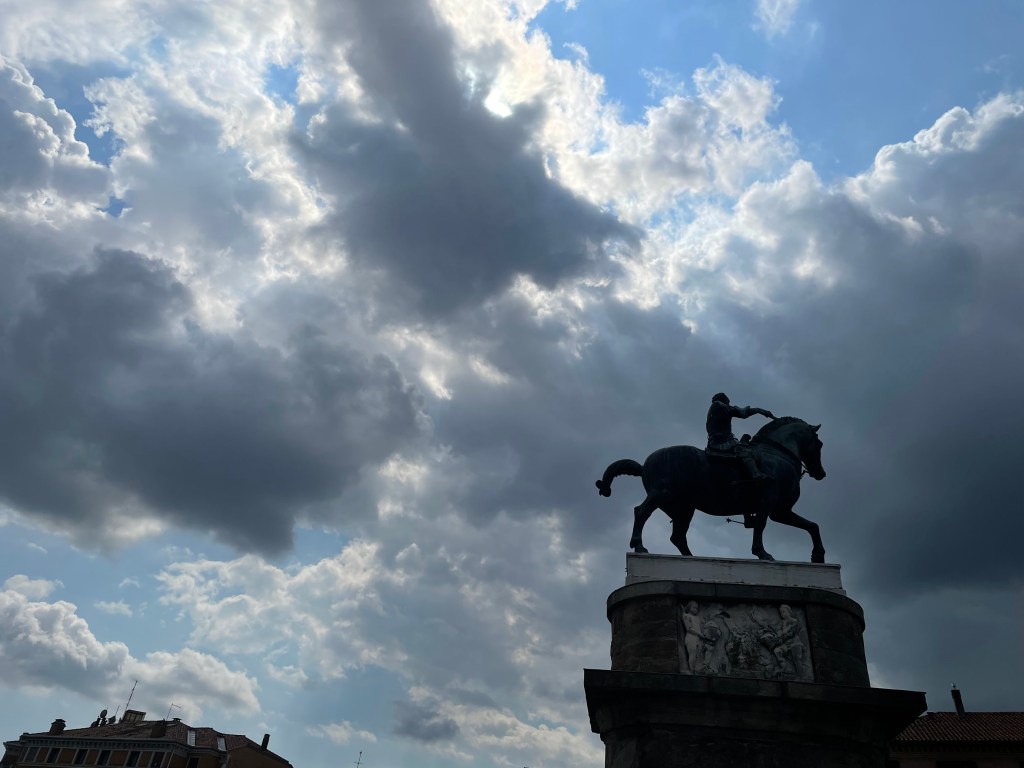
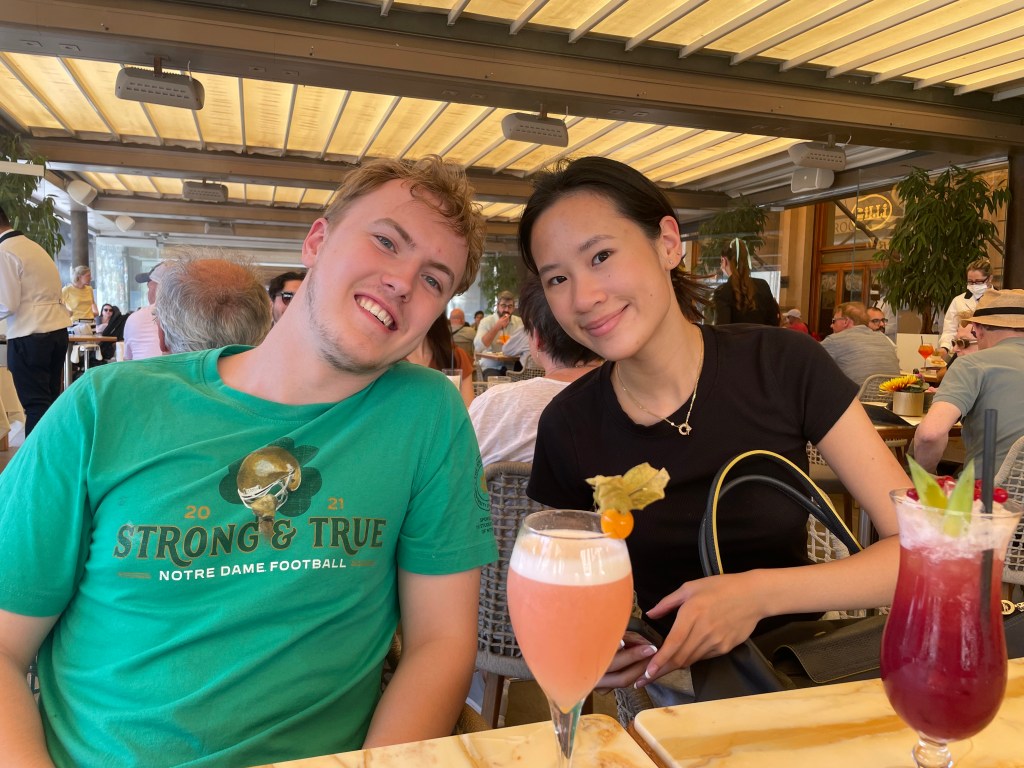
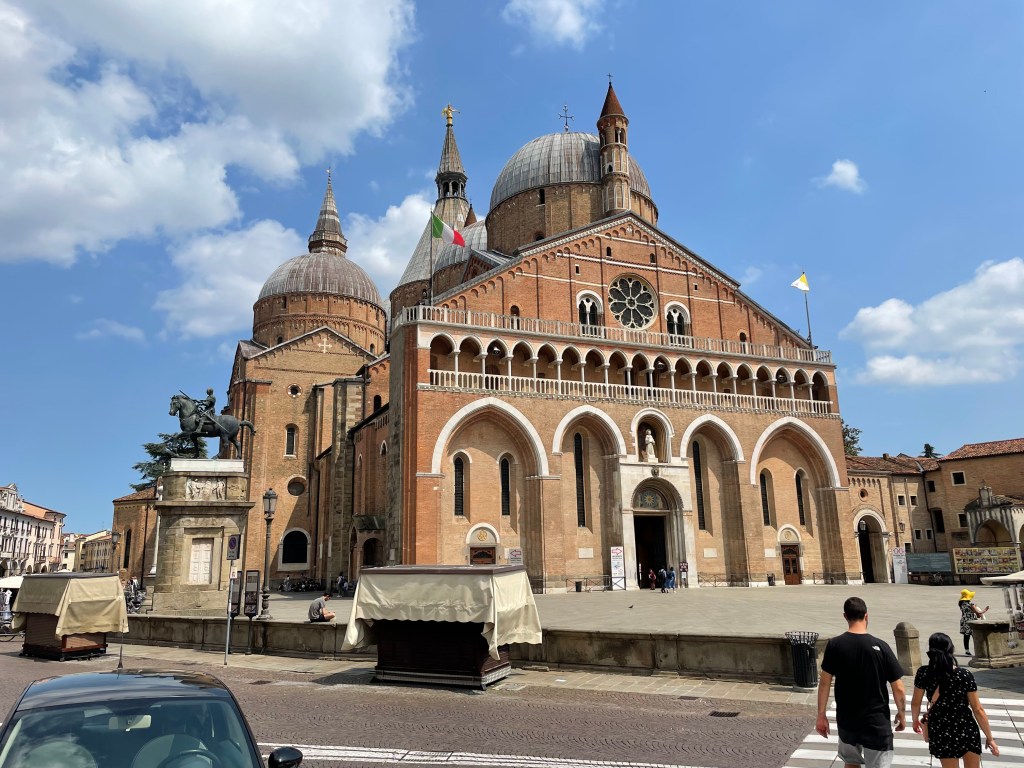
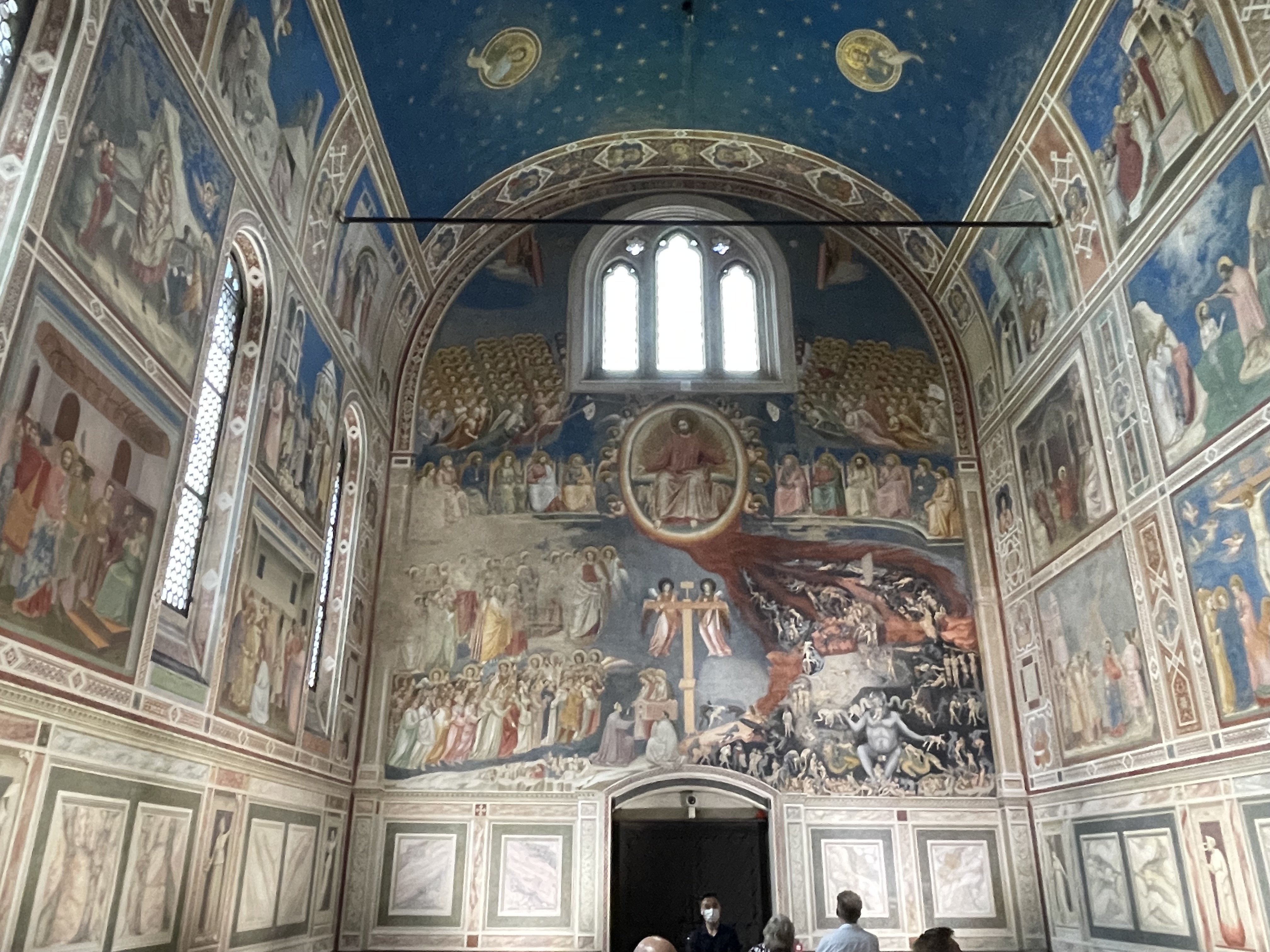
Let’s see, where to start? Maybe with our daytrip to Padua, or Padova, a small city outside of Venice with perhaps the most important works of Western art, ever, frescoes by the Florentine artist Giotto di Bondone, in a small early 14th century chapel next to an ancient Roman arena. Rick and I left Will and Amy in Venice to spend the day on their own, going to the Biennale, Venice’s huge modern art extravaganza, and shopping. But Rick and I opted for the medieval, traveling the 30 minutes by train to Padua, home of one of Europe’s oldest universities (Galileo studied there) and also the home this weekend to a saber Grand Prix, where several of Will’s friends and teammates are fencing. Will’s coach from OFA, Adam, and his daughter are here, and we are missing them in Venice by just one day. We joked with Will that his Notre Dame teammate and friend Jared Smith was going to take a break from the fencing to meet us at the Scrovegni Chapel, and that Jared just LOVED it.
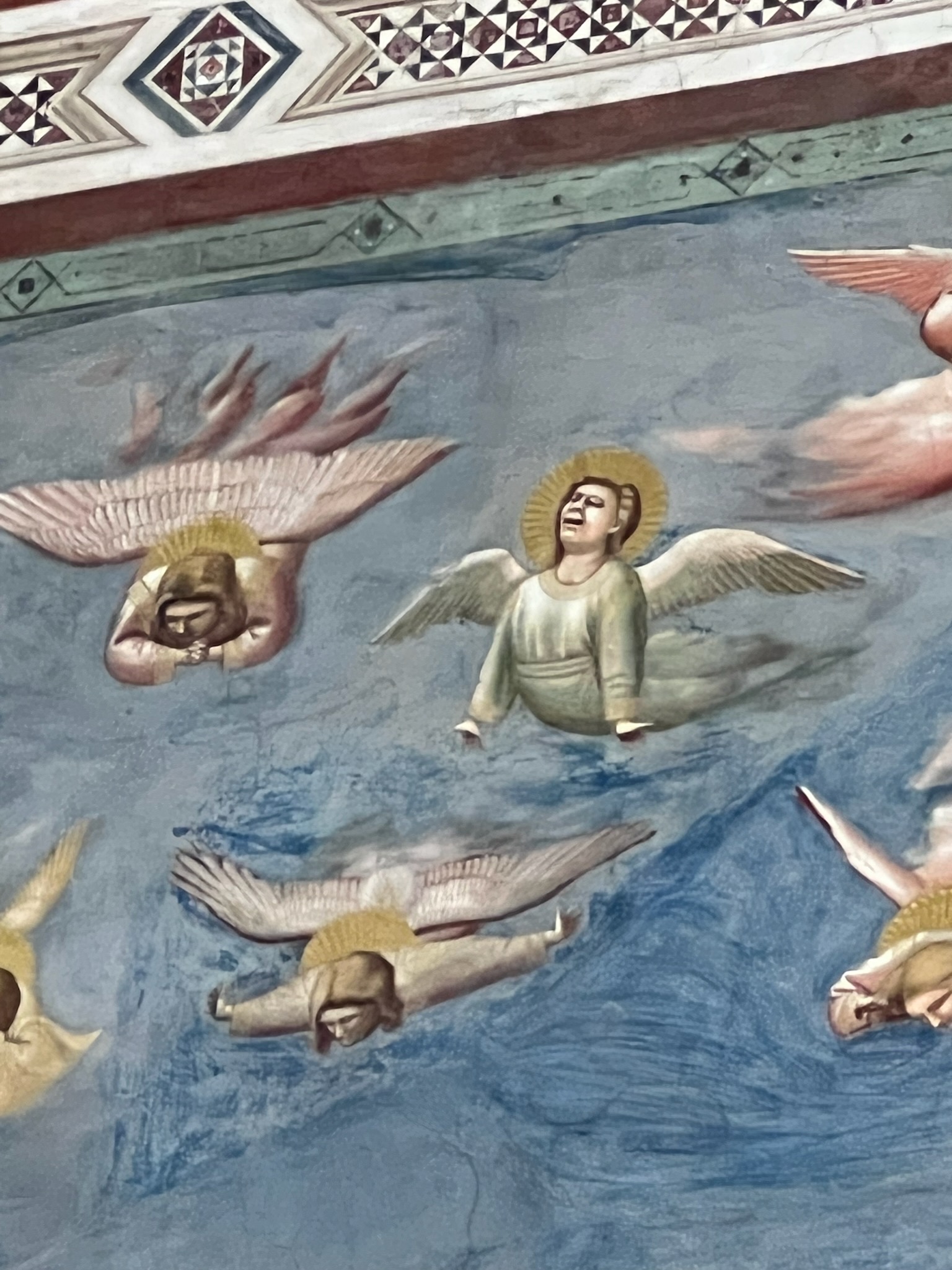
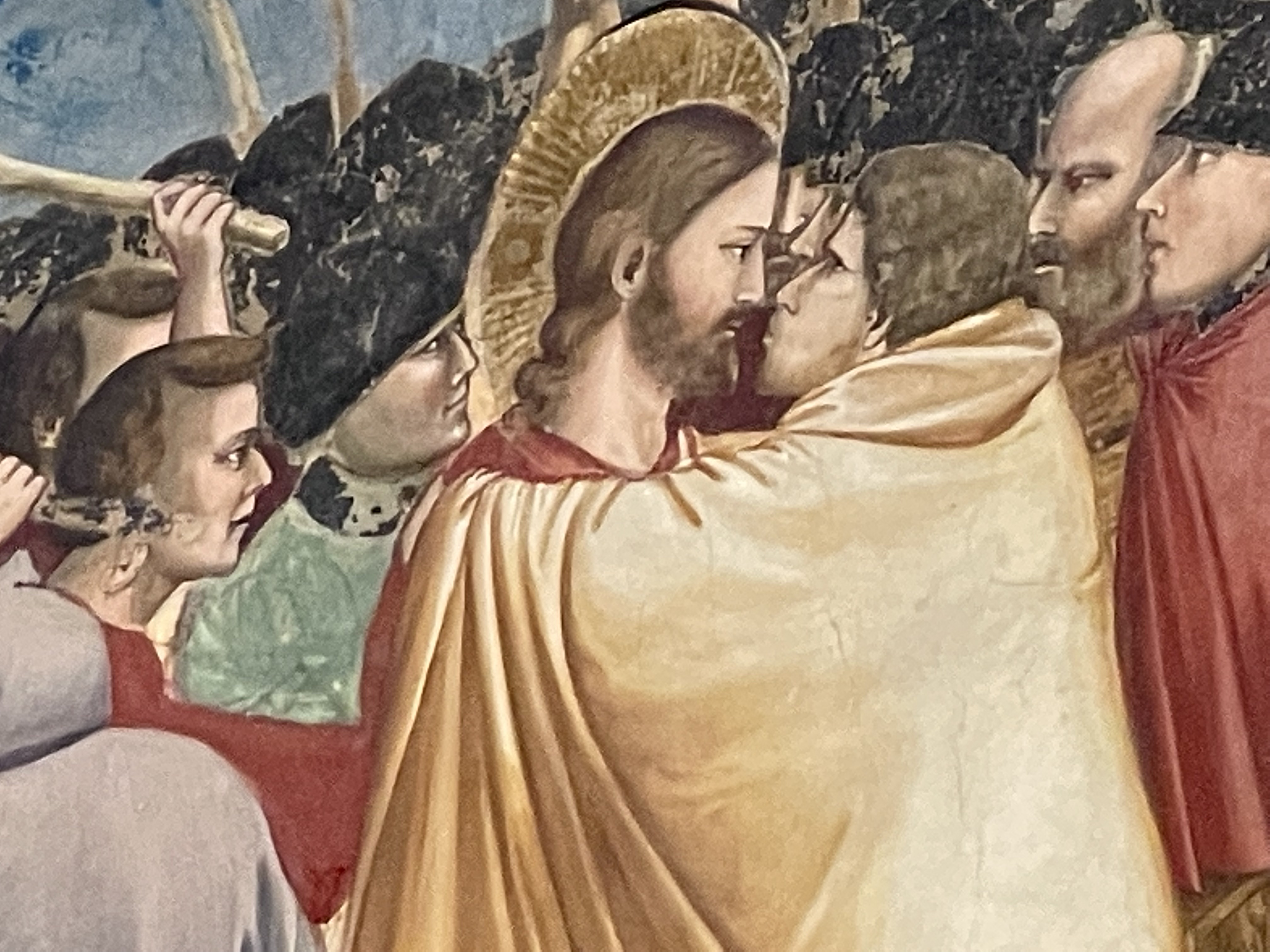
But all kidding aside, the Scrovegni chapel was breathtaking. I literally was moved to tears, not only by the beauty of the frescoes with their deep humanity – with pathos and humor instantly recognizable to a 21stcentury observer – but also that I was able to see them in my lifetime. With Covid and all, I wasn’t sure I would ever make it here. We only had 15 minutes in the small chapel – entry is restricted to limit the humidity, which can damage the frescoes, dating from 1303-05, but it was so moving to see them in person. Apparently, Dante (whose tomb we saw yesterday in Ravenna) was a friend of Giotto’s, and they are said to have hung out in the chapel while Giotto was painting it. You wonder if the depiction of hell in Giotto’s Last Judgement inspired Dante’s Inferno. The main walls are covered with deeply colored panels, telling the stories of the life of Mary, of Jesus and of his Passion and resurrection. It was hard to see the detail from the floor, but I had studied them in classes with Dr. Rocky (see previous posts) so I knew what to look for – the funny “side-eye” glance of a shepherd sizing up Joachim’s mental state, the bulbous, wine-sipping priest whose shape is reflected in the nearby wine jugs, the look of despair in the eyes of Mary lamenting her son, or the angels above who mourn with their whole bodies. And who can forget the two kisses – that of the parents of Mary – the “first kiss in Western art” according to Rocky – and the kiss of Judas, in which Jesus looks straight into Judas’s eyes at the moment of betrayal and basically melts him with his laser beam. These frescoes were part of the pre-Black Death zeitgeist in Europe, when Christianity, art and literature were being humanized, brought down to human scale. Dante was soon to write the Divine Comedy in the vernacular, in the Tuscan dialect, so that common people could understand it, if not read it themselves. At the time, everything written – and spoken by the priests in church – was in unintelligible Latin. Giotto was doing the same thing in paint, making the stories of the Bible human, making the people human, with real emotions, rather than the distant, otherworldly, highly stylized Byzantine figures of the Madonna and Jesus. This paved the way, after the Black Death, for the Florentine Renaisance of the 15th century. I tell you all this because it was incredibly exciting to see these frescoes, and think of all that came after, and before. They are just so beautiful, and even for a non-Christian, they are moving portraits of all the range of human emotion, and body language. People still make the same gestures, facial expressions, exclamations of full-body grief that people did 700 years ago.
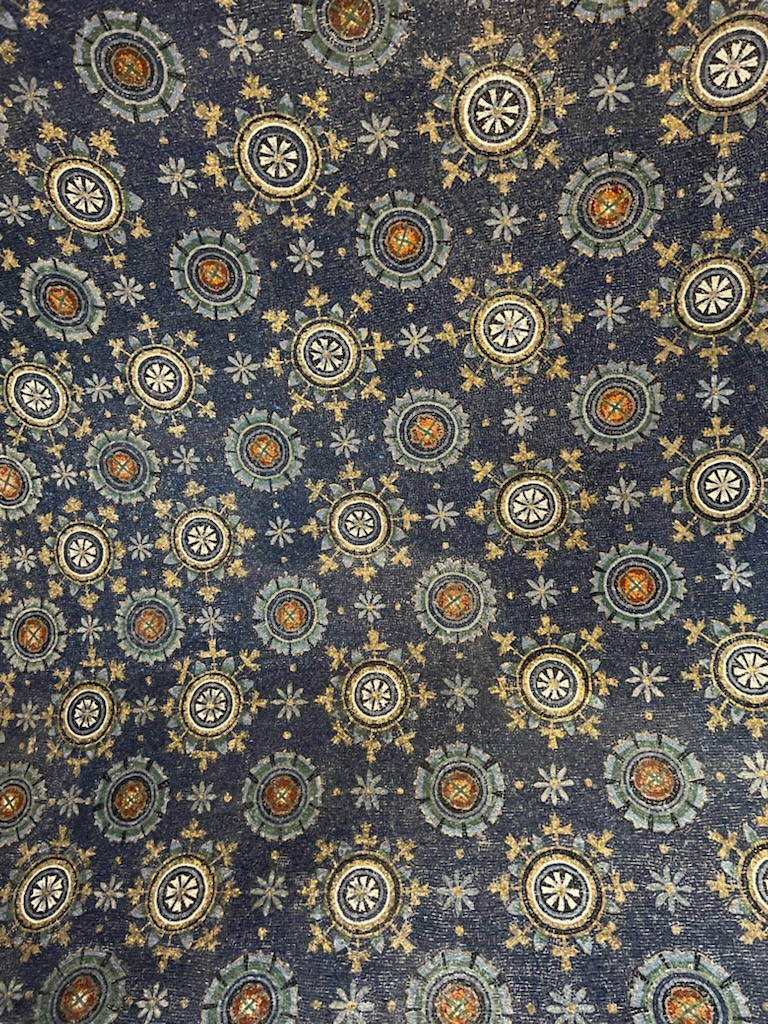
Fast-forward to yesterday – when we went to another important city and art pilgrimage site – Ravenna, a long two-hour drive south of Venice. A professor at Stanford, Martin Evans, who has since passed away, said once in a class I was in that everyone should try to go to Ravenna once in their lifetime to see the incredible mosaics from late antiquity. So I did. Finally. This ancient capital of the Roman Empire as it was collapsing in the 5th century has some of the world’s best preserved and most beautiful ancient mosaics – probably because it is so far out of the way no one bothered to plunder them. Our favorite was the Mausoleum of Galla Placidia – the 5th century AD daughter of an emperor who once wrote love letters to Attila the Hun – she was a scream. It isn’t believed she is buried here, but it is an absolute jewel box worthy of an imperial personage or a girlfriend of Attila. The deep blue sky of the small dome sparkled with gold stars looked like an ancient Persian rug, the beautiful plants, animals and Apollo-esque Jesus-as-Shepherd, all felt deeply tied to pagan antiquity. While the other monuments felt more political – the Emperor Justinian declaring his sovereignty (he had retaken Italy from the barbarians in the 6th century) in his portrait in San Vitale, or the wholesale re-writing of the mosaics at Sant’ Apollinare in Nuovo, where the barbarian-yet-Christian Theodoric had his courtiers repurposed as Christian martyrs by later Catholic re-conquerers. If all that sounds confusing, don’t worry, it is. But it was amusing – or canny – that the mosaicists failed to airbrush out the hands of his courtiers, still stubbornly holding onto the columns of the palace. Their bodies had been “mosaicked” over with curtains. But everywhere, the colors of the tiny tiles and the skill of the unnamed mosaicists were stunning. We had let Will and Amy go their own way, dropping them at the beach, while Rick and I sped through the beautiful old town, hopping from mausoleum to basilica. We had intended to take Will and Amy to one last mosaic-filled church on the way out of town, but it got so late we had to skip that last church. So they will have to come back on their own, one day, and see these mosaics themselves.
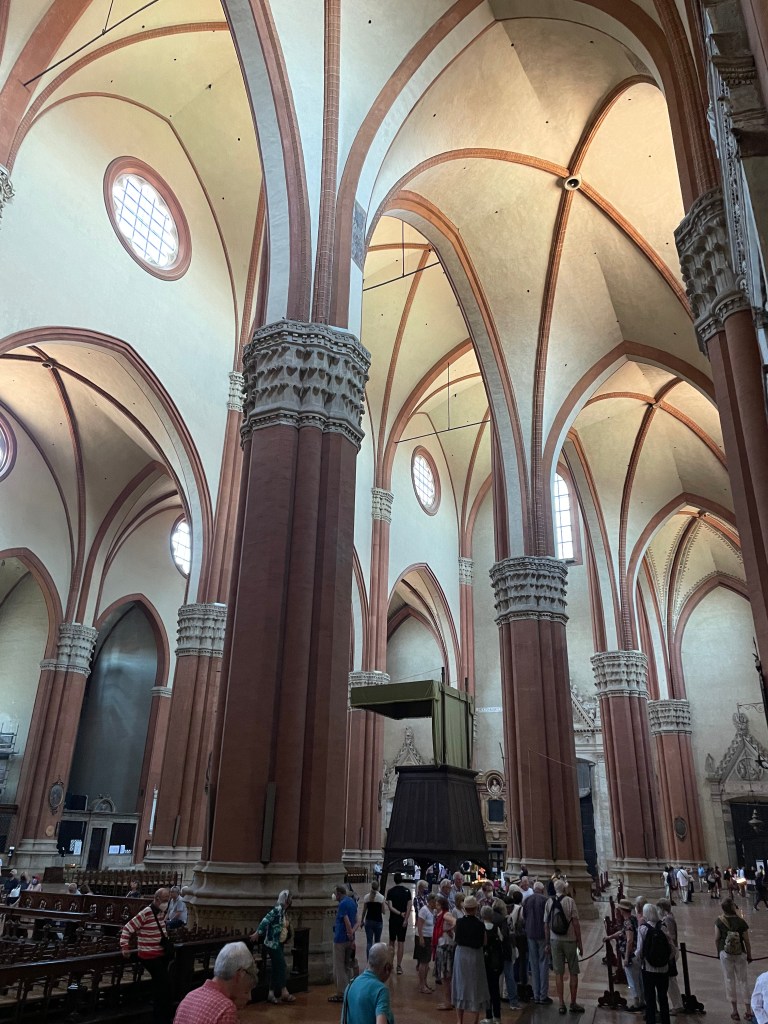
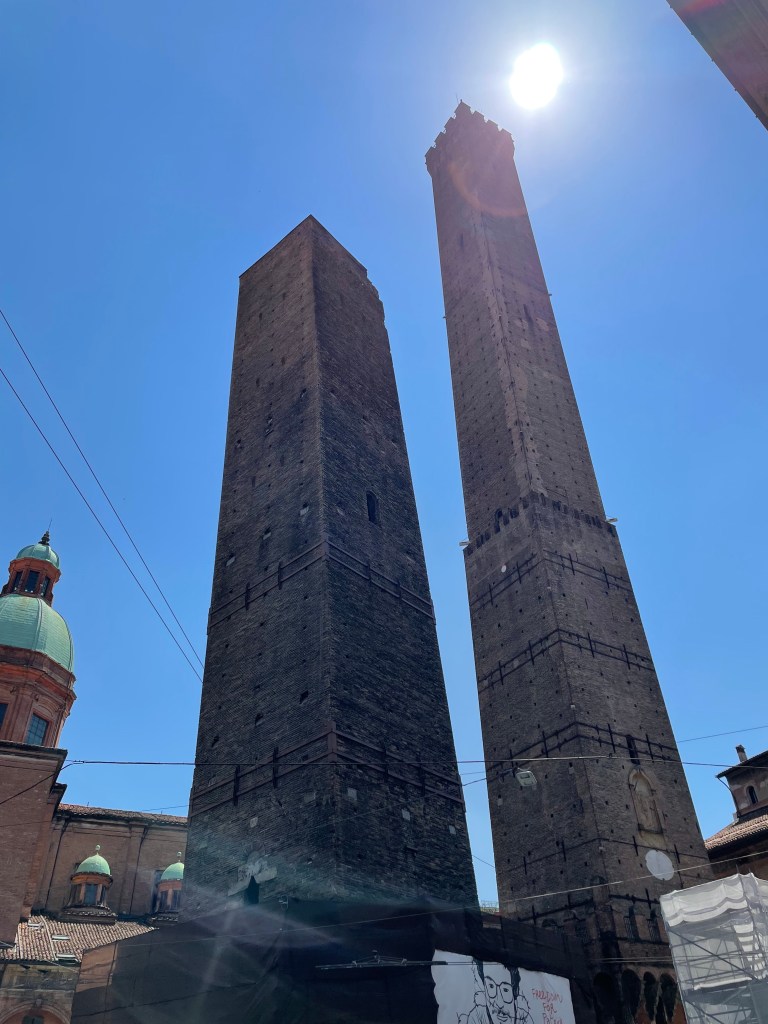
After loooooong hours of driving and perhaps 500 traffic circles, we arrived at Bologna last night, after driving from Venice to Ravenna, to the beach, to Ravenna again, to the beach, and then finally to Bologna. Bologna is a great city, with an estimated 40 km of covered porticoes – we had breakfast under a wooden one dating back to the 13th century – and swarms of young people. It is crowded but not with tourists – yes, there are tourists too, but mostly it seems to be university students, and people rushing to work – many on the not-quite-sea-worthy bikes that are ubiquitous. It has a nice vibe, and tons of great food, and shopping, and energy. We are glad we had a quiet day here and are gathering our energy for our trip to Florence tomorrow, where we will meet up with Grazia again.
So Ma, look! I blogged!
 The Thompson Attigs