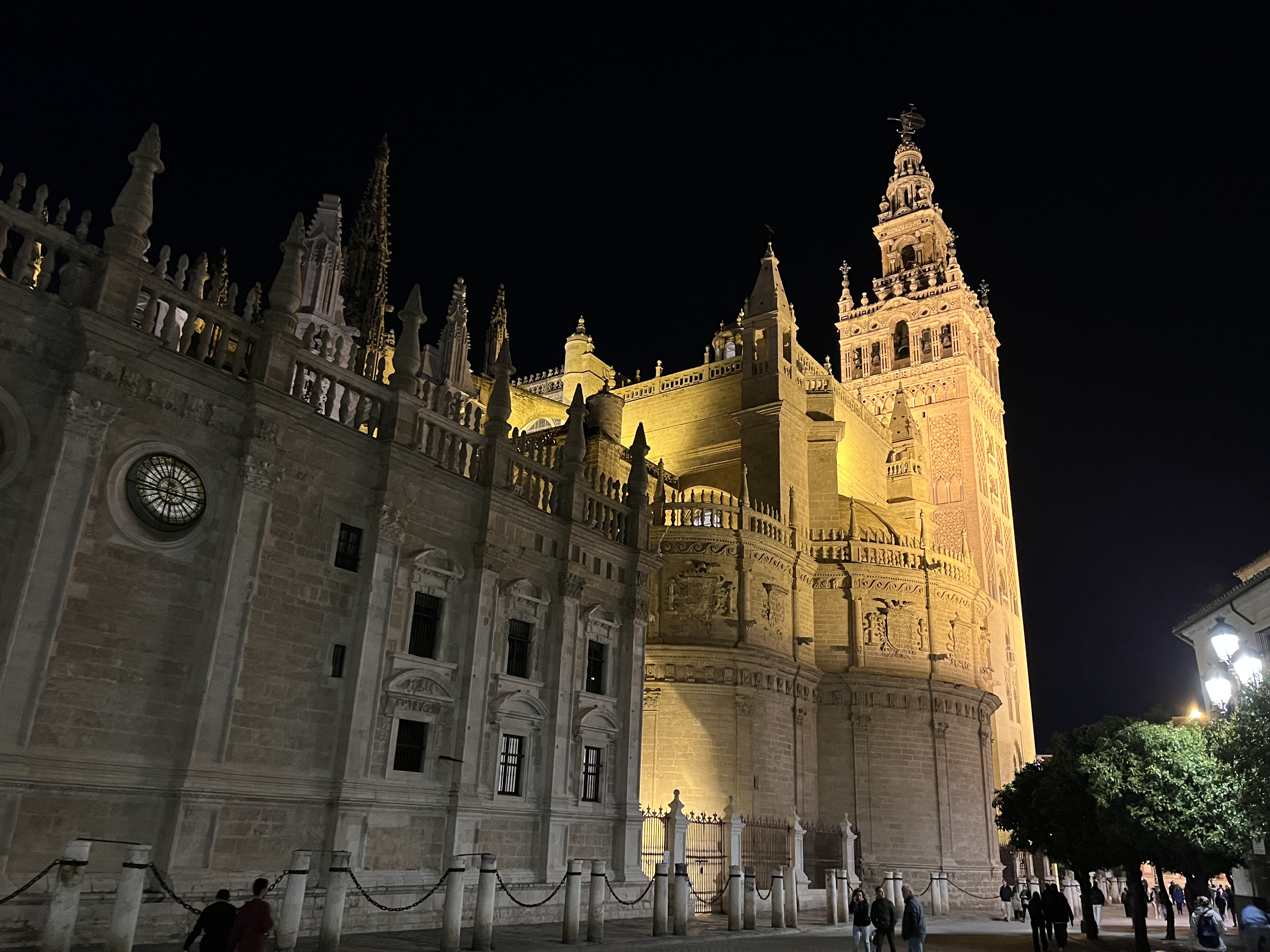

Seville – Sunday, March 9, 2025 – We arrived in Seville last night on a fast-train from Madrid with our friends Helen and Mike, who were fresh off a plane from Philly. We had a wonderful time last night bumbling through three tapas bars – there are shifting mores and customs, depending on the city and the establishment, on how and what to order, how to gracefully snag an open table without enraging the staff, not that that happened!, but that is a whole other topic we can delve into sometime.
But after a short night (yes we have been going to bed at midnight!!! Imagine!!), but waking up at 5 am, I thought I would write a quick post on our museum experience in Madrid. We saw both the Thyssen-Bournemisza and the Prado, the later with our art historian guide Almu Cros. We have never had a guide for a museum, but she had a unique perspective on the collection – who the rulers were who commissioned or bought all this art – one of the greatest collections in the world – and also on how the artists used the collection over the centuries to inspire their own work. For example, perhaps the most famous painting in the collection is Las Meninas, Seville-born Diego Velasquez’s iconic 17th-century painting of the artist painting the king and the queen, when their little girl bursts in on the scene with her maids and her dog. Later artists, including many modern and contemporary artists, including Francis Bacon, have been obsessed with this painting and painted their own “versions.” What I hadn’t realized, is that there is another extremely important painting that had been in the collection in the 17th century, Jan Van Eyck’s Arnolfini Wedding from two centuries earlier, that Velasquez had been looking at. Famously, there is a mirror in both paintings, with a tiny, hard-to-discern reflection of the artist, or in the case of Velasquez, the subject of the painting – the King Philip IV and his queen. In the painting, there are other elements from the Van Eyck – a dog, the light shining in at a slant, many little elements that Velasquez drew on to create his uniquely modern (for his time) portrait of an artist at work. Another example, Picasso’s massive Guernica (which is at another museum in Madrid), the Cubist artists cry against the horrors of modern warfare on civilians following the Nazi bombing of a small northern Spanish town in the Civil War of the 1930. Though he was in exile from Franco’s fascist Spain, he drew on his memory of Goya’s depiction of the street fighting in the streets of Madrid during an uprising against Napoleon’s occupation in 1808. Once you look at the massive Goya painting in the Prado, you can see it – the horse (there were no horses in Guenica), the raised arms of the woman, the body on the ground with the broken sword. Another mirror into the past, and into an artist’s mind.
And you think the Spanish surrealist Salvador Dali is weird? Well he is actually just channeling his much, much weirder predecessor, 16th century Dutch painter Hieronymus Bosch, whose famously strange Garden of Earthly delights is a highlight of the Prado. Dali literally quoted from the Dutch painters strange and disturbing hybrid creatures who act out the follies of human behavior. But as Almu pointed out, even Bosch was looking to other strange minds for inspiration – the monks who drew strange hybrid (and sometimes obscene) monsters in the margins of the sacred texts they were copying.
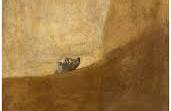
That is looking at art with your mind – it’s magical working through the intellectual puzzles with your mind. But there is a far different way to experience art, something that the Stanford professor Alexander Nemerov (affectionately known to his undergraduates as the “Art Preacher”) opened me up to. You look a piece of art with your heart, not just your mind. You never know how a piece of art will affect you, and I am sometimes just so moved by something that I find myself in tears. That is the power of art to really reach through the centuries and strike you at your heart. Such a thing happened at the Prado, in the Goya room. We were standing in front of his painting of May 3, 1808, showing the execution of Spanish resisters to Napoleon’s invasion – the peasant raises his hands like a Christ-figure as he faces the firing squad. I have been haunted by this image since I saw it as a child, in my parent’s Time-Life history of Western art. But as I looked at the painting, thinking about the history, I glanced to my right and saw a painting I had only seen in art class, called the Drowning Dog, though I don’t think Goya named it that. It shows a small dog in a vast canvas of almost Byzantine gold, looking up as if he is swimming to keep his head above a wave that threatens to submerge him. It took my breath away – the tiny dog has the look of despair, or of hope, or of both – but it was an emotion I recognized, and recognize as I write this. The sense of that the world is out of one’s control, that feeling when you have to confront your own end, the terror, the horror and yet somehow, the hope. I had seen that look the day before, at the Thyssen, in the face of an El Greco Jesus, looking up to heaven with a look of despair, as if saying Why Me? Is this all there is? Seeing our friends again after all these years, when we have all faced life and health challenges and scares, when we face futures filled with uncertainty, uncertain diagnoses, uncertain futures, the gold, and the face of that sweet little dog from Goya’s dark period, gives me hope.
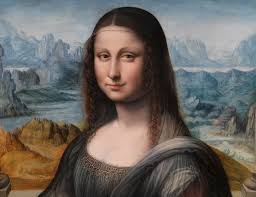
Last thought – don’t tell anyone, but the real Mona Lisa is not at the Louvre. It’s at the Prado Shhhhhh!!!! Almu has us convinced – the Prado’s Mona Lisa looks just like the one at the Louvre – except they cleaned it, revealing beautiful greens and blues in the background. Her iconic smile is there, the same clothes, the same pose, the same lack of jewelry. The label on the side says “Workshop of Leonardo,” but Almu has some wonderfully persuasive arguments that this, in fact, is from the hand of Leonardo. It was painted on more expensive wood, walnut, for example, using more expensive paint. Could this have been the version that the patron chose, leaving Leonardo with the other copy, which he would carry with him to France, where he died with it in his possession? She wears no jewelry, much like another Renaissance portrait of a young wife, painted after her early death. Could Mona Lisa be the painting for another grieving widower, and he chose the more exquisite of the two versions? Almu thinks so, and so do we. But God forbid that the word gets out – NO ONE was looking at the Prado Mona Lisa – ok, maybe a few people casually walked by while we were discussing it. But you cannot imagine how the experience would be ruined if the selfie-taking hordes descended on this Mona Lisa. Meanwhile, you can enjoy Leonardo’s wonderful creation in the relative peace of the photo-banning Prado.
Art – where you find a mirror into your self, into the past, into your emotions.
 The Thompson Attigs