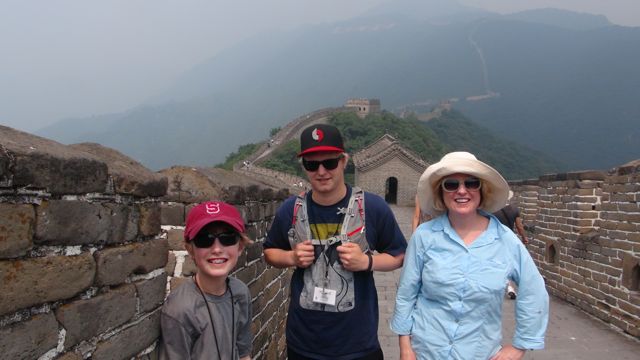
Our whirlwind tour comes to a close; we will be China’s next exports

Image

Monday, July 23, 2012

SHANGHAI – We have moved so quickly, and with such full days, through  
Beijing, Xi’an, Chengdu and now, Shanghai, that none of us has had the  
energy at day’s end to produce a blog post. Everyone is a bit  
nostalgic for Courtenay’s Terrible Thompson Torture Tours, which at  
least give everyone a few hours break before dinner, our favorite time  
to blog.

But we came back to the hotel on our last afternoon in China to the  
news that Beijing has suffered its heaviest rain and worst flooding in  
years, with more than 37 deaths, and realized we should let our  
families and friends know we are happy and safe here in Shanghai.  
Tomorrow we catch our long flight home, via Vancouver, B.C.

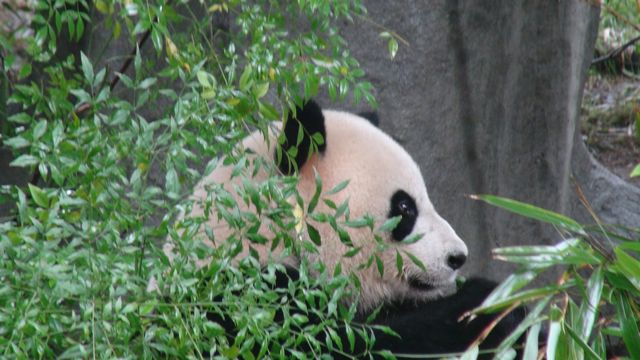
We have many stories to tell: Courtenay and Will enjoying a quiet walk  
together on the Great Wall far away from the madding crowds, Mitchell  
and I enjoying a young panda skittering through the grass only a few  
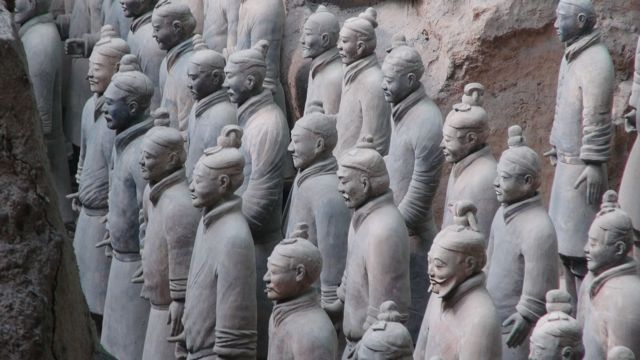
feet away, all of us mesmerized by the 2,300-year-old terracotta army.

It will take us some time to reflect on all that we have seen and  
learned in China. For now we all have this blur of memories, ancient  
art, acrobats and opera singers, middle-aged dancers and kite fliers  
livening up the public parks, the gray pall of pollution over Xi’an —  
with its beautiful 400-year-old walls and waiters who giggled  
charmingly at the silly Americans as they attempted to eat local  
dishes — the lush greenery of Chengdu, the stunning yet zany and  
futuristic skyline of Shanghai lit up at night.

There will be time to write later about the food we have experienced,  
some of it hot, some of it unidentifiable, much of it beautifully  
created and presented. And Will and Mitchell return with a trove of  
Chinese treasures—masks and warrior statues, chopsticks and chess sets.

“Everything new is good,” our guide cheerfully announced as we drove  
among the massive highrises of Shanghai on our way in from the airport  
yesterday. Well, yes. We have great new friends we have made among the  
Stanford travelers. We have fresh memories, new stories, moments in  
our lives that will remain in our memories. And finally, we have a new  
appreciation of China, this rapidly changing country that we have  
merely glimpsed over the past two weeks.
ImageImage

They call it the Forbidden City, but they let us in anyway

Image

Sunday July 15, 2012

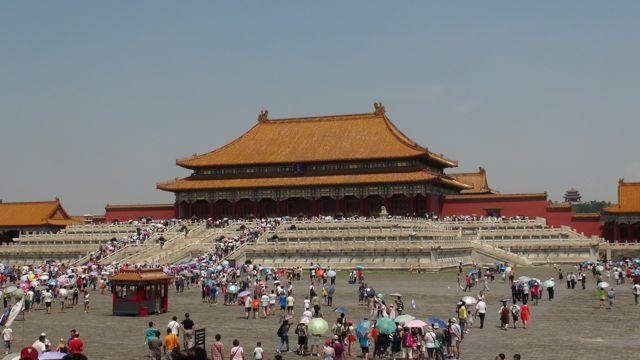
BEIJING – On a hot Sunday morning, with the temperature nearing 90  
degrees, we walked with tens of thousands of other people across  
Tiananmen Square and into the main gates of the Forbidden City, which  
for more than 500 years served as home for Chinese emperors, their  
families and concubines. The crowds were incredible—imagine everyone  
leaving a college football game through the same few large gates, but  
for hours and hours and hours. It was a beautiful scene, though, a sea  
of brightly colored sun umbrellas moving across the stone walkways and  
into elaborate, brightly colored palace buildings. The Forbidden City  
is a collection of more than 900 buildings, and we toured fewer than  
two dozen of them over a period of several hours. It’s a massive  
place, on a scale that is hard to grasp even as you are being swept  
through the place with the sea of other visitors. During the trip,  
Will made a new friend in the group, Nicholas, who is here with his  
grandparents, and the two 10-year-old boys navigated the Forbidden  
City and its crowds together, chatting and pointing out things to one  
another.

From the Forbidden City, we went to a group lunch at a small hotel  
near what is known as the Drum Tower, which served as a night-time  
clock tower in old Beijing, with drummers pounding out the time in  
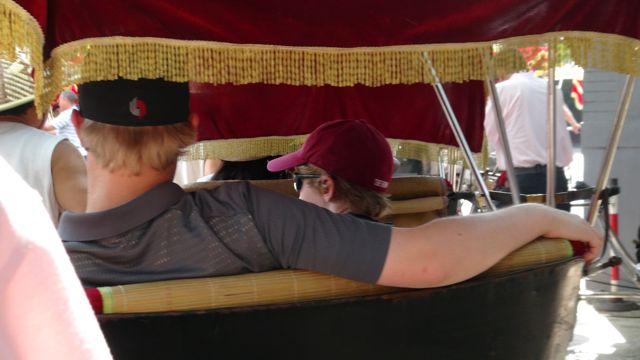
intervals of every two hours. After that, we climbed two by two into a  
flock of pedicabs that had assembled outside the restaurant. Mitchell  
rode with Will, and after the driver took our camera and snapped a  
picture, Courtenay and I rode away on another cab. We rode slowly in a  
long line through a series of hutongs, the small alleyways of  
Beijing. We rode by Chinese cooling their infants in pots of water  
and old men playing board games. The cabs didn’t seem to have working  
brakes, and every time the group slowed for a corner, or a passing  
car, we’d bump the cab in front of us, and get a corresponding tap  
from behind. Yes, it was a touristy little ride that went out in 20-
minute circle, but it was fun and interesting to rattle along through  
the hutongs, where there are piles of sand, dirt and brick everywhere,  
people working on their homes and tiny businesses.

The bus ride back to the hotel took us by dealerships for luxury  
cars such as Maseratis and Jaquars, and it was jarring to go so  
quickly from the sight of men driving rusting pedicabs to those  
shopping for some of the most expensive cars on earth. Beijing is both  
desperately poor and incredibly rich, sometimes within the same couple  
blocks. Everywhere you look you see the deep economic tensions in this  
country, which were described to us in an hour-long lecture late  
Sunday. The speaker, Frank Hawke, a Stanford grad who has spent most  
of his life in China, says it can go either way—with a hugely changed,  
reformed China joining the community of nations with a free and  
democratic economy, or a China in chaos. But it cannot go on this way,  
without change in some way.

By late-afternoon, we were back at the hotel, and Will hit the pool  
with some of his other new buddies among the Stanford travelers, while  
Mitchell and I took refuge at the hotel bar. It’s a great treat for me  
to have both of my sons here together, sharing these experiences. For  
Courtenay, today also was a new experience, the first that we have  
ever had together as part of an organized tour. It’s probably not  
something we’ll always want to do in our traveling, but it was clearly  
a relief for her to leave the organizing and the communicating and the  
decision-making to others, and just wander along taking everything in.

We go next to the Temple of Heaven and the next day to the Great  
Wall, before we say goodbye to Beijing and head for Xi’an, the home of  
the terracotta warriors. Whenever I think of Beijing, I will remember  
the mass of people streaming into the main entrance of the Forbidden  
City, the brilliant umbrellas flowing like a river through the blazing  
sun.

Image