They call it the Forbidden City, but they let us in anyway

Image

Sunday July 15, 2012

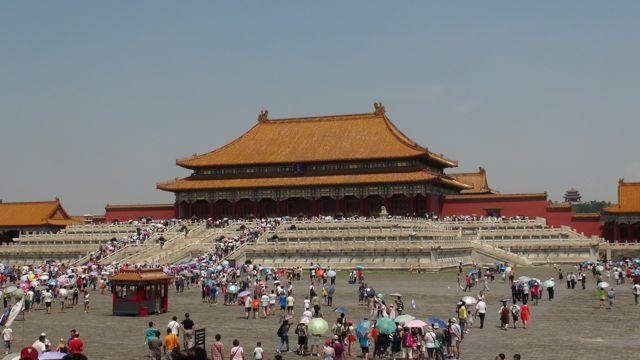
BEIJING – On a hot Sunday morning, with the temperature nearing 90  
degrees, we walked with tens of thousands of other people across  
Tiananmen Square and into the main gates of the Forbidden City, which  
for more than 500 years served as home for Chinese emperors, their  
families and concubines. The crowds were incredible—imagine everyone  
leaving a college football game through the same few large gates, but  
for hours and hours and hours. It was a beautiful scene, though, a sea  
of brightly colored sun umbrellas moving across the stone walkways and  
into elaborate, brightly colored palace buildings. The Forbidden City  
is a collection of more than 900 buildings, and we toured fewer than  
two dozen of them over a period of several hours. It’s a massive  
place, on a scale that is hard to grasp even as you are being swept  
through the place with the sea of other visitors. During the trip,  
Will made a new friend in the group, Nicholas, who is here with his  
grandparents, and the two 10-year-old boys navigated the Forbidden  
City and its crowds together, chatting and pointing out things to one  
another.

From the Forbidden City, we went to a group lunch at a small hotel  
near what is known as the Drum Tower, which served as a night-time  
clock tower in old Beijing, with drummers pounding out the time in  
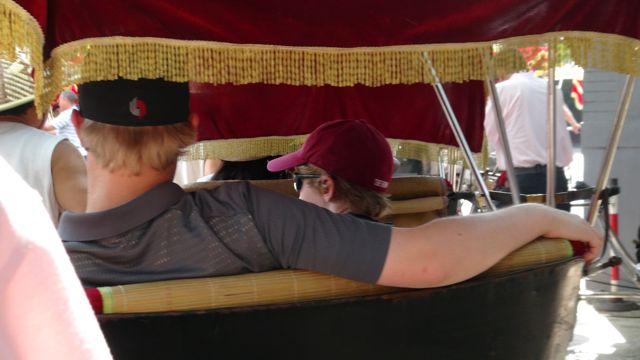
intervals of every two hours. After that, we climbed two by two into a  
flock of pedicabs that had assembled outside the restaurant. Mitchell  
rode with Will, and after the driver took our camera and snapped a  
picture, Courtenay and I rode away on another cab. We rode slowly in a  
long line through a series of hutongs, the small alleyways of  
Beijing. We rode by Chinese cooling their infants in pots of water  
and old men playing board games. The cabs didn’t seem to have working  
brakes, and every time the group slowed for a corner, or a passing  
car, we’d bump the cab in front of us, and get a corresponding tap  
from behind. Yes, it was a touristy little ride that went out in 20-
minute circle, but it was fun and interesting to rattle along through  
the hutongs, where there are piles of sand, dirt and brick everywhere,  
people working on their homes and tiny businesses.

The bus ride back to the hotel took us by dealerships for luxury  
cars such as Maseratis and Jaquars, and it was jarring to go so  
quickly from the sight of men driving rusting pedicabs to those  
shopping for some of the most expensive cars on earth. Beijing is both  
desperately poor and incredibly rich, sometimes within the same couple  
blocks. Everywhere you look you see the deep economic tensions in this  
country, which were described to us in an hour-long lecture late  
Sunday. The speaker, Frank Hawke, a Stanford grad who has spent most  
of his life in China, says it can go either way—with a hugely changed,  
reformed China joining the community of nations with a free and  
democratic economy, or a China in chaos. But it cannot go on this way,  
without change in some way.

By late-afternoon, we were back at the hotel, and Will hit the pool  
with some of his other new buddies among the Stanford travelers, while  
Mitchell and I took refuge at the hotel bar. It’s a great treat for me  
to have both of my sons here together, sharing these experiences. For  
Courtenay, today also was a new experience, the first that we have  
ever had together as part of an organized tour. It’s probably not  
something we’ll always want to do in our traveling, but it was clearly  
a relief for her to leave the organizing and the communicating and the  
decision-making to others, and just wander along taking everything in.

We go next to the Temple of Heaven and the next day to the Great  
Wall, before we say goodbye to Beijing and head for Xi’an, the home of  
the terracotta warriors. Whenever I think of Beijing, I will remember  
the mass of people streaming into the main entrance of the Forbidden  
City, the brilliant umbrellas flowing like a river through the blazing  
sun.
Image

The family lands in Beijing: Hutong, Tiananmen and airsickness bags

Editor’s note: The Chinese government blocks access to a number of websites, including any blog with “wordpress” in its domain, thus preventing us from blocking directly from China during our stay here. Our friend Mike Francis has agreed to serve as our “poster” during our travels to China the next couple weeks. Thanks, Mike, for all your help. Without access, we won’t be able to respond to your comments, but we may see them in our e-mail.

BEIJING — Wednesday, July 11, 2002 – Day One Beijing and the boys did great – two temples, two museums (one never found but arduously searched for in 94-degree heat), Tiananmen Square before 8 a.m., hutong back-alley walk to find a closed restaurant, toy store, three subway rides, including a “sardine train” where we had to literally shove our way in. The boys can’t wait for the official Stanford tour the start on Sunday so they can relax a bit (and Mommy won’t be in charge anymore.)

It was a great start to our vacation, after a rough landing yesterday. The plane ride was a bit bumpy the last three of nearly 12 hours, and Rick and Will were green by the time we landed. Like both were clutching barf bags. We made it past customs and were greeted in a very crowded airline terminal by a big red Stanford “S” held by Catherine Zhong, a native Beijinger who will be one of the guides on our Stanford Alumni tour. We were a bit delirious with jetlag, and she cheerfully guided us to a car for our ride to our hotel. She shared great stories about the history of Beijing and her own family – both a father and an uncle who had attended Stanford in the 1930s, only to return to join the war effort against the Japanese. Her dad was an interpretor for the Americans helping in the air strike effort. Her uncle was an engineer who helped raise herself and nearly 30 siblings and cousins in Beijing during the Cultural Revolution, when her parents (her dad an intellectual, a chemistry professor) were sent to the countryside as part of Mao’s craziness. People have been through so much here. Catherine been a tour guide in Beijing for the last 30 years, and was just such a warm welcome to this city of 22 million people. Let’s see, that’s 7 times more people than the whole state of Oregon, right?

So Rick and Will were utterly green and exhausted by the time we fought our way through traffic to our lovely hotel located very near the Forbidden City. Will and Rick went to bed without dinner – Will woke about 12 hours later at 5 a.m. – the best dodge of jet lag we’ve ever had coming to the Far East.

After an amazing breakfast of Chinese dumplings and watermelon juice, Will was ready for the walk to Tiananmen. We thought we were going so early we would avoid the heat and the crowds. Well, we were only partially correct. We had a lovely walk in mild heat along a tree-lined canal along the Forbidden City. Shopkeepers and workers were sweeping the streets with very picturesque brooms made of tree or bush branches. An old woman did her morning calesthenics to the Chinese music on her boom box. We skirted the first of hundreds of police officers ducking across a barrier (Zao shang hao, we said. Good morning. They smiled and said back, Zao shang hao.)

Then we hit Tiananmen. It was hard to get to (it is blocked by barriers on all sides and access tightly controlled). We meandered among Chinese tour groups and finally made our way under the street to the front of the VAST building that is the Great Hall of the People. We then crossed into Tiananmen Square, had our bags scanned, and wandered into the VAST space. It was pretty crowded and not even 8 a.m. There were big lamp posts everywhere, sprinkled with surveillance cameras and loud speakers. We saw a huge line leading to Chairman Mao’s mausoleum, and decided not to go in. We would have had to check our bags somewhere “across the street,” according to the guide books, and we couldn’t face that  particular long march. It was overwhelming, really. So much history, and pain, and suffering, and hope have coalesced on this space, it was difficult to take in.

 Will wants to add in his part:  Yo,

That was what THEY thought this is what I think. As soon as we got to China I felt jetlagged. It took FOREVER to go through customs and when we did we met this guid who drove us to our hotel. There was a bee in the car and MOM was making a very big FUSS about it so dad killed it with a newspaper. It was cool. When we got there INSTEAD of going straight to the room, we had to sit at this table. I was mad then I went to sleep.

Our sweet (suite) is not big. I woke up  and we went in to the city It was DIRTY so I got MAD. We went to Tiananmen square bla, bla, It was cool. People wanted to take PICTURES with me. We went to the subway It was WAY too crowded. We went to see the Lama monastery but I thought It was llama, the animal. So when I got in there I saw two turtle/lions(I like turtle/lions—they have the body of a turtle and haed of a lion) and I’m like what? And then I realized that Lama was a person, a Buddhist. Beijing was pretty peaceful we only saw ONE brawl between pickpocket vs police men in the subway we quickly raced up the stairs.

We got lost in a Hootong, and I got mad.

FROM, WILL

Well, I can’t really top that. It was a great day – trip to see ancient bronzes and Buddhist sculpture at the Poly Museum, apparently an offshoot of the People’s Army, which is rumored to be using arms sales to fund the repatriation of ancient artifacts. Gun running and archaelogical smuggling – can’t get any better than that.

 And wonderful quiet spaces at the Lama Monastery and the Confucian Temple – but sorry, I’ve got to go. Will is done swimming at the hotel pool and we must get up to sleep, ready for more adventures tomorrow. Hope all is well with you all!