Shimonoseki: Atmospheric and Downhill

SHIMONOSEKI, Japan — May 18, 2025 — We spent today exploring this deeply historic city on the edge of the Kanmon Strait, which over the centuries has been the site of some of Japan’s most legendary naval battles, and now is busy with shipping and fishing vessels.

It was a beautiful Sunday, and it seemed like everyone in the city — multigenerational families, young couples pushing strollers, packs of teenagers — were relaxing and picnicking along the waterfront. We started our day among the cannons and statues lining Mimosusogawa Park, the narrow pinch point in the Kanmon Strait, and where many fierce naval battles and bombardments have taken place over the years, including the famous 12th century battle that launched the age of samurai rule. (Our hotel room looked out on two island where the victors, under Minamoto warrior Yoshitsune, hid before defeating the Heike and their child-emperor.)

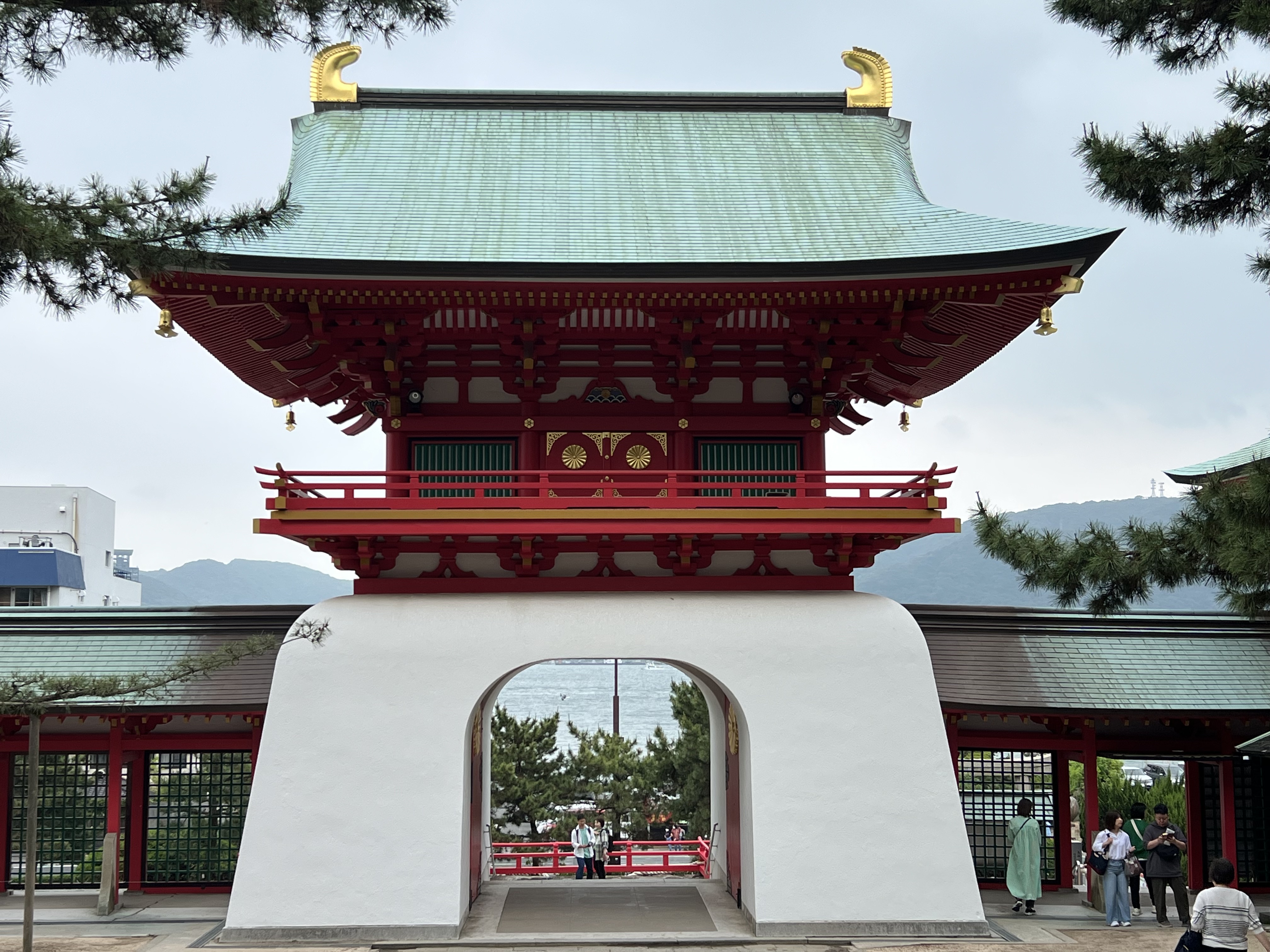
We walked on to Akama-Jingu, a shrine dedicated to a child emperor who was killed in the battle of Dannoura, in the churning strait, along with his grandmother, who saw how the battle was turning and jumped into the sea to perish with him. The story of the Heike became one of the epics of Japanese literature, its stories reverberating down the centuries. As we climbed the steps to Akama-Jingu, we came upon a wedding party posing for pictures, the blue-green waters of the Kanmon in front of the them, the bright red-orange shrine behind. We also saw the small and moving shrine to a blind Biwa-player named Houichi, who legend says lost his ears to the ghosts of the Heike.

 From there, we strolled through a Sunday outdoor arts and crafts tent market, a nice scene with music and kids running all over the place, and past the Karato Seafood Market, which seemed like the epicenter of Shimonoseki life, absolutely jammed with locals. We weren’t hungry yet, but we would return later to pick up fresh sushi and join the people sitting and eating along the strait.
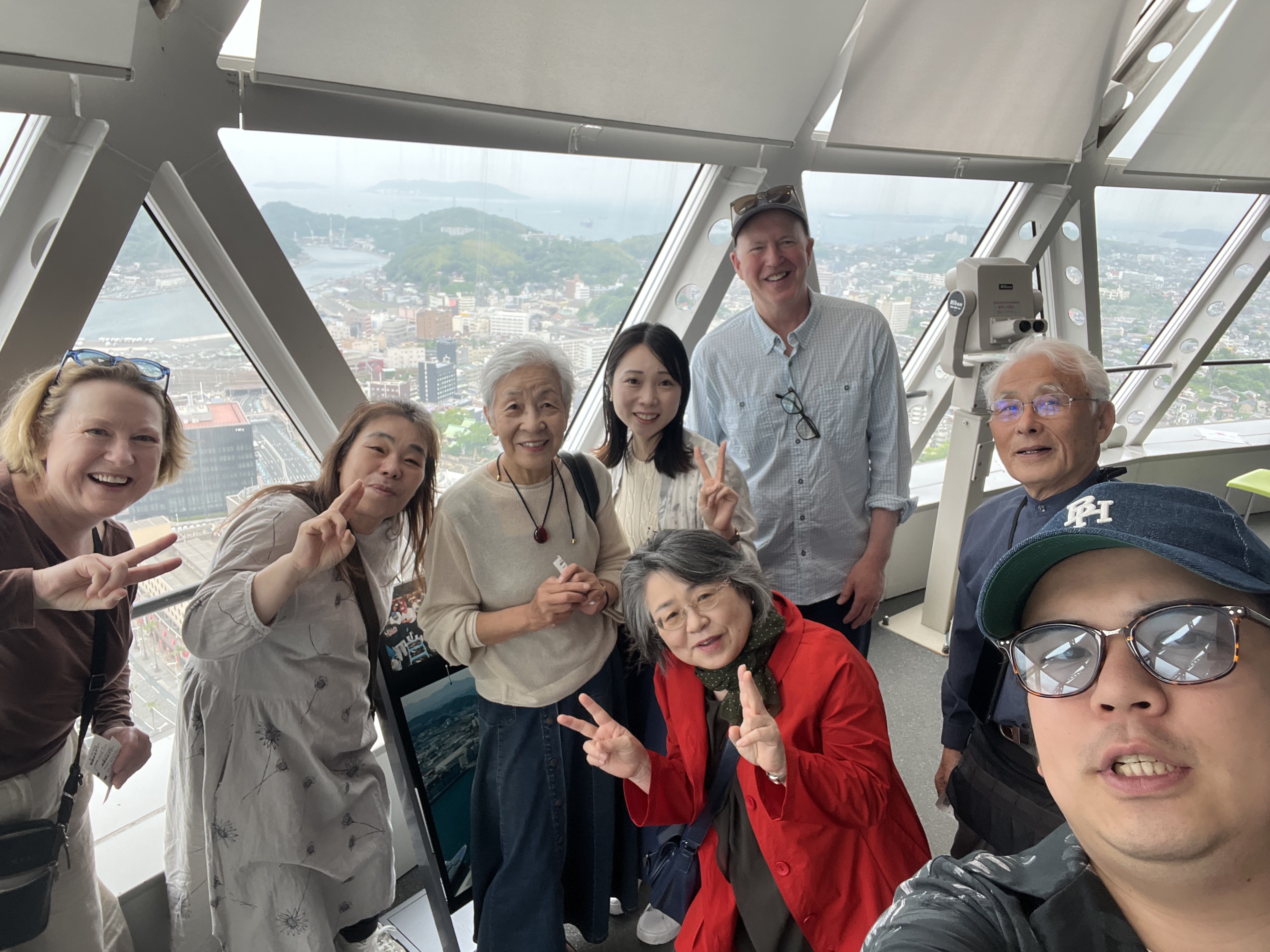
We went from the fish market to the Kaikyo-yume Tower, a 30-story-high observation tower that rises over Shimonoseki and offers a bird’s-eye view of the city, the islands and rugged nearby mountains, and the Sea of Japan in the distance. We wanted to take a bus to the tower, but were unsure about the routes and bus numbers. Courtenay asked some waiting passengers for advice, and it turned out that they, too, were headed for the tower, and that quick, we had new friends and travel partners. They were three generations of family, there to spend the weekend together. They were so friendly and welcoming, full of questions about us, and they guided us onto the bus and up to the tower, eager to show and tell us about Shimonoseki. The patriarch, who had attended twice-weekly English lessons for years, had spent his life here, and worked in construction management; he proudly told us that his company had been involved in inspecting the very tower that we were ascending. It was great fun, meeting and talking and posing for pictures with them. As we parted, they offered us gifts of fugu-themed rice crackers. (Everything is fugu-themed here – fugu, or the potentially poisonous puffer fish – is the local mascot and appears on everything from mail boxes to sewer covers. It also makes for a mean sashimi – just make sure you don’t try it at home – it has to be prepared by someone who knows what they are doing to avoid fatal consequences. BTW, we survived.)

We spent the afternoon in Shimonoseki’s Chofu Castle Town District, which is studded with shrines, abandoned temples, and samurai-era streets lined with stone walls and beautifully preserved homes. We started at the Iminomiya Shrine, where Courtenay had read might be celebrating a rabbit-themed spring festival today, which sounded like it might be a sweet scene. However, it turned out that the shrine was holding nothing more than a flea market, and a bit of a shabby one at that. (Courtenay thinks Rick is being overly harsh here, given the depth of his disappointment over the rabbits. It was just a regular flea market with dial-up phones, old clothes, some crafts.)

If the rabbit festival was a bust, the rest of Chofu Castle Town was actually quite cool. We wandered through the Chofu Mori Residence, a stunning house where the Emperor Meiji once stayed. We also walked up into the Kozanji Temple, one of the oldest temples constructed in the Zen-style in Japan and a designated national treasurer. I was wearing down after so much walking, but we came up on the Dangu Kawa River, more of a creek, I would say, where the town and its residents have restored the waterway and been trying to bring back the fireflies that were once common there. Courtenay asked me if I wanted to keep walking, and I said, sure, since the street we were on was “atmospheric and downhill,” which struck her as funny, and has since become something of a catchphrase on this trip.

We walked from the castle district on to the Chofu Garden, where we stopped to get our entry tickets and found the attendant absolutely sound asleep, and had to wake her to get our tickets. The garden, as you might expect, was quite peaceful. It was beautiful walking around a koi-filled pond while we heard the sounds of a pipe-player putting on a concert in a nearby building.

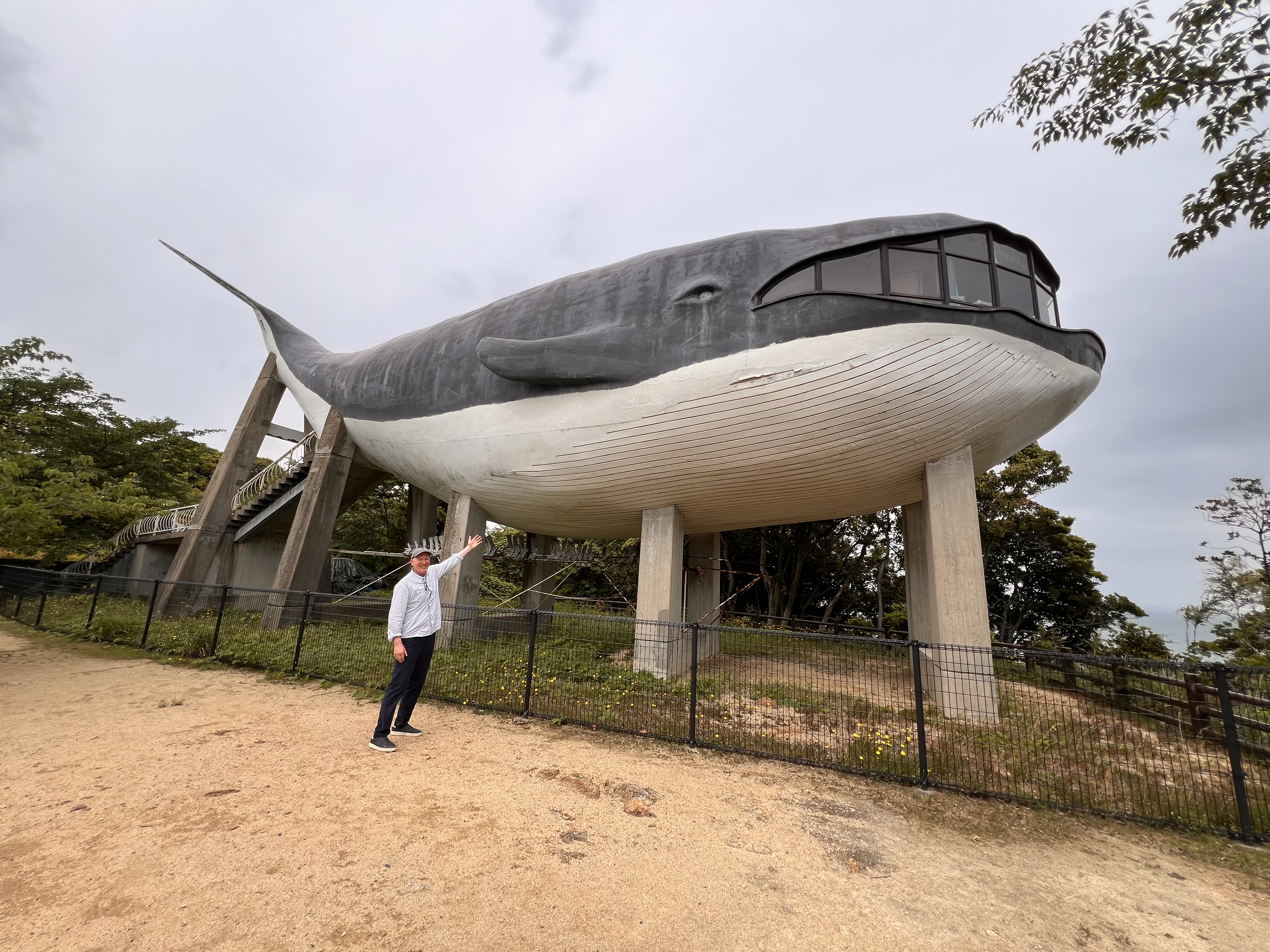
We finished our walk by climbing up to the ruins of the old Shimonoseki castle that overlooked our hotel. All that was left of the small castle that had once been here were some walls – the rest destroyed in the early 17century at the orders of the first Shogun Tokugawa Ieyasu, who wanted to limit the power of his provincial rivals. In fact, this part of the country is known for its independent, rebellious streak, resistant to control from the center. While Courtenay enjoyed the ruins, Rick was absolutely delighted by a giant decaying model of a great blue whale that once stood near the Shimonoseki Aquarium. The whale had seen better days and the aquarium apparently wanted to get rid of it, and so it dropped it on the hill by the ruined castle. I loved the whale; it reminded me of the cheesy Paul Bunyan and Babe the Blue Ox models at the Trees of Mystery, in Southern Oregon. — Rick
Sumo and the Six-Minute Shinkansen Transfer

ON THE SHINKANSEN, Southern Honshu, Saturday, May 17, 2025 – Our time in Tokyo went by as fast as, well, as fast as the 300-kilometer-an-hour bullet train hurtling us southward right now. We had a long, busy day yesterday, starting with the teamLab Borderless digital art museum/experience at Azabu-dai. It was classic teamLab – digital art projected on walls, ceilings and floors, or from strings of crystals or sparkling globes, hanging from the ceiling, surrounded by mirrors. The installations give you a feeling an infinity, like Kusama Yayoi’s famous pieces. We saw the same tigers made up of moving masses of flowers, and hauntingly weird rabbits and other frog-like creatures we had seen projected on the stone castle walls at Kanazawa back in 2023. (It was much more beautiful, and interesting, projected on atmospheric castle walls – don’t miss it if you ever have a chance.) Our highlight experience was probably the room that had children’s drawings of fish and other sea creatures swirling around the walls and ceilings of one room – we finally figured out we too could make drawings to be projected on the walls. So I made a “Hazel Fish,” and Poppa made a “Rory Fish.” Soon, Rory and Hazel were swimming happily around the room with the other fantastical creatures.

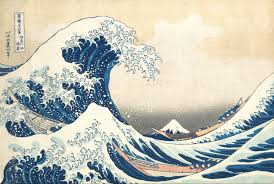
From there, we headed over to the other side of the Sumida River, where we visited a new and interesting museum dedicated to the woodblock print art of Hokusai, most famous for his series of prints “36 Views of Mount Fuji,” including his most famous “The Great Wave Off Kanagawa.” The Sumida Hokusai Museum, which became quite crowded, had excellent displays on how the blocks were drawn, carved, and printed in many layers. These woodblock prints had a big influence on the art of late 19th century France, including the Impressionists – Monet, Manet etc. – as well as Vincent Van Gogh, who collected them whenever he could find them.

After that, we stopped at a famous soba shop, Hosokawa, where the owner makes the buckwheat noodles by hand every morning. We had heard the lines can be long, so we went early, and immediately got a table with several groups of older Japanese women – two had been shopping and one elderly woman was enjoying her noodles all alone – they were that good. It will be interesting to compare them to the soba we have along the southwestern edge of Honshu, which is also famous for its pure buckwheat noodles. We love soba so seek it out whenever we are in Japan.

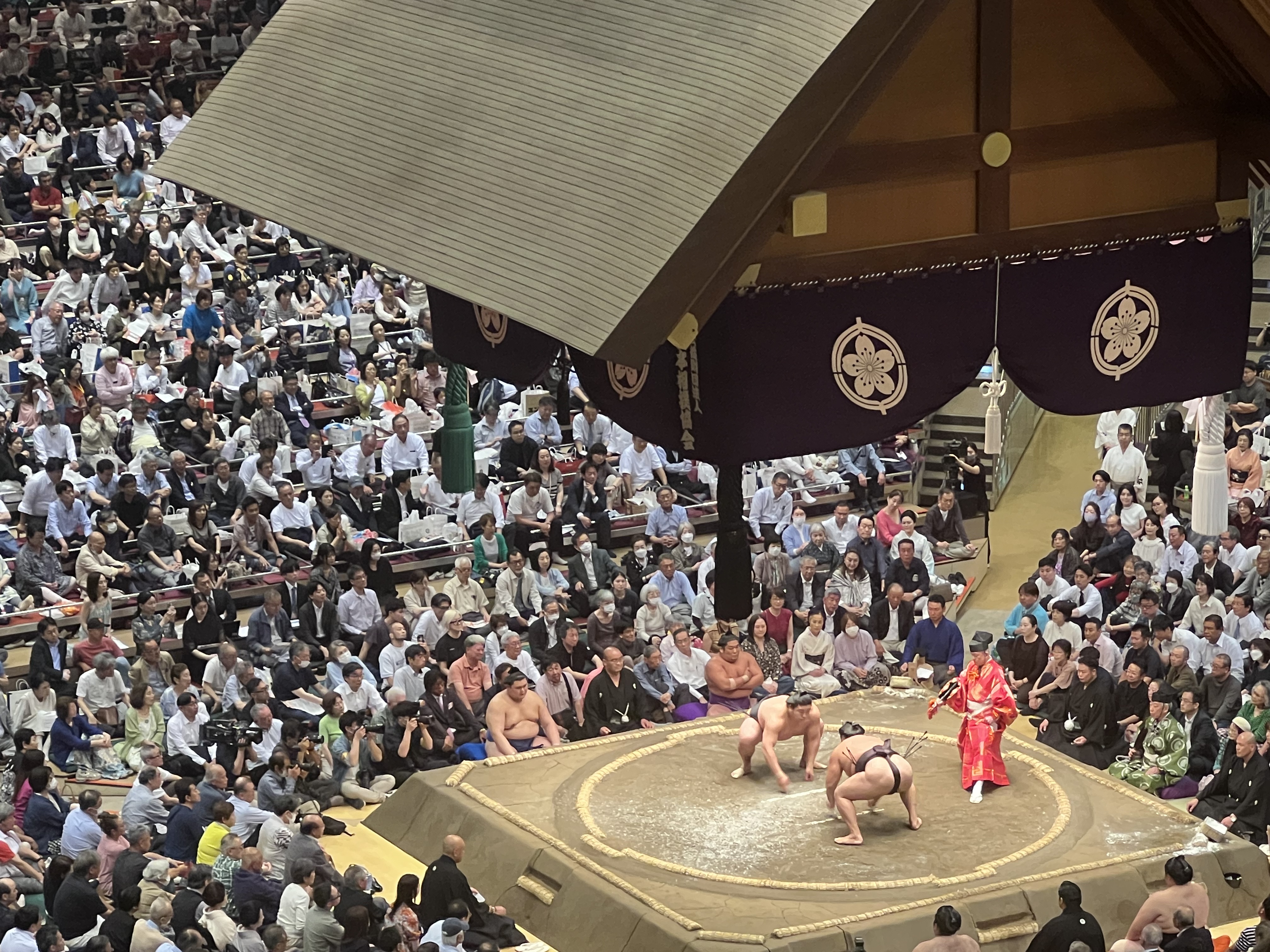
Our last stop was the Ryogoku Kokugikan, or the national sumo arena, a short walk away. It was only 1 p.m. and the main sumo didn’t start for two and a half hours, but we didn’t dare take a cab back to the hotel – the worst thing to do when you are jet lagged is stop moving. So we watched some of the rikishi, or sumo wrestlers, walk into the stadium in their yukata robes and flip-flops. We then took our seats, which were very far from the center arena, or dohyo, in a section that was filled with gaijin, as we foreigners are called here. All of those in our row had gone through the same hours-long process of trying to get tickets the second they went on sale. The website kept crashing, but those of us in row 9 had persevered and finally managed to secure tickets. I joked that the website had identified all the IP addresses outside Japan and stuck us all in the same section, but it was fine. Even the lovely Canadian couple sitting next to us were very sweet and didn’t mention anything about, um, things back home.

I had spent some time reading about the wrestlers – who is on their way up, who is on his way out – and had some fun details about which wrestler had a tiny toy poodle and loved gardening, and which was the bad boy who got caught at hostess bars during the pandemic, and. which was the eponymous “Flying Monkey.” In any case, we have followed sumo over the years, first when I was in Japan as an exchange student in college and then when Will was little and we would watch together in the evenings on one epic trip to Japan. So it was really wonderful to finally see it in person. My friend Hope had said it’s best to sit on the floor in reserved seating where she had gone as a child growing up in Japan, but we didn’t even try for those seats – we couldn’t imagine sitting on the floor for four to five hours straight without perhaps losing feeling in our legs and our legs altogether. So we sat in the nose-bleed seats and were really able to see all the action just fine. It was just too far to clearly see the rikishi’s facial expression or really feel the intensity of the wresting or the size of the wrestlers themselves, a few of whom are up to 6-foot-5 and/or 420 pounds. But to see the rituals and camaraderie of the sport which dates back centuries and is steeped in Shinto spiritual practices was really, well, awesome.

As you perhaps know, I am a cautious traveler who arrives at the airport two hours early and never books an airline transfer under 90 minutes, so I was a bit worried about a six-minute transfer from one Shinkansen to another today in Hiroshima. Six minutes? I mean, in the US, that would be insane for practically any transfer. But I trusted that the Shinkansen website would not lead me astray, and it turns out that six minutes is a loooong time for a transfer in Hiroshima. We just walked across the platform, and after a very long four-minute wait, there came our train – a sleek, pink Hello-Kitty themed train that everyone had their phones to capture its adorableness. So now we are speeding south on that pink cat-covered Shinkansen – which is also awesome. Rory and Hazel would love it. My mother would love it. I love it. I’m so happy to be back in Japan!

Epic Jet Lag Moments in Tokyo

By Will

PANCAKE FLABBERGAST

The first story is about a extremely jet lagged boy (me) and a silly shop-like thing. So it started as we just finished tromping around this really cool little museum in the outskirts of Tokyo. We decided to get a snack at this little snack shop thing. So I was REALLY tired at the moment, so even the door clearly in big green letters said PULL I began to push the stupid door. After 30 seconds of solid pushing, Dad pulled open the door. We got in there and the only things they really sold were orange juice and weird little pastry things. I got this thing that was a pancake on the outside, and bean paste on the inside. It was so bad I had to step outside for a moment. Then (being me) I called it pancake flabbergast. I walked in the room and whispered to Mike, That was the worst pancake flabbergast I have ever had. He cracked up. After that we were talking about how we should invent a product called pancake flabbergast.

EVIL TOILET

So in Japan there are all these VERY expensive toilets everywhere. And so this morning our friend Helen told us a story about her encounter with a EVIL TOILET–dun dun dunnn. She tried to flush the toilet by pressing all these buttons. So first a jet of water sprayed from the toilet and got her all wet. Then pressed all these buttons and like heated the toilet, sprayed more water and opened and closed the seats but not flushing the darn toilet. Then she began to wave her hands around in despair she opened the door only to find old Japanese ladies waiting. She stared at them for a second and then quickly closed the door. Then she open the door and one of those ladies helped her flush it.

TO GO OR HERE

My dad was at a Starbucks just near our hotel when he ordered a coffee. He does not speak any Japanese so he just grunted and pointed at what he wanted. When it came time when the lady asked him if he wanted it for here or to go, he was completely flabbergasted (ha ha ha ha.) All he could do was grunt and point. so the lady had to bring out a mug or a paper cup he pointed to the mug.

THE END

FROM WILL

Arrival: Tommy the Talking Toilet and The Elevator Guy

TOKYO, Monday, Nov. 19, 2012, 4:36 a.m. — Hello everybody, it’s Will here and I am supposed to tell you about my day. We woke up REALLY early and my brother drove us to the airport. When we got there and navigated our way through security,customs and whatever you call it. We checked our baggage and mom got all darn WORRIED that her BAG did not go through. She thought the people there would be all like: “Oh there is a bag sitting on the ramp that was checked”. “Great John, let’s just leave it there cause we’re idiots.”Ha ha. We were sitting in our gate for like FOUR HOURS. Cause we had to come so EARLY!!! I read the new Diary of a Wimpy Kid book. It’s good. We got on our plane and they did not have those movie screens in the back of your seat thing and so I played video games for a LONGGGGGGGGGGG time.

When we got there dad looked up who won in the Ducks game and… NNNNNNNNOOOOOOOOOOOOOOOOOOOOOO!!!!!!!!! QUINCY, YOU DID NOT CHEER LOUD ENOUGH! The Ducks lost and so my mom was all smirky. So then I felt weird and started babbling. I said: “when I am in Africa I want to see Earl the talking elevator.” I felt SO weird and tired. When we got our bags we went to see if we could find our friends Mike and Helen. I was still babbling so I said, “Lets go find Michael Jackson and Helen of the Bob Dynasty We were waiting in this VERY long line and I found these two random people and thought it was Helen and Mike. Then they snuck up behind us.

We were in this very busy under ground train station and waiting in this long line. I was feeling awful. Mike turned my hat inside out and said it was my rally cap. Two hours later we were rushing to the train–we missed the first one because of this stupid security officer. I named him Vaz the Spaz. 45 minutes later we were on the train. I played video games for the whole hour long ride. When we got out we rushed out of this train station and into this department store. It was crazy. I got dumplings and a moon cake. It took a long time for everyone else to find their food. They found these snack boxes of WHAT? We never knew. Then dad randomly bought these fried things. I was just happy I had my dumplings. We stopped at this gum shop and watched them make hard candy and gum. They had samples. It was so good. It was still warm and fruit flavored.

We raced back to the hotel. and checked in. Some Japanese guy was in the elevator we waited for him to go and we pressed the button agian. AAAAAHHHH! THAT JAPANESE GUY WAS STILL IN THERE! We waited again and this time it came up empty. We went to our room and Helen and Mike went into the wrong room with some guy in it. We got in our room and the toilet open the seat when you opened the door. “AAAAHHHHH”!!! I screamed. I named it Tommy the Talking Toilet. We were going too have dinner. MY DUMPLINGS TURNED OUT TO BE FROZEN! So I had a moon cake for dinner because I did not want too touchthe purple rice and the fried whatever. Then I fell asleep. GOODBYE.

Editor’s note: As the grownups were finishing dinner and their beers in the hotel, Will reclined onto one of the beds and announced, “OK, that about wraps it up, folks,” rudely urging Mike and Helen to return to their own room, calling an end to our first hours in Japan ….

Foxes, rice and the phoenix

Kyoto, Saturday, June 19, 2010, 6 p.m. — This may be our last post for a while — we enter the wifi-free zone of ryokan, the traditional Japanese inn. We had a great day in Kyoto, visiting the Fushimi Inari Shrine, the mother shrine for rice, the most important food in Japan. Because rice was once used as a means of exchange, it is also the shrine for business — and for sake, the rice wine. We wandered up a mountain lined by vermillion torii gates creating shaded tunnels up the hill. It was really fun and picturesque. The boys left wishes on a wooden plaque in the shape of a fox — the guardian animal of the shrine — on which they had drawn funny faces. I wish I could upload the photos.
We also visited the Phoenix Hall or Byoodoin, the only remaining temple from the Heian period in the 11th century. It was beautiful, its red paint faded gray, hovering like a bird over the rock-lined pond in front. The statue of Amida Buddha inside was larger than I imagined (I’d seen it in many art history slides) and very peaceful. And many green tea ice creams were consumed.
We’re now back at the hotel, enjoying a beautiful view of the eastern hills of Kyoto, against a backdrop of clouds. Asma is moving into a room with a view for our last night in Kyoto.
We’re off to Takayama in the mountains of Nagano tomorrow. It’s likely to be hot and rainy there as well, but we’re kind of used to it by now. And we’ve heard it was a whopping 48 degrees and hailing at home, so we won’t complain. We hope all is well with all our friends and family, and we’ll be in touch when we can.

Ninjas and Birthday Magic

Wednesday, June 16, 2010, Heisei 22, Tokyo — Well we made it to Tokyo and finally have wee-fee so that we can actually post something. i’m not sure we’ll post much because we have very little down time. And what downtime we have seems to be filled with two 8-year-olds fighting with foam swords and generally wreaking havoc.


Will had a truly unforgettable birthday yesterday, starting with a cake in our room with “Happy 8th Birthday Will” written in Japanese and English. We then wandered Ginza, watched World Cup soccer in 3D at the top of the Sony Center, bought foam swords at Hakuhinkan as Will’s birthday gift, had a fabulous tempura lunch at Rick’s favorite restaurant, Ten-tei.


The highlight of the day was the Ninja Akasaka restaurant, a kischty but totally fun restaurant that would never fly in the U.S. because it must break every fire code in the book. The concierge clapped her hands and a black-dressed “ninja” appeared from a secret doorway to grab a menu and lead us down and up winding corridors, complete with a drawbridge and a master ninja doing magic tricks at our table. We then — because Asma is a determined traveler, thank goodness — we ascended the Tokyo Tower and saw the beautiful lights of the city.
Gotta go, Tokyo is calling.

Wide-eyed in Tokyo

Ohayo Gozaimas! It’s 4 a.m. Tuesday in Tokyo, and I’ve been awake for a couple hours on my first morning here. My time clock is messed up after the 11-hour flight from Portland and bus and taxi rides. I went out last night into Ginza and bravely ventured into a yakitori/sake restaurant. The staff concluded that I was Australian, but I’m not certain why, or whether that is a good or bad thing. Tokyo is just as we left it when we visited three years ago, over-the-top busy, noisy and compelling, a sensory overload of a city. I have my first meetings today with leaders of the Foreign Press Center and one of Japan’s top experts on fisheries resources, which are in trouble here. Japan is badly overfishing its waters, its seafood consumption is shrinking and the number of Japanese fishermen, who are aging, is falling by 10,000 people a year. At this pace, they say, Japan will have no fishermen in just 12 years.

Last night I met Suzuki-san, the Foreign Press Center officer who arranged my trip. She speaks very good English, having lived and studied in Toronto for four years. I am a good two feet taller than she is — a towering Australian, as it were.

There is some sort of contraption in my room to press slacks and shirts. It’s not an iron, exactly, and I think I will give it a try now. I still have two hours to kill before breakfast.

Jamata, for now